AGM301. Agricultural microbiology (1+1)
Potash releasing &Zinc
solubilizing micro organisms
Pottasium In soil
• Pottasium is a chemical element with the symbol of K.
• Both N & P are constituents of soil organic matter, but not
pottasium.
• K is important to production of ATP.
• Water uptake by roots and its loss through stomate affected
by pottasium.
Potash releasing micro organisms
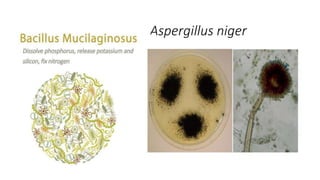
• Many bacteria such as Acidothiobacillus
ferrooxidans, Paenibacillus spp., Bacillus
mucilaginosus, B. edaphicus, and B.
circulans have capacity to release K.
• Aspergillus niger, Penicillium frequentans and
Cladosporium, were found to grow on muscovite,
biotite, orthoclase microclase and mica in vitro and
also releases K.
Mechanism Of K release
• It is generally believed that microorganisms
contribute to the release of K+ from K-bearing
minerals by several mechanisms.
• the major mechanism of K mineral solubilization
is by production the organic and inorganic
acids ,which are able to convert the insoluble K
(mica, muscovite, and biotite feldspar) to soluble
forms of K, easily taking up by the plant.
• The types of various organic acids such as oxalic acid,
tartaric acids, gluconic acid, 2-ketogluconic acid, citric
acid, malic acid, succinic acid, lactic acid, propionic
acid, glycolic acid, malonic acid, fumaric acid, etc.
which are effective in releasing K from K-bearing
minerals .
• These organic acids produced, enhance the
dissolution of potassium compounds by complexing
Ca2+ ions.
Aspergillus niger
Zn in soils
• Zinc is a chemical element with the symbol of Zn.
• The amount of zinc present in the soil depends on the parent
materials of that soil. Sandy and highly leached acid soils generally
have low plant available zinc. Mineral soils have low zinc
availablity.
• Plants take up zinc as the divalent ionic form (Zn2+) and chelated-zinc.
Zinc solubilizing micro organisms
• Zn solubilizing microrganisms are capable of solubilizing
insoluble zinc compounds through the production of
gluconic acid
• Inoculation of zinc solubilizing bacteria in soils inherently
along with cheaper insoluble zinc compounds, like ZnO or
ZnCO3, will be useful for enhancing Zn nutrition & alleviation
of Zn deficiency.
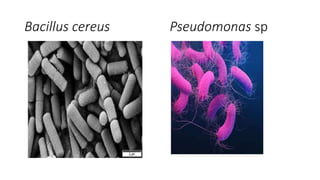
• Ex:Bacillus cereus, Bacillus sphaericus, Bacillus subtilis,
Gluconacetobacter diazotrophicus, Pseudomonas sp
Mechanism of Zn solubilization
• Zinc solubilizing microorganisms solubilize zinc through
various mechanisms, one of which is acidification.
• These microbes produce organic acids in soil which sequester
the zinc cations and decrease the pH of the nearby soil.
Moreoverr, the anions can also chelate zinc and enhance zinc
solubility .
• Other mechanisms possibly involved in zinc solubilization
include production of siderophores and proton, oxido-
reductive systems on cell membranes and chelates.
Bacillus cereus Pseudomonas sp
Advantages of Zn solubilizing M.O
• Enhance the grain Zn content
• Minimize the adverse effects of Zn deficiency.
• Increase the bioavailability of native and applied zinc
to the plants.
• . Overcome the malnutrition due to the Zn deficiency..
References
• www.ncbi.nlm.nih.gov.org
•www.sciencedirect.com
•Archana, D.S., Nandish, M.S., Savalagi,
V.P., Alagawadi, A.R. 2012. Screening
of potassium solubilizing bacteria
(KSB) for plant growth promotional
activity. BIOINFOLET-A Quarterly J.
Life Sci. 9, 627-630.
POTASSIUM RELEASING & ZINC SOLUBILIZING MICRO ORGANISMS

POTASSIUM RELEASING & ZINC SOLUBILIZING MICRO ORGANISMS

  • 1.
    AGM301. Agricultural microbiology(1+1) Potash releasing &Zinc solubilizing micro organisms
  • 2.
    Pottasium In soil •Pottasium is a chemical element with the symbol of K. • Both N & P are constituents of soil organic matter, but not pottasium. • K is important to production of ATP. • Water uptake by roots and its loss through stomate affected by pottasium.
  • 3.
    Potash releasing microorganisms • Many bacteria such as Acidothiobacillus ferrooxidans, Paenibacillus spp., Bacillus mucilaginosus, B. edaphicus, and B. circulans have capacity to release K. • Aspergillus niger, Penicillium frequentans and Cladosporium, were found to grow on muscovite, biotite, orthoclase microclase and mica in vitro and also releases K.
  • 4.
    Mechanism Of Krelease • It is generally believed that microorganisms contribute to the release of K+ from K-bearing minerals by several mechanisms. • the major mechanism of K mineral solubilization is by production the organic and inorganic acids ,which are able to convert the insoluble K (mica, muscovite, and biotite feldspar) to soluble forms of K, easily taking up by the plant.
  • 5.
    • The typesof various organic acids such as oxalic acid, tartaric acids, gluconic acid, 2-ketogluconic acid, citric acid, malic acid, succinic acid, lactic acid, propionic acid, glycolic acid, malonic acid, fumaric acid, etc. which are effective in releasing K from K-bearing minerals . • These organic acids produced, enhance the dissolution of potassium compounds by complexing Ca2+ ions.
  • 6.
  • 7.
    Zn in soils •Zinc is a chemical element with the symbol of Zn. • The amount of zinc present in the soil depends on the parent materials of that soil. Sandy and highly leached acid soils generally have low plant available zinc. Mineral soils have low zinc availablity. • Plants take up zinc as the divalent ionic form (Zn2+) and chelated-zinc.
  • 8.
    Zinc solubilizing microorganisms • Zn solubilizing microrganisms are capable of solubilizing insoluble zinc compounds through the production of gluconic acid • Inoculation of zinc solubilizing bacteria in soils inherently along with cheaper insoluble zinc compounds, like ZnO or ZnCO3, will be useful for enhancing Zn nutrition & alleviation of Zn deficiency. • Ex:Bacillus cereus, Bacillus sphaericus, Bacillus subtilis, Gluconacetobacter diazotrophicus, Pseudomonas sp
  • 9.
    Mechanism of Znsolubilization • Zinc solubilizing microorganisms solubilize zinc through various mechanisms, one of which is acidification. • These microbes produce organic acids in soil which sequester the zinc cations and decrease the pH of the nearby soil. Moreoverr, the anions can also chelate zinc and enhance zinc solubility . • Other mechanisms possibly involved in zinc solubilization include production of siderophores and proton, oxido- reductive systems on cell membranes and chelates.
  • 10.
  • 11.
    Advantages of Znsolubilizing M.O • Enhance the grain Zn content • Minimize the adverse effects of Zn deficiency. • Increase the bioavailability of native and applied zinc to the plants. • . Overcome the malnutrition due to the Zn deficiency..
  • 12.
    References • www.ncbi.nlm.nih.gov.org •www.sciencedirect.com •Archana, D.S.,Nandish, M.S., Savalagi, V.P., Alagawadi, A.R. 2012. Screening of potassium solubilizing bacteria (KSB) for plant growth promotional activity. BIOINFOLET-A Quarterly J. Life Sci. 9, 627-630.