Genetics In Bacteria
Srijon ghosh
Department of GEB,SUST
Gene transfer
In bacteria or other organism ,gene
transfer mainly two ways.
1.vertical gene transfer
2.horizontal gene transfer
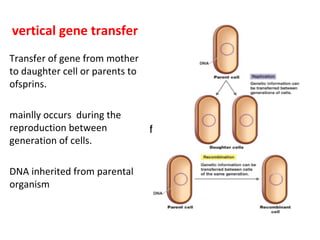
vertical gene transfer
Transfer of gene from mother
to daughter cell or parents to
ofsprins.
mainlly occurs during the
reproduction between
generation of cells.
DNA inherited from parental
organism
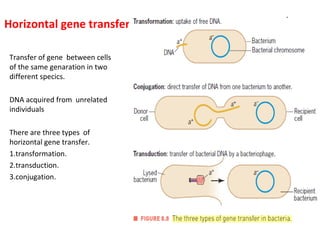
Horizontal gene transfer
Transfer of gene between cells
of the same genaration in two
different specics.
DNA acquired from unrelated
individuals
There are three types of
horizontal gene transfer.
1.transformation.
2.transduction.
3.conjugation.
Distinguishing between the Three
Parasexual Processes in Bacteria
Three distinct parasexual processes occur in bacteria. The
most obvious difference between these three processes is
the mechanism by which DNA is transferred from one cell to
another ( Figure 8.8).
Transformation involves the uptake of free DNA molecules
released from one bacterium (the donor cell) by another
bacterium (the recipient cell).
Conjugation involves the direct transfer of DNA from a
donor cell to a recipient cell.
Transduction occurs when bacterial genes are carried from a
donor cell to a recipient
cell by a bacteriophage.
Distinguishing…
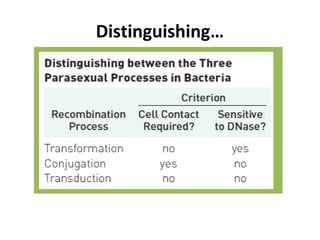
The three parasexual processes of gene transfer—
transformation,conjugation, and transduction—in
bacteria can be distinguished by
two simple criteria (Table ;next slide).
(1) Does the process require cell contact?
(2) Is the process sensitive to deoxyribonuclease
(DNase), an enzyme that degrades DNA?
Distinguishing…
These two criteria can be tested experimentally quite easily.
Sensitivity to DNase is determined
simply by adding the enzyme to the medium in which the
bacteria are growing.
If gene transfer no longer occurs, the process involves
transformation. The protein coats of bacteriophages and the
walls and membranes of bacterial cells protect the donor DNA
from degradation by DNase during transduction and
conjugation, respectively
Distinguishing…
Transformation
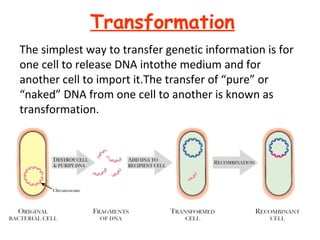
The simplest way to transfer genetic information is for
one cell to release DNA intothe medium and for
another cell to import it.The transfer of “pure” or
“naked” DNA from one cell to another is known as
transformation.
.
By “naked” means that no other biological macromolecules,
such as protein, are present to enclose or protect the DNA.
No actual cell-to-cell contact is involved in transformation, nor is
the DNA packaged inside a virus particle.
In practice, transformation is mostly a laboratory technique.The
DNA is extracted
from one organism by the experimenter and offered to other
cells in culture. Cells able
to take up DNA are said to be “competent.”
Transformation
Transformation
• Besides,genetic recombination in which
a DNA fragment from a dead, degraded
bacterium enters a competent recipient
bacterium and it is exchanged for a
piece of the recipient's DNA.
Competent cell
competent cell Cell that is capable of
taking up DNA from the surrounding
medium.
Electroporator
Device that uses a high voltage discharge to
make cells competent to take up DNA
Transfection
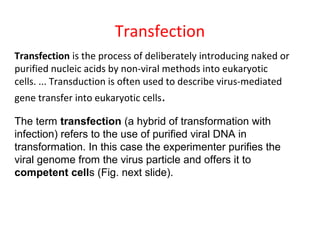
Transfection is the process of deliberately introducing naked or 
purified nucleic acids by non-viral methods into eukaryotic 
cells. ... Transduction is often used to describe virus-mediated 
gene transfer into eukaryotic cells.
The term transfection (a hybrid of transformation with
infection) refers to the use of purified viral DNA in
transformation. In this case the experimenter purifies the
viral genome from the virus particle and offers it to
competent cells (Fig. next slide).
Transfection
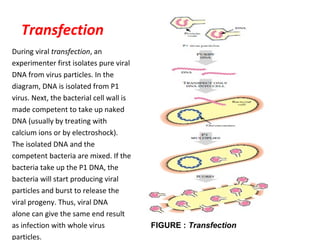
During viral transfection, an
experimenter first isolates pure viral
DNA from virus particles. In the
diagram, DNA is isolated from P1
virus. Next, the bacterial cell wall is
made competent to take up naked
DNA (usually by treating with
calcium ions or by electroshock).
The isolated DNA and the
competent bacteria are mixed. If the
bacteria take up the P1 DNA, the
bacteria will start producing viral
particles and burst to release the
viral progeny. Thus, viral DNA
alone can give the same end result
as infection with whole virus
particles.
FIGURE : Transfection
Transformation in Nature
Bacteria develop natural competence in dense cultures.
Competence is induced by competence pheromones. (A
pheromone is a hormone that travels between organisms,
rather than circulating within the same organism).
Competence pheromones are short peptides that are
secreted into the culture medium by dividing bacteria . Only
when the density of bacteria is high will the
pheromones reach sufficient levels to trigger competence.
This mechanism is presumably meant to ensure that any
DNA taken up will come from related bacteria as
competenceis only induced when there are many nearby
cells of the same species.
Mechanism of Natural Competence
A cell that is naturally competent takes DNA into its
cytoplasm by a protein-mediated process. First,
the long molecule of double-stranded DNA is recognized
by a receptor on the surface of the
competent cell. A cell-surface endonuclease digests the
DNA into small fragments. An exonuclease
then degrades one strand of the DNA. The remaining
single-stranded fragment is taken into the
cytoplasm of the bacterium.
Mechanism of Natural Competence
Natural competence is not merely due to random entry of DNA but involves
the induction of a variety of genes whose products take part in DNA uptake.
First DNA is bound by cell surface receptors (Fig. next slide). Then the bound
DNA is cut into shorter segments by endonucleases and one of the strands is
completely degraded by an exonuclease. Only the resulting short single-
stranded segments of DNA enter the cell. Part of the incoming DNA may then
displace the corresponding region of the host
chromosome by recombination.
Note that in the case of artificially induced competence, the mechanism is
quite different. Double-stranded DNA enters the cell through a cell wall that is
seriously
Mechanism of Natural Competence
The protein complexes used for
transformation
The protein complexes that take up free DNA must be able to
move it through gram-negative and gram-positive walls, which
may be both thick and complex. As expected, the machinery is
quite large and complicated and appears related to protein secretion
systems..
Competency is a complex phenomenon and is dependent on
several conditions. Bacteria need to be in a certain stage of growth;
for example, Streptococcus pneumoniae becomes competent during
the exponential phase when the population reaches about 107
to 108 cells per ml. When a population becomes competent, bacteria
such as S. pneumoniae secrete a small protein called the competence
factor that stimulates the production of 8 to 10 new
proteins required for transformation
The protein complexes used for
transformation in N.gonorrhoeae
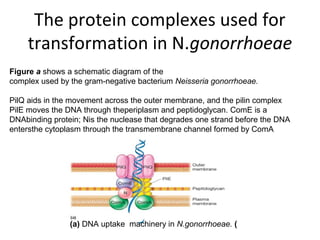
Figure a shows a schematic diagram of the
complex used by the gram-negative bacterium Neisseria gonorrhoeae.
PilQ aids in the movement across the outer membrane, and the pilin complex
PilE moves the DNA through theperiplasm and peptidoglycan. ComE is a
DNAbinding protein; Nis the nuclease that degrades one strand before the DNA
entersthe cytoplasm through the transmembrane channel formed by ComA
(a) DNA uptake machinery in N.gonorrhoeae. (
The protein complexes used for
transformation in Bacillus subtilis
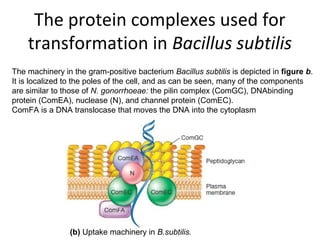
The machinery in the gram-positive bacterium Bacillus subtilis is depicted in figure b.
It is localized to the poles of the cell, and as can be seen, many of the components
are similar to those of N. gonorrhoeae: the pilin complex (ComGC), DNAbinding
protein (ComEA), nuclease (N), and channel protein (ComEC).
ComFA is a DNA translocase that moves the DNA into the cytoplasm
(b) Uptake machinery in B.subtilis.
Transduction
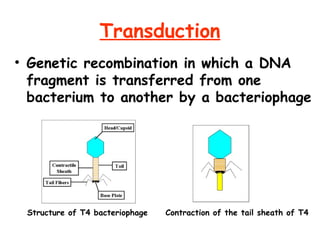
• Genetic recombination in which a DNA
fragment is transferred from one
bacterium to another by a bacteriophage
Structure of T4 bacteriophage Contraction of the tail sheath of T4
Gene Transfer by Virus—Transduction
When a virus succeeds in infecting a bacterial cell it
manufactures more virus particles,each of which should
contain a new copy of the virus genome.
Occasionally,
Viruses make mistakes in packaging DNA, and fragments of
bacterial DNA get packaged into the virus particle. From the
viewpoint of the virus, this results in a defective particle.
Nonetheless, such a virus particle, carrying bacterial DNA,
may infect another bacterial cell. If so, instead of injecting
viral genes, it injects DNA from the previous bacterial
victim. This mode of gene transfer is known as transduction.
Gene Transfer by Virus—Transduction
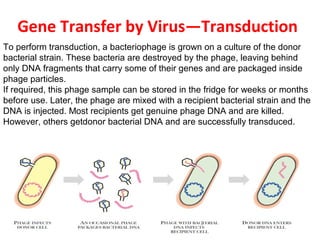
To perform transduction, a bacteriophage is grown on a culture of the donor
bacterial strain. These bacteria are destroyed by the phage, leaving behind
only DNA fragments that carry some of their genes and are packaged inside
phage particles.
If required, this phage sample can be stored in the fridge for weeks or months
before use. Later, the phage are mixed with a recipient bacterial strain and the
DNA is injected. Most recipients get genuine phage DNA and are killed.
However, others getdonor bacterial DNA and are successfully transduced.
Transduction
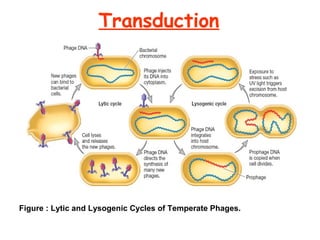
Figure : Lytic and Lysogenic Cycles of Temperate Phages.
Generalized Transduction
Type of transduction where fragments of
bacterial DNA are packaged at random and all
genes have roughly the same chance of being
transferred
specialized transduction
Type of transduction where certain regions of the
bacterial DNA are carried preferentially
specialized transduction
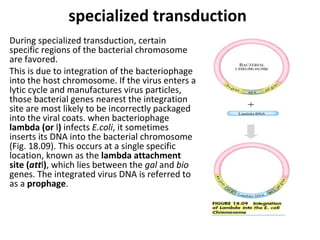
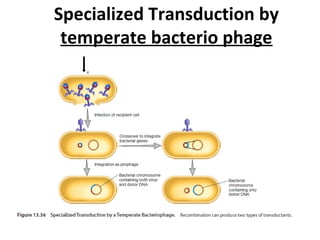
During specialized transduction, certain
specific regions of the bacterial chromosome
are favored.
This is due to integration of the bacteriophage
into the host chromosome. If the virus enters a
lytic cycle and manufactures virus particles,
those bacterial genes nearest the integration
site are most likely to be incorrectly packaged
into the viral coats. when bacteriophage
lambda (or l) infects E.coli, it sometimes
inserts its DNA into the bacterial chromosome
(Fig. 18.09). This occurs at a single specific
location, known as the lambda attachment
site (attl), which lies between the gal and bio
genes. The integrated virus DNA is referred to
as a prophage.
specialized transduction
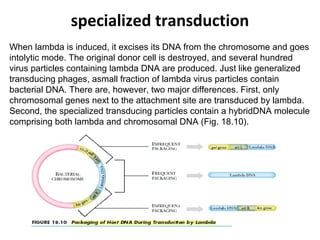
When lambda is induced, it excises its DNA from the chromosome and goes
intolytic mode. The original donor cell is destroyed, and several hundred
virus particles containing lambda DNA are produced. Just like generalized
transducing phages, asmall fraction of lambda virus particles contain
bacterial DNA. There are, however, two major differences. First, only
chromosomal genes next to the attachment site are transduced by lambda.
Second, the specialized transducing particles contain a hybridDNA molecule
comprising both lambda and chromosomal DNA (Fig. 18.10).
Specialized Transduction by
temperate bacterio phage
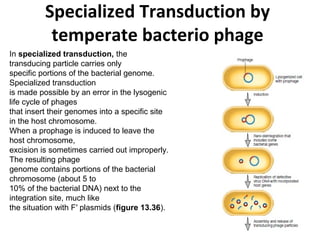
In specialized transduction, the
transducing particle carries only
specific portions of the bacterial genome.
Specialized transduction
is made possible by an error in the lysogenic
life cycle of phages
that insert their genomes into a specific site
in the host chromosome.
When a prophage is induced to leave the
host chromosome,
excision is sometimes carried out improperly.
The resulting phage
genome contains portions of the bacterial
chromosome (about 5 to
10% of the bacterial DNA) next to the
integration site, much like
the situation with F′ plasmids (figure 13.36).
Specialized Transduction by
temperate bacterio phage
Conjugation
Bacterial Conjugation is genetic
recombination in which there is a transfer of
DNA from a living donor bacterium to a
recipient bacterium. Often involves a sex
pilus
During conjugation, DNA is transferred
from a donor cell to a recipient cell through
a specialized intercellular conjugation
channel,which forms between them
Conjugation
Donor cells have cell-surface appendages called F pili (singular, F pilus). The
synthesis of these F pili is controlled by genes present on a small circular molecule
of DNA called an F factor (for fertility factor).
Most F factors are approximately 105 nucleotide pairs in size .
Bacteria that contain an F factor are able to transfer genes to other bacteria. The F
pili of a donor cell make contact with a recipient cell that lacks an F factor and attach
to that cell, so that the two cells can be
pulled into close contact..
After the F pili bring a donor cell and a recipient cell together, a conjugation channel
forms between the cells, and DNA is transferred from the donor cell to the recipient
cell through this channel.
Conjugation
The factor can exist in either of two states:
(1) the autonomous state, in which it
replicates independently of the bacterial chromosome,
(2) the integrated state, in
which it is covalently inserted into the bacterial
chromosome and replicates like any other
segment of that chromosome. Genetic elements with
these properties are
called episomes.
Conjugation
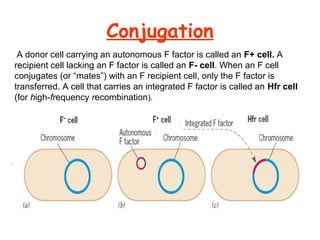
A donor cell carrying an autonomous F factor is called an F+ cell. A
recipient cell lacking an F factor is called an F- cell. When an F cell
conjugates (or “mates”) with an F recipient cell, only the F factor is
transferred. A cell that carries an integrated F factor is called an Hfr cell
(for high-frequency recombination).
Conjugation
Both cells (donor and recipient) become F cells because the
F factor
is replicated during transfer, and each cell receives a copy.
Thus, if a population of F cells is mixed with a population of F
cells, virtually all of the cells will acquire an F factor.
The F factor can integrate into the bacterial chromosome by
site-specific recombination events. The integration of the F
factor is mediated by short DNA sequences that are present
in multiple copies in both the F factor and the bacterial
chromosome. Thus, an F factor can integrate at many
different sites in the bacterial chromosome

Genetics of bacteria

  • 1.
    Genetics In Bacteria Srijonghosh Department of GEB,SUST
  • 2.
    Gene transfer In bacteriaor other organism ,gene transfer mainly two ways. 1.vertical gene transfer 2.horizontal gene transfer
  • 3.
    vertical gene transfer Transferof gene from mother to daughter cell or parents to ofsprins. mainlly occurs during the reproduction between generation of cells. DNA inherited from parental organism
  • 4.
    Horizontal gene transfer Transferof gene between cells of the same genaration in two different specics. DNA acquired from unrelated individuals There are three types of horizontal gene transfer. 1.transformation. 2.transduction. 3.conjugation.
  • 5.
    Distinguishing between theThree Parasexual Processes in Bacteria Three distinct parasexual processes occur in bacteria. The most obvious difference between these three processes is the mechanism by which DNA is transferred from one cell to another ( Figure 8.8). Transformation involves the uptake of free DNA molecules released from one bacterium (the donor cell) by another bacterium (the recipient cell). Conjugation involves the direct transfer of DNA from a donor cell to a recipient cell. Transduction occurs when bacterial genes are carried from a donor cell to a recipient cell by a bacteriophage.
  • 6.
    Distinguishing… The three parasexualprocesses of gene transfer— transformation,conjugation, and transduction—in bacteria can be distinguished by two simple criteria (Table ;next slide). (1) Does the process require cell contact? (2) Is the process sensitive to deoxyribonuclease (DNase), an enzyme that degrades DNA?
  • 7.
    Distinguishing… These two criteriacan be tested experimentally quite easily. Sensitivity to DNase is determined simply by adding the enzyme to the medium in which the bacteria are growing. If gene transfer no longer occurs, the process involves transformation. The protein coats of bacteriophages and the walls and membranes of bacterial cells protect the donor DNA from degradation by DNase during transduction and conjugation, respectively
  • 8.
  • 9.
    Transformation The simplest wayto transfer genetic information is for one cell to release DNA intothe medium and for another cell to import it.The transfer of “pure” or “naked” DNA from one cell to another is known as transformation.
  • 10.
    . By “naked” meansthat no other biological macromolecules, such as protein, are present to enclose or protect the DNA. No actual cell-to-cell contact is involved in transformation, nor is the DNA packaged inside a virus particle. In practice, transformation is mostly a laboratory technique.The DNA is extracted from one organism by the experimenter and offered to other cells in culture. Cells able to take up DNA are said to be “competent.” Transformation
  • 11.
    Transformation • Besides,genetic recombinationin which a DNA fragment from a dead, degraded bacterium enters a competent recipient bacterium and it is exchanged for a piece of the recipient's DNA.
  • 12.
    Competent cell competent cellCell that is capable of taking up DNA from the surrounding medium. Electroporator Device that uses a high voltage discharge to make cells competent to take up DNA
  • 13.
    Transfection Transfection is the process of deliberately introducing naked or  purified nucleic acids by non-viral methods into eukaryotic  cells. ... Transduction is often used to describe virus-mediated  gene transfer into eukaryotic cells. The term transfection(a hybrid of transformation with infection) refers to the use of purified viral DNA in transformation. In this case the experimenter purifies the viral genome from the virus particle and offers it to competent cells (Fig. next slide).
  • 14.
  • 15.
    Transformation in Nature Bacteriadevelop natural competence in dense cultures. Competence is induced by competence pheromones. (A pheromone is a hormone that travels between organisms, rather than circulating within the same organism). Competence pheromones are short peptides that are secreted into the culture medium by dividing bacteria . Only when the density of bacteria is high will the pheromones reach sufficient levels to trigger competence. This mechanism is presumably meant to ensure that any DNA taken up will come from related bacteria as competenceis only induced when there are many nearby cells of the same species.
  • 16.
    Mechanism of NaturalCompetence A cell that is naturally competent takes DNA into its cytoplasm by a protein-mediated process. First, the long molecule of double-stranded DNA is recognized by a receptor on the surface of the competent cell. A cell-surface endonuclease digests the DNA into small fragments. An exonuclease then degrades one strand of the DNA. The remaining single-stranded fragment is taken into the cytoplasm of the bacterium.
  • 17.
    Mechanism of NaturalCompetence Natural competence is not merely due to random entry of DNA but involves the induction of a variety of genes whose products take part in DNA uptake. First DNA is bound by cell surface receptors (Fig. next slide). Then the bound DNA is cut into shorter segments by endonucleases and one of the strands is completely degraded by an exonuclease. Only the resulting short single- stranded segments of DNA enter the cell. Part of the incoming DNA may then displace the corresponding region of the host chromosome by recombination. Note that in the case of artificially induced competence, the mechanism is quite different. Double-stranded DNA enters the cell through a cell wall that is seriously
  • 18.
  • 19.
    The protein complexesused for transformation The protein complexes that take up free DNA must be able to move it through gram-negative and gram-positive walls, which may be both thick and complex. As expected, the machinery is quite large and complicated and appears related to protein secretion systems.. Competency is a complex phenomenon and is dependent on several conditions. Bacteria need to be in a certain stage of growth; for example, Streptococcus pneumoniae becomes competent during the exponential phase when the population reaches about 107 to 108 cells per ml. When a population becomes competent, bacteria such as S. pneumoniae secrete a small protein called the competence factor that stimulates the production of 8 to 10 new proteins required for transformation
  • 20.
    The protein complexesused for transformation in N.gonorrhoeae Figure a shows a schematic diagram of the complex used by the gram-negative bacterium Neisseria gonorrhoeae. PilQ aids in the movement across the outer membrane, and the pilin complex PilE moves the DNA through theperiplasm and peptidoglycan. ComE is a DNAbinding protein; Nis the nuclease that degrades one strand before the DNA entersthe cytoplasm through the transmembrane channel formed by ComA (a) DNA uptake machinery in N.gonorrhoeae. (
  • 21.
    The protein complexesused for transformation in Bacillus subtilis The machinery in the gram-positive bacterium Bacillus subtilis is depicted in figure b. It is localized to the poles of the cell, and as can be seen, many of the components are similar to those of N. gonorrhoeae: the pilin complex (ComGC), DNAbinding protein (ComEA), nuclease (N), and channel protein (ComEC). ComFA is a DNA translocase that moves the DNA into the cytoplasm (b) Uptake machinery in B.subtilis.
  • 22.
    Transduction • Genetic recombinationin which a DNA fragment is transferred from one bacterium to another by a bacteriophage Structure of T4 bacteriophage Contraction of the tail sheath of T4
  • 23.
    Gene Transfer byVirus—Transduction When a virus succeeds in infecting a bacterial cell it manufactures more virus particles,each of which should contain a new copy of the virus genome. Occasionally, Viruses make mistakes in packaging DNA, and fragments of bacterial DNA get packaged into the virus particle. From the viewpoint of the virus, this results in a defective particle. Nonetheless, such a virus particle, carrying bacterial DNA, may infect another bacterial cell. If so, instead of injecting viral genes, it injects DNA from the previous bacterial victim. This mode of gene transfer is known as transduction.
  • 24.
    Gene Transfer byVirus—Transduction To perform transduction, a bacteriophage is grown on a culture of the donor bacterial strain. These bacteria are destroyed by the phage, leaving behind only DNA fragments that carry some of their genes and are packaged inside phage particles. If required, this phage sample can be stored in the fridge for weeks or months before use. Later, the phage are mixed with a recipient bacterial strain and the DNA is injected. Most recipients get genuine phage DNA and are killed. However, others getdonor bacterial DNA and are successfully transduced.
  • 25.
    Transduction Figure : Lyticand Lysogenic Cycles of Temperate Phages.
  • 26.
    Generalized Transduction Type oftransduction where fragments of bacterial DNA are packaged at random and all genes have roughly the same chance of being transferred specialized transduction Type of transduction where certain regions of the bacterial DNA are carried preferentially
  • 27.
    specialized transduction During specializedtransduction, certain specific regions of the bacterial chromosome are favored. This is due to integration of the bacteriophage into the host chromosome. If the virus enters a lytic cycle and manufactures virus particles, those bacterial genes nearest the integration site are most likely to be incorrectly packaged into the viral coats. when bacteriophage lambda (or l) infects E.coli, it sometimes inserts its DNA into the bacterial chromosome (Fig. 18.09). This occurs at a single specific location, known as the lambda attachment site (attl), which lies between the gal and bio genes. The integrated virus DNA is referred to as a prophage.
  • 28.
    specialized transduction When lambdais induced, it excises its DNA from the chromosome and goes intolytic mode. The original donor cell is destroyed, and several hundred virus particles containing lambda DNA are produced. Just like generalized transducing phages, asmall fraction of lambda virus particles contain bacterial DNA. There are, however, two major differences. First, only chromosomal genes next to the attachment site are transduced by lambda. Second, the specialized transducing particles contain a hybridDNA molecule comprising both lambda and chromosomal DNA (Fig. 18.10).
  • 29.
    Specialized Transduction by temperatebacterio phage In specialized transduction, the transducing particle carries only specific portions of the bacterial genome. Specialized transduction is made possible by an error in the lysogenic life cycle of phages that insert their genomes into a specific site in the host chromosome. When a prophage is induced to leave the host chromosome, excision is sometimes carried out improperly. The resulting phage genome contains portions of the bacterial chromosome (about 5 to 10% of the bacterial DNA) next to the integration site, much like the situation with F′ plasmids (figure 13.36).
  • 30.
  • 31.
    Conjugation Bacterial Conjugation isgenetic recombination in which there is a transfer of DNA from a living donor bacterium to a recipient bacterium. Often involves a sex pilus During conjugation, DNA is transferred from a donor cell to a recipient cell through a specialized intercellular conjugation channel,which forms between them
  • 32.
    Conjugation Donor cells havecell-surface appendages called F pili (singular, F pilus). The synthesis of these F pili is controlled by genes present on a small circular molecule of DNA called an F factor (for fertility factor). Most F factors are approximately 105 nucleotide pairs in size . Bacteria that contain an F factor are able to transfer genes to other bacteria. The F pili of a donor cell make contact with a recipient cell that lacks an F factor and attach to that cell, so that the two cells can be pulled into close contact.. After the F pili bring a donor cell and a recipient cell together, a conjugation channel forms between the cells, and DNA is transferred from the donor cell to the recipient cell through this channel.
  • 33.
    Conjugation The factor canexist in either of two states: (1) the autonomous state, in which it replicates independently of the bacterial chromosome, (2) the integrated state, in which it is covalently inserted into the bacterial chromosome and replicates like any other segment of that chromosome. Genetic elements with these properties are called episomes.
  • 34.
    Conjugation A donor cellcarrying an autonomous F factor is called an F+ cell. A recipient cell lacking an F factor is called an F- cell. When an F cell conjugates (or “mates”) with an F recipient cell, only the F factor is transferred. A cell that carries an integrated F factor is called an Hfr cell (for high-frequency recombination).
  • 35.
    Conjugation Both cells (donorand recipient) become F cells because the F factor is replicated during transfer, and each cell receives a copy. Thus, if a population of F cells is mixed with a population of F cells, virtually all of the cells will acquire an F factor. The F factor can integrate into the bacterial chromosome by site-specific recombination events. The integration of the F factor is mediated by short DNA sequences that are present in multiple copies in both the F factor and the bacterial chromosome. Thus, an F factor can integrate at many different sites in the bacterial chromosome