knobbe.com 
Information Technology and Biotechnology Breakout Session: 
New Pieces to the Patent Puzzle 
Maria Anderson 
Rose Thiessen 
Eli Loots 
November 6, 2014 
IP Impact, Silicon Valley
©2012 Knobbe Martens, Olson & Bear, LLP all rights reserved. 
© 2014 Knobbe, Martens, Olson & Bear, LLP all rights reserved. 
2 
PATENT ELIGIBLE SUBJECT MATTER LIFE IN SOFTWARE/IT AFTER ALICE CORPORATION V. CLS BANK (AND OTHER RECENT 101 DECISIONS)
3 
© 2014 Knobbe, Martens, Olson & Bear, LLP all rights reserved. 
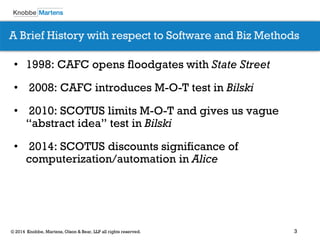
•1998: CAFC opens floodgates with State Street 
• 2008: CAFC introduces M-O-T test in Bilski 
• 2010: SCOTUS limits M-O-T and gives us vague “abstract idea” test in Bilski 
• 2014: SCOTUS discounts significance of computerization/automation in Alice 
A Brief History with respect to Software and Biz Methods
4 
© 2014 Knobbe, Martens, Olson & Bear, LLP all rights reserved. 
USPTO’s (Over)Reaction to Alice 
•Preliminary Guidelines and Examiner Training 
•Dramatic increase in 101 rejections in classes 705 and 709 
•Unwillingness to withdraw Alice-based rejections
5 
© 2014 Knobbe, Martens, Olson & Bear, LLP all rights reserved. 
•Great uncertainty due to vague “abstract idea” test 
•Additional cases needed 
Where Are We Now?
6 
© 2014 Knobbe, Martens, Olson & Bear, LLP all rights reserved. 
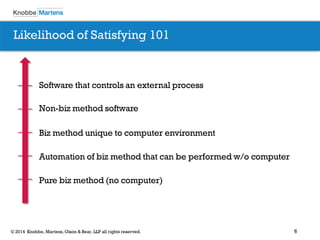
Likelihood of Satisfying 101 
Software that controls an external process 
Non-biz method software 
Biz method unique to computer environment 
Automation of biz method that can be performed w/o computer 
Pure biz method (no computer)
7 
© 2014 Knobbe, Martens, Olson & Bear, LLP all rights reserved. 
Responding to 101 Rejections by (Re)Applying the Mayo Framework – Part I 
•What do you do when the Examiner asserts that your claims are directed to an abstract idea? 
–Argue that the Examiner has taken the abstraction of the claims too far and/or in a manner that SCOTUS (and the PTO guidelines) cautioned against 
•Examiner has ignored meaningful claim recitations 
•Examiner’s “abstraction” is an over-simplification of the claimed recitations 
–Argue that the claimed subject matter is not “long prevalent” or “fundamental” and thus, grant of the claims would NOT preempt use in all fields or effectively grant a monopoly over an abstract idea/fundamental practice 
•This is essentially a reverse 102/103 argument
8 
© 2014 Knobbe, Martens, Olson & Bear, LLP all rights reserved. 
Responding to 101 Rejections by (Re)Applying the Mayo Framework – Part II 
•What do you do when the Examiner determines, after considering your elements individually and in combination, that they do NOT transform the nature of the claim into a patent- eligible application? 
–Do not concede (even implicitly) that the claims recite an abstract idea, or over-emphasize Part II 
–Instead, argue that the elements amount to significantly more than a patent upon the abstract idea itself (assuming arguendo, that the claims simply recite an abstract idea)
©2012 Knobbe Martens, Olson & Bear, LLP all rights reserved. 
© 2014 Knobbe, Martens, Olson & Bear, LLP all rights reserved. 
9 
PATENT ELIGIBLE SUBJECT MATTER LIFE IN BIOTECH AFTER MAYO V. PROMETHEUS AND MYRIAD (AND OTHER RECENT 101 DECISIONS)
10 
© 2014 Knobbe, Martens, Olson & Bear, LLP all rights reserved. 
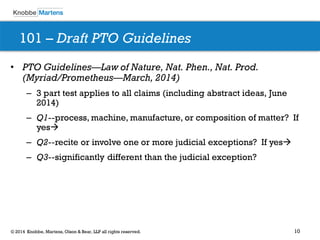
101 – Draft PTO Guidelines 
•PTO Guidelines—Law of Nature, Nat. Phen., Nat. Prod. (Myriad/Prometheus—March, 2014) 
–3 part test applies to all claims (including abstract ideas, June 2014) 
–Q1--process, machine, manufacture, or composition of matter? If yes 
–Q2--recite or involve one or more judicial exceptions? If yes 
–Q3--significantly different than the judicial exception?
11 
© 2014 Knobbe, Martens, Olson & Bear, LLP all rights reserved. 
101 – Draft PTO Guidelines 
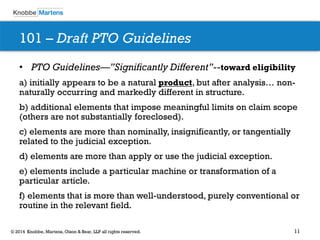
•PTO Guidelines—”Significantly Different”--toward eligibility 
a) initially appears to be a natural product, but after analysis… non- naturally occurring and markedly different in structure. 
b) additional elements that impose meaningful limits on claim scope (others are not substantially foreclosed). 
c) elements are more than nominally, insignificantly, or tangentially related to the judicial exception. 
d) elements are more than apply or use the judicial exception. 
e) elements include a particular machine or transformation of a particular article. 
f) elements that is more than well-understood, purely conventional or routine in the relevant field.
12 
© 2014 Knobbe, Martens, Olson & Bear, LLP all rights reserved. 
101 – Draft PTO Guidelines 
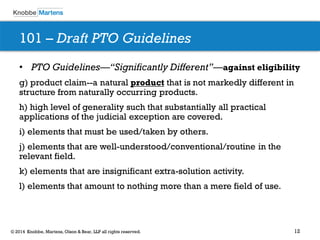
•PTO Guidelines—“Significantly Different”—against eligibility 
g) product claim--a natural product that is not markedly different in structure from naturally occurring products. 
h) high level of generality such that substantially all practical applications of the judicial exception are covered. 
i) elements that must be used/taken by others. 
j) elements that are well-understood/conventional/routine in the relevant field. 
k) elements that are insignificant extra-solution activity. 
l) elements that amount to nothing more than a mere field of use.
13 
© 2014 Knobbe, Martens, Olson & Bear, LLP all rights reserved. 
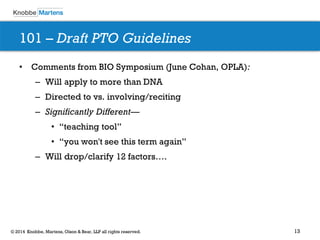
•Comments from BIO Symposium (June Cohan, OPLA): 
–Will apply to more than DNA 
–Directed to vs. involving/reciting 
–Significantly Different— 
•“teaching tool” 
•“you won't see this term again” 
–Will drop/clarify 12 factors…. 
101 – Draft PTO Guidelines
14 
© 2014 Knobbe, Martens, Olson & Bear, LLP all rights reserved. 
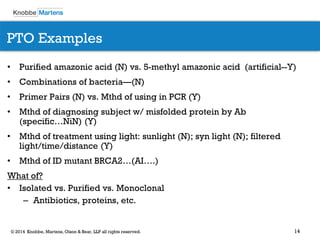
•Purified amazonic acid (N) vs. 5-methyl amazonic acid (artificial--Y) 
•Combinations of bacteria—(N) 
•Primer Pairs (N) vs. Mthd of using in PCR (Y) 
•Mthd of diagnosing subject w/ misfolded protein by Ab (specific…NiN) (Y) 
•Mthd of treatment using light: sunlight (N); syn light (N); filtered light/time/distance (Y) 
•Mthd of ID mutant BRCA2…(AI….) 
What of? 
•Isolated vs. Purified vs. Monoclonal 
–Antibiotics, proteins, etc. 
PTO Examples
15 
© 2014 Knobbe, Martens, Olson & Bear, LLP all rights reserved. 
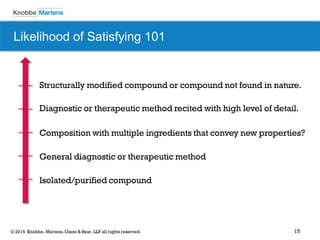
Likelihood of Satisfying 101 
Structurally modified compound or compound not found in nature. 
Diagnostic or therapeutic method recited with high level of detail. 
Composition with multiple ingredients that convey new properties? 
General diagnostic or therapeutic method 
Isolated/purified compound
16 
© 2014 Knobbe, Martens, Olson & Bear, LLP all rights reserved. 
Practice Points – Biotech Prosecution 
•Effectively used as alternative “prior art”--discount/ignore elements in claims 
•What is adequate to overcome… art? 
–Novel structural element? 
–Definitions 
–New steps vs. old steps for new purpose (from preamble to element). 
–Tie to unique initial or resulting step 
•But…distributed infringement 
•Beyond simple “extra-solution” 
–“Not occurring in nature” or “non-natural” 
–Novel function/characteristic (vs. PTO)
17 
© 2014 Knobbe, Martens, Olson & Bear, LLP all rights reserved. 
Practice Points – Biotech Prosecution 
•What is adequate to overcome… art? 
–Do not rely on unclaimed aspects 
–Amount/Concentration (vs. PTO) 
–Compositions (pharmaceutical carrier/buffer) (vs. PTO) 
•PTO: 
–Examiner vs OPL 
–Guidelines—“in October or soon thereafter”
18 
© 2014 Knobbe, Martens, Olson & Bear, LLP all rights reserved. 
Quotes from Myriad II—Oral Hearing 
•Judge Prost: Is it your position that you should look at the entire claim?.... You take away the abstract idea or law of nature, look at the additional steps, and determine whether the additional steps are well-understood, routine, and conventional such that they add nothing significant. 
•Judge Dyk: Function can’t be the test, can it? 
vs 
•Judge Dyk: The Supreme Court was concerned about excluding all possible claims that would reward the invention here.
©2012 Knobbe Martens, Olson & Bear, LLP all rights reserved. 
© 2014 Knobbe, Martens, Olson & Bear, LLP all rights reserved. 
19 
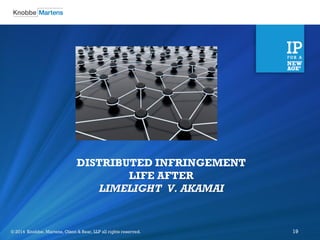
DISTRIBUTED INFRINGEMENT LIFE AFTER LIMELIGHT V. AKAMAI
20 
© 2014 Knobbe, Martens, Olson & Bear, LLP all rights reserved. 
•Definition: Two or more entities collectively perform all steps of a method claim, but no single entity performs all of them. 
•Case law: 
–2007: CAFC in BMC v. Paymentech introduces “direct or control” test and states that induced infringement requires a direct infringer 
– 2007-2012: Numerous decisions find no infringement due to divided infringement issues 
– 2012: CAFC addresses perceived unfairness by expanding induced infringement to cover divided infringement scenarios 
– 2014: Supreme Court in Akamai reverses CAFC and remands 
A Brief History
21 
© 2014 Knobbe, Martens, Olson & Bear, LLP all rights reserved. 
Where Are We Now? 
•Many accused infringers can again avoid liability where divided infringement issues exist 
•CAFC may now address the perceived unfairness by revisiting the law of direct infringement (as suggested by SCOTUS)
22 
© 2014 Knobbe, Martens, Olson & Bear, LLP all rights reserved. 
Practice Points – Software/IT Prosecution 
•Draft claims for single infringer 
–From the perspective of the interesting actor, e.g., server side v. client side 
–Consider whether aspects of the claim can be obtained from a separate service or whether the invention itself can be spun into a separate service 
•Draft claims that are directed to who will control/direct actions 
–The host/service provider? The manufacturer/owner of the end user device? 
–Who controls “the cloud”? Who controls a mobile app? 
•Draft claims to refer obliquely to other parties 
•Include server side claims to block the resulting functionality of those system claims being used in the U.S.
23 
© 2014 Knobbe, Martens, Olson & Bear, LLP all rights reserved. 
Practice Points – Biotech Prosecution 
•Draft claims for single infringer 
–Patient? 
–Treatment based on presence of characteristic, rather than testing for characteristic 
–Historical element vs steps to perform 
•Who will control/direct actions 
–Hospital/Dr./Insurance 
•Effect of functional limitations (“configured”, etc.) on subsequent options to block import of products? 
–e.g. import lyophilized forms, and claim requires “binds to” 
•Trade Secret/Contracts? 
•Downstream products--who owns
©2012 Knobbe Martens, Olson & Bear, LLP all rights reserved. 
© 2014 Knobbe, Martens, Olson & Bear, LLP all rights reserved. 
24 
INDEFINITENESS LIFE AFTER NAUTILUS, INC. V. BIOSIG INSTRUMENTS
25 
© 2014 Knobbe, Martens, Olson & Bear, LLP all rights reserved. 
Nautilus v. Biosig Instruments 
•“Old” Fed. Cir. (high) standard: claim satisfies§112 if “amenable to construction” and not “insolubly ambiguous” 
•After Nautilus: A patent is invalid for indefiniteness if its claims, read in light of the specification delineating the patent, and the prosecution history, fail to inform, with reasonable certainty, those skilled in the art at the time the patent was filed about the scope of the invention.
26 
© 2014 Knobbe, Martens, Olson & Bear, LLP all rights reserved. 
Practice points – Biotech Prosecution 
•Evolving terms in the art (at the time of filing) 
–Protein X in 2010 (isolated) vs 2011 (after sequenced) vs 2016 (after glycosylation pattern) 
•Genus vs species for meaning of a term? 
–Terms with multiple definitions at time of filing, 1 definition or all? 
•Molecular Weight (Teva Pharmaceuticals) 
•CDRs 
•Functionally defined or defining terms or degree 
–Hidden parameters that also could be defined? 
•How defining Kd? 
•How defining “activity” 
•“Product by process” or “product described by process” terms 
–Hidden parameters that also could be defined?
27 
© 2014 Knobbe, Martens, Olson & Bear, LLP all rights reserved. 
Practice Points – Biotech Prosecution 
•The claim is as precise as language allows (inherent limitation of language, “regard to the subject matter,” and provides notice) 
•Deposits 
•Definitions 
–Minor inconsistencies need not be a redefining of terms (Ancora) 
•Parallel definitions vs. serial definitions 
–Implicit/inherent definitions helpful (Dan) 
•File History 
–Clarification of definition 
•Continuations 
•UPSTO currently uses “broadest reasonable interpretation” 
–In re Packard—prima facie approach
28 
© 2014 Knobbe, Martens, Olson & Bear, LLP all rights reserved. 
Practice Points – Software/IT Prosecution 
•Patent Drafting: Say what you mean 
–Consider including definitions 
–Include clear explanations of inventive concepts, including specific illustrative numerical parameters 
–Include at least one teaching claim (i.e., a claim that covers in greater detail, and as unambiguously as possible, what is important to the client) 
–Use dependent claims to further define claim terms 
–Include multiple claims to various embodiments
©2012 Knobbe Martens, Olson & Bear, LLP all rights reserved. 
© 2014 Knobbe, Martens, Olson & Bear, LLP all rights reserved. 
29 
CONCLUSION
30 
© 2014 Knobbe, Martens, Olson & Bear, LLP all rights reserved. 
Conclusion 
•Court’s attempt to reduce scope 
–Similar to developments in§112, W.D. over the last 20 years 
–Addressable during prosecution 
•Drafting 
–Definitions 
–Larger number of narrower claims (support) 
•Pending 
–Narrower claims (more) 
•Issued: 
–Supp. Examination is available.
knobbe.com 
Orange County 
San Diego 
San Francisco 
Silicon Valley 
Los Angeles 
Seattle 
Washington DC 
Maria.Anderson@knobbe.com 
Rose.Thiessen@knobbe.com 
Eli.Loots@knobbe.com 
Maria Anderson 
Rose Thiessen 
Eli Loots 
Thank You

Information Technology/Biotechnology

  • 1.
    knobbe.com Information Technologyand Biotechnology Breakout Session: New Pieces to the Patent Puzzle Maria Anderson Rose Thiessen Eli Loots November 6, 2014 IP Impact, Silicon Valley
  • 2.
    ©2012 Knobbe Martens,Olson & Bear, LLP all rights reserved. © 2014 Knobbe, Martens, Olson & Bear, LLP all rights reserved. 2 PATENT ELIGIBLE SUBJECT MATTER LIFE IN SOFTWARE/IT AFTER ALICE CORPORATION V. CLS BANK (AND OTHER RECENT 101 DECISIONS)
  • 3.
    3 © 2014Knobbe, Martens, Olson & Bear, LLP all rights reserved. •1998: CAFC opens floodgates with State Street • 2008: CAFC introduces M-O-T test in Bilski • 2010: SCOTUS limits M-O-T and gives us vague “abstract idea” test in Bilski • 2014: SCOTUS discounts significance of computerization/automation in Alice A Brief History with respect to Software and Biz Methods
  • 4.
    4 © 2014Knobbe, Martens, Olson & Bear, LLP all rights reserved. USPTO’s (Over)Reaction to Alice •Preliminary Guidelines and Examiner Training •Dramatic increase in 101 rejections in classes 705 and 709 •Unwillingness to withdraw Alice-based rejections
  • 5.
    5 © 2014Knobbe, Martens, Olson & Bear, LLP all rights reserved. •Great uncertainty due to vague “abstract idea” test •Additional cases needed Where Are We Now?
  • 6.
    6 © 2014Knobbe, Martens, Olson & Bear, LLP all rights reserved. Likelihood of Satisfying 101 Software that controls an external process Non-biz method software Biz method unique to computer environment Automation of biz method that can be performed w/o computer Pure biz method (no computer)
  • 7.
    7 © 2014Knobbe, Martens, Olson & Bear, LLP all rights reserved. Responding to 101 Rejections by (Re)Applying the Mayo Framework – Part I •What do you do when the Examiner asserts that your claims are directed to an abstract idea? –Argue that the Examiner has taken the abstraction of the claims too far and/or in a manner that SCOTUS (and the PTO guidelines) cautioned against •Examiner has ignored meaningful claim recitations •Examiner’s “abstraction” is an over-simplification of the claimed recitations –Argue that the claimed subject matter is not “long prevalent” or “fundamental” and thus, grant of the claims would NOT preempt use in all fields or effectively grant a monopoly over an abstract idea/fundamental practice •This is essentially a reverse 102/103 argument
  • 8.
    8 © 2014Knobbe, Martens, Olson & Bear, LLP all rights reserved. Responding to 101 Rejections by (Re)Applying the Mayo Framework – Part II •What do you do when the Examiner determines, after considering your elements individually and in combination, that they do NOT transform the nature of the claim into a patent- eligible application? –Do not concede (even implicitly) that the claims recite an abstract idea, or over-emphasize Part II –Instead, argue that the elements amount to significantly more than a patent upon the abstract idea itself (assuming arguendo, that the claims simply recite an abstract idea)
  • 9.
    ©2012 Knobbe Martens,Olson & Bear, LLP all rights reserved. © 2014 Knobbe, Martens, Olson & Bear, LLP all rights reserved. 9 PATENT ELIGIBLE SUBJECT MATTER LIFE IN BIOTECH AFTER MAYO V. PROMETHEUS AND MYRIAD (AND OTHER RECENT 101 DECISIONS)
  • 10.
    10 © 2014Knobbe, Martens, Olson & Bear, LLP all rights reserved. 101 – Draft PTO Guidelines •PTO Guidelines—Law of Nature, Nat. Phen., Nat. Prod. (Myriad/Prometheus—March, 2014) –3 part test applies to all claims (including abstract ideas, June 2014) –Q1--process, machine, manufacture, or composition of matter? If yes –Q2--recite or involve one or more judicial exceptions? If yes –Q3--significantly different than the judicial exception?
  • 11.
    11 © 2014Knobbe, Martens, Olson & Bear, LLP all rights reserved. 101 – Draft PTO Guidelines •PTO Guidelines—”Significantly Different”--toward eligibility a) initially appears to be a natural product, but after analysis… non- naturally occurring and markedly different in structure. b) additional elements that impose meaningful limits on claim scope (others are not substantially foreclosed). c) elements are more than nominally, insignificantly, or tangentially related to the judicial exception. d) elements are more than apply or use the judicial exception. e) elements include a particular machine or transformation of a particular article. f) elements that is more than well-understood, purely conventional or routine in the relevant field.
  • 12.
    12 © 2014Knobbe, Martens, Olson & Bear, LLP all rights reserved. 101 – Draft PTO Guidelines •PTO Guidelines—“Significantly Different”—against eligibility g) product claim--a natural product that is not markedly different in structure from naturally occurring products. h) high level of generality such that substantially all practical applications of the judicial exception are covered. i) elements that must be used/taken by others. j) elements that are well-understood/conventional/routine in the relevant field. k) elements that are insignificant extra-solution activity. l) elements that amount to nothing more than a mere field of use.
  • 13.
    13 © 2014Knobbe, Martens, Olson & Bear, LLP all rights reserved. •Comments from BIO Symposium (June Cohan, OPLA): –Will apply to more than DNA –Directed to vs. involving/reciting –Significantly Different— •“teaching tool” •“you won't see this term again” –Will drop/clarify 12 factors…. 101 – Draft PTO Guidelines
  • 14.
    14 © 2014Knobbe, Martens, Olson & Bear, LLP all rights reserved. •Purified amazonic acid (N) vs. 5-methyl amazonic acid (artificial--Y) •Combinations of bacteria—(N) •Primer Pairs (N) vs. Mthd of using in PCR (Y) •Mthd of diagnosing subject w/ misfolded protein by Ab (specific…NiN) (Y) •Mthd of treatment using light: sunlight (N); syn light (N); filtered light/time/distance (Y) •Mthd of ID mutant BRCA2…(AI….) What of? •Isolated vs. Purified vs. Monoclonal –Antibiotics, proteins, etc. PTO Examples
  • 15.
    15 © 2014Knobbe, Martens, Olson & Bear, LLP all rights reserved. Likelihood of Satisfying 101 Structurally modified compound or compound not found in nature. Diagnostic or therapeutic method recited with high level of detail. Composition with multiple ingredients that convey new properties? General diagnostic or therapeutic method Isolated/purified compound
  • 16.
    16 © 2014Knobbe, Martens, Olson & Bear, LLP all rights reserved. Practice Points – Biotech Prosecution •Effectively used as alternative “prior art”--discount/ignore elements in claims •What is adequate to overcome… art? –Novel structural element? –Definitions –New steps vs. old steps for new purpose (from preamble to element). –Tie to unique initial or resulting step •But…distributed infringement •Beyond simple “extra-solution” –“Not occurring in nature” or “non-natural” –Novel function/characteristic (vs. PTO)
  • 17.
    17 © 2014Knobbe, Martens, Olson & Bear, LLP all rights reserved. Practice Points – Biotech Prosecution •What is adequate to overcome… art? –Do not rely on unclaimed aspects –Amount/Concentration (vs. PTO) –Compositions (pharmaceutical carrier/buffer) (vs. PTO) •PTO: –Examiner vs OPL –Guidelines—“in October or soon thereafter”
  • 18.
    18 © 2014Knobbe, Martens, Olson & Bear, LLP all rights reserved. Quotes from Myriad II—Oral Hearing •Judge Prost: Is it your position that you should look at the entire claim?.... You take away the abstract idea or law of nature, look at the additional steps, and determine whether the additional steps are well-understood, routine, and conventional such that they add nothing significant. •Judge Dyk: Function can’t be the test, can it? vs •Judge Dyk: The Supreme Court was concerned about excluding all possible claims that would reward the invention here.
  • 19.
    ©2012 Knobbe Martens,Olson & Bear, LLP all rights reserved. © 2014 Knobbe, Martens, Olson & Bear, LLP all rights reserved. 19 DISTRIBUTED INFRINGEMENT LIFE AFTER LIMELIGHT V. AKAMAI
  • 20.
    20 © 2014Knobbe, Martens, Olson & Bear, LLP all rights reserved. •Definition: Two or more entities collectively perform all steps of a method claim, but no single entity performs all of them. •Case law: –2007: CAFC in BMC v. Paymentech introduces “direct or control” test and states that induced infringement requires a direct infringer – 2007-2012: Numerous decisions find no infringement due to divided infringement issues – 2012: CAFC addresses perceived unfairness by expanding induced infringement to cover divided infringement scenarios – 2014: Supreme Court in Akamai reverses CAFC and remands A Brief History
  • 21.
    21 © 2014Knobbe, Martens, Olson & Bear, LLP all rights reserved. Where Are We Now? •Many accused infringers can again avoid liability where divided infringement issues exist •CAFC may now address the perceived unfairness by revisiting the law of direct infringement (as suggested by SCOTUS)
  • 22.
    22 © 2014Knobbe, Martens, Olson & Bear, LLP all rights reserved. Practice Points – Software/IT Prosecution •Draft claims for single infringer –From the perspective of the interesting actor, e.g., server side v. client side –Consider whether aspects of the claim can be obtained from a separate service or whether the invention itself can be spun into a separate service •Draft claims that are directed to who will control/direct actions –The host/service provider? The manufacturer/owner of the end user device? –Who controls “the cloud”? Who controls a mobile app? •Draft claims to refer obliquely to other parties •Include server side claims to block the resulting functionality of those system claims being used in the U.S.
  • 23.
    23 © 2014Knobbe, Martens, Olson & Bear, LLP all rights reserved. Practice Points – Biotech Prosecution •Draft claims for single infringer –Patient? –Treatment based on presence of characteristic, rather than testing for characteristic –Historical element vs steps to perform •Who will control/direct actions –Hospital/Dr./Insurance •Effect of functional limitations (“configured”, etc.) on subsequent options to block import of products? –e.g. import lyophilized forms, and claim requires “binds to” •Trade Secret/Contracts? •Downstream products--who owns
  • 24.
    ©2012 Knobbe Martens,Olson & Bear, LLP all rights reserved. © 2014 Knobbe, Martens, Olson & Bear, LLP all rights reserved. 24 INDEFINITENESS LIFE AFTER NAUTILUS, INC. V. BIOSIG INSTRUMENTS
  • 25.
    25 © 2014Knobbe, Martens, Olson & Bear, LLP all rights reserved. Nautilus v. Biosig Instruments •“Old” Fed. Cir. (high) standard: claim satisfies§112 if “amenable to construction” and not “insolubly ambiguous” •After Nautilus: A patent is invalid for indefiniteness if its claims, read in light of the specification delineating the patent, and the prosecution history, fail to inform, with reasonable certainty, those skilled in the art at the time the patent was filed about the scope of the invention.
  • 26.
    26 © 2014Knobbe, Martens, Olson & Bear, LLP all rights reserved. Practice points – Biotech Prosecution •Evolving terms in the art (at the time of filing) –Protein X in 2010 (isolated) vs 2011 (after sequenced) vs 2016 (after glycosylation pattern) •Genus vs species for meaning of a term? –Terms with multiple definitions at time of filing, 1 definition or all? •Molecular Weight (Teva Pharmaceuticals) •CDRs •Functionally defined or defining terms or degree –Hidden parameters that also could be defined? •How defining Kd? •How defining “activity” •“Product by process” or “product described by process” terms –Hidden parameters that also could be defined?
  • 27.
    27 © 2014Knobbe, Martens, Olson & Bear, LLP all rights reserved. Practice Points – Biotech Prosecution •The claim is as precise as language allows (inherent limitation of language, “regard to the subject matter,” and provides notice) •Deposits •Definitions –Minor inconsistencies need not be a redefining of terms (Ancora) •Parallel definitions vs. serial definitions –Implicit/inherent definitions helpful (Dan) •File History –Clarification of definition •Continuations •UPSTO currently uses “broadest reasonable interpretation” –In re Packard—prima facie approach
  • 28.
    28 © 2014Knobbe, Martens, Olson & Bear, LLP all rights reserved. Practice Points – Software/IT Prosecution •Patent Drafting: Say what you mean –Consider including definitions –Include clear explanations of inventive concepts, including specific illustrative numerical parameters –Include at least one teaching claim (i.e., a claim that covers in greater detail, and as unambiguously as possible, what is important to the client) –Use dependent claims to further define claim terms –Include multiple claims to various embodiments
  • 29.
    ©2012 Knobbe Martens,Olson & Bear, LLP all rights reserved. © 2014 Knobbe, Martens, Olson & Bear, LLP all rights reserved. 29 CONCLUSION
  • 30.
    30 © 2014Knobbe, Martens, Olson & Bear, LLP all rights reserved. Conclusion •Court’s attempt to reduce scope –Similar to developments in§112, W.D. over the last 20 years –Addressable during prosecution •Drafting –Definitions –Larger number of narrower claims (support) •Pending –Narrower claims (more) •Issued: –Supp. Examination is available.
  • 31.
    knobbe.com Orange County San Diego San Francisco Silicon Valley Los Angeles Seattle Washington DC Maria.Anderson@knobbe.com Rose.Thiessen@knobbe.com Eli.Loots@knobbe.com Maria Anderson Rose Thiessen Eli Loots Thank You