Control of Gene Expression
In pro and eukaryotes
By Dr Sajid Ali
Assistant Professor
Biotech,AWKUM.
2
Control of Gene Expression
• Controlling gene expression is often
accomplished by controlling transcription
initiation.
• Regulatory proteins bind to DNA to
either block or stimulate transcription,
depending on how they interact with RNA
polymerase.
3
Control of Gene Expression
• Prokaryotic organisms regulate gene
expression in response to their
environment.
• Eukaryotic cells regulate gene expression
to maintain homeostasis in the organism.
4
Regulatory Proteins
• DNA-binding motifs are regions of
regulatory proteins which bind to DNA
5
Prokaryotic Regulation
• Control of transcription initiation can be:
–positive control – increases
transcription when activators bind DNA
–negative control – reduces
transcription when repressors bind to
DNA regulatory regions called
operators
6
Prokaryotic Regulation
• Prokaryotic cells often respond to their
environment by changes in gene
expression.
• Genes involved in the same metabolic
pathway are organized in operons.
• Some operons are induced when the
metabolic pathway is needed.
• Some operons are repressed when the
metabolic pathway is no longer needed.
7
Prokaryotic Regulation
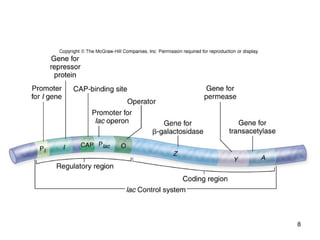
• The lac operon contains genes for the
use of lactose as an energy source.
• Regulatory regions of the operon include
the CAP binding site, promoter, and the
operator.
• The coding region contains genes for 3
enzymes:
β-galactosidase, permease, and
transacetylase
8
9
Prokaryotic Regulation
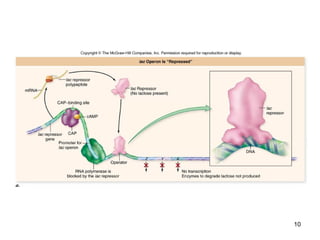
• The lac operon is negatively regulated by
a repressor protein:
–lac repressor binds to the operator to
block transcription
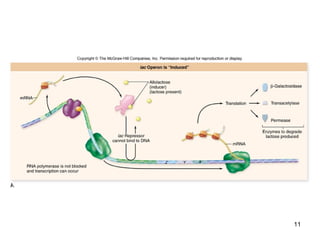
–in the presence of lactose, an inducer
molecule binds to the repressor protein
–repressor can no longer bind to operator
–transcription proceeds
10
11
12
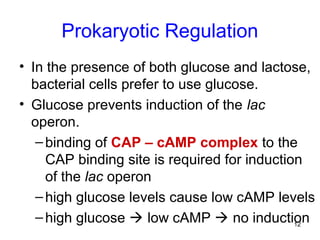
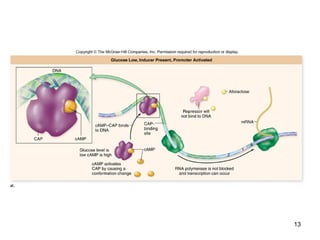
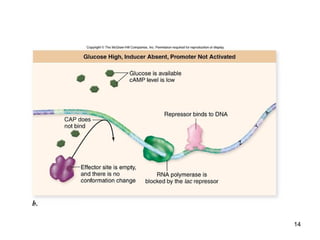
Prokaryotic Regulation
• In the presence of both glucose and lactose,
bacterial cells prefer to use glucose.
• Glucose prevents induction of the lac
operon.
–binding of CAP – cAMP complex to the
CAP binding site is required for induction
of the lac operon
–high glucose levels cause low cAMP levels
–high glucose  low cAMP  no induction
13
14
15
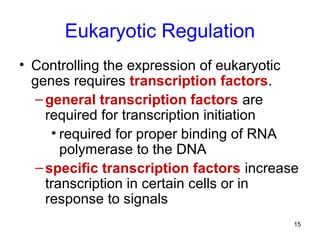
Eukaryotic Regulation
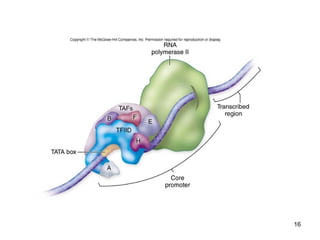
• Controlling the expression of eukaryotic
genes requires transcription factors.
–general transcription factors are
required for transcription initiation
• required for proper binding of RNA
polymerase to the DNA
–specific transcription factors increase
transcription in certain cells or in
response to signals
16
17
Eukaryotic Transcription
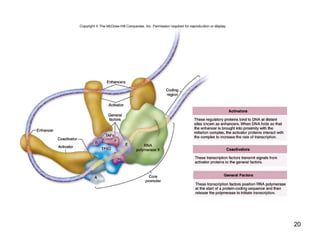
• General transcription factors bind to the
promoter region of the gene.
• RNA polymerase II then binds to the
promoter to begin transcription at the start
site .
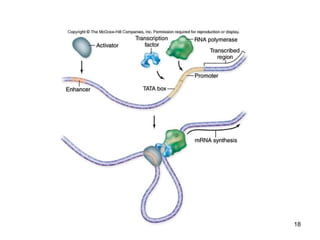
• Enhancers are DNA sequences to which
specific transcription factors (activators)
bind to increase the rate of transcription.
18
19
Eukaryotic Transcription
• Coactivators and mediators are also
required for the function of transcription
factors.
–coactivators and mediators bind to
transcription factors and bind to other
parts of the transcription apparatus
20
21
Eukaryotic Chromosome Structure
• Eukaryotic DNA is packaged into
chromatin.
• Chromatin structure is directly related to
the control of gene expression.
• Chromatin structure begins with the
organization of the DNA into
nucleosomes.
• Nucleosomes may block RNA polymerase
II from gaining access to promoters.
22
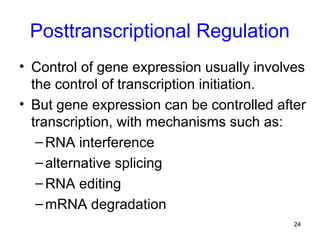
Eukaryotic Chromosome Structure
• Methylation (the addition of –CH3) of DNA
or histone proteins is associated with the
control of gene expression.
• Clusters of methylated cytosine nucleotides
bind to a protein that prevents activators
from binding to DNA.
• Methylated histone proteins are associated
with inactive regions of chromatin.
23
24
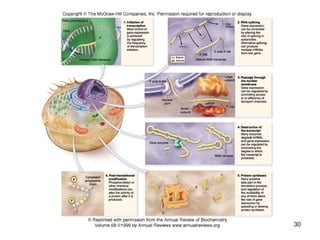
Posttranscriptional Regulation
• Control of gene expression usually involves
the control of transcription initiation.
• But gene expression can be controlled after
transcription, with mechanisms such as:
–RNA interference
–alternative splicing
–RNA editing
–mRNA degradation
25
Posttranscriptional Regulation
• RNA interference involves the use of
small RNA molecules
• The enzyme Dicer chops double stranded
RNA into small pieces of RNA
–micro-RNAs bind to complementary
RNA to prevent translation
–small interfering RNAs degrade
particular mRNAs before translation
26
Posttranscriptional Regulation
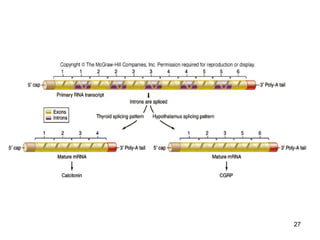
• Introns are spliced out of pre-mRNAs to
produce the mature mRNA that is
translated.
• Alternative splicing recognizes different
splice sites in different tissue types.
• The mature mRNAs in each tissue possess
different exons, resulting in different
polypeptide products from the same gene.
27
28
Posttranscriptional Regulation
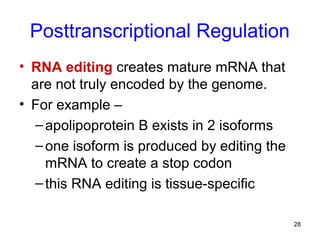
• RNA editing creates mature mRNA that
are not truly encoded by the genome.
• For example –
–apolipoprotein B exists in 2 isoforms
–one isoform is produced by editing the
mRNA to create a stop codon
–this RNA editing is tissue-specific
29
Posttranscriptional Regulation
• Mature mRNA molecules have various
half-lives depending on the gene and the
location (tissue) of expression.
• The amount of polypeptide produced from
a particular gene can be influenced by the
half-life of the mRNA molecules.
30
31
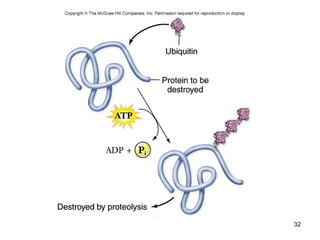
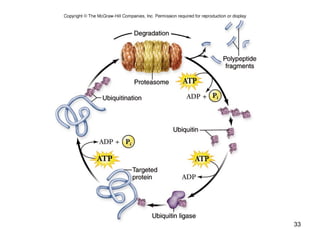
Protein Degradation
• Proteins are produced and degraded
continually in the cell.
• Proteins to be degraded are tagged with
ubiquitin.
• Degradation of proteins marked with
ubiquitin occurs at the proteasome.
32
33

Gene regulation

  • 1.
    Control of GeneExpression In pro and eukaryotes By Dr Sajid Ali Assistant Professor Biotech,AWKUM.
  • 2.
    2 Control of GeneExpression • Controlling gene expression is often accomplished by controlling transcription initiation. • Regulatory proteins bind to DNA to either block or stimulate transcription, depending on how they interact with RNA polymerase.
  • 3.
    3 Control of GeneExpression • Prokaryotic organisms regulate gene expression in response to their environment. • Eukaryotic cells regulate gene expression to maintain homeostasis in the organism.
  • 4.
    4 Regulatory Proteins • DNA-bindingmotifs are regions of regulatory proteins which bind to DNA
  • 5.
    5 Prokaryotic Regulation • Controlof transcription initiation can be: –positive control – increases transcription when activators bind DNA –negative control – reduces transcription when repressors bind to DNA regulatory regions called operators
  • 6.
    6 Prokaryotic Regulation • Prokaryoticcells often respond to their environment by changes in gene expression. • Genes involved in the same metabolic pathway are organized in operons. • Some operons are induced when the metabolic pathway is needed. • Some operons are repressed when the metabolic pathway is no longer needed.
  • 7.
    7 Prokaryotic Regulation • Thelac operon contains genes for the use of lactose as an energy source. • Regulatory regions of the operon include the CAP binding site, promoter, and the operator. • The coding region contains genes for 3 enzymes: β-galactosidase, permease, and transacetylase
  • 8.
  • 9.
    9 Prokaryotic Regulation • Thelac operon is negatively regulated by a repressor protein: –lac repressor binds to the operator to block transcription –in the presence of lactose, an inducer molecule binds to the repressor protein –repressor can no longer bind to operator –transcription proceeds
  • 10.
  • 11.
  • 12.
    12 Prokaryotic Regulation • Inthe presence of both glucose and lactose, bacterial cells prefer to use glucose. • Glucose prevents induction of the lac operon. –binding of CAP – cAMP complex to the CAP binding site is required for induction of the lac operon –high glucose levels cause low cAMP levels –high glucose  low cAMP  no induction
  • 13.
  • 14.
  • 15.
    15 Eukaryotic Regulation • Controllingthe expression of eukaryotic genes requires transcription factors. –general transcription factors are required for transcription initiation • required for proper binding of RNA polymerase to the DNA –specific transcription factors increase transcription in certain cells or in response to signals
  • 16.
  • 17.
    17 Eukaryotic Transcription • Generaltranscription factors bind to the promoter region of the gene. • RNA polymerase II then binds to the promoter to begin transcription at the start site . • Enhancers are DNA sequences to which specific transcription factors (activators) bind to increase the rate of transcription.
  • 18.
  • 19.
    19 Eukaryotic Transcription • Coactivatorsand mediators are also required for the function of transcription factors. –coactivators and mediators bind to transcription factors and bind to other parts of the transcription apparatus
  • 20.
  • 21.
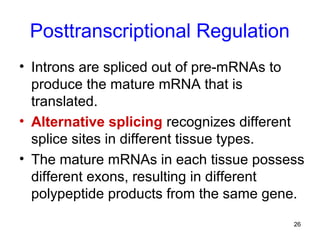
    21 Eukaryotic Chromosome Structure •Eukaryotic DNA is packaged into chromatin. • Chromatin structure is directly related to the control of gene expression. • Chromatin structure begins with the organization of the DNA into nucleosomes. • Nucleosomes may block RNA polymerase II from gaining access to promoters.
  • 22.
    22 Eukaryotic Chromosome Structure •Methylation (the addition of –CH3) of DNA or histone proteins is associated with the control of gene expression. • Clusters of methylated cytosine nucleotides bind to a protein that prevents activators from binding to DNA. • Methylated histone proteins are associated with inactive regions of chromatin.
  • 23.
  • 24.
    24 Posttranscriptional Regulation • Controlof gene expression usually involves the control of transcription initiation. • But gene expression can be controlled after transcription, with mechanisms such as: –RNA interference –alternative splicing –RNA editing –mRNA degradation
  • 25.
    25 Posttranscriptional Regulation • RNAinterference involves the use of small RNA molecules • The enzyme Dicer chops double stranded RNA into small pieces of RNA –micro-RNAs bind to complementary RNA to prevent translation –small interfering RNAs degrade particular mRNAs before translation
  • 26.
    26 Posttranscriptional Regulation • Intronsare spliced out of pre-mRNAs to produce the mature mRNA that is translated. • Alternative splicing recognizes different splice sites in different tissue types. • The mature mRNAs in each tissue possess different exons, resulting in different polypeptide products from the same gene.
  • 27.
  • 28.
    28 Posttranscriptional Regulation • RNAediting creates mature mRNA that are not truly encoded by the genome. • For example – –apolipoprotein B exists in 2 isoforms –one isoform is produced by editing the mRNA to create a stop codon –this RNA editing is tissue-specific
  • 29.
    29 Posttranscriptional Regulation • MaturemRNA molecules have various half-lives depending on the gene and the location (tissue) of expression. • The amount of polypeptide produced from a particular gene can be influenced by the half-life of the mRNA molecules.
  • 30.
  • 31.
    31 Protein Degradation • Proteinsare produced and degraded continually in the cell. • Proteins to be degraded are tagged with ubiquitin. • Degradation of proteins marked with ubiquitin occurs at the proteasome.
  • 32.
  • 33.