DONE BY: HADIAH BASSAM AL MAHDI
M A S T E R O F S C I E N C E
G E N E T I C S D E P A R T M E N T , F A C U L T Y O F S C I E N C E
RNA INTERFERENCE
OUTLINE
 Introduction
 RNA silencing
 Definition of RNA interference
 Discovery of RNAi
 Mechanism of RNA interference
 siRNA
 miRNA
 Expolotion of RNA interference
 Conclusion
INTRODUCTION
RNA silencing
Several terms are used to describe RNA silencing;
usually there are three phenotypically different but
mechanistically similar phenomena:
1. post-trascriptional gene silencing (PTGS) in plants
2. Quelling in fungi
3. RNA interference in animal kingdom
Definition
RNA interference (RNAi) is a mechanism
that inhibits gene expression at the stage
of translation or by hindering the
transcription of specific genes.
Why do we need for interference ?
 Defense Mechanism
 Defense against Infection by viruses, etc
 As a defense mechanism to protect against transposons and
other insertional elements
 Genome Wide Regulation
 RNAi plays a role in regulating development and genome
maintenance.
 30% of human genome regulated
Discovery Of RNAi
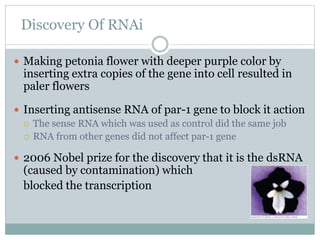
 Making petonia flower with deeper purple color by
inserting extra copies of the gene into cell resulted in
paler flowers
 Inserting antisense RNA of par-1 gene to block it action
 The sense RNA which was used as control did the same job
 RNA from other genes did not affect par-1 gene
 2006 Nobel prize for the discovery that it is the dsRNA
(caused by contamination) which
blocked the transcription
MECHANISIM OF RNAi
RNAi Mechanism
 RNA interference (RNAi) acts in 3 ways:
1. Inhibit transcription by silencing the gene
2. Inhibit translation of mRNA
3. Destruct mRNA
where do these RNAi come from?
 Small interfering
RNA (siRNA) are
made from dsRNA
precursors
 microRNA (miRNA)
are encoded by genes
In Interference
 RNA
 siRNA: dsRNA 21-22 nt.
 miRNA: ssRNA 19-25nt. Encoded by non protein coding
genome
 RISC:
 RNA induced Silencing Complex, that cleaves mRNA
 The catalytic component of the RISC complex
include Argonaute
 Enzymes
 Dicer : produces 20-21 nt cleavages that initiate RNAi
 Drosha : cleaves base hairpin in to form pre miRNA; which is
later processed by Dicer
The mechanism of siRNA :
 Long dsRNA .
Dicer
 siRNA into two single-
stranded RNAs (ssRNAs)
 Guide (siRNA) enters the cell.
RISC + Argonaute
 Single stranded siRNA binds
to its target mRNA.
 The mRNA is now cut and
recognized as abnormal by the
cell.
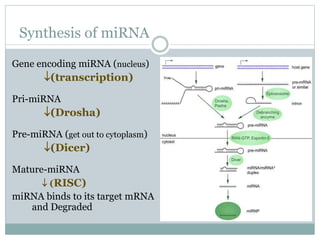
Synthesis of miRNA
Gene encoding miRNA (nucleus)
(transcription)
Pri-miRNA
(Drosha)
Pre-miRNA (get out to cytoplasm)
(Dicer)
Mature-miRNA
 (RISC)
miRNA binds to its target mRNA
and Degraded
• Drosha cuts 11 bp away from dsRNA-ssRNA
junction
• Dicer is needed to generatemature miRNA from
pre-miRNA
miRNA siRNA
 Precursor: 70 nt shRNA
 Imperfect pairing required
 Function: mRNA cleavage
 Nearly conserved
 Encoded by own genes
(endogenous source )
 Precursor: Long dsRNA
 perfect pairing required
 Function: mRNA cleavage
 Not conserved
 Encoded by transposon or
viruses (exogenous source)
miRNA vs siRNA
HTTPS://WWW.YOUTUBE.
COM/WATCH?V=2DL7SH
_UDKS
Expolotion OF RNAi
Expolotion of RNAi
 Protection against transposons & viruses
 Faster identification of gene function
 Role in regulating gene translation
 Role in cancer pathogenesis
 Agriculture
Protection against transposons & viruses
 45% of human genome is DNA originated from
transposons
 RNAi machinery silence transposons by recruiting
histone modifiers
 Mutations affecting RNAi machinery could reactivate
transposons
 RNAi machinery Silencing genes in HIV
 Silence the main structural protein in the virus, p24, and the
human protein CD4.
 Hit the virus where it counts by eliminating a protein it needs
to reproduce or cause infections.
Role in regulating gene translation
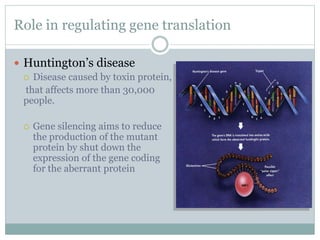
 Huntington’s disease
 Disease caused by toxin protein,
that affects more than 30,000
people.
 Gene silencing aims to reduce
the production of the mutant
protein by shut down the
expression of the gene coding
for the aberrant protein
Role in cancer pathogenesis
 miRNA are classified as:
1. Oncogenic: their increase expression lead to cancer
1. Tumor suppressor: their absence increase cancer
 Half of the identified miRNA (~300) are located at
chromosomal regions disrupted by rearrangement
in cancer pathogenesis
Oncogenic miRNA
(miR-17-92)
Tumor suppressor
miRNA (miR-15 & miR-16)
 Located in 13q31
 Expression of miR-17-92 increased in
small cell lung cancer
 It target RB2 and E2F1 responsible
for regulating cell cycle (tumor
suppressor genes)
 Located in 13q14
 Deletion of miR-15 & miR-16 will reduce
their expression  chronic lymphocytic
leukemia (CLL)
 miR15+16 BCL2apoptosis
 Deletion of miR15+16
BCL2apoptosis
Role in cancer pathogenesis
CONCLUSION
Conclusion
 Eukaryotes use dsRNA as an agent of gene silencing, in a process called RNAi
 Special enzymes (Drosha and, most generally Dicer) recognize dsRNA and generate
from that short (21-22 nucleotide) RNAs that are the active species for gene
silencing.
 The dsRNAs that give rise to siRNAs can arise from various sources ranging from
infecting viruses.
 siRNAs and miRNAs act in essentially the same way. They are incorporated into a
machine called RISC.
 miRNAs have also been associated with cancer, with some miRNAs being classified
as tumor suppressors and others as oncogenes.
 RNAi has become a regulator tool and is particularly useful in systems.
Thank You

RNA interfernce

  • 1.
    DONE BY: HADIAHBASSAM AL MAHDI M A S T E R O F S C I E N C E G E N E T I C S D E P A R T M E N T , F A C U L T Y O F S C I E N C E RNA INTERFERENCE
  • 2.
    OUTLINE  Introduction  RNAsilencing  Definition of RNA interference  Discovery of RNAi  Mechanism of RNA interference  siRNA  miRNA  Expolotion of RNA interference  Conclusion
  • 3.
  • 4.
    RNA silencing Several termsare used to describe RNA silencing; usually there are three phenotypically different but mechanistically similar phenomena: 1. post-trascriptional gene silencing (PTGS) in plants 2. Quelling in fungi 3. RNA interference in animal kingdom
  • 5.
    Definition RNA interference (RNAi)is a mechanism that inhibits gene expression at the stage of translation or by hindering the transcription of specific genes.
  • 6.
    Why do weneed for interference ?  Defense Mechanism  Defense against Infection by viruses, etc  As a defense mechanism to protect against transposons and other insertional elements  Genome Wide Regulation  RNAi plays a role in regulating development and genome maintenance.  30% of human genome regulated
  • 7.
    Discovery Of RNAi Making petonia flower with deeper purple color by inserting extra copies of the gene into cell resulted in paler flowers  Inserting antisense RNA of par-1 gene to block it action  The sense RNA which was used as control did the same job  RNA from other genes did not affect par-1 gene  2006 Nobel prize for the discovery that it is the dsRNA (caused by contamination) which blocked the transcription
  • 8.
  • 9.
    RNAi Mechanism  RNAinterference (RNAi) acts in 3 ways: 1. Inhibit transcription by silencing the gene 2. Inhibit translation of mRNA 3. Destruct mRNA
  • 10.
    where do theseRNAi come from?  Small interfering RNA (siRNA) are made from dsRNA precursors  microRNA (miRNA) are encoded by genes
  • 11.
    In Interference  RNA siRNA: dsRNA 21-22 nt.  miRNA: ssRNA 19-25nt. Encoded by non protein coding genome  RISC:  RNA induced Silencing Complex, that cleaves mRNA  The catalytic component of the RISC complex include Argonaute  Enzymes  Dicer : produces 20-21 nt cleavages that initiate RNAi  Drosha : cleaves base hairpin in to form pre miRNA; which is later processed by Dicer
  • 12.
    The mechanism ofsiRNA :  Long dsRNA . Dicer  siRNA into two single- stranded RNAs (ssRNAs)  Guide (siRNA) enters the cell. RISC + Argonaute  Single stranded siRNA binds to its target mRNA.  The mRNA is now cut and recognized as abnormal by the cell.
  • 13.
    Synthesis of miRNA Geneencoding miRNA (nucleus) (transcription) Pri-miRNA (Drosha) Pre-miRNA (get out to cytoplasm) (Dicer) Mature-miRNA  (RISC) miRNA binds to its target mRNA and Degraded
  • 14.
    • Drosha cuts11 bp away from dsRNA-ssRNA junction • Dicer is needed to generatemature miRNA from pre-miRNA
  • 15.
    miRNA siRNA  Precursor:70 nt shRNA  Imperfect pairing required  Function: mRNA cleavage  Nearly conserved  Encoded by own genes (endogenous source )  Precursor: Long dsRNA  perfect pairing required  Function: mRNA cleavage  Not conserved  Encoded by transposon or viruses (exogenous source) miRNA vs siRNA
  • 16.
  • 17.
  • 18.
    Expolotion of RNAi Protection against transposons & viruses  Faster identification of gene function  Role in regulating gene translation  Role in cancer pathogenesis  Agriculture
  • 19.
    Protection against transposons& viruses  45% of human genome is DNA originated from transposons  RNAi machinery silence transposons by recruiting histone modifiers  Mutations affecting RNAi machinery could reactivate transposons  RNAi machinery Silencing genes in HIV  Silence the main structural protein in the virus, p24, and the human protein CD4.  Hit the virus where it counts by eliminating a protein it needs to reproduce or cause infections.
  • 20.
    Role in regulatinggene translation  Huntington’s disease  Disease caused by toxin protein, that affects more than 30,000 people.  Gene silencing aims to reduce the production of the mutant protein by shut down the expression of the gene coding for the aberrant protein
  • 21.
    Role in cancerpathogenesis  miRNA are classified as: 1. Oncogenic: their increase expression lead to cancer 1. Tumor suppressor: their absence increase cancer  Half of the identified miRNA (~300) are located at chromosomal regions disrupted by rearrangement in cancer pathogenesis
  • 22.
    Oncogenic miRNA (miR-17-92) Tumor suppressor miRNA(miR-15 & miR-16)  Located in 13q31  Expression of miR-17-92 increased in small cell lung cancer  It target RB2 and E2F1 responsible for regulating cell cycle (tumor suppressor genes)  Located in 13q14  Deletion of miR-15 & miR-16 will reduce their expression  chronic lymphocytic leukemia (CLL)  miR15+16 BCL2apoptosis  Deletion of miR15+16 BCL2apoptosis Role in cancer pathogenesis
  • 23.
  • 24.
    Conclusion  Eukaryotes usedsRNA as an agent of gene silencing, in a process called RNAi  Special enzymes (Drosha and, most generally Dicer) recognize dsRNA and generate from that short (21-22 nucleotide) RNAs that are the active species for gene silencing.  The dsRNAs that give rise to siRNAs can arise from various sources ranging from infecting viruses.  siRNAs and miRNAs act in essentially the same way. They are incorporated into a machine called RISC.  miRNAs have also been associated with cancer, with some miRNAs being classified as tumor suppressors and others as oncogenes.  RNAi has become a regulator tool and is particularly useful in systems.
  • 25.