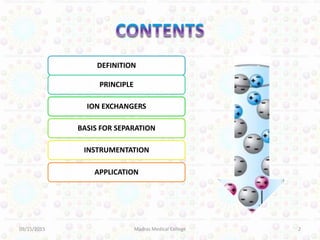
DEFINITION
PRINCIPLE
ION EXCHANGERS
BASIS FOR SEPARATION
INSTRUMENTATION
APPLICATION
09/15/2015 2Madras Medical College
ION EXCHANGE CHROMATOGRAPHY:
It is the
based on their affinity towards the ion
exchangers.
09/15/2015 3Madras Medical College
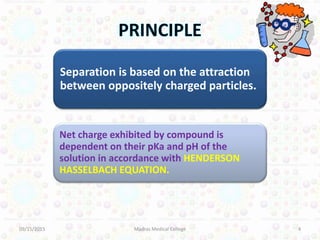
Separation is based on the attraction
between oppositely charged particles.
Net charge exhibited by compound is
dependent on their pKa and pH of the
solution in accordance with HENDERSON
HASSELBACH EQUATION.
09/15/2015 Madras Medical College 4
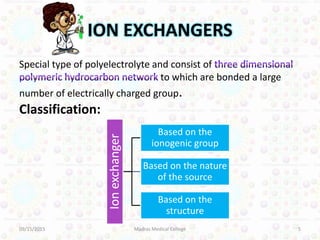
ION EXCHANGERS
Special type of polyelectrolyte and consist of
to which are bonded a large
number of electrically charged group.
Classification:
09/15/2015 5
Ionexchanger
Based on the
ionogenic group
Based on the nature
of the source
Based on the
structure
Madras Medical College
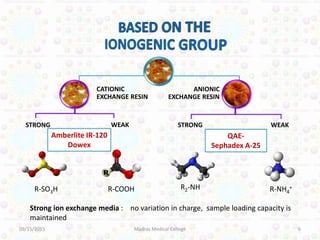
CATIONIC
EXCHANGE RESIN
STRONG WEAK
ANIONIC
EXCHANGE RESIN
09/15/2015 6
STRONG WEAK
R-SO3H R-COOH R-NH4
+R2-NH
Strong ion exchange media : no variation in charge, sample loading capacity is
maintained
Amberlite IR-120
Dowex
QAE-
Sephadex A-25
Madras Medical College
09/15/2015 7Madras Medical College
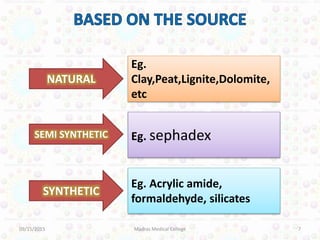
Eg.
Clay,Peat,Lignite,Dolomite,
etc
Eg. sephadex
Eg. Acrylic amide,
formaldehyde, silicates
NATURAL
SEMI SYNTHETIC
SYNTHETIC
09/15/2015 8Madras Medical College
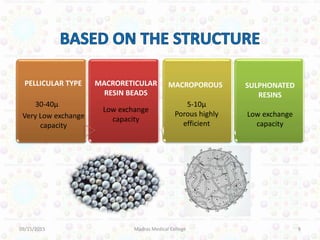
PELLICULAR TYPE MACRORETICULAR
RESIN BEADS
MACROPOROUS
30-40µ
Low exchange
capacityVery Low exchange
capacity
5-10µ
Porous highly
efficient
SULPHONATED
RESINS
Low exchange
capacity
PROPERTIES
It must be sufficiently cross linked to have only a
negligible solubility.In order to permit diffusion of ions
through the structure at constant and finite rates
Swollen resin must be denser than water
Resin must be chemically stable
Cross linking is of greater importance
Swelling
polar solvents--- swelling
Non-polar solvents----- contraction
Particle size---- decrease higher the rate of ion exchange
50-100mesh/100-200mesh
09/15/2015 9Madras Medical College
BASIS FOR SEPARATION
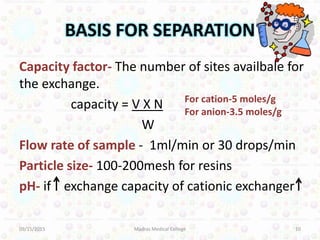
Capacity factor- The number of sites availbale for
the exchange.
capacity = V X N
W
Flow rate of sample - 1ml/min or 30 drops/min
Particle size- 100-200mesh for resins
pH- if exchange capacity of cationic exchanger
09/15/2015 10Madras Medical College
For cation-5 moles/g
For anion-3.5 moles/g
Contd…
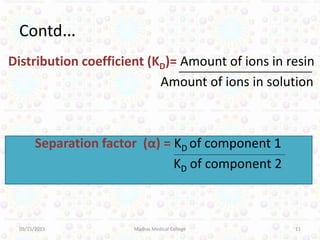
Distribution coefficient (KD)= Amount of ions in resin
Amount of ions in solution
Separation factor (α) = KD of component 1
KD of component 2
09/15/2015 Madras Medical College 11
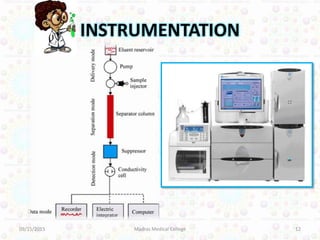
INSTRUMENTATION
09/15/2015 12Madras Medical College
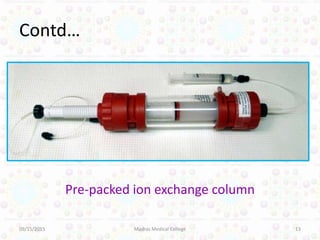
Contd…
•
Pre-packed ion exchange column
09/15/2015 Madras Medical College 13
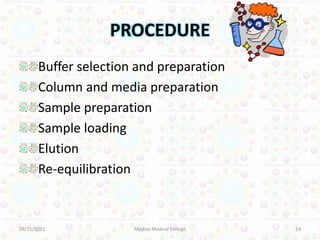
PROCEDURE
Buffer selection and preparation
Column and media preparation
Sample preparation
Sample loading
Elution
Re-equilibration
09/15/2015 14Madras Medical College
Eg.
In cation exchange chromatography, using a functional group on the solid
support with a pKa of 1.2, a sample molecule with a pI of 8.2 may be run in a
mobile phase buffer of pH 6.0.
09/15/2015 15Madras Medical College
As a rule, the pH of the mobile phase buffer must be between the
pI (isoelectric point) or pKa (acid dissociation constant) of the
charged molecule and the pKa of the charged group on the solid
support.
USUALLY PREPARED VOLUME – 500ml
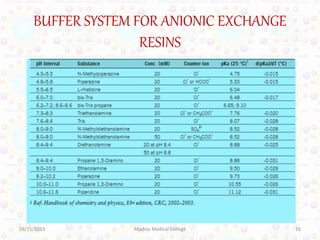
BUFFER SYSTEM FOR ANIONIC EXCHANGE
RESINS
09/15/2015 Madras Medical College 16
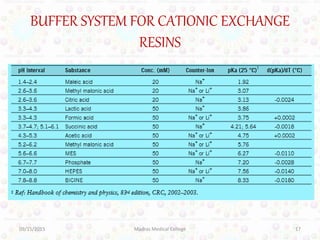
BUFFER SYSTEM FOR CATIONIC EXCHANGE
RESINS
09/15/2015 Madras Medical College 17
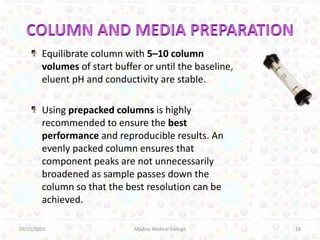
Equilibrate column with 5–10 column
volumes of start buffer or until the baseline,
eluent pH and conductivity are stable.
Using prepacked columns is highly
recommended to ensure the best
performance and reproducible results. An
evenly packed column ensures that
component peaks are not unnecessarily
broadened as sample passes down the
column so that the best resolution can be
achieved.
09/15/2015 18Madras Medical College
Contd…
Allow buffers, media or prepacked columns to reach the same
temperature before use.
Rapid changes in temperature, for example removing packed
columns from a cold room and then applying buffer at room
temperature, can cause air bubbles in the packing and affect
the separation.
Wash away storage solutions and preservatives before using
any IEX medium.
09/15/2015 Madras Medical College 19
Contd..
Increase the volumes used for column equilibration before
the first run if using buffers containing detergents or a
different counter-ion to the one in which the medium has
been stored.
The volume required for the packed bed is determined by the
amount of sample to be purified and the binding capacity of
the medium.
Pack a column that will have approximately 5-fold excess of
the binding capacity required with a bed height up to 20 cm.
Wet packing
09/15/2015 Madras Medical College 20
Desalt the sample and transfer to the buffer
Adjust the sample to the chosen starting pH and ionic
strength and apply to the column.
Sample volume should be based on the capacity of ion
exchange resins
For protein samples maximum concentration of about 50-
70mg/ml can be used
09/15/2015 21Madras Medical College
Apply samples directly to the column via a chromatography
system, a peristaltic pump or a syringe.
The choice of equipment depends largely on the sample
volume, the size of column, the type of IEX medium and the
requirements for accuracy in gradient elution.
Ensure that the top of the column bed is not disturbed during
sample application
Do not change buffer conditions until all unbound material
has been washed through the column (monitored by UV
absorbance) and until UV and conductivity values have
returned
09/15/2015 22Madras Medical College
Achieved by decreasing the affinity of solute. It is done by
using salt of varying concentration
Bound proteins are eluted by controlled changes in ionic
strength or pH. The way in which these changes take place, by
using a linear or step elution, is selected according to the aim
of the separation:
Linear gradient elution
–high resolution separation or analysis
Step elution
–faster separation time, reduced buffer consumption
–group separation
09/15/2015 238/31/2015 23Madras Medical College
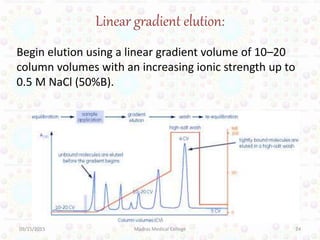
Linear gradient elution:
Begin elution using a linear gradient volume of 10–20
column volumes with an increasing ionic strength up to
0.5 M NaCl (50%B).
09/15/2015 Madras Medical College 24
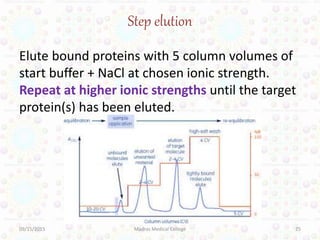
Step elution
Elute bound proteins with 5 column volumes of
start buffer + NaCl at chosen ionic strength.
Repeat at higher ionic strengths until the target
protein(s) has been eluted.
09/15/2015 Madras Medical College 25
Wash with 5 column volumes of 1 M NaCl (100%B) to elute any remaining
ionically-bound material. Include a wash step at the end of every run in order
to remove any molecules that are still bound to the medium. Monitor UV
absorbance so that the wash step can be shortened or prolonged, as
necessary
Re-equilibrate with 5–10 column volumes of start buffer or until eluent pH
and conductivity reach the required values. A re-equilibration step after
washing returns the column to start conditions before applying further
samples. Whenever possible, monitor pH and conductivity to check when
start conditions have been reached. The re-equilibration step can then be
shortened or prolonged as necessary
09/15/2015 26Madras Medical College
SPECTROPHOTOMETRIC METHOD
09/15/2015 Madras Medical College 27
FLAME PHOTOMETRY
CONDUCTOMETRIC METHODS
RADIO ISOTOPE METHOD
09/15/2015 28Madras Medical College
APPLICATION
• Separation of similar ions from one another
• Removal of interfering radicals
• Softening of hard water
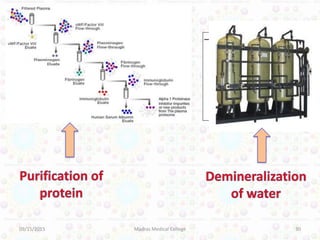
• Complete demineralisation of water
• Separation lanthanides and actinides
• Separation of sugars
• Separation of amino acids
• Preparation of pure reagents
• Hydrometallurgy
09/15/2015 29Madras Medical College
09/15/2015 Madras Medical College 30
REFERENCE
www.harvardapparaturs.com, guide to ion
exchange chromatography
Instrumental analysis of chemical analysis by
Gurudeep R.Chatwal, Sham.K.Anand, Pg. 2.662-
2.672
Instrumental methods of chemical analysis by
B.K.sharma, C-123 -150
http://www.gelifesciences.com/file_source/GELS
/Service%20and%20Support/Documents%20and
%20Downloads/Handbooks/pdfs/Ion%20Exchang
e%20Chromatography.pdf
09/15/2015 31Madras Medical College
Ion Exchange Chromatography

Ion Exchange Chromatography

  • 2.
    DEFINITION PRINCIPLE ION EXCHANGERS BASIS FORSEPARATION INSTRUMENTATION APPLICATION 09/15/2015 2Madras Medical College
  • 3.
    ION EXCHANGE CHROMATOGRAPHY: Itis the based on their affinity towards the ion exchangers. 09/15/2015 3Madras Medical College
  • 4.
    Separation is basedon the attraction between oppositely charged particles. Net charge exhibited by compound is dependent on their pKa and pH of the solution in accordance with HENDERSON HASSELBACH EQUATION. 09/15/2015 Madras Medical College 4
  • 5.
    ION EXCHANGERS Special typeof polyelectrolyte and consist of to which are bonded a large number of electrically charged group. Classification: 09/15/2015 5 Ionexchanger Based on the ionogenic group Based on the nature of the source Based on the structure Madras Medical College
  • 6.
    CATIONIC EXCHANGE RESIN STRONG WEAK ANIONIC EXCHANGERESIN 09/15/2015 6 STRONG WEAK R-SO3H R-COOH R-NH4 +R2-NH Strong ion exchange media : no variation in charge, sample loading capacity is maintained Amberlite IR-120 Dowex QAE- Sephadex A-25 Madras Medical College
  • 7.
    09/15/2015 7Madras MedicalCollege Eg. Clay,Peat,Lignite,Dolomite, etc Eg. sephadex Eg. Acrylic amide, formaldehyde, silicates NATURAL SEMI SYNTHETIC SYNTHETIC
  • 8.
    09/15/2015 8Madras MedicalCollege PELLICULAR TYPE MACRORETICULAR RESIN BEADS MACROPOROUS 30-40µ Low exchange capacityVery Low exchange capacity 5-10µ Porous highly efficient SULPHONATED RESINS Low exchange capacity
  • 9.
    PROPERTIES It must besufficiently cross linked to have only a negligible solubility.In order to permit diffusion of ions through the structure at constant and finite rates Swollen resin must be denser than water Resin must be chemically stable Cross linking is of greater importance Swelling polar solvents--- swelling Non-polar solvents----- contraction Particle size---- decrease higher the rate of ion exchange 50-100mesh/100-200mesh 09/15/2015 9Madras Medical College
  • 10.
    BASIS FOR SEPARATION Capacityfactor- The number of sites availbale for the exchange. capacity = V X N W Flow rate of sample - 1ml/min or 30 drops/min Particle size- 100-200mesh for resins pH- if exchange capacity of cationic exchanger 09/15/2015 10Madras Medical College For cation-5 moles/g For anion-3.5 moles/g
  • 11.
    Contd… Distribution coefficient (KD)=Amount of ions in resin Amount of ions in solution Separation factor (α) = KD of component 1 KD of component 2 09/15/2015 Madras Medical College 11
  • 12.
  • 13.
    Contd… • Pre-packed ion exchangecolumn 09/15/2015 Madras Medical College 13
  • 14.
    PROCEDURE Buffer selection andpreparation Column and media preparation Sample preparation Sample loading Elution Re-equilibration 09/15/2015 14Madras Medical College
  • 15.
    Eg. In cation exchangechromatography, using a functional group on the solid support with a pKa of 1.2, a sample molecule with a pI of 8.2 may be run in a mobile phase buffer of pH 6.0. 09/15/2015 15Madras Medical College As a rule, the pH of the mobile phase buffer must be between the pI (isoelectric point) or pKa (acid dissociation constant) of the charged molecule and the pKa of the charged group on the solid support. USUALLY PREPARED VOLUME – 500ml
  • 16.
    BUFFER SYSTEM FORANIONIC EXCHANGE RESINS 09/15/2015 Madras Medical College 16
  • 17.
    BUFFER SYSTEM FORCATIONIC EXCHANGE RESINS 09/15/2015 Madras Medical College 17
  • 18.
    Equilibrate column with5–10 column volumes of start buffer or until the baseline, eluent pH and conductivity are stable. Using prepacked columns is highly recommended to ensure the best performance and reproducible results. An evenly packed column ensures that component peaks are not unnecessarily broadened as sample passes down the column so that the best resolution can be achieved. 09/15/2015 18Madras Medical College
  • 19.
    Contd… Allow buffers, mediaor prepacked columns to reach the same temperature before use. Rapid changes in temperature, for example removing packed columns from a cold room and then applying buffer at room temperature, can cause air bubbles in the packing and affect the separation. Wash away storage solutions and preservatives before using any IEX medium. 09/15/2015 Madras Medical College 19
  • 20.
    Contd.. Increase the volumesused for column equilibration before the first run if using buffers containing detergents or a different counter-ion to the one in which the medium has been stored. The volume required for the packed bed is determined by the amount of sample to be purified and the binding capacity of the medium. Pack a column that will have approximately 5-fold excess of the binding capacity required with a bed height up to 20 cm. Wet packing 09/15/2015 Madras Medical College 20
  • 21.
    Desalt the sampleand transfer to the buffer Adjust the sample to the chosen starting pH and ionic strength and apply to the column. Sample volume should be based on the capacity of ion exchange resins For protein samples maximum concentration of about 50- 70mg/ml can be used 09/15/2015 21Madras Medical College
  • 22.
    Apply samples directlyto the column via a chromatography system, a peristaltic pump or a syringe. The choice of equipment depends largely on the sample volume, the size of column, the type of IEX medium and the requirements for accuracy in gradient elution. Ensure that the top of the column bed is not disturbed during sample application Do not change buffer conditions until all unbound material has been washed through the column (monitored by UV absorbance) and until UV and conductivity values have returned 09/15/2015 22Madras Medical College
  • 23.
    Achieved by decreasingthe affinity of solute. It is done by using salt of varying concentration Bound proteins are eluted by controlled changes in ionic strength or pH. The way in which these changes take place, by using a linear or step elution, is selected according to the aim of the separation: Linear gradient elution –high resolution separation or analysis Step elution –faster separation time, reduced buffer consumption –group separation 09/15/2015 238/31/2015 23Madras Medical College
  • 24.
    Linear gradient elution: Beginelution using a linear gradient volume of 10–20 column volumes with an increasing ionic strength up to 0.5 M NaCl (50%B). 09/15/2015 Madras Medical College 24
  • 25.
    Step elution Elute boundproteins with 5 column volumes of start buffer + NaCl at chosen ionic strength. Repeat at higher ionic strengths until the target protein(s) has been eluted. 09/15/2015 Madras Medical College 25
  • 26.
    Wash with 5column volumes of 1 M NaCl (100%B) to elute any remaining ionically-bound material. Include a wash step at the end of every run in order to remove any molecules that are still bound to the medium. Monitor UV absorbance so that the wash step can be shortened or prolonged, as necessary Re-equilibrate with 5–10 column volumes of start buffer or until eluent pH and conductivity reach the required values. A re-equilibration step after washing returns the column to start conditions before applying further samples. Whenever possible, monitor pH and conductivity to check when start conditions have been reached. The re-equilibration step can then be shortened or prolonged as necessary 09/15/2015 26Madras Medical College
  • 27.
    SPECTROPHOTOMETRIC METHOD 09/15/2015 MadrasMedical College 27 FLAME PHOTOMETRY CONDUCTOMETRIC METHODS RADIO ISOTOPE METHOD
  • 28.
  • 29.
    APPLICATION • Separation ofsimilar ions from one another • Removal of interfering radicals • Softening of hard water • Complete demineralisation of water • Separation lanthanides and actinides • Separation of sugars • Separation of amino acids • Preparation of pure reagents • Hydrometallurgy 09/15/2015 29Madras Medical College
  • 30.
  • 31.
    REFERENCE www.harvardapparaturs.com, guide toion exchange chromatography Instrumental analysis of chemical analysis by Gurudeep R.Chatwal, Sham.K.Anand, Pg. 2.662- 2.672 Instrumental methods of chemical analysis by B.K.sharma, C-123 -150 http://www.gelifesciences.com/file_source/GELS /Service%20and%20Support/Documents%20and %20Downloads/Handbooks/pdfs/Ion%20Exchang e%20Chromatography.pdf 09/15/2015 31Madras Medical College