Bioluminescence
1
Contents
• Introduction
• Source Of luminosity
• Myriad of colors
• Fluorescent proteins
• Role play in critters’ life
• Evolutionary aspect
• Commercial exploitation
• Bibliography
2
Introduction
Bioluminescence is the production and emission of light by a living organism.
The phenomenon only adds to the diversity of the animal kingdom. Although it
is not very common among terrestrial organisms, this has been witnessed in at
least a few members of each type of marine creatures from bacteria to sharks.
As the term indicates it has something to do with living entities however this is
nothing but a sub-category of chemiluminescence. Also the light that is
generated is termed as ‘cold light’ since only 20% of its energy is released as
heat. There is hardly any evidence that bioluminescence is also seen in
freshwater creatures as well albeit in marine water animals throughout the
water column from the deepness of sea-bed to the warmth of surface of water; it
can be seen anywhere.
3
Source Of Luminosity
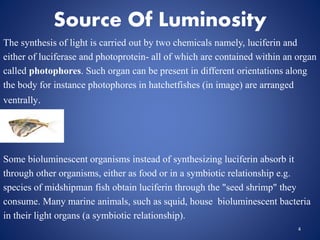
The synthesis of light is carried out by two chemicals namely, luciferin and
either of luciferase and photoprotein- all of which are contained within an organ
called photophores. Such organ can be present in different orientations along
the body for instance photophores in hatchetfishes (in image) are arranged
ventrally.
Some bioluminescent organisms instead of synthesizing luciferin absorb it
through other organisms, either as food or in a symbiotic relationship e.g.
species of midshipman fish obtain luciferin through the "seed shrimp" they
consume. Many marine animals, such as squid, house bioluminescent bacteria
in their light organs (a symbiotic relationship).
4
Source Of Luminosity (contd.)
Most bioluminescent reactions involve luciferin and luciferase except a few
that involve a chemical called a Photoprotein that combines with luciferins and
Oxygen & another agent, often an ion of the element calcium, to produce light.
Photoproteins were only recently identified, and are still being studied for their
unusual chemical properties. Photoproteins were first studied in bioluminescent
Crystal jellies ("green fluorescent protein" or GFP) found off the west coast of
North America.
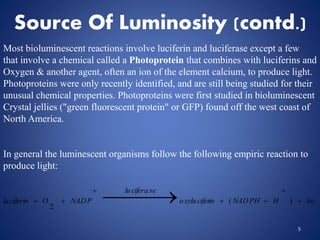
In general the luminescent organisms follow the following empiric reaction to
produce light:
5
hHNADPHinoxylucifer
luciferase
NADPOluciferin 



   )(
2
Myriad Of Colors
The variegation of colors in the appearance of bioluminescent light is quite
fascinating. Even some organisms emit light of two different colors
simultaneously due to having different luciferases in the same body (e.g.
railroad worm; its head glows red, while its body glows green)
Most of the organisms, irrespective of being terrestrial or marine, display the
blue-green wavelength of light. Yellow color is although rare but is seen in
fireflies and a snail, Quantula striata.
The persistence of bioluminescing is also quite similar throughout all the
species and it is normally for less than 10 sec in the form of ‘flashes’ albeit
some species of fungi present in decaying wood emit a fairly consistent glow
(foxfire).
6
Fluorescent Protein
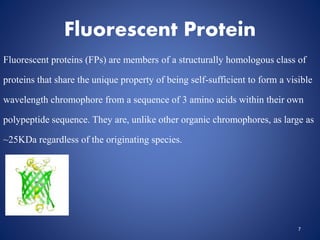
Fluorescent proteins (FPs) are members of a structurally homologous class of
proteins that share the unique property of being self-sufficient to form a visible
wavelength chromophore from a sequence of 3 amino acids within their own
polypeptide sequence. They are, unlike other organic chromophores, as large as
~25KDa regardless of the originating species.
7
Fluorescent Protein (contd.)
The common traits that they share are as follows:
• An extremely rigid β-barrel-fold comprising 11 β-sheets that surround a
central α-helix.
• In all of the jellyfish and coral FPs, studied thus far, the principle
chromophore is derived from only a few crucial amino acids that are located
near the center of the β-barrel.
• Many of the interior amino acids in FPs are charged or polar and this helps
in binding H2O molecules to maintain the structural rigidity.
• The first residue is G67, which is crucial for cyclization of the chromophore
through nucleophilic attack; the second conserved residue is Y66, involved
in chromophore formation. The last two conserved amino acid residues are
R96 and E222, both of which are essential to the maturation process
8
Fluorescent Protein (contd.)
Among all the different FPs, Green Fluorescent Protein is the most talked-
about and well-studied one. Reportedly has existed for more than one
hundred and sixty million years in one species of jellyfish, Aequorea
Victoria (avGFP). Today there are many genetically-modified forms of
GFP like Enhanced Green Fluorescent Protein (eGFP).
Apart from GFPs, there are also yellow-to-red fluorescent proteins, which
are so far reported, obligatory tetramers.
9
Role Play In Critters' Life
Bioluminescence is used by living things to hunt prey, defend against predators,
find mates, and execute other vital activities.
• Defensive adaptation: Some species luminesce to confuse attackers such as
the vampire squid ejects sticky bioluminescent mucus, which can startle,
confuse, and delay predators, allowing them to flee.
Also marine species use a technique called counter-illumination to
protect themselves from predators, such as sharks, which hunt from below;
by disguising their shadows and become virtually invisible to predators
looking up e.g. Hatchet fishes.
The burglar-alarm theory is a possible explanation for how this
response to disturbance helps the plankton survive.
10
Role Play In Critters' Life
• Offensive adaptation: Bioluminescence may be used to lure prey or
search for prey.
The most interesting example is probably the anglerfish
which luminesces the esca at the end of its filament above the huge
head to draw its prey.
• Other roles: Adult fireflies, also called lightning bugs, are
bioluminescent. They light up to attract mates although both male
and female fireflies can luminesce.
Organisms can luminesce when they are disturbed by
changes in the environment, such as a drop in salinity.
11
Evolutionary Aspect
The phenomenon of bioluminescence has largely been witnessed in deep-sea
creatures in the aphotic zone and at times at the lower end of twilight zone
where no or very sun light reaches respectively. Hence organisms living
down there have developed fluorescence to generate visible wavelength of
light to communicate with each other.
Moreover the basic needs of hunting for food and defending from predators are
served by bioluminescence. The fact that avGFP maintains a conserved
structure for more than 160 million years refers to the indispensible role of
such property particularly in marine organisms.
12
Commercial Exploitation
Biologists and engineers are studying the chemicals and circumstances involved
in bioluminescence to understand how people can use the process to make
life easier and safer.
• Green fluorescent protein (GFP), for instance, is a valuable reporter gene.
The importance of GFP was recognized in 2008 when the Nobel Committee
awarded Osamu Shimomura, Marty Chalfie and Roger Tsien the Chemistry
Nobel Prize for the discovery and development of the green fluorescent
protein, GFP.
• Advancements in fluorescent protein engineering by selectively mutating the
fluorescence gene to enhance the emission maxima
• Besides development of red-shifted fluorophores generally provide
improved contrast (owing to decreased background fluorescence and greater
tissue penetration)
13
Commercial
Exploitation(contd.)
More experimental prospects like bioluminescent trees, for instance,
could help light city streets and highways. This would reduce the
need for electricity; bioluminescent crops and other plants could
luminesce when they needed water or other nutrients, or when they
were ready to be harvested. This would reduce costs for farmers and
agribusinesses.
14
Bibliography
1. Davidson, M. W., & Campbell, R. E. (2009). Engineered fluorescent
proteins: innovations and applications. Nature Methods, 713-717.
2. Kremers, G.J., Gilbert, S.G., & Cranfill, P.J. (January 15, 2011).
Fluorescent proteins at a glance. Journal of Cell Science, 157-160.
15
16

bioluminescence

  • 1.
  • 2.
    Contents • Introduction • SourceOf luminosity • Myriad of colors • Fluorescent proteins • Role play in critters’ life • Evolutionary aspect • Commercial exploitation • Bibliography 2
  • 3.
    Introduction Bioluminescence is theproduction and emission of light by a living organism. The phenomenon only adds to the diversity of the animal kingdom. Although it is not very common among terrestrial organisms, this has been witnessed in at least a few members of each type of marine creatures from bacteria to sharks. As the term indicates it has something to do with living entities however this is nothing but a sub-category of chemiluminescence. Also the light that is generated is termed as ‘cold light’ since only 20% of its energy is released as heat. There is hardly any evidence that bioluminescence is also seen in freshwater creatures as well albeit in marine water animals throughout the water column from the deepness of sea-bed to the warmth of surface of water; it can be seen anywhere. 3
  • 4.
    Source Of Luminosity Thesynthesis of light is carried out by two chemicals namely, luciferin and either of luciferase and photoprotein- all of which are contained within an organ called photophores. Such organ can be present in different orientations along the body for instance photophores in hatchetfishes (in image) are arranged ventrally. Some bioluminescent organisms instead of synthesizing luciferin absorb it through other organisms, either as food or in a symbiotic relationship e.g. species of midshipman fish obtain luciferin through the "seed shrimp" they consume. Many marine animals, such as squid, house bioluminescent bacteria in their light organs (a symbiotic relationship). 4
  • 5.
    Source Of Luminosity(contd.) Most bioluminescent reactions involve luciferin and luciferase except a few that involve a chemical called a Photoprotein that combines with luciferins and Oxygen & another agent, often an ion of the element calcium, to produce light. Photoproteins were only recently identified, and are still being studied for their unusual chemical properties. Photoproteins were first studied in bioluminescent Crystal jellies ("green fluorescent protein" or GFP) found off the west coast of North America. In general the luminescent organisms follow the following empiric reaction to produce light: 5 hHNADPHinoxylucifer luciferase NADPOluciferin        )( 2
  • 6.
    Myriad Of Colors Thevariegation of colors in the appearance of bioluminescent light is quite fascinating. Even some organisms emit light of two different colors simultaneously due to having different luciferases in the same body (e.g. railroad worm; its head glows red, while its body glows green) Most of the organisms, irrespective of being terrestrial or marine, display the blue-green wavelength of light. Yellow color is although rare but is seen in fireflies and a snail, Quantula striata. The persistence of bioluminescing is also quite similar throughout all the species and it is normally for less than 10 sec in the form of ‘flashes’ albeit some species of fungi present in decaying wood emit a fairly consistent glow (foxfire). 6
  • 7.
    Fluorescent Protein Fluorescent proteins(FPs) are members of a structurally homologous class of proteins that share the unique property of being self-sufficient to form a visible wavelength chromophore from a sequence of 3 amino acids within their own polypeptide sequence. They are, unlike other organic chromophores, as large as ~25KDa regardless of the originating species. 7
  • 8.
    Fluorescent Protein (contd.) Thecommon traits that they share are as follows: • An extremely rigid β-barrel-fold comprising 11 β-sheets that surround a central α-helix. • In all of the jellyfish and coral FPs, studied thus far, the principle chromophore is derived from only a few crucial amino acids that are located near the center of the β-barrel. • Many of the interior amino acids in FPs are charged or polar and this helps in binding H2O molecules to maintain the structural rigidity. • The first residue is G67, which is crucial for cyclization of the chromophore through nucleophilic attack; the second conserved residue is Y66, involved in chromophore formation. The last two conserved amino acid residues are R96 and E222, both of which are essential to the maturation process 8
  • 9.
    Fluorescent Protein (contd.) Amongall the different FPs, Green Fluorescent Protein is the most talked- about and well-studied one. Reportedly has existed for more than one hundred and sixty million years in one species of jellyfish, Aequorea Victoria (avGFP). Today there are many genetically-modified forms of GFP like Enhanced Green Fluorescent Protein (eGFP). Apart from GFPs, there are also yellow-to-red fluorescent proteins, which are so far reported, obligatory tetramers. 9
  • 10.
    Role Play InCritters' Life Bioluminescence is used by living things to hunt prey, defend against predators, find mates, and execute other vital activities. • Defensive adaptation: Some species luminesce to confuse attackers such as the vampire squid ejects sticky bioluminescent mucus, which can startle, confuse, and delay predators, allowing them to flee. Also marine species use a technique called counter-illumination to protect themselves from predators, such as sharks, which hunt from below; by disguising their shadows and become virtually invisible to predators looking up e.g. Hatchet fishes. The burglar-alarm theory is a possible explanation for how this response to disturbance helps the plankton survive. 10
  • 11.
    Role Play InCritters' Life • Offensive adaptation: Bioluminescence may be used to lure prey or search for prey. The most interesting example is probably the anglerfish which luminesces the esca at the end of its filament above the huge head to draw its prey. • Other roles: Adult fireflies, also called lightning bugs, are bioluminescent. They light up to attract mates although both male and female fireflies can luminesce. Organisms can luminesce when they are disturbed by changes in the environment, such as a drop in salinity. 11
  • 12.
    Evolutionary Aspect The phenomenonof bioluminescence has largely been witnessed in deep-sea creatures in the aphotic zone and at times at the lower end of twilight zone where no or very sun light reaches respectively. Hence organisms living down there have developed fluorescence to generate visible wavelength of light to communicate with each other. Moreover the basic needs of hunting for food and defending from predators are served by bioluminescence. The fact that avGFP maintains a conserved structure for more than 160 million years refers to the indispensible role of such property particularly in marine organisms. 12
  • 13.
    Commercial Exploitation Biologists andengineers are studying the chemicals and circumstances involved in bioluminescence to understand how people can use the process to make life easier and safer. • Green fluorescent protein (GFP), for instance, is a valuable reporter gene. The importance of GFP was recognized in 2008 when the Nobel Committee awarded Osamu Shimomura, Marty Chalfie and Roger Tsien the Chemistry Nobel Prize for the discovery and development of the green fluorescent protein, GFP. • Advancements in fluorescent protein engineering by selectively mutating the fluorescence gene to enhance the emission maxima • Besides development of red-shifted fluorophores generally provide improved contrast (owing to decreased background fluorescence and greater tissue penetration) 13
  • 14.
    Commercial Exploitation(contd.) More experimental prospectslike bioluminescent trees, for instance, could help light city streets and highways. This would reduce the need for electricity; bioluminescent crops and other plants could luminesce when they needed water or other nutrients, or when they were ready to be harvested. This would reduce costs for farmers and agribusinesses. 14
  • 15.
    Bibliography 1. Davidson, M.W., & Campbell, R. E. (2009). Engineered fluorescent proteins: innovations and applications. Nature Methods, 713-717. 2. Kremers, G.J., Gilbert, S.G., & Cranfill, P.J. (January 15, 2011). Fluorescent proteins at a glance. Journal of Cell Science, 157-160. 15
  • 16.