ULTRA PERFORMANCE
LIQUID CHROMATOGRAPHY
B.KEERTHANA,
B.PHARM.
INTRODUCTION
UPLC means Ultra Performance Liquid Chromatography
UPLC is a chromatographic technique, in which it can separate a mixture of
compounds and is used in biochemistry and analytical chemistry to identify, quality,
purity in the individual components of a mixture utilizing a small packaging particle
and columns with high pack pressure.
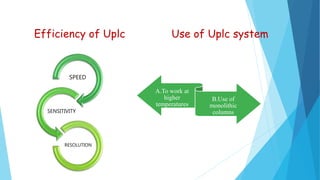
Efficiency of Uplc
SPEED
SENSITIVITY
RESOLUTION
A.To work at
higher
temperatures
B.Use of
monolithic
columns
Use of Uplc system
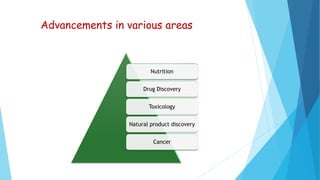
Advancements in various areas
Nutrition
Drug Discovery
Toxicology
Natural product discovery
Cancer
Advantages
 Operation cost is reduced
 Less solvent consumption
 Run time and increase sensitivity
 Maintains resolution performance
Disadvantages
 High price of instruments, spare parts and
columns
 Number of stationary phases still limited
 Lack of variety in commercial columns
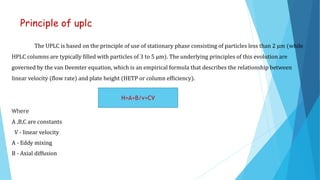
Principle of uplc
The UPLC is based on the principle of use of stationary phase consisting of particles less than 2 μm (while
HPLC columns are typically filled with particles of 3 to 5 μm). The underlying principles of this evolution are
governed by the van Deemter equation, which is an empirical formula that describes the relationship between
linear velocity (flow rate) and plate height (HETP or column efficiency).
Where
A ,B,C are constants
V - linear velocity
A - Eddy mixing
B - Axial diffusion
H=A+B/v+CV
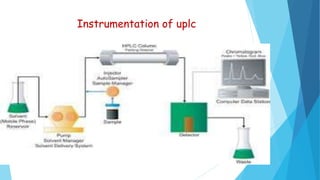
Instrumentation of uplc
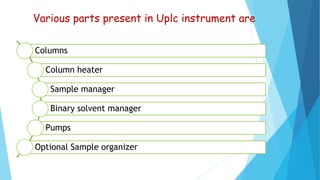
Various parts present in Uplc instrument are
Columns
Column heater
Sample manager
Binary solvent manager
Pumps
Optional Sample organizer
Binary solvent manager
 The binary solvent manager uses two individual serial flow pumps to deliver a parallel binary
gradient.
 The binary solvent manager is a high pressure pump that moves solvent through the system.
 The binary solvent manager delivers solvent at flow rates of 1 ml/min at 103421 Kрa [ 1034 bar,
1500 psi] and up to 2ml/min at reduced pressures to 62053 Kpa [621 bar, 9000 psF] . The solvent
manager can pump two solvents immediately.
Sample manager:
 The Acuity sample manager injects the sample it draws from Micro titer plates or vials in to the
chromatographic flow stream.
 A locating mechanism uses a probe to access sample locations and draw sample from them.
 The Sample manager can perform an injection in approximately 15 seconds. The sample manager
also controls the column heater. Column temperatures up to 65°С can be attained.
Column heater:
 The column heater is of a modular design and its foot print is identical to that of the sample manager.
Thus it attaches to the top of the sample manager and serves as the instrument’s top cover.
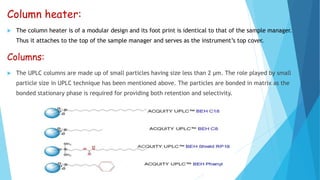
Columns:
 The UPLC columns are made up of small particles having size less than 2 μm. The role played by small
particle size in UPLC technique has been mentioned above. The particles are bonded in matrix as the
bonded stationary phase is required for providing both retention and selectivity.
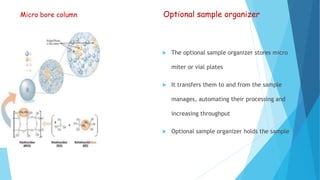
Micro bore column Optional sample organizer
 The optional sample organizer stores micro
miter or vial plates
 It transfers them to and from the sample
manages, automating their processing and
increasing throughput
 Optional sample organizer holds the sample
Pumps:
 The UPLC pump is considered to be one of the most important components in a liquid chromatography
system which has to provide a continuous constant flow of the eluent through the UPLC injector,
column, and detector.
The two basic classifications are
 Constant pressure pump
 Constant flow pump
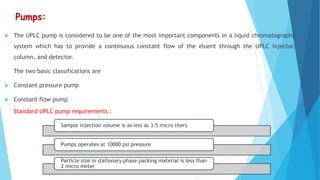
Standard UPLC pump requirements :
Sample injection volume is as less as 3-5 micro liters
Pumps operates at 10000 psi pressure
Particle size in stationary phase packing material is less than
2 micro meter
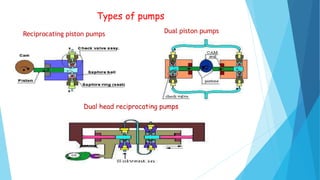
Types of pumps
Reciprocating piston pumps Dual piston pumps
Dual head reciprocating pumps
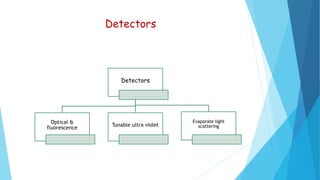
Detectors
Detectors
Optical &
fluorescence
Tunable ultra violet
Evaporate light
scattering
Applications of Uplc
 Rapid analysis of products
 Bio equivalence studies
 Dissolution testing
 Impurity profiling
 Identification of metabolites
 High through put qualitative analysis
 Drug discovery
 Analysis of dosage form
 Study of metabolomics
 Forced degradation studies
 In finger print analysis
 ADME screening
 Determination of pesticides
 Analysis of amino acids
 In QA control
References
1. Jerkovich A.D., Mellors J.S., and Jorgenson J.W., LCGC 21(7), 660–611(2003).
2. Wu N Lippert J.A. and Lee M.L., J. Chromatogram. 911(1) (2001).
3. Unger K. K., Kumar D. , Grun M., Buchel G., Ludtke S., AdamTh., Scumacher K., and Renker S., J. Chromatogram., A
892(47)(2000).
4. Swartz M. E. and Murphy B., Lab Plus Int., 18(6) (2004).
5. Swartz M. E. and Murphy B., Pharm. Formulation Quality 6(5), p. 40 (2004)
6. Gerber F. , Krummen M., Potgeter H., Roth A. , Siffrin C., and Spoendlin C., J. Chromatogr., A1036, 127-133 (2004).
7. Tanaka N. , Kobayashi H., Nakanishi K., Minakuchi H., and Ishizuka N., Anal. Chem. 73, 420A–429A (2001).
8. Wu N. , Dempsey J. , Yehl P.M., Dovletoglu A., Ellison A., and Wyvratt J., Anal. Chim. Acta 523, 149–15 -6 (2004).
9. Preeti vinod gaikwad, Ultra performance liquid chromatography: A recent novel development in HPLC. Pharmacie globale
International journal of comprehensive pharmacy, 01, 2012, 1-3.
10. Swartz M., LCGC 23(1), 46–53 (2005).
ULTRA PERFORMANCE LIQUID CHROMATOGRAPHY

ULTRA PERFORMANCE LIQUID CHROMATOGRAPHY

  • 1.
  • 2.
    INTRODUCTION UPLC means UltraPerformance Liquid Chromatography UPLC is a chromatographic technique, in which it can separate a mixture of compounds and is used in biochemistry and analytical chemistry to identify, quality, purity in the individual components of a mixture utilizing a small packaging particle and columns with high pack pressure.
  • 3.
    Efficiency of Uplc SPEED SENSITIVITY RESOLUTION A.Towork at higher temperatures B.Use of monolithic columns Use of Uplc system
  • 4.
    Advancements in variousareas Nutrition Drug Discovery Toxicology Natural product discovery Cancer
  • 5.
    Advantages  Operation costis reduced  Less solvent consumption  Run time and increase sensitivity  Maintains resolution performance Disadvantages  High price of instruments, spare parts and columns  Number of stationary phases still limited  Lack of variety in commercial columns
  • 6.
    Principle of uplc TheUPLC is based on the principle of use of stationary phase consisting of particles less than 2 μm (while HPLC columns are typically filled with particles of 3 to 5 μm). The underlying principles of this evolution are governed by the van Deemter equation, which is an empirical formula that describes the relationship between linear velocity (flow rate) and plate height (HETP or column efficiency). Where A ,B,C are constants V - linear velocity A - Eddy mixing B - Axial diffusion H=A+B/v+CV
  • 7.
  • 8.
    Various parts presentin Uplc instrument are Columns Column heater Sample manager Binary solvent manager Pumps Optional Sample organizer
  • 9.
    Binary solvent manager The binary solvent manager uses two individual serial flow pumps to deliver a parallel binary gradient.  The binary solvent manager is a high pressure pump that moves solvent through the system.  The binary solvent manager delivers solvent at flow rates of 1 ml/min at 103421 Kрa [ 1034 bar, 1500 psi] and up to 2ml/min at reduced pressures to 62053 Kpa [621 bar, 9000 psF] . The solvent manager can pump two solvents immediately. Sample manager:  The Acuity sample manager injects the sample it draws from Micro titer plates or vials in to the chromatographic flow stream.  A locating mechanism uses a probe to access sample locations and draw sample from them.  The Sample manager can perform an injection in approximately 15 seconds. The sample manager also controls the column heater. Column temperatures up to 65°С can be attained.
  • 10.
    Column heater:  Thecolumn heater is of a modular design and its foot print is identical to that of the sample manager. Thus it attaches to the top of the sample manager and serves as the instrument’s top cover. Columns:  The UPLC columns are made up of small particles having size less than 2 μm. The role played by small particle size in UPLC technique has been mentioned above. The particles are bonded in matrix as the bonded stationary phase is required for providing both retention and selectivity.
  • 11.
    Micro bore columnOptional sample organizer  The optional sample organizer stores micro miter or vial plates  It transfers them to and from the sample manages, automating their processing and increasing throughput  Optional sample organizer holds the sample
  • 12.
    Pumps:  The UPLCpump is considered to be one of the most important components in a liquid chromatography system which has to provide a continuous constant flow of the eluent through the UPLC injector, column, and detector. The two basic classifications are  Constant pressure pump  Constant flow pump Standard UPLC pump requirements : Sample injection volume is as less as 3-5 micro liters Pumps operates at 10000 psi pressure Particle size in stationary phase packing material is less than 2 micro meter
  • 13.
    Types of pumps Reciprocatingpiston pumps Dual piston pumps Dual head reciprocating pumps
  • 14.
  • 15.
    Applications of Uplc Rapid analysis of products  Bio equivalence studies  Dissolution testing  Impurity profiling  Identification of metabolites  High through put qualitative analysis  Drug discovery  Analysis of dosage form  Study of metabolomics  Forced degradation studies  In finger print analysis  ADME screening  Determination of pesticides  Analysis of amino acids  In QA control
  • 16.
    References 1. Jerkovich A.D.,Mellors J.S., and Jorgenson J.W., LCGC 21(7), 660–611(2003). 2. Wu N Lippert J.A. and Lee M.L., J. Chromatogram. 911(1) (2001). 3. Unger K. K., Kumar D. , Grun M., Buchel G., Ludtke S., AdamTh., Scumacher K., and Renker S., J. Chromatogram., A 892(47)(2000). 4. Swartz M. E. and Murphy B., Lab Plus Int., 18(6) (2004). 5. Swartz M. E. and Murphy B., Pharm. Formulation Quality 6(5), p. 40 (2004) 6. Gerber F. , Krummen M., Potgeter H., Roth A. , Siffrin C., and Spoendlin C., J. Chromatogr., A1036, 127-133 (2004). 7. Tanaka N. , Kobayashi H., Nakanishi K., Minakuchi H., and Ishizuka N., Anal. Chem. 73, 420A–429A (2001). 8. Wu N. , Dempsey J. , Yehl P.M., Dovletoglu A., Ellison A., and Wyvratt J., Anal. Chim. Acta 523, 149–15 -6 (2004). 9. Preeti vinod gaikwad, Ultra performance liquid chromatography: A recent novel development in HPLC. Pharmacie globale International journal of comprehensive pharmacy, 01, 2012, 1-3. 10. Swartz M., LCGC 23(1), 46–53 (2005).