(Ultra Pressure Liquid
Chromatography)
Presented by: Guided by:
Ms. Sonali R.Phadke Dr. Asha B. Thomas
M.Pharm :sem-I(QAT)
UPLC-An overview 1
Comparison between HPLC and
UPLC :
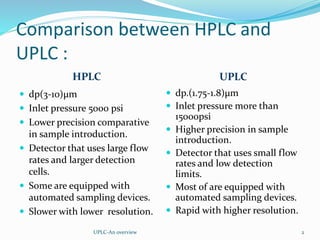
HPLC
 dp(3-10)µm
 Inlet pressure 5000 psi
 Lower precision comparative
in sample introduction.
 Detector that uses large flow
rates and larger detection
cells.
 Some are equipped with
automated sampling devices.
 Slower with lower resolution.
UPLC
 dp.(1.75-1.8)µm
 Inlet pressure more than
15000psi
 Higher precision in sample
introduction.
 Detector that uses small flow
rates and low detection
limits.
 Most of are equipped with
automated sampling devices.
 Rapid with higher resolution.
UPLC-An overview 2
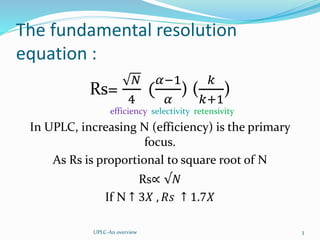
The fundamental resolution
equation :
Rs=
𝑁
4
(
𝛼−1
𝛼
) (
𝑘
𝑘+1
)
efficiency selectivity retensivity
In UPLC, increasing N (efficiency) is the primary
focus.
As Rs is proportional to square root of N
Rs∝ √𝑁
If N ↑ 3𝑋 , 𝑅𝑠 ↑ 1.7𝑋
UPLC-An overview 3
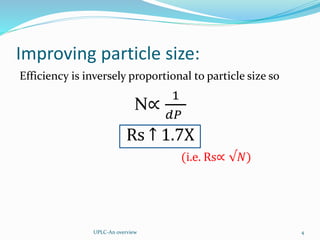
Improving particle size:
Efficiency is inversely proportional to particle size so
N∝
1
𝑑𝑃
Rs ↑ 1.7X
(i.e. Rs∝ √𝑁)
UPLC-An overview 4
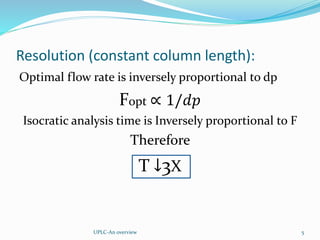
Resolution (constant column length):
Optimal flow rate is inversely proportional to dp
Fopt ∝ 1/𝑑𝑝
Isocratic analysis time is Inversely proportional to F
Therefore
T ↓3X
UPLC-An overview 5
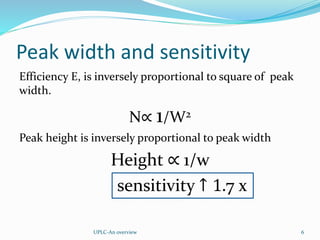
Peak width and sensitivity
Efficiency E, is inversely proportional to square of peak
width.
N∝ 1/W2
Peak height is inversely proportional to peak width
Height ∝ 1/w
sensitivity ↑ 1.7 x
UPLC-An overview 6
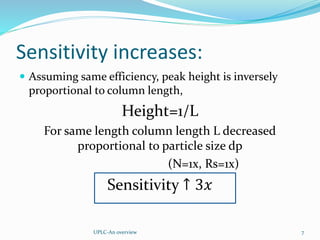
Sensitivity increases:
 Assuming same efficiency, peak height is inversely
proportional to column length,
Height=1/L
For same length column length L decreased
proportional to particle size dp
(N=1x, Rs=1x)
Sensitivity ↑ 3𝑥
UPLC-An overview 7
Backpressure increases:
Backpressure (p) is directly proportional to column
length
P∝ 𝐿
For constant L/dp, Backpressure is inversely
proportional to the square to particle size,dp
P∝ 1/dp2
P↑ 𝟗𝑿
UPLC-An overview 8
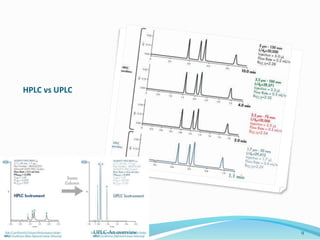
HPLC vs UPLC
UPLC-An overview 9
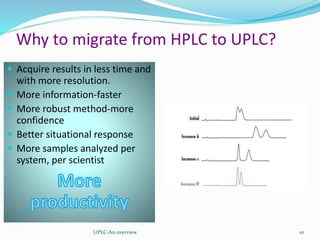
Why to migrate from HPLC to UPLC?
 Acquire results in less time and
with more resolution.
 More information-faster
 More robust method-more
confidence
 Better situational response
 More samples analyzed per
system, per scientist
UPLC-An overview 10
UPLC stationary phases :
 Mechanical strength and stability of columns were
critical issues due to high pressure.
 Classical gel-sol method used for generation of
durable columns which are superior than silica
particles
 Made by incorporating carbon in form of methyl
groups
 Mechanically strong, better efficiency and can be used
over extended range of pH.
UPLC-An overview 11
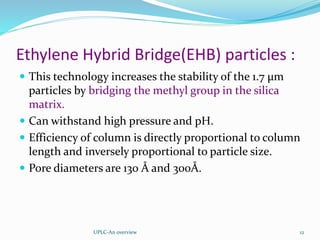
Ethylene Hybrid Bridge(EHB) particles :
 This technology increases the stability of the 1.7 µm
particles by bridging the methyl group in the silica
matrix.
 Can withstand high pressure and pH.
 Efficiency of column is directly proportional to column
length and inversely proportional to particle size.
 Pore diameters are 130 Å and 300Å.
UPLC-An overview 12
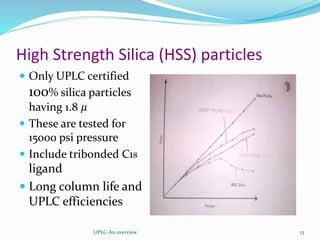
High Strength Silica (HSS) particles
 Only UPLC certified
100% silica particles
having 1.8 𝜇
 These are tested for
15000 psi pressure
 Include tribonded C18
ligand
 Long column life and
UPLC efficiencies
UPLC-An overview 13
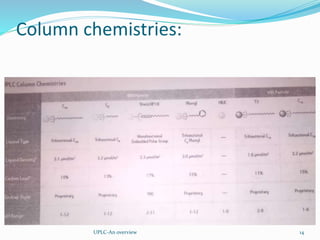
Column chemistries:
UPLC-An overview 14
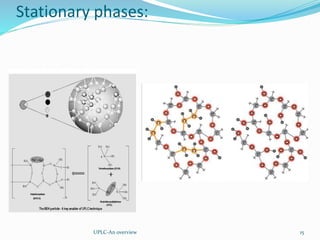
Stationary phases:
UPLC-An overview 15
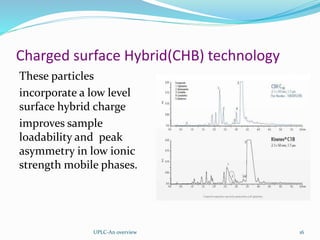
Charged surface Hybrid(CHB) technology
These particles
incorporate a low level
surface hybrid charge
improves sample
loadability and peak
asymmetry in low ionic
strength mobile phases.
UPLC-An overview 16
Instrumentation :
UPLC-An overview 17
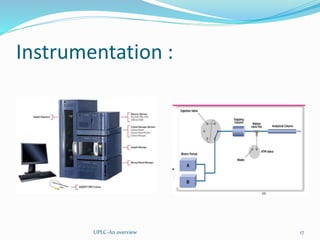
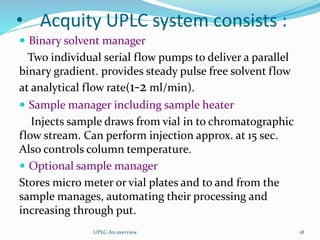
• Acquity UPLC system consists :
 Binary solvent manager
Two individual serial flow pumps to deliver a parallel
binary gradient. provides steady pulse free solvent flow
at analytical flow rate(1-2 ml/min).
 Sample manager including sample heater
Injects sample draws from vial in to chromatographic
flow stream. Can perform injection approx. at 15 sec.
Also controls column temperature.
 Optional sample manager
Stores micro meter or vial plates and to and from the
sample manages, automating their processing and
increasing through put.
UPLC-An overview 18
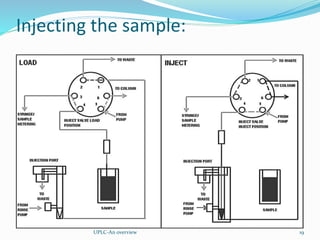
Injecting the sample:
UPLC-An overview 19
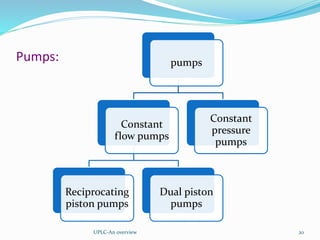
Pumps: pumps
Constant
flow pumps
Reciprocating
piston pumps
Dual piston
pumps
Constant
pressure
pumps
UPLC-An overview 20
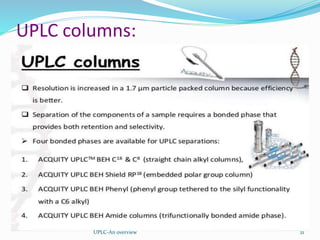
UPLC columns:
UPLC-An overview 21
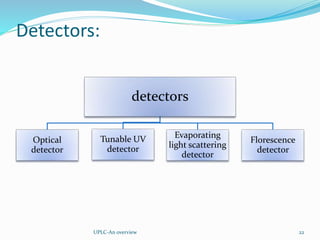
Detectors:
detectors
Optical
detector
Tunable UV
detector
Evaporating
light scattering
detector
Florescence
detector
UPLC-An overview 22
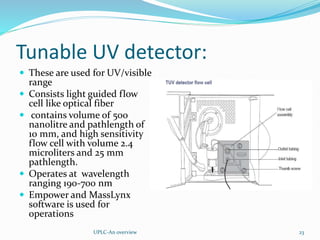
Tunable UV detector:
 These are used for UV/visible
range
 Consists light guided flow
cell like optical fiber
 contains volume of 500
nanolitre and pathlength of
10 mm, and high sensitivity
flow cell with volume 2.4
microliters and 25 mm
pathlength.
 Operates at wavelength
ranging 190-700 nm
 Empower and MassLynx
software is used for
operations
UPLC-An overview 23
Applications:
 Identification of metabolites in in vitro discovery
studies.
 Bioequivalence study
 Detection of impurities
 Dissolution testing in relatively high potent drug
sample
 Method development/validation
 Forced degradation studies
 Impurity profiling
UPLC-An overview 24
References :
 Waters AAPS 2007 seminars, November 12-13,2007
 UPLC: a preeminent technique in pharmaceutical
analysis by Ashok Kumar et al, Acta Poloniae
Pharmaceutica-Drug research, vol.69 No.3pp.371-
380,2012
 Ultra Performance Liquid Chromatography: An
Indroduction And Review by T. Sunil Kumar Reddy et
al,IJPRA,vol 2,issue 1, 2012,24-31
 Ultra Performance Liquid Chromatography : A Review
by Patil V.P. et al.IRJP2(6) 2011 39-44
 Ultra Performance Liquid Chromatography: A
chromatography technique by Uttam Singh Baghel et
al.IJPQA.2010;2(1):19-25
UPLC-An overview 25
Thank you
UPLC-An overview 26

Uplc

  • 1.
    (Ultra Pressure Liquid Chromatography) Presentedby: Guided by: Ms. Sonali R.Phadke Dr. Asha B. Thomas M.Pharm :sem-I(QAT) UPLC-An overview 1
  • 2.
    Comparison between HPLCand UPLC : HPLC  dp(3-10)µm  Inlet pressure 5000 psi  Lower precision comparative in sample introduction.  Detector that uses large flow rates and larger detection cells.  Some are equipped with automated sampling devices.  Slower with lower resolution. UPLC  dp.(1.75-1.8)µm  Inlet pressure more than 15000psi  Higher precision in sample introduction.  Detector that uses small flow rates and low detection limits.  Most of are equipped with automated sampling devices.  Rapid with higher resolution. UPLC-An overview 2
  • 3.
    The fundamental resolution equation: Rs= 𝑁 4 ( 𝛼−1 𝛼 ) ( 𝑘 𝑘+1 ) efficiency selectivity retensivity In UPLC, increasing N (efficiency) is the primary focus. As Rs is proportional to square root of N Rs∝ √𝑁 If N ↑ 3𝑋 , 𝑅𝑠 ↑ 1.7𝑋 UPLC-An overview 3
  • 4.
    Improving particle size: Efficiencyis inversely proportional to particle size so N∝ 1 𝑑𝑃 Rs ↑ 1.7X (i.e. Rs∝ √𝑁) UPLC-An overview 4
  • 5.
    Resolution (constant columnlength): Optimal flow rate is inversely proportional to dp Fopt ∝ 1/𝑑𝑝 Isocratic analysis time is Inversely proportional to F Therefore T ↓3X UPLC-An overview 5
  • 6.
    Peak width andsensitivity Efficiency E, is inversely proportional to square of peak width. N∝ 1/W2 Peak height is inversely proportional to peak width Height ∝ 1/w sensitivity ↑ 1.7 x UPLC-An overview 6
  • 7.
    Sensitivity increases:  Assumingsame efficiency, peak height is inversely proportional to column length, Height=1/L For same length column length L decreased proportional to particle size dp (N=1x, Rs=1x) Sensitivity ↑ 3𝑥 UPLC-An overview 7
  • 8.
    Backpressure increases: Backpressure (p)is directly proportional to column length P∝ 𝐿 For constant L/dp, Backpressure is inversely proportional to the square to particle size,dp P∝ 1/dp2 P↑ 𝟗𝑿 UPLC-An overview 8
  • 9.
  • 10.
    Why to migratefrom HPLC to UPLC?  Acquire results in less time and with more resolution.  More information-faster  More robust method-more confidence  Better situational response  More samples analyzed per system, per scientist UPLC-An overview 10
  • 11.
    UPLC stationary phases:  Mechanical strength and stability of columns were critical issues due to high pressure.  Classical gel-sol method used for generation of durable columns which are superior than silica particles  Made by incorporating carbon in form of methyl groups  Mechanically strong, better efficiency and can be used over extended range of pH. UPLC-An overview 11
  • 12.
    Ethylene Hybrid Bridge(EHB)particles :  This technology increases the stability of the 1.7 µm particles by bridging the methyl group in the silica matrix.  Can withstand high pressure and pH.  Efficiency of column is directly proportional to column length and inversely proportional to particle size.  Pore diameters are 130 Å and 300Å. UPLC-An overview 12
  • 13.
    High Strength Silica(HSS) particles  Only UPLC certified 100% silica particles having 1.8 𝜇  These are tested for 15000 psi pressure  Include tribonded C18 ligand  Long column life and UPLC efficiencies UPLC-An overview 13
  • 14.
  • 15.
  • 16.
    Charged surface Hybrid(CHB)technology These particles incorporate a low level surface hybrid charge improves sample loadability and peak asymmetry in low ionic strength mobile phases. UPLC-An overview 16
  • 17.
  • 18.
    • Acquity UPLCsystem consists :  Binary solvent manager Two individual serial flow pumps to deliver a parallel binary gradient. provides steady pulse free solvent flow at analytical flow rate(1-2 ml/min).  Sample manager including sample heater Injects sample draws from vial in to chromatographic flow stream. Can perform injection approx. at 15 sec. Also controls column temperature.  Optional sample manager Stores micro meter or vial plates and to and from the sample manages, automating their processing and increasing through put. UPLC-An overview 18
  • 19.
  • 20.
    Pumps: pumps Constant flow pumps Reciprocating pistonpumps Dual piston pumps Constant pressure pumps UPLC-An overview 20
  • 21.
  • 22.
  • 23.
    Tunable UV detector: These are used for UV/visible range  Consists light guided flow cell like optical fiber  contains volume of 500 nanolitre and pathlength of 10 mm, and high sensitivity flow cell with volume 2.4 microliters and 25 mm pathlength.  Operates at wavelength ranging 190-700 nm  Empower and MassLynx software is used for operations UPLC-An overview 23
  • 24.
    Applications:  Identification ofmetabolites in in vitro discovery studies.  Bioequivalence study  Detection of impurities  Dissolution testing in relatively high potent drug sample  Method development/validation  Forced degradation studies  Impurity profiling UPLC-An overview 24
  • 25.
    References :  WatersAAPS 2007 seminars, November 12-13,2007  UPLC: a preeminent technique in pharmaceutical analysis by Ashok Kumar et al, Acta Poloniae Pharmaceutica-Drug research, vol.69 No.3pp.371- 380,2012  Ultra Performance Liquid Chromatography: An Indroduction And Review by T. Sunil Kumar Reddy et al,IJPRA,vol 2,issue 1, 2012,24-31  Ultra Performance Liquid Chromatography : A Review by Patil V.P. et al.IRJP2(6) 2011 39-44  Ultra Performance Liquid Chromatography: A chromatography technique by Uttam Singh Baghel et al.IJPQA.2010;2(1):19-25 UPLC-An overview 25
  • 26.