Gel Electrophoresis

NAYANA.P and Jitendra Kumar
Dept OF FRM
COLLEGE OF FISHERIES

jitenderanduat@gmail.com
Introduction
Gel

electrophoresis is a method used in clinical
chemistry to separate proteins by charge and or
size and in biochemistry and molecular biology to
separate a mixed population
of DNA and RNA fragments by length, to
estimate the size of DNA and RNA fragments or
to separate proteins by charge.
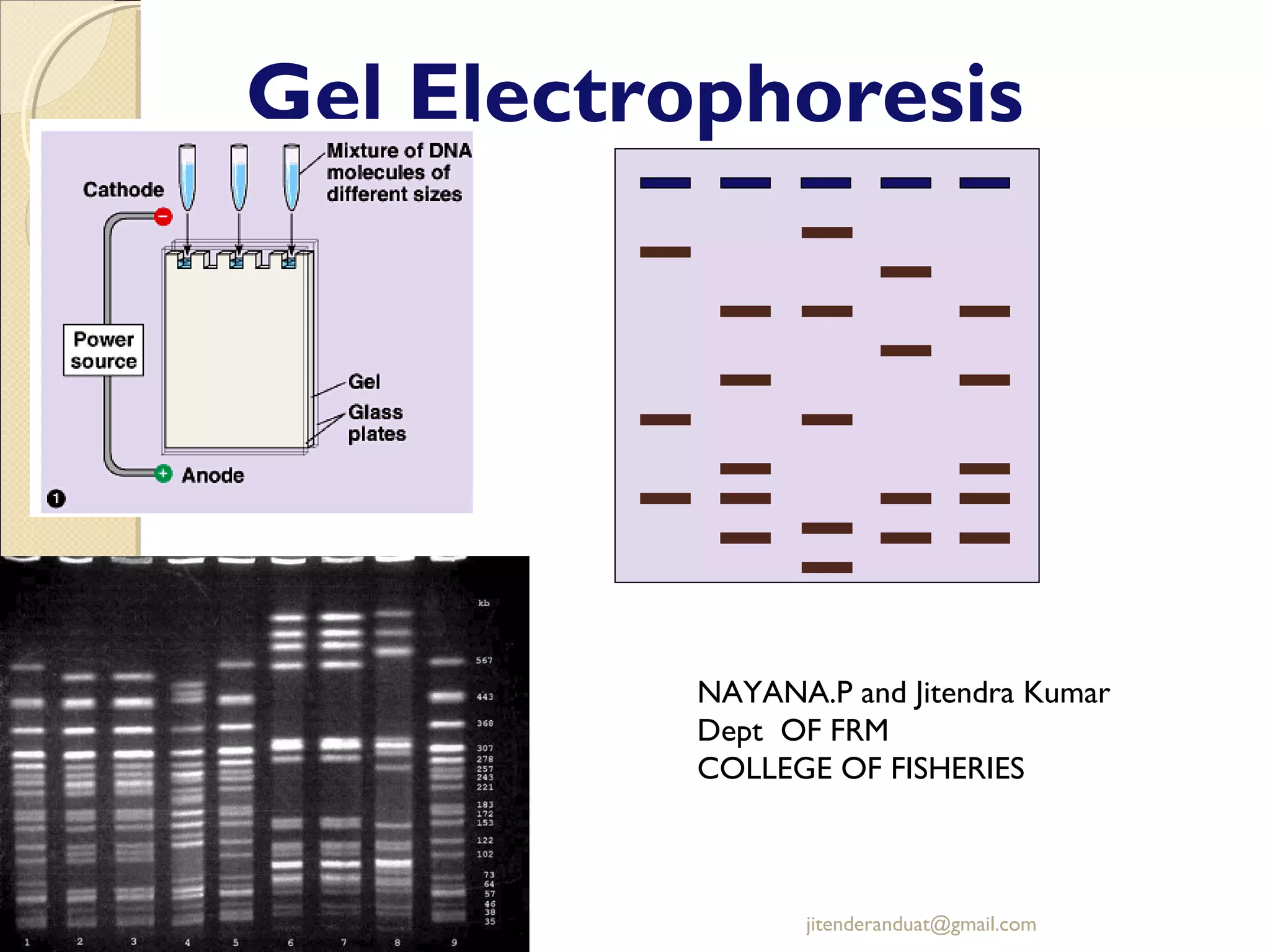
Nucleic acid molecules are separated by applying
an electric field to move the negatively charged
molecules through an agarose matrix.

jitenderanduat@gmail.com
Gel

electrophoresis separates molecules on
the basis of their charge and size. The
charged macromolecules migrate across a
span of gel because they are placed in an
electrical field.
The gel acts as a sieve to retard the passage
of molecules according to their size and
shape.
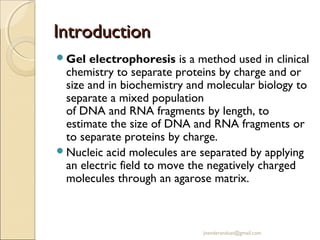
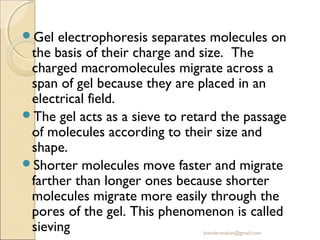
Shorter molecules move faster and migrate
farther than longer ones because shorter
molecules migrate more easily through the
pores of the gel. This phenomenon is called
sieving
jitenderanduat@gmail.com
Gel

electrophoresis is usually performed for
analytical purposes, often after amplification of
DNA via PCR, but may be used as a
preparative technique prior to use of other
methods such as mass spectrometry, RFLP, 
PCR, cloning, DNA sequencing, or 
Southern blotting for further characterization.

jitenderanduat@gmail.com
Types of gel
Agarose
Polyacrylamide
Starch

jitenderanduat@gmail.com
Agarose
 gels

are easily cast and handled compared
to other matrices, because the gel setting is
a physical rather than chemical change.
Samples are also easily recovered. After the
experiment is finished, the resulting gel can
be stored in a plastic bag in a refrigerator.
advantages: it is used for the separation of
DNA fragments ranging from 50 base pair to
several millions of bases using specialized
apparatus. The distance between DNA
bands of a given length is determined by the
percent agarose in the gel
jitenderanduat@gmail.com
The

disadvantage of higher concentrations is
the long run times (sometimes days).
Low percentage gels are very weak and may
break when you try to lift them. High
percentage gels are often brittle and do not
set evenly
Agarose gels do not have a uniform pore size,
but are optimal for electrophoresis of
proteins that are larger

jitenderanduat@gmail.com
Polyacrylamide
Polyacrylamide gel

electrophoresis
(PAGE) is used for separating proteins
Pore size is controlled by controlling the
concentrations of acrylamide and bisacrylamide powder used in creating a gel.

jitenderanduat@gmail.com
Starch
Partially

hydrolyzed potato starch makes
for another non-toxic medium for
protein electrophoresis.
The gels are slightly more opaque than
acrylamide or agarose.
Non-denatured proteins can be
separated according to charge and size.
They are visualized using Napthal Black
or Amido Black staining.
jitenderanduat@gmail.com
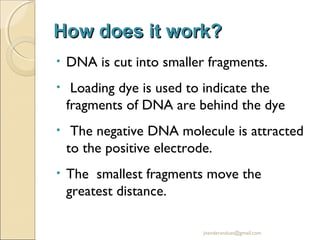
How does it work?
•

DNA is cut into smaller fragments.

•

Loading dye is used to indicate the
fragments of DNA are behind the dye

•

The negative DNA molecule is attracted
to the positive electrode.

•

The smallest fragments move the
greatest distance.
jitenderanduat@gmail.com
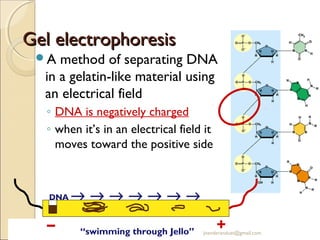
Gel electrophoresis
A

method of separating DNA
in a gelatin-like material using
an electrical field
◦ DNA is negatively charged
◦ when it’s in an electrical field it
moves toward the positive side

DNA

–

→→→→→→→
“swimming through Jello”

+

jitenderanduat@gmail.com
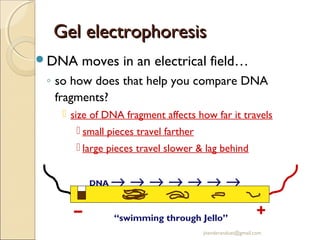
Gel electrophoresis
DNA

moves in an electrical field…

◦ so how does that help you compare DNA
fragments?
 size of DNA fragment affects how far it travels
 small pieces travel farther
 large pieces travel slower & lag behind
DNA

–

→→→→→→→
“swimming through Jello”

+

jitenderanduat@gmail.com
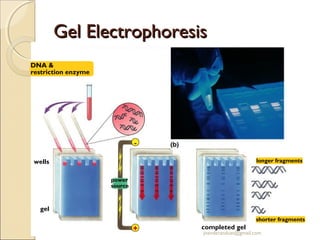
Gel Electrophoresis
DNA &
restriction enzyme

longer fragments

wells
power
source

gel
shorter fragments

+

completed gel

jitenderanduat@gmail.com
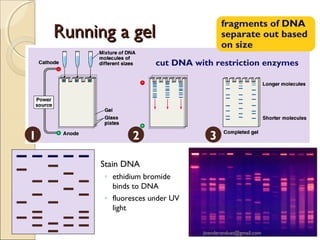
fragments of DNA
separate out based
on size

Running a gel

cut DNA with restriction enzymes

1

2

3

Stain DNA
◦ ethidium bromide
binds to DNA
◦ fluoresces under UV
light
jitenderanduat@gmail.com
Procedure
Remove

comb and observe wells.
Place carbon paper in each end of the tray.
Cover with buffer, making sure the allow
buffer to overflow into each end of the tray.
Load gels.
Connect the electrodes.
Turn on power supply.
Allow gels to run – make sure you see
bubbles coming from the electrodes.
jitenderanduat@gmail.com
PROCEDURE (CONTINUED)
It

will take about 30 minutes for the gel
to run.
Turn off power supply and remove
electrodes.
Pour off buffer into the designated
container.
Carefully remove gel from gel box and
place in glad container and cover with
stain.
Store in appropriate location.
jitenderanduat@gmail.com
Applications
Estimation

of the size of DNA molecules
following restriction enzyme digestion, e.g. in 
restriction mapping of cloned DNA.
Analysis of PCR products, e.g. in
molecular genetic diagnosis or genetic
fingerprinting
Separation of restricted genomic DNA
Gel electrophoresis is used
in forensics, molecular
biology, genetics, microbiology and biochemist
ry.
jitenderanduat@gmail.com
Proteins

can also be run on gels. Most
commonly proteins are run on gels made
of polyacrylamide in the presence of SDS
Scientific dyes can also be separated by
gel electrophoresis.

jitenderanduat@gmail.com

Gel electrophorosis final

  • 1.
    Gel Electrophoresis NAYANA.P andJitendra Kumar Dept OF FRM COLLEGE OF FISHERIES jitenderanduat@gmail.com
  • 2.
    Introduction Gel electrophoresis is a methodused in clinical chemistry to separate proteins by charge and or size and in biochemistry and molecular biology to separate a mixed population of DNA and RNA fragments by length, to estimate the size of DNA and RNA fragments or to separate proteins by charge. Nucleic acid molecules are separated by applying an electric field to move the negatively charged molecules through an agarose matrix. jitenderanduat@gmail.com
  • 3.
    Gel electrophoresis separates moleculeson the basis of their charge and size. The charged macromolecules migrate across a span of gel because they are placed in an electrical field. The gel acts as a sieve to retard the passage of molecules according to their size and shape. Shorter molecules move faster and migrate farther than longer ones because shorter molecules migrate more easily through the pores of the gel. This phenomenon is called sieving jitenderanduat@gmail.com
  • 4.
    Gel electrophoresis is usuallyperformed for analytical purposes, often after amplification of DNA via PCR, but may be used as a preparative technique prior to use of other methods such as mass spectrometry, RFLP,  PCR, cloning, DNA sequencing, or  Southern blotting for further characterization. jitenderanduat@gmail.com
  • 5.
  • 6.
    Agarose  gels are easily castand handled compared to other matrices, because the gel setting is a physical rather than chemical change. Samples are also easily recovered. After the experiment is finished, the resulting gel can be stored in a plastic bag in a refrigerator. advantages: it is used for the separation of DNA fragments ranging from 50 base pair to several millions of bases using specialized apparatus. The distance between DNA bands of a given length is determined by the percent agarose in the gel jitenderanduat@gmail.com
  • 7.
    The disadvantage of higherconcentrations is the long run times (sometimes days). Low percentage gels are very weak and may break when you try to lift them. High percentage gels are often brittle and do not set evenly Agarose gels do not have a uniform pore size, but are optimal for electrophoresis of proteins that are larger jitenderanduat@gmail.com
  • 8.
    Polyacrylamide Polyacrylamide gel electrophoresis (PAGE) is usedfor separating proteins Pore size is controlled by controlling the concentrations of acrylamide and bisacrylamide powder used in creating a gel. jitenderanduat@gmail.com
  • 9.
    Starch Partially hydrolyzed potato starchmakes for another non-toxic medium for protein electrophoresis. The gels are slightly more opaque than acrylamide or agarose. Non-denatured proteins can be separated according to charge and size. They are visualized using Napthal Black or Amido Black staining. jitenderanduat@gmail.com
  • 10.
    How does itwork? • DNA is cut into smaller fragments. • Loading dye is used to indicate the fragments of DNA are behind the dye • The negative DNA molecule is attracted to the positive electrode. • The smallest fragments move the greatest distance. jitenderanduat@gmail.com
  • 11.
    Gel electrophoresis A method ofseparating DNA in a gelatin-like material using an electrical field ◦ DNA is negatively charged ◦ when it’s in an electrical field it moves toward the positive side DNA – →→→→→→→ “swimming through Jello” + jitenderanduat@gmail.com
  • 12.
    Gel electrophoresis DNA moves inan electrical field… ◦ so how does that help you compare DNA fragments?  size of DNA fragment affects how far it travels  small pieces travel farther  large pieces travel slower & lag behind DNA – →→→→→→→ “swimming through Jello” + jitenderanduat@gmail.com
  • 13.
    Gel Electrophoresis DNA & restrictionenzyme longer fragments wells power source gel shorter fragments + completed gel jitenderanduat@gmail.com
  • 14.
    fragments of DNA separateout based on size Running a gel cut DNA with restriction enzymes 1 2 3 Stain DNA ◦ ethidium bromide binds to DNA ◦ fluoresces under UV light jitenderanduat@gmail.com
  • 15.
    Procedure Remove comb and observewells. Place carbon paper in each end of the tray. Cover with buffer, making sure the allow buffer to overflow into each end of the tray. Load gels. Connect the electrodes. Turn on power supply. Allow gels to run – make sure you see bubbles coming from the electrodes. jitenderanduat@gmail.com
  • 16.
    PROCEDURE (CONTINUED) It will takeabout 30 minutes for the gel to run. Turn off power supply and remove electrodes. Pour off buffer into the designated container. Carefully remove gel from gel box and place in glad container and cover with stain. Store in appropriate location. jitenderanduat@gmail.com
  • 17.
    Applications Estimation of the sizeof DNA molecules following restriction enzyme digestion, e.g. in  restriction mapping of cloned DNA. Analysis of PCR products, e.g. in molecular genetic diagnosis or genetic fingerprinting Separation of restricted genomic DNA Gel electrophoresis is used in forensics, molecular biology, genetics, microbiology and biochemist ry. jitenderanduat@gmail.com
  • 18.
    Proteins can also berun on gels. Most commonly proteins are run on gels made of polyacrylamide in the presence of SDS Scientific dyes can also be separated by gel electrophoresis. jitenderanduat@gmail.com
  • 19.