ELECTROPHORESIS
Electrophoresis 
Electrorefers to electron flow or current. 
Phoresisrefers to movement. 
Thus Electrophoresis is movement under electric current. 

This technique therefore can separate molecules which can move in an electric field i.e charged molecules
3 
Movementin an Electric Field 
Charged molecules in an electric field behave in a predictable manner. 
Positively charged molecules will move towards the negative pole while negatively charged molecules move towards the positive pole.
Some media for Electrophoresis 
Medium Conditions Principal Uses 
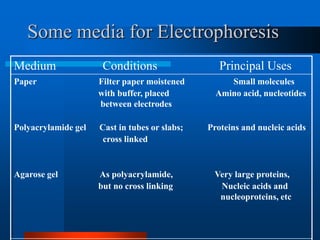
Paper Filter paper moistened Small molecules 
with buffer, placed Amino acid, nucleotides between electrodes 
Polyacrylamide gel Cast in tubes or slabs; Proteins and nucleic acids 
cross linked 
Agarose gel As polyacrylamide, Very large proteins, 
but no cross linking Nucleic acids and nucleoproteins, etc
Types of Gel Electrophoresis
Types of Gel Electrophoresis 
There are two types of gel Electrophoresis 
→One dimension 
→ Two dimensions
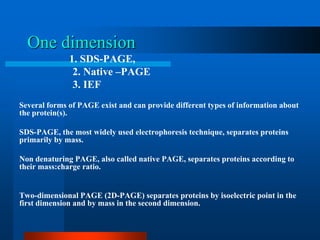
One dimension 
1. SDS-PAGE, 
2. Native –PAGE 
3. IEF 
Several forms of PAGE exist and can provide different types of information about the protein(s). 
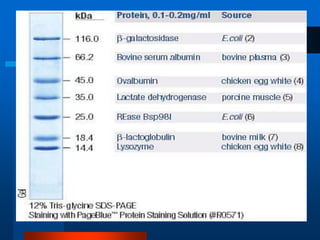
SDS-PAGE, the most widely used electrophoresis technique, separates proteins primarily by mass. 
Non denaturing PAGE, also called native PAGE, separates proteins according to their mass:charge ratio. 
Two-dimensional PAGE (2D-PAGE) separates proteins by isoelectric point in the first dimension and by mass in the second dimension.

Procedure 
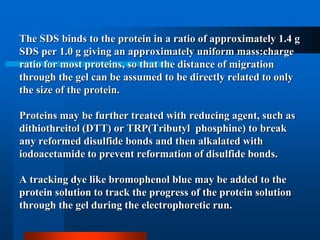
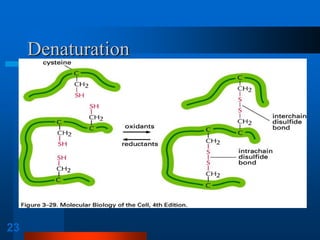
The samples are treated with SDS (sodium dodecyl sulfate), an anionic detergent which denatures the protein by breaking the disulfide bondsand gives negative charge to each protein in proportion to its mass. 
Without SDS, different proteins with similar molecular weights would migrate differently due to differences in folding, as differences in folding patterns would cause some proteins to better fit through the gel matrix than others. SDS linearizes the proteins so that they may be separated strictly by molecular weight.
The SDS binds to the protein in a ratio of approximately 1.4 g SDS per 1.0 g giving an approximately uniform mass:charge ratio for most proteins, so that the distance of migration through the gel can be assumed to be directly related to only the size of the protein. Proteins may be further treated with reducing agent, such as dithiothreitol (DTT) or TRP(Tributyl phosphine) to break any reformed disulfide bonds and then alkalated with iodoacetamide to prevent reformation of disulfide bonds. A tracking dye like bromophenol blue may be added to the protein solution to track the progress of the protein solution through the gel during the electrophoretic run.
GEL
Gel 
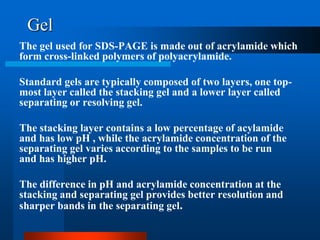
The gel used for SDS-PAGE is made out of acrylamide which form cross-linked polymers of polyacrylamide. 
Standard gels are typically composed of two layers, one top- most layer called the stacking gel and a lower layer called separating or resolving gel. 
The stacking layer contains a low percentage of acylamide and has low pH , while the acrylamide concentration of the separating gel varies according to the samples to be run and has higher pH. 
The difference in pH and acrylamide concentration at the stacking and separating gel provides better resolution and sharper bands in the separating gel.
Stacking gel 
The stacking gel is a large pore PAG (4%T). This gel is prepared with Tris/HCl buffer pH 
6.8 of about 2.0 pH units lower than that of electrophoresis buffer (Tris/Glycine). 
This gel is cast over the resolving gel. The height of the stacking gel region is always maintained more than double the height and the volume of the sample to be applied.
Resolving gel 
The resolving gel is a small pore polyacrylamide gel (3 -30% acrylamide monomer)typically made using a pH 8.8 Tris /HCl buffer. 
In the resolving gel, macromolecules separate according to their size. Resolving gels have an optimal range of separation that is based on the percent of monomer present in the polymerization reaction.
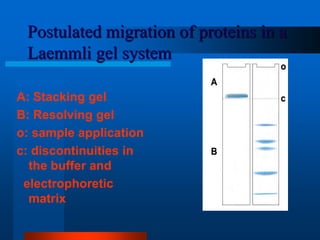
Postulated migration of proteins in a Laemmli gel system 
A:Stacking gel 
B: Resolving gel 
o: sample application 
c: discontinuities in the buffer and 
electrophoretic matrix
SDS Polyacrylamide Gel Electrophoresis 
Sodium dodecyl sulphate polyacrylamide gel electrophoresis(SDS-PAGE). 
SDS-PAGE is a method of gel electrophoresis to separate proteins based on the their mass. 
Sodium dodecyl sulfate (SDS) is a detergent that breaks up the interactions between proteins. 
Disrupts secondary and tertiary protein structures by breaking hydrogen bonds and unfolding protein
17 
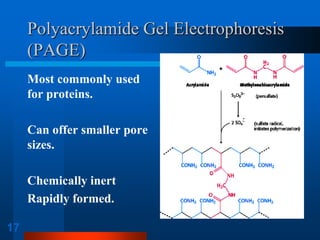
Polyacrylamide Gel Electrophoresis (PAGE) 
Most commonly used for proteins. 
Can offer smaller pore sizes. 
Chemically inert 
Rapidly formed.
How Phenomena works 
The proteins are dissolved in SDS and then electrophorised. 
Binds to protein in a ratio of one SDS molecule/two amino acids. 
Masks’ charge on protein so that all proteins are uniformly negatively charged. 
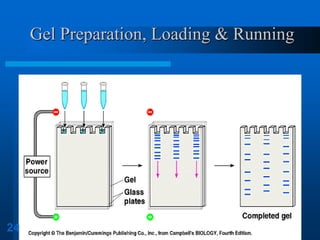
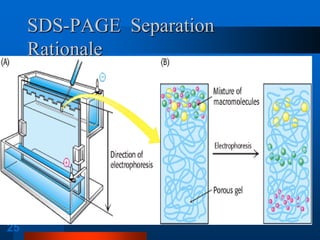
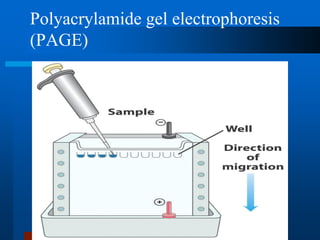
The proteins denatured by SDS are applied to one end of a layer of polyacrylamide gel submerged in a buffer. 
Buffer provide uniform pH and ions for conducting electric potential.
When an electric current is applied across the gel, the negatively-charged proteins migrate across the gel to the positive pole. 
Short proteins will more easily fit through the pores in the gel and move fast, while larger ones will have more difficulty. 
Due to differential migration based on their size, smaller proteins move farther down the gel, while larger ones stay closer to the point of origin. 
After a given period of time, proteins might have separated roughly according to their sizes. 
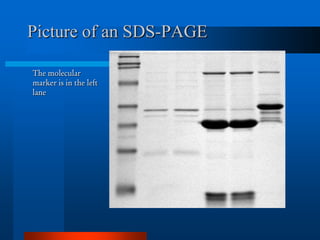
Proteins of known molecular weight (marker proteins)can be run in a separate lane in the gel to calibrate the gel.
Acrylamide polymerization 
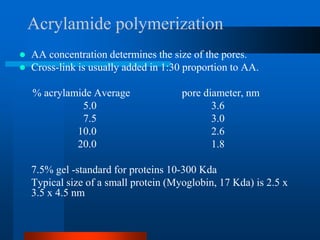
AA concentration determines the size of the pores. 
Cross-link is usually added in 1:30 proportion to AA. 
% acrylamide Average pore diameter, nm 
5.0 3.6 
7.5 3.0 
10.0 2.6 
20.0 1.8 
7.5% gel -standard for proteins 10-300 Kda 
Typical size of a small protein (Myoglobin, 17 Kda) is 2.5 x 3.5 x 4.5 nm
21 
Steps in SDS-PAGE 
Extract Protein 
Solubilize and Denature Protein 
Separate Proteins on a gel 
Stain proteins (visualization) 
Analyze and interpret results
22 
Proteins Extraction 
Rupture plasma membrane to prepare tissue/ cell homogenates: 
High speed blender Sonication 
Tissue homogenize Osmotic shock 
Solublization in a buffer 
Centrifugation to remove debris
23 
Denaturation
Gel Preparation, Loading & Running 
24
25 
SDS-PAGE Separation Rationale
Staining and analysis 
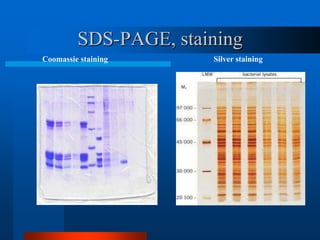
Following electrophoresis, the gel may be stained with Coomassie Brilliant Blue or silver stain to visualize the separated proteins. 
After staining, different proteins will appear as distinct bands within the gel according to their sizes(and therefore by molecular weights). 
The molecular weight of a protein in the band can be estimated by comparing it with the marker proteins of known molecular weights. 
The separatesd proteins can be cut from the gel and further analyzed by other proteomics techniques.
Picture of an SDS-PAGE 
The molecular marker is in the left lane
28 
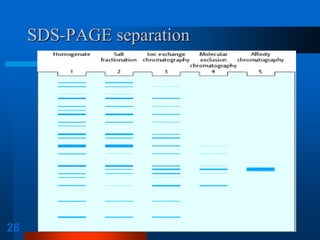
SDS-PAGE separation
SDS-PAGE, staining 
Coomassie staining Silver staining
Native-PAGE 
Native PAGE is used to separate proteins in their native states according to difference in their charge density. 
Native state of protein means proteins are in properly folded state, not denatured or unfolded state. 
There are no denaturants present in the gel and buffer in the gel maintains the protein in its native state. 
Many proteins are shown to be enzymatically active after separation by native PAGE. Thus, it is used for preparation of purified and active proteins.
In native PAGE the mobility depends on both the protein's charge and its hydrodynamic size. The charge depend on the amino acid composition of the protein as well as post- translational modifications. The hydrodynamic size and mobility of native protein on the gel will vary with the nature of the conformation. Proteins with compact conformations have higher mobility and larger structures like oligomers have lower mobility.
Native PAGE can be carried out near neutral pH to avoid acid or alkaline denaturation to study conformation as well as self- association or aggregation, and the binding of other proteins or compounds. 
The apparatus is kept cool to minimize denaturation of proteins and proteolysis.
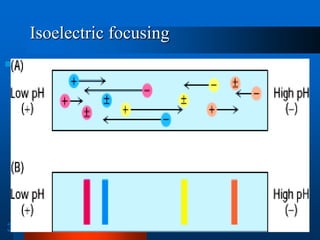
Isoelectric Focusing(IEF) 
Isoelectric focusing (IEF), also known as electro focusing, is a technique for separating different differences. electric chargeby their molecules 
In Isoelectric focusing, proteins are separated by electrophoresis in a pH gradient based on their isoelectric point(pl). 
A pH gradient is generated in the gel and an electric potential is applied across the gel.
At all pHs other than their isoelectric point, proteins will be charged. If they are positively charged, they will move towards the more negative end of the gel and if they are negatively charged they will move towards the more positive end of the gel. 
At its isoelectric point, since the protein molecule carry no net charge it accumulates or focuses into a sharp band.
35 
Isoelectric focusing
36 
Molecular weight determination
38 
Uses of SDS-PAGE 
Determine Mw of a peptide/protein 
Identify protein 
Determine sample purity 
Identify existence of disulfide bonds 
Quantify amounts of protein 
Second dimension in 2-D electrophoresis 
Detection/Estimation of Genetic Diversity 
Proteins induced in response to environmental changes
39 
Problems with SDS-PAGE or IEF 
A limited number (20~30) proteins may be separated by SDS-PAGE/IEF. 
Some proteins may have either same pI or same molecular weight. 
Cellular proteome consists of about 2-3 thousand proteins.
40 
Solutions 
Combination of SDS-PAGE/IEF 
The technique is called 2-D electrophoresis
41 
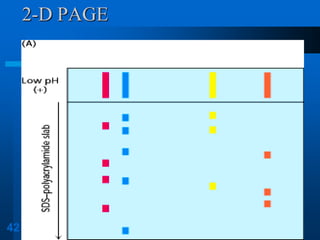
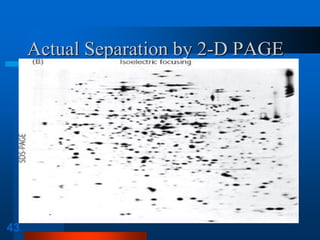
Two-Dimensional Electrophoresis 
First dimension is generally IEF. 
Second dimension is generally SDS-PAGE. 
Few thousand proteins may be resolved in a single run. 
Proteins have same molecular weigh or same pI are also resolved
42 
2-D PAGE
43 
Actual Separation by 2-D PAGE
44 
Uses of 2-D PAGE 
Analysis of complex mixture of proteins 
Comparison of different physiological states of the same tissue 
Stress exposed/control tissues 
Different tissuesbehavior 
Partial characterization of proteins 
Molecular weight 
Isoelectric point 
Nature 
Purification of proteins for further analysis e.g. sequencing/MALDI-TOF
Zymography 
-SDS 
Zymography is an electrophoretic technique based on copolymerized with the substrate, that includes a PAGEpolyacrylamide gel, for the detection of enzyme activity. 
Samples are prepared in the standard SDS-PAGE treatment 
buffer but without boiling, and reducing agent. 
After electrophoresis, SDS was removed by incubating the gel in Triton-X100. 
The zymogram is subsequently stained (commonly with Amido Black or Coomassie Brilliant Blue), and areas of digestion appear as clear bands against a darkly stained background where the substrate has been degraded by the enzyme.
Identification of Isoforms of -amylase from seeds of halophytic grass, Panicum turgidum
Extraction Procedure 
Seeds were crushed and homogenized in Phosphate buffer(50mM, pH 7.0) and centrifuged at 14000 r.p.m (4oC) for 20 minutes to remove debris.
Enzyme assay 
The activity of -amylase in the extract was assayed by incubating 0.1 ml extract with 1 ml soluble starch (2 % w/v, prepared in 50mM Tris-HCl buffer of pH 7.0) at 60°C for 10 minutes. 
(Ul Qader et al. 2009, Cordeiro et al. 2002)
Polyacrylamide gel electrophoresis (PAGE)
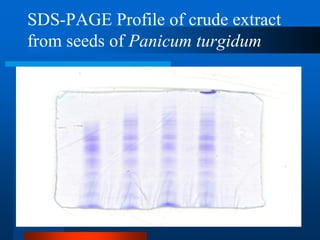
SDS-PAGE Profile of crude extract from seeds of Panicum turgidum
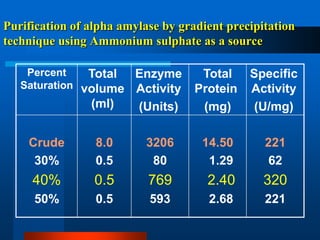
Purification of alpha amylase by gradient precipitation technique using Ammonium sulphate as a source 
Specific Activity 
(U/mg) 
Total Protein 
(mg) 
Enzyme Activity 
(Units) 
Total volume (ml) 
Percent Saturation 
221 
62 
320 
221 
14.50 
1.29 
2.40 
2.68 
3206 
80 
769 
593 
8.0 
0.5 
0.5 
0.5 
Crude 
30% 
40% 
50%
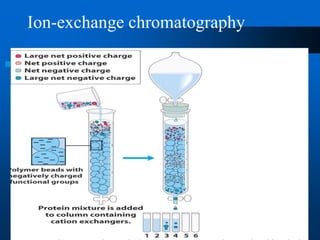
Ion-exchange chromatography
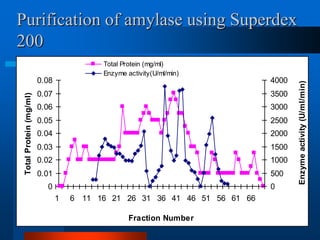
Purification of amylase using Superdex 20000.010.020.030.040.050.060.070.0816111621263136414651566166Fraction Number Total Protein (mg/ml) 05001000150020002500300035004000 Enzyme activity (U/ml/min) Total Protein (mg/ml) Enzyme activity(U/ml/min)
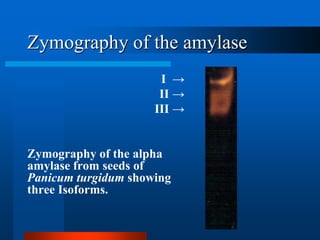
Zymography of the amylase 
I → 
II → 
III → 
Zymography of the alpha amylase from seeds of Panicum turgidumshowing three Isoforms.
Future Plan 
Complete purification 
Purity to Homogeneity 
Amino acid analysis 
Protein sequencing 
Isoforms of Alpha amylase
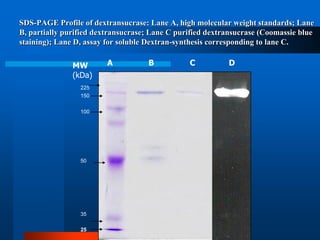
SDS-PAGE Profile of dextransucrase: Lane A, high molecular weight standards; Lane B, partially purified dextransucrase; Lane C purified dextransucrase (Coomassie blue staining); Lane D, assay for soluble Dextran-synthesis corresponding to lane C. 
225 
150 
100 
50 
35 
25 
ABCD 
MW 
(kDa)
Role of Electrophoresis in Diagnosis of Different Diseases 
The serum protein electrophoresis (SPEP) test measures specific proteinsin the blood to help identify some diseases. 
Blood serum contains two major protein groups: Albumin and Globulin.
Usingproteinelectrophoresis,thesetwogroupscanbeseparatedintofivesmallergroups(fractions). 
Albumin 
Alpha-1 globulin 
Alpha-2 globulin 
Beta globulin 
Gamma globulin 
Each of these five protein groups moves at a different rate in an electrical field and together form a specific pattern. This pattern helps identify some diseases.
Why It Is Done? 
Serum protein electrophoresis is most often done to: 
Screen for a disease such as multiple myeloma, macroglobulinemia or amyloidosis. 
Find the cause of hypogammaglobulinemia (HGG), a condition characterized by low levels of gamma globulin antibodies. HGG can make a person more susceptible to infection .
Urinary Protein Electrophoresis 
Electrophoresis on protein in urine may also be done, especially if the results of the serum protein electrophoresis test are abnormal. Normally very little protein is found in urine, but certain diseases (such as multiple myeloma) cause large amounts of protein to leak into the urine. 
Although abnormal protein levels may be found in manyconditions (such as kidney disease, chronic liver disease, systemic lupus erythematosus, rheumatoid arthritis, or leprosy), serum protein electrophoresis is usually not done to diagnose these conditions.
THANKS

Electrophoresis

  • 1.
  • 2.
    Electrophoresis Electrorefers toelectron flow or current. Phoresisrefers to movement. Thus Electrophoresis is movement under electric current. This technique therefore can separate molecules which can move in an electric field i.e charged molecules
  • 3.
    3 Movementin anElectric Field Charged molecules in an electric field behave in a predictable manner. Positively charged molecules will move towards the negative pole while negatively charged molecules move towards the positive pole.
  • 5.
    Some media forElectrophoresis Medium Conditions Principal Uses Paper Filter paper moistened Small molecules with buffer, placed Amino acid, nucleotides between electrodes Polyacrylamide gel Cast in tubes or slabs; Proteins and nucleic acids cross linked Agarose gel As polyacrylamide, Very large proteins, but no cross linking Nucleic acids and nucleoproteins, etc
  • 6.
    Types of GelElectrophoresis
  • 7.
    Types of GelElectrophoresis There are two types of gel Electrophoresis →One dimension → Two dimensions
  • 8.
    One dimension 1.SDS-PAGE, 2. Native –PAGE 3. IEF Several forms of PAGE exist and can provide different types of information about the protein(s). SDS-PAGE, the most widely used electrophoresis technique, separates proteins primarily by mass. Non denaturing PAGE, also called native PAGE, separates proteins according to their mass:charge ratio. Two-dimensional PAGE (2D-PAGE) separates proteins by isoelectric point in the first dimension and by mass in the second dimension.
  • 9.
    Procedure The samplesare treated with SDS (sodium dodecyl sulfate), an anionic detergent which denatures the protein by breaking the disulfide bondsand gives negative charge to each protein in proportion to its mass. Without SDS, different proteins with similar molecular weights would migrate differently due to differences in folding, as differences in folding patterns would cause some proteins to better fit through the gel matrix than others. SDS linearizes the proteins so that they may be separated strictly by molecular weight.
  • 10.
    The SDS bindsto the protein in a ratio of approximately 1.4 g SDS per 1.0 g giving an approximately uniform mass:charge ratio for most proteins, so that the distance of migration through the gel can be assumed to be directly related to only the size of the protein. Proteins may be further treated with reducing agent, such as dithiothreitol (DTT) or TRP(Tributyl phosphine) to break any reformed disulfide bonds and then alkalated with iodoacetamide to prevent reformation of disulfide bonds. A tracking dye like bromophenol blue may be added to the protein solution to track the progress of the protein solution through the gel during the electrophoretic run.
  • 11.
  • 12.
    Gel The gelused for SDS-PAGE is made out of acrylamide which form cross-linked polymers of polyacrylamide. Standard gels are typically composed of two layers, one top- most layer called the stacking gel and a lower layer called separating or resolving gel. The stacking layer contains a low percentage of acylamide and has low pH , while the acrylamide concentration of the separating gel varies according to the samples to be run and has higher pH. The difference in pH and acrylamide concentration at the stacking and separating gel provides better resolution and sharper bands in the separating gel.
  • 13.
    Stacking gel Thestacking gel is a large pore PAG (4%T). This gel is prepared with Tris/HCl buffer pH 6.8 of about 2.0 pH units lower than that of electrophoresis buffer (Tris/Glycine). This gel is cast over the resolving gel. The height of the stacking gel region is always maintained more than double the height and the volume of the sample to be applied.
  • 14.
    Resolving gel Theresolving gel is a small pore polyacrylamide gel (3 -30% acrylamide monomer)typically made using a pH 8.8 Tris /HCl buffer. In the resolving gel, macromolecules separate according to their size. Resolving gels have an optimal range of separation that is based on the percent of monomer present in the polymerization reaction.
  • 15.
    Postulated migration ofproteins in a Laemmli gel system A:Stacking gel B: Resolving gel o: sample application c: discontinuities in the buffer and electrophoretic matrix
  • 16.
    SDS Polyacrylamide GelElectrophoresis Sodium dodecyl sulphate polyacrylamide gel electrophoresis(SDS-PAGE). SDS-PAGE is a method of gel electrophoresis to separate proteins based on the their mass. Sodium dodecyl sulfate (SDS) is a detergent that breaks up the interactions between proteins. Disrupts secondary and tertiary protein structures by breaking hydrogen bonds and unfolding protein
  • 17.
    17 Polyacrylamide GelElectrophoresis (PAGE) Most commonly used for proteins. Can offer smaller pore sizes. Chemically inert Rapidly formed.
  • 18.
    How Phenomena works The proteins are dissolved in SDS and then electrophorised. Binds to protein in a ratio of one SDS molecule/two amino acids. Masks’ charge on protein so that all proteins are uniformly negatively charged. The proteins denatured by SDS are applied to one end of a layer of polyacrylamide gel submerged in a buffer. Buffer provide uniform pH and ions for conducting electric potential.
  • 19.
    When an electriccurrent is applied across the gel, the negatively-charged proteins migrate across the gel to the positive pole. Short proteins will more easily fit through the pores in the gel and move fast, while larger ones will have more difficulty. Due to differential migration based on their size, smaller proteins move farther down the gel, while larger ones stay closer to the point of origin. After a given period of time, proteins might have separated roughly according to their sizes. Proteins of known molecular weight (marker proteins)can be run in a separate lane in the gel to calibrate the gel.
  • 20.
    Acrylamide polymerization AAconcentration determines the size of the pores. Cross-link is usually added in 1:30 proportion to AA. % acrylamide Average pore diameter, nm 5.0 3.6 7.5 3.0 10.0 2.6 20.0 1.8 7.5% gel -standard for proteins 10-300 Kda Typical size of a small protein (Myoglobin, 17 Kda) is 2.5 x 3.5 x 4.5 nm
  • 21.
    21 Steps inSDS-PAGE Extract Protein Solubilize and Denature Protein Separate Proteins on a gel Stain proteins (visualization) Analyze and interpret results
  • 22.
    22 Proteins Extraction Rupture plasma membrane to prepare tissue/ cell homogenates: High speed blender Sonication Tissue homogenize Osmotic shock Solublization in a buffer Centrifugation to remove debris
  • 23.
  • 24.
  • 25.
  • 26.
    Staining and analysis Following electrophoresis, the gel may be stained with Coomassie Brilliant Blue or silver stain to visualize the separated proteins. After staining, different proteins will appear as distinct bands within the gel according to their sizes(and therefore by molecular weights). The molecular weight of a protein in the band can be estimated by comparing it with the marker proteins of known molecular weights. The separatesd proteins can be cut from the gel and further analyzed by other proteomics techniques.
  • 27.
    Picture of anSDS-PAGE The molecular marker is in the left lane
  • 28.
  • 29.
    SDS-PAGE, staining Coomassiestaining Silver staining
  • 30.
    Native-PAGE Native PAGEis used to separate proteins in their native states according to difference in their charge density. Native state of protein means proteins are in properly folded state, not denatured or unfolded state. There are no denaturants present in the gel and buffer in the gel maintains the protein in its native state. Many proteins are shown to be enzymatically active after separation by native PAGE. Thus, it is used for preparation of purified and active proteins.
  • 31.
    In native PAGEthe mobility depends on both the protein's charge and its hydrodynamic size. The charge depend on the amino acid composition of the protein as well as post- translational modifications. The hydrodynamic size and mobility of native protein on the gel will vary with the nature of the conformation. Proteins with compact conformations have higher mobility and larger structures like oligomers have lower mobility.
  • 32.
    Native PAGE canbe carried out near neutral pH to avoid acid or alkaline denaturation to study conformation as well as self- association or aggregation, and the binding of other proteins or compounds. The apparatus is kept cool to minimize denaturation of proteins and proteolysis.
  • 33.
    Isoelectric Focusing(IEF) Isoelectricfocusing (IEF), also known as electro focusing, is a technique for separating different differences. electric chargeby their molecules In Isoelectric focusing, proteins are separated by electrophoresis in a pH gradient based on their isoelectric point(pl). A pH gradient is generated in the gel and an electric potential is applied across the gel.
  • 34.
    At all pHsother than their isoelectric point, proteins will be charged. If they are positively charged, they will move towards the more negative end of the gel and if they are negatively charged they will move towards the more positive end of the gel. At its isoelectric point, since the protein molecule carry no net charge it accumulates or focuses into a sharp band.
  • 35.
  • 36.
    36 Molecular weightdetermination
  • 38.
    38 Uses ofSDS-PAGE Determine Mw of a peptide/protein Identify protein Determine sample purity Identify existence of disulfide bonds Quantify amounts of protein Second dimension in 2-D electrophoresis Detection/Estimation of Genetic Diversity Proteins induced in response to environmental changes
  • 39.
    39 Problems withSDS-PAGE or IEF A limited number (20~30) proteins may be separated by SDS-PAGE/IEF. Some proteins may have either same pI or same molecular weight. Cellular proteome consists of about 2-3 thousand proteins.
  • 40.
    40 Solutions Combinationof SDS-PAGE/IEF The technique is called 2-D electrophoresis
  • 41.
    41 Two-Dimensional Electrophoresis First dimension is generally IEF. Second dimension is generally SDS-PAGE. Few thousand proteins may be resolved in a single run. Proteins have same molecular weigh or same pI are also resolved
  • 42.
  • 43.
  • 44.
    44 Uses of2-D PAGE Analysis of complex mixture of proteins Comparison of different physiological states of the same tissue Stress exposed/control tissues Different tissuesbehavior Partial characterization of proteins Molecular weight Isoelectric point Nature Purification of proteins for further analysis e.g. sequencing/MALDI-TOF
  • 45.
    Zymography -SDS Zymographyis an electrophoretic technique based on copolymerized with the substrate, that includes a PAGEpolyacrylamide gel, for the detection of enzyme activity. Samples are prepared in the standard SDS-PAGE treatment buffer but without boiling, and reducing agent. After electrophoresis, SDS was removed by incubating the gel in Triton-X100. The zymogram is subsequently stained (commonly with Amido Black or Coomassie Brilliant Blue), and areas of digestion appear as clear bands against a darkly stained background where the substrate has been degraded by the enzyme.
  • 46.
    Identification of Isoformsof -amylase from seeds of halophytic grass, Panicum turgidum
  • 47.
    Extraction Procedure Seedswere crushed and homogenized in Phosphate buffer(50mM, pH 7.0) and centrifuged at 14000 r.p.m (4oC) for 20 minutes to remove debris.
  • 48.
    Enzyme assay Theactivity of -amylase in the extract was assayed by incubating 0.1 ml extract with 1 ml soluble starch (2 % w/v, prepared in 50mM Tris-HCl buffer of pH 7.0) at 60°C for 10 minutes. (Ul Qader et al. 2009, Cordeiro et al. 2002)
  • 49.
  • 50.
    SDS-PAGE Profile ofcrude extract from seeds of Panicum turgidum
  • 51.
    Purification of alphaamylase by gradient precipitation technique using Ammonium sulphate as a source Specific Activity (U/mg) Total Protein (mg) Enzyme Activity (Units) Total volume (ml) Percent Saturation 221 62 320 221 14.50 1.29 2.40 2.68 3206 80 769 593 8.0 0.5 0.5 0.5 Crude 30% 40% 50%
  • 52.
  • 53.
    Purification of amylaseusing Superdex 20000.010.020.030.040.050.060.070.0816111621263136414651566166Fraction Number Total Protein (mg/ml) 05001000150020002500300035004000 Enzyme activity (U/ml/min) Total Protein (mg/ml) Enzyme activity(U/ml/min)
  • 54.
    Zymography of theamylase I → II → III → Zymography of the alpha amylase from seeds of Panicum turgidumshowing three Isoforms.
  • 55.
    Future Plan Completepurification Purity to Homogeneity Amino acid analysis Protein sequencing Isoforms of Alpha amylase
  • 56.
    SDS-PAGE Profile ofdextransucrase: Lane A, high molecular weight standards; Lane B, partially purified dextransucrase; Lane C purified dextransucrase (Coomassie blue staining); Lane D, assay for soluble Dextran-synthesis corresponding to lane C. 225 150 100 50 35 25 ABCD MW (kDa)
  • 57.
    Role of Electrophoresisin Diagnosis of Different Diseases The serum protein electrophoresis (SPEP) test measures specific proteinsin the blood to help identify some diseases. Blood serum contains two major protein groups: Albumin and Globulin.
  • 58.
    Usingproteinelectrophoresis,thesetwogroupscanbeseparatedintofivesmallergroups(fractions). Albumin Alpha-1globulin Alpha-2 globulin Beta globulin Gamma globulin Each of these five protein groups moves at a different rate in an electrical field and together form a specific pattern. This pattern helps identify some diseases.
  • 59.
    Why It IsDone? Serum protein electrophoresis is most often done to: Screen for a disease such as multiple myeloma, macroglobulinemia or amyloidosis. Find the cause of hypogammaglobulinemia (HGG), a condition characterized by low levels of gamma globulin antibodies. HGG can make a person more susceptible to infection .
  • 60.
    Urinary Protein Electrophoresis Electrophoresis on protein in urine may also be done, especially if the results of the serum protein electrophoresis test are abnormal. Normally very little protein is found in urine, but certain diseases (such as multiple myeloma) cause large amounts of protein to leak into the urine. Although abnormal protein levels may be found in manyconditions (such as kidney disease, chronic liver disease, systemic lupus erythematosus, rheumatoid arthritis, or leprosy), serum protein electrophoresis is usually not done to diagnose these conditions.
  • 61.