Tapeshwar Yadav
(Lecturer)
BMLT, DNHE,
M.Sc. Medical Biochemistry
Introduction
 Electrophoresis is the movement of charged particles
through an electrode when subjected to an electric
Field
 Cations move towards cathode
 Anions move towards anode
 By this technique solutes are separated by their different
rates of travel through an electric field.
 Commonly used in biological analysis, particularly in the
separations of proteins, peptides and nucleic acids
Definition:
 Electrophoresis may be defined as the
migration of the charged particle through a
solution under the influence of an external
electrical field.
 Ions that are suspended between two electrodes
tends to travel towards the electrodes that bears
opposite charges.
Factors affecting
Electrophoresis
The rate of migration of a solute in an electric field
depends on the following factors-
1) Net charge on the particle
2) Mass and shape of the particles
3) p H of the medium
4) Strength of electric field
5) Properties of supporting medium
6) Temperature
Electrophoretic Mobility
 Electrophoretic mobility is defined as the rate of
migration (cm/sec) per unit field strength(Volts/cm)
 µ=Q/6πrη
 Where µ- Electrophoretic mobility
Q-Net charge on the ion
r- Ionic radius of the solute
η- Viscosity of the medium
Electrophoretic mobility
 The Electrophoretic mobility is directly
proportional to net charge and inversely
proportional to molecular size and viscosity of the
electrophoresis medium
 The p H of solution affects the mobility of the ion by
determining the amount and nature of charge
 Proteins, nucleic acids, nucleotides and amino acids
bear charged polar groups making them suitable
groups for electrophoresis
Electrophoretic mobility
 Carbohydrates carrying no charged groups are first
bound to charged groups like Borate or Sulfite ions and
then electrophoresis is carried out.
 Lipids are not electrophoresed because
electrophoretic current requires polar solvents in which
most lipids are insoluble
Electrophoresis Apparatus
Electrophoresis apparatus consists of-
1) Buffer tank -to hold the buffer
2) Buffer
3) Electrodes- made of platinum or carbon
4) Power supply
5) Support media
Note-Choice of buffer depends on the nature of substance to
be separated and the electricity is supplied at a constant
current and voltage.
Electrophoresis Apparatus
 The electrophoresis support on which
separation takes place may contact the
buffer directly or by means of wicks.
 The entire apparatus is covered to
minimize separation
Support media for
electrophoresis
1) Filter Paper
2) Cellulose acetate membrane
3) Agar or Agarose gel
4) Starch Gel
5) Polyacrylamide gel
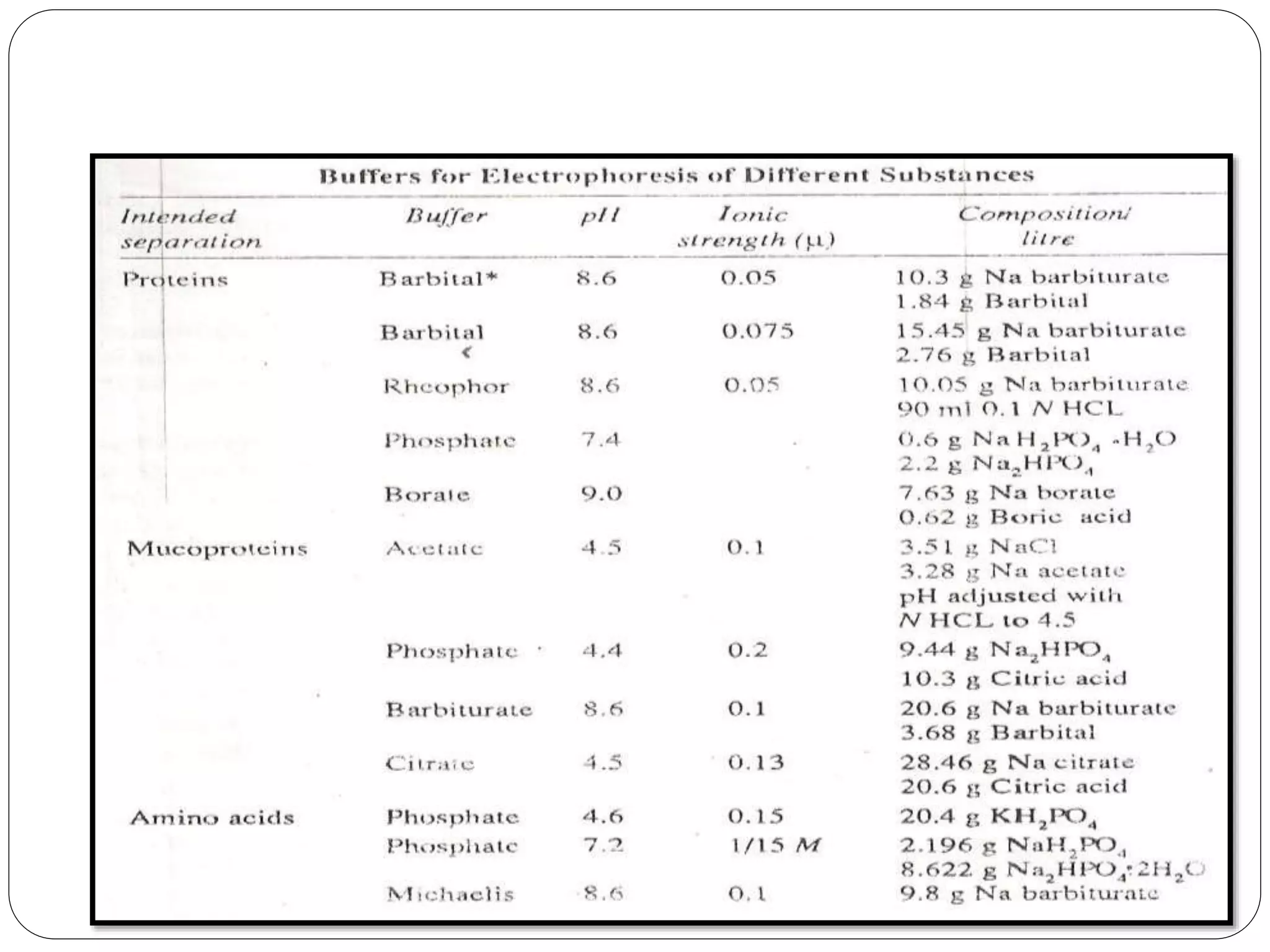
Buffers:
The buffer serves as a multifunctional
component in the electrophoretic process as it,
Carriers the applied current.
Establishes the pH at which electrophoresis
is performed and
Determines the Electrical charge on the
solute.
As the ionic strength of the buffer increases,
the proportion of current carried by the
buffer will increase and the share of the
current carried by the sample will decrease,
thus slowing down the rate of migration.
So always ionic strength of 0.05M is
preferred for the separation of proteins, or
lipoproteins in an electric field.
Support Media
The Support Medium provides the matrix in
which separation takes place.
Various types of support media are used in
electrophoresis and vary from pure buffer
solution in a capillary to insoluble gels (e.g.,
sheet, slabs, or columns of starch, agarose,
or polyacrylamide) or membrances of
cellulose acetate.
Working procedure of
electrophoresis:
General Operations performed in
conventional electrophoresis include
1. Separation,
2. Staining
3. Detection, and
4. Quantification.
Working procedure of
Electrophoresis
 The porous support is hydrated and placed
between the two chambers containing a suitable
buffer
 Sample is applied (in microlitres) on the support
at the cathode end and the components are
allowed to move from cathode to anode under the
influence of direct current.
 At the end of the run, the support is removed and
the position of the molecules on the support is
Contd…
 The separated components are then stained to
visualize them.
 The bands can be quantitated (by elution or by
scanning with a densitometer) as the uptake of
the dye is directly proportional to the
concentration of the molecule in each band.
TYPES OF ELECTROPHORESIS
1) Zone Electrophoresis
a) Paper Electrophoresis
b) Gel Electrophoresis
c) Thin Layer Electrophoresis
d) Cellulose acetate Electrophoresis
2) Moving Boundary Electrophoresis
a) Capillary Electrophoresis
c) Isoelectric Focussing
d) Immuno Electrophoresis
APPLICATIONS OF ELECTROPHORESIS
1. DNA Sequencing
2. Medical Research
3. Protein research/purification
4. Agricultural testing
5. Separation of organic acid, alkaloids, carbohydrates, amino
acids, alcohols, phenols, nucleic acids, insulin.
6. In food industry
APPLICATIONS OF ELECTROPHORESIS
7. It is employed in biochemical and clinical fields i.e. in the study of
protein mixtures such as blood serum, haemoglobins and in the
study of antigen- antibody interactions.
8. Electrophoresis in combination with autoradiography is used to
study the binding of iron to serum proteins.
9. Used for analysis of terpenoids , steroids and antibiotics.
10. For testing purity of thyroid hormones by zone electrophoresis.
APPLICATIONS OF ELECTROPHORESIS
11. Paper chromato-electrophoresis is used to separate free Insulin from
plasma proteins.
12. It is used for diagnosis of various diseases of kidney , liver and CVS.
13. It is also used for separation of Scopolamine and Ephedrine using
buffer at PH 4.2.
14. Electrophoresis is also used for separation of carbohydrates and
vitamins.
15. Quantitative separation of all fractions of cellular entities, antibiotics,
RBC, Enzymes etc is possible.
24

Electrophoresis

  • 1.
  • 2.
    Introduction  Electrophoresis isthe movement of charged particles through an electrode when subjected to an electric Field  Cations move towards cathode  Anions move towards anode  By this technique solutes are separated by their different rates of travel through an electric field.  Commonly used in biological analysis, particularly in the separations of proteins, peptides and nucleic acids
  • 3.
    Definition:  Electrophoresis maybe defined as the migration of the charged particle through a solution under the influence of an external electrical field.  Ions that are suspended between two electrodes tends to travel towards the electrodes that bears opposite charges.
  • 4.
    Factors affecting Electrophoresis The rateof migration of a solute in an electric field depends on the following factors- 1) Net charge on the particle 2) Mass and shape of the particles 3) p H of the medium 4) Strength of electric field 5) Properties of supporting medium 6) Temperature
  • 5.
    Electrophoretic Mobility  Electrophoreticmobility is defined as the rate of migration (cm/sec) per unit field strength(Volts/cm)  µ=Q/6πrη  Where µ- Electrophoretic mobility Q-Net charge on the ion r- Ionic radius of the solute η- Viscosity of the medium
  • 6.
    Electrophoretic mobility  TheElectrophoretic mobility is directly proportional to net charge and inversely proportional to molecular size and viscosity of the electrophoresis medium  The p H of solution affects the mobility of the ion by determining the amount and nature of charge  Proteins, nucleic acids, nucleotides and amino acids bear charged polar groups making them suitable groups for electrophoresis
  • 7.
    Electrophoretic mobility  Carbohydratescarrying no charged groups are first bound to charged groups like Borate or Sulfite ions and then electrophoresis is carried out.  Lipids are not electrophoresed because electrophoretic current requires polar solvents in which most lipids are insoluble
  • 8.
    Electrophoresis Apparatus Electrophoresis apparatusconsists of- 1) Buffer tank -to hold the buffer 2) Buffer 3) Electrodes- made of platinum or carbon 4) Power supply 5) Support media Note-Choice of buffer depends on the nature of substance to be separated and the electricity is supplied at a constant current and voltage.
  • 9.
    Electrophoresis Apparatus  Theelectrophoresis support on which separation takes place may contact the buffer directly or by means of wicks.  The entire apparatus is covered to minimize separation
  • 11.
    Support media for electrophoresis 1)Filter Paper 2) Cellulose acetate membrane 3) Agar or Agarose gel 4) Starch Gel 5) Polyacrylamide gel
  • 12.
    Buffers: The buffer servesas a multifunctional component in the electrophoretic process as it, Carriers the applied current. Establishes the pH at which electrophoresis is performed and Determines the Electrical charge on the solute.
  • 15.
    As the ionicstrength of the buffer increases, the proportion of current carried by the buffer will increase and the share of the current carried by the sample will decrease, thus slowing down the rate of migration. So always ionic strength of 0.05M is preferred for the separation of proteins, or lipoproteins in an electric field.
  • 16.
    Support Media The SupportMedium provides the matrix in which separation takes place. Various types of support media are used in electrophoresis and vary from pure buffer solution in a capillary to insoluble gels (e.g., sheet, slabs, or columns of starch, agarose, or polyacrylamide) or membrances of cellulose acetate.
  • 17.
    Working procedure of electrophoresis: GeneralOperations performed in conventional electrophoresis include 1. Separation, 2. Staining 3. Detection, and 4. Quantification.
  • 18.
    Working procedure of Electrophoresis The porous support is hydrated and placed between the two chambers containing a suitable buffer  Sample is applied (in microlitres) on the support at the cathode end and the components are allowed to move from cathode to anode under the influence of direct current.  At the end of the run, the support is removed and the position of the molecules on the support is
  • 19.
    Contd…  The separatedcomponents are then stained to visualize them.  The bands can be quantitated (by elution or by scanning with a densitometer) as the uptake of the dye is directly proportional to the concentration of the molecule in each band.
  • 20.
    TYPES OF ELECTROPHORESIS 1)Zone Electrophoresis a) Paper Electrophoresis b) Gel Electrophoresis c) Thin Layer Electrophoresis d) Cellulose acetate Electrophoresis 2) Moving Boundary Electrophoresis a) Capillary Electrophoresis c) Isoelectric Focussing d) Immuno Electrophoresis
  • 21.
    APPLICATIONS OF ELECTROPHORESIS 1.DNA Sequencing 2. Medical Research 3. Protein research/purification 4. Agricultural testing 5. Separation of organic acid, alkaloids, carbohydrates, amino acids, alcohols, phenols, nucleic acids, insulin. 6. In food industry
  • 22.
    APPLICATIONS OF ELECTROPHORESIS 7.It is employed in biochemical and clinical fields i.e. in the study of protein mixtures such as blood serum, haemoglobins and in the study of antigen- antibody interactions. 8. Electrophoresis in combination with autoradiography is used to study the binding of iron to serum proteins. 9. Used for analysis of terpenoids , steroids and antibiotics. 10. For testing purity of thyroid hormones by zone electrophoresis.
  • 23.
    APPLICATIONS OF ELECTROPHORESIS 11.Paper chromato-electrophoresis is used to separate free Insulin from plasma proteins. 12. It is used for diagnosis of various diseases of kidney , liver and CVS. 13. It is also used for separation of Scopolamine and Ephedrine using buffer at PH 4.2. 14. Electrophoresis is also used for separation of carbohydrates and vitamins. 15. Quantitative separation of all fractions of cellular entities, antibiotics, RBC, Enzymes etc is possible.
  • 24.