
GENE LIBRARY
By,
Pillai Aswathy viswanath
PG 2 Botany
St. Thomas college kozhencherry
INTRODUCTION
 In molecular biology, a gene library is
a collection of DNA that is stored and
propagated in a population of micro-
organisms .
 so that there is a high probility of
finding any particular piece of the
DNA in the collection
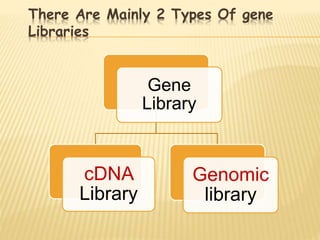
There Are Mainly 2 Types Of gene
Libraries
Gene
Library
cDNA
Library
Genomic
library
 cDNA library :-
The cDNA library contain
only complementary DNA molecules
synthesized from mRNA molecules in a
cell
 It represents only the expressed part
of the genome and contain only coding
sequences
 cDNA has only coding sequences
therefore can be directly expressed in
prokaryotic system.
 Genomic library :-
The genomic library contains
DNA fragment representing entire
genome of an organism ,having both
coding and non coding regions.So the
genes taken from genomic library is
difficult in prokaryotic system like
bacteria due to absence of splicing
mechanism.
Procedure for the
construction of a genomic
library using phage λ system
1. Isolation Of DNA
 To create a genomic library, a
researcher begins by isolation of DNA
from the organisms.
 Lysis of cells with detergent containing
lysis buffer.
 Incubation of cells with digestion
buffer containing protease-K, SDS to
release genomic DNA from DNA-protein
complex.
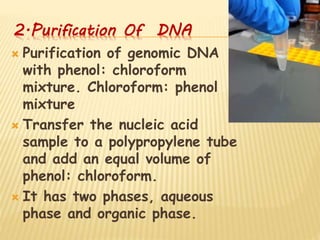
2.Purification Of DNA
 Purification of genomic DNA
with phenol: chloroform
mixture. Chloroform: phenol
mixture
 Transfer the nucleic acid
sample to a polypropylene tube
and add an equal volume of
phenol: chloroform.
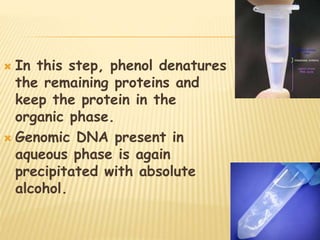
 It has two phases, aqueous
phase and organic phase.
 In this step, phenol denatures
the remaining proteins and
keep the protein in the
organic phase.
 Genomic DNA present in
aqueous phase is again
precipitated with absolute
alcohol.
3.Generation Of Genomic DNA Into
Suitable Small Size Fragments.
 The purified DNA consist of extremely
long strands and needs to be cut into
desirable fragment sizes.
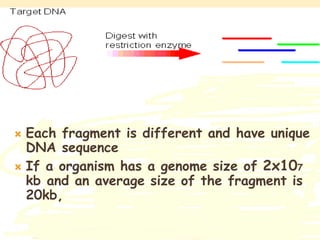
 The DNA therefore is digested with
restriction enzymes which cut the DNA
at specific sequences
 The restriction enzyme cut the DNA
into 1000s of smaller fragments , each
of which contain one or more gene
 Each fragment is different and have unique
DNA sequence
 If a organism has a genome size of 2x10⁷
kb and an average size of the fragment is
20kb,
4.Cloning Into The Suitable Vector
 Cloning vector are those DNA molecule
that carry a foreign DNA fragments
when inserted into it
 The suitable vector to prepare the
genomic library can be selected based
on size of the fragment of genomic DNA
 For constructing genomic DNA library,
we mostly preferred λ phage vectors
 λ phage as a higher transformation
efficiency about 1000 times higher
compared to a plasmid.
 λ phage has high cloning and packaging
efficiency and is easy to handle and
store as compared to plasmid vectors
 A 50kb can be inserted into the λ phage
 The vector as to maintain its lytic
growth.
 λ-phage can be digested with the same
restriction enzyme used for digestion of
DNA
 The vector arms and genomic fragments
are annealed together
 T4 DNA ligase is used to ligate the
selected DNA sequence
5.TRANSFORMATION IN SUITABLE HOST
 Once the recombinant
DNA molecule has been
constructed, it has to
be introduced in to
suitable host
amplification. This is
called gene cloning
 Phage λ contains a
proteinaceous head and
a long tail attached to
the head
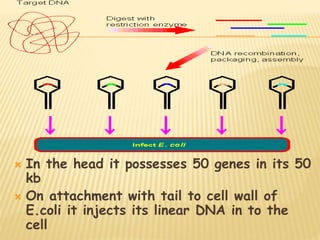
 In the head it possesses 50 genes in its 50
kb
 On attachment with tail to cell wall of
E.coli it injects its linear DNA in to the
cell
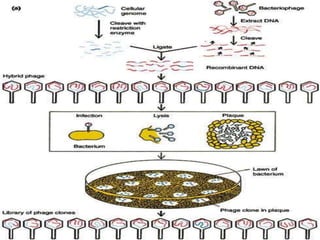
 clones are transformed in a suitable
host to get colonies
 When the bacteria have taken up the
DNA,the entire collection of cells and
DNA represents a human genome
library
REFERENCE
 Dubey R.C,A textbook of
biotechnology,(2004),published by S.Chand
and company LTD.
 Chawla H.S,Introduction to plant
biotechnology,(2000).oxford and IBH
publishing Co.Pvt.Ltd.New Delhi
 Rastogi S.C,shivani Rastogi,introduction to
biotechnology , CBS publishers and
distributors
 http://www.biotechnologyforums.com/threa
d1830.html
 http://www.majordifferences.com/2013/11
/differencebetweengenomicandcdna
Aswathy gene library

Aswathy gene library

  • 1.
    GENE LIBRARY By, Pillai Aswathyviswanath PG 2 Botany St. Thomas college kozhencherry
  • 2.
    INTRODUCTION  In molecularbiology, a gene library is a collection of DNA that is stored and propagated in a population of micro- organisms .  so that there is a high probility of finding any particular piece of the DNA in the collection
  • 3.
    There Are Mainly2 Types Of gene Libraries Gene Library cDNA Library Genomic library
  • 4.
     cDNA library:- The cDNA library contain only complementary DNA molecules synthesized from mRNA molecules in a cell  It represents only the expressed part of the genome and contain only coding sequences  cDNA has only coding sequences therefore can be directly expressed in prokaryotic system.
  • 5.
     Genomic library:- The genomic library contains DNA fragment representing entire genome of an organism ,having both coding and non coding regions.So the genes taken from genomic library is difficult in prokaryotic system like bacteria due to absence of splicing mechanism.
  • 6.
    Procedure for the constructionof a genomic library using phage λ system
  • 7.
    1. Isolation OfDNA  To create a genomic library, a researcher begins by isolation of DNA from the organisms.  Lysis of cells with detergent containing lysis buffer.  Incubation of cells with digestion buffer containing protease-K, SDS to release genomic DNA from DNA-protein complex.
  • 8.
    2.Purification Of DNA Purification of genomic DNA with phenol: chloroform mixture. Chloroform: phenol mixture  Transfer the nucleic acid sample to a polypropylene tube and add an equal volume of phenol: chloroform.  It has two phases, aqueous phase and organic phase.
  • 9.
     In thisstep, phenol denatures the remaining proteins and keep the protein in the organic phase.  Genomic DNA present in aqueous phase is again precipitated with absolute alcohol.
  • 10.
    3.Generation Of GenomicDNA Into Suitable Small Size Fragments.  The purified DNA consist of extremely long strands and needs to be cut into desirable fragment sizes.  The DNA therefore is digested with restriction enzymes which cut the DNA at specific sequences  The restriction enzyme cut the DNA into 1000s of smaller fragments , each of which contain one or more gene
  • 11.
     Each fragmentis different and have unique DNA sequence  If a organism has a genome size of 2x10⁷ kb and an average size of the fragment is 20kb,
  • 12.
    4.Cloning Into TheSuitable Vector  Cloning vector are those DNA molecule that carry a foreign DNA fragments when inserted into it  The suitable vector to prepare the genomic library can be selected based on size of the fragment of genomic DNA  For constructing genomic DNA library, we mostly preferred λ phage vectors
  • 13.
     λ phageas a higher transformation efficiency about 1000 times higher compared to a plasmid.  λ phage has high cloning and packaging efficiency and is easy to handle and store as compared to plasmid vectors  A 50kb can be inserted into the λ phage  The vector as to maintain its lytic growth.
  • 14.
     λ-phage canbe digested with the same restriction enzyme used for digestion of DNA  The vector arms and genomic fragments are annealed together  T4 DNA ligase is used to ligate the selected DNA sequence
  • 15.
    5.TRANSFORMATION IN SUITABLEHOST  Once the recombinant DNA molecule has been constructed, it has to be introduced in to suitable host amplification. This is called gene cloning  Phage λ contains a proteinaceous head and a long tail attached to the head
  • 16.
     In thehead it possesses 50 genes in its 50 kb  On attachment with tail to cell wall of E.coli it injects its linear DNA in to the cell
  • 17.
     clones aretransformed in a suitable host to get colonies  When the bacteria have taken up the DNA,the entire collection of cells and DNA represents a human genome library
  • 19.
    REFERENCE  Dubey R.C,Atextbook of biotechnology,(2004),published by S.Chand and company LTD.  Chawla H.S,Introduction to plant biotechnology,(2000).oxford and IBH publishing Co.Pvt.Ltd.New Delhi  Rastogi S.C,shivani Rastogi,introduction to biotechnology , CBS publishers and distributors  http://www.biotechnologyforums.com/threa d1830.html  http://www.majordifferences.com/2013/11 /differencebetweengenomicandcdna