By,
Pillai Aswathy viswanath
PG 1 Botany
St. Thomas college
kozhencherry
Soil characters influencing
nutrient availability
 Plants are unable to grow in pure water,
the reason is that in addition to water
plants also require a number of mineral
elements.These are take up as inorganic
ions from the soil solution.
 The soil support the plant and it is the
main reservoir of water and nutrients for
plant.
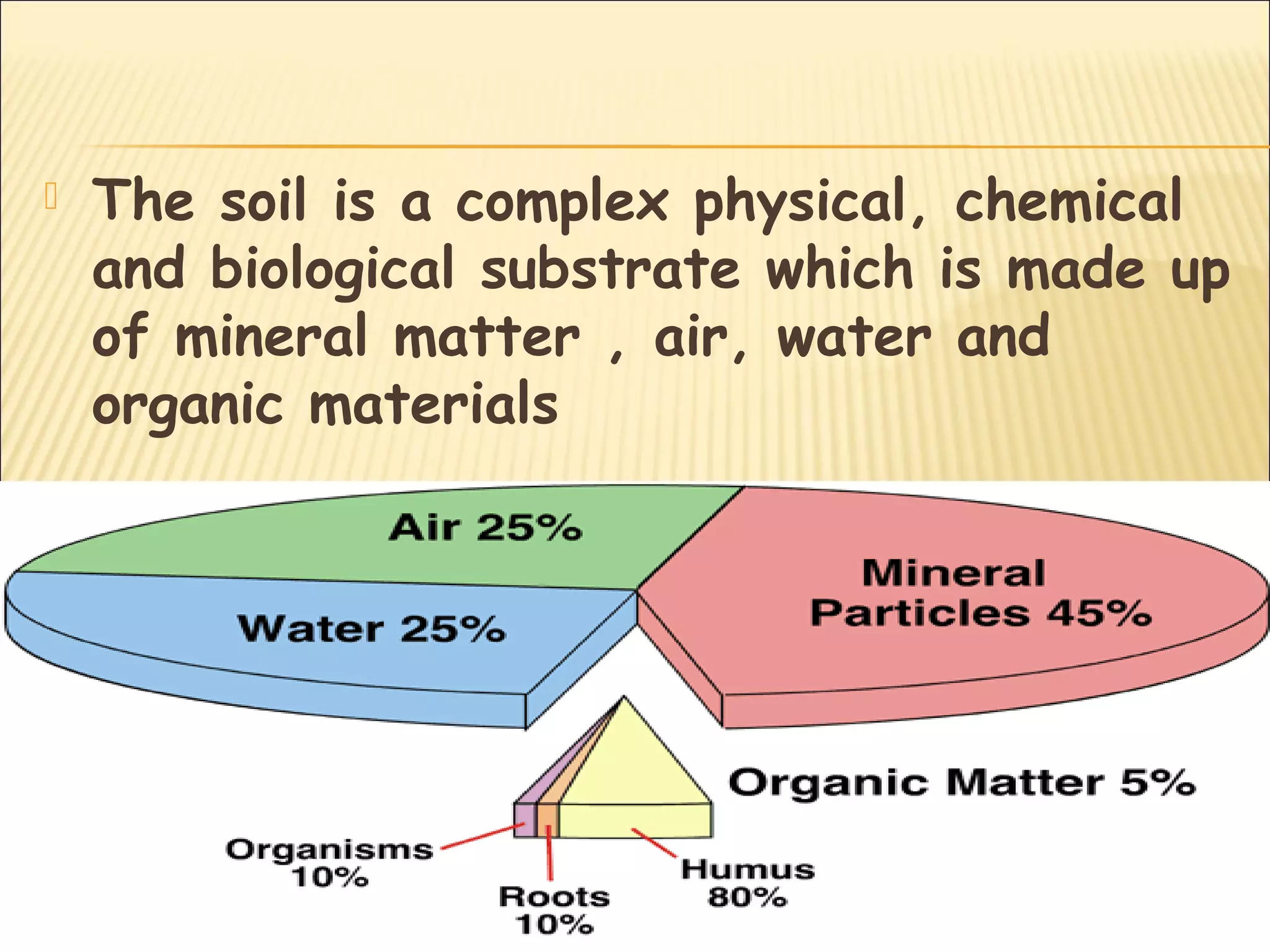
 The soil is a complex physical, chemical
and biological substrate which is made up
of mineral matter , air, water and
organic materials
 It is a heterogenous material containing
solid, liquid and gaseous phase
 All of these phase interact with mineral
elements
 The solid particles may be inorganic,
organic or a mixture of both.
 Inorganic particles, often called mineral
particles
 Organic particles was formed by the
decay of organism
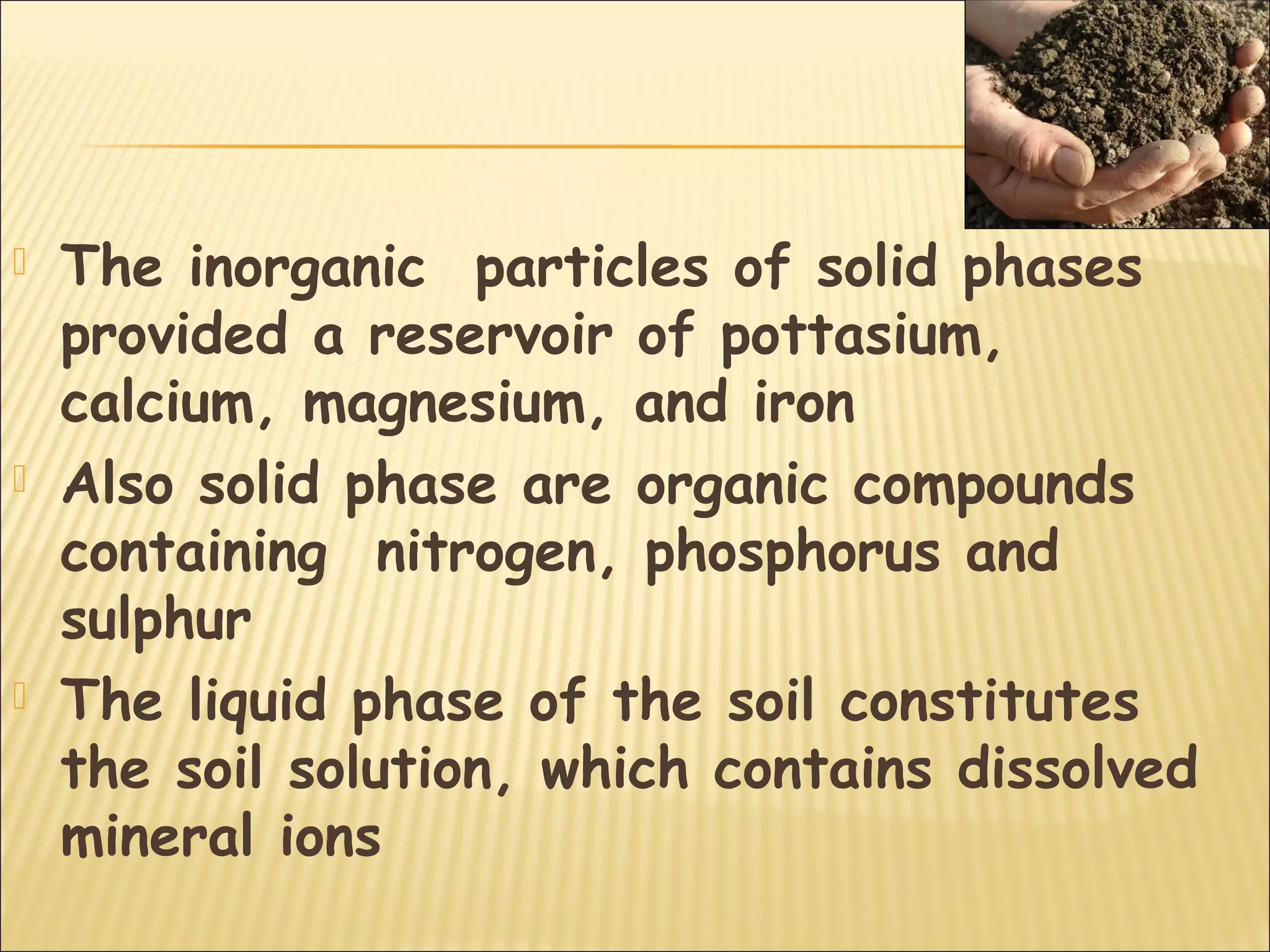
 The inorganic particles of solid phases
provided a reservoir of pottasium,
calcium, magnesium, and iron
 Also solid phase are organic compounds
containing nitrogen, phosphorus and
sulphur
 The liquid phase of the soil constitutes
the soil solution, which contains dissolved
mineral ions
 Plants obtain most of their oxygen and
carbon from the air by photosynthesis
and hydrogen is obtained directly or
indirectly from the water in the soil
 These three element together make up
the 90%of fresh plant tissue
 How ever plants cannot survive with out
the much smaller quantity of essential
nutrients
 So the nutrients like nitrogen,
phosphorous, pottassium,calcium
magnesium and sulphur obtained from
the soil
 So the characters of the soil play a big
part in the plants ability to extract
water and nutrients
 Soil characters like size , charge of
soil particles and soil pH will influence
the nutrient availability for plants
Soil particles are classed on their size :
 Anything over 2mm in diameter is referred
to as gravel, pebbles or stones
 Particles from 2mm to 0.5mm are called
sand particles
 0.5mm to 0.002mm are called silt particles
 Any particle under 0.002 mm is referred to
as clay
 Sand and silt are similar in composition
and are formed by physical and chemical
break down of rocks
 The texture of a soil depends on the
reletive mixture of sand ,silt and clay
particles
 Soil texture has an important role in
nutrient management because it
influences nutrient retention.
 For instance, finer textured soils tend
to have greater ability to store soil
nutrients
 More nutrients can be adsorbed by gram
of clay particles than by a gram of
sand or silt particles
 Because the clay particles provide a
much greater surface area for
adsorption
 Also soil texture influence in water
holding capacity and water infiltrating
rates
 In the soil ,the larger portion of plants
nutrients is bound up in complex compounds
that are unavailable to plants
 The complex compounds are gradually
changed in to the simpler compounds by
chemical weathering
 Thus the fertility of a soil depends in parts
on how easily the complex compounds be
change to simpler forms this is referred to
as the availability of a nutrients
 Plant nutrients are composed of single
elements eg;phosphorus
 compound of elements eg; ammonium
nitrate
 Most of the soil nutrients that a plant
take up must be in a soluble form (mixed
with water)
 When an atom is in water it is usually
becomes electrically charged and is called
an ion
 An ion with positive charge is called a
cation
 An ion with a negative charge is called an
anion
 Cation include sodium ,potassium,
calcium magnesium and aluminium
 Anions include chloride ,nitrate,
sulphate, carbonate and borate
 Both organic and inorganic soil particles
have predominantly negative charge on
their surfaces
 As a result
mineral cations
become adsorbed
on the negative
surface of soil
particles
 And also found
dissolved in the
soil solution and it
will later
absorbed by the
 This cation absorption is an important
factor in the soil fertility
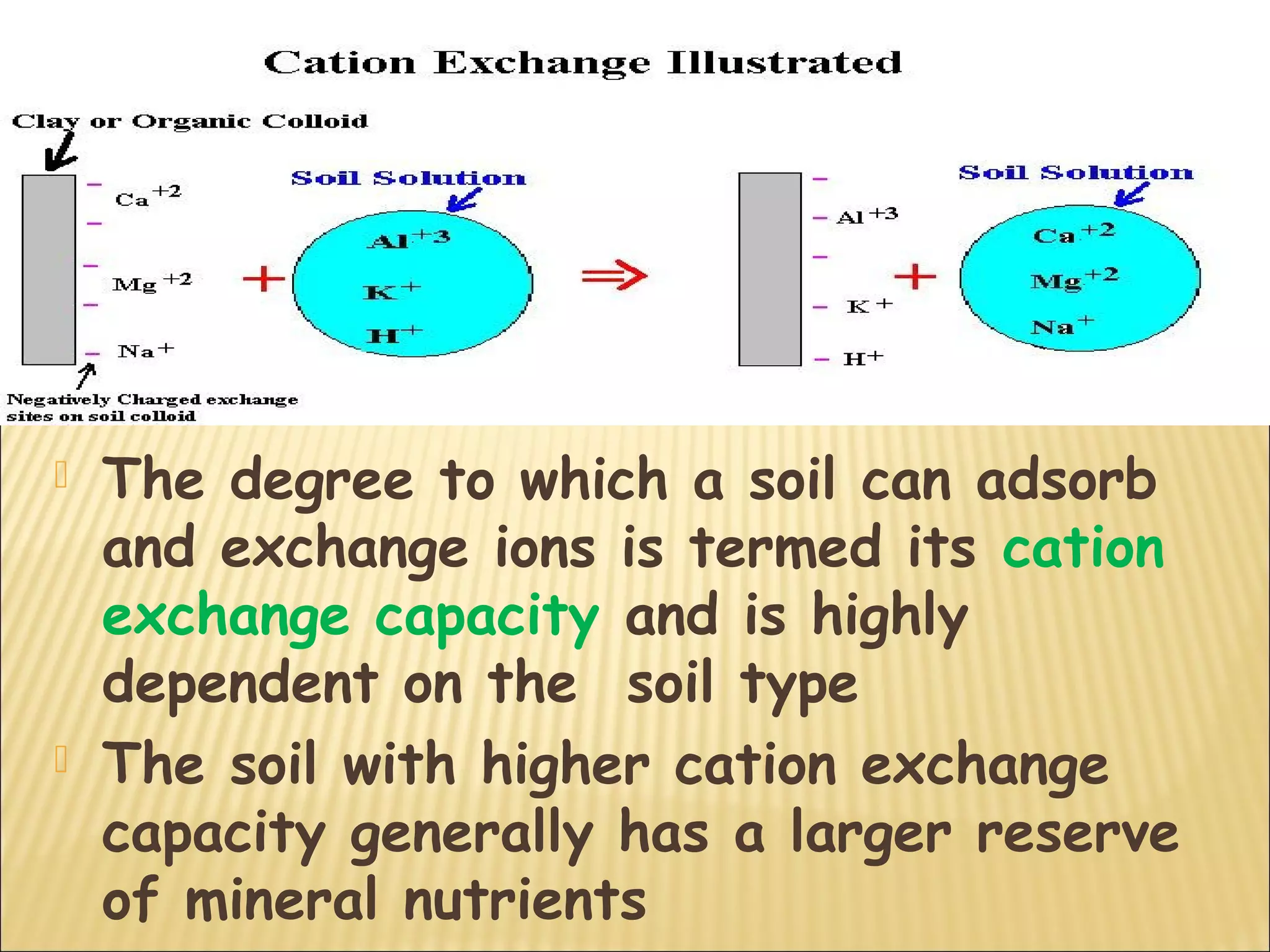
 Mineral cation adsorbed on the surface
of soil particles are not easily lost when
the soil is leached by water and they
provide a nutrients reserve available to
plants roots
 Mineral nutrients adsorbed in this way
can be replaced by other cations in a
process known as cation exchange
 The degree to which a soil can adsorb
and exchange ions is termed its cation
exchange capacity and is highly
dependent on the soil type
 The soil with higher cation exchange
capacity generally has a larger reserve
of mineral nutrients
 Mineral anions such as nitrate and
chloride tend to be repelled by the
negative charge on the surface of soil
particles and remain dissolved in the soil
solution
 Thus the anion exchange capacity of
most agricultural soil is small compared
to the cation exchange capacity
 Among anions, sulphate in the presence
of calcium forms gypsum
 Gypsum is only slightly soluble, but it
releases sufficient sulphate to support
plant growth
 Phosphate ions may bind to soil particles
containing aluminum or iron because the
positively charged iron and aluminum ions
have hydroxyl group that exchange with
phosphate
 As a result, phosphate can tightly
bound, and its mobility and availability in
soil limit plant growth
 Once the nutrients are in the soil
solution ,they can be adsorbed by the
plant’s roots
 The soil solution is the medium by which
most soil nutrients are supplied to
growing plants
 The soil solution can be neutral ,acid, or
alkaline this is called soil pH
 When the soil solution contain more H ions it is
acidic
 When there are fewer H ions the soil solution
is alkaline
 The level of the acidity and the alkalinity in
a soil affects the availability of soil nutrients
 Hydrogen ion concentration (pH)is an
important property of soil because it
affects the growth of plant roots and
soil microorganism
 Root growth is generally favored in
slightly acidic soil,at pH values between
5.5 and 6.5
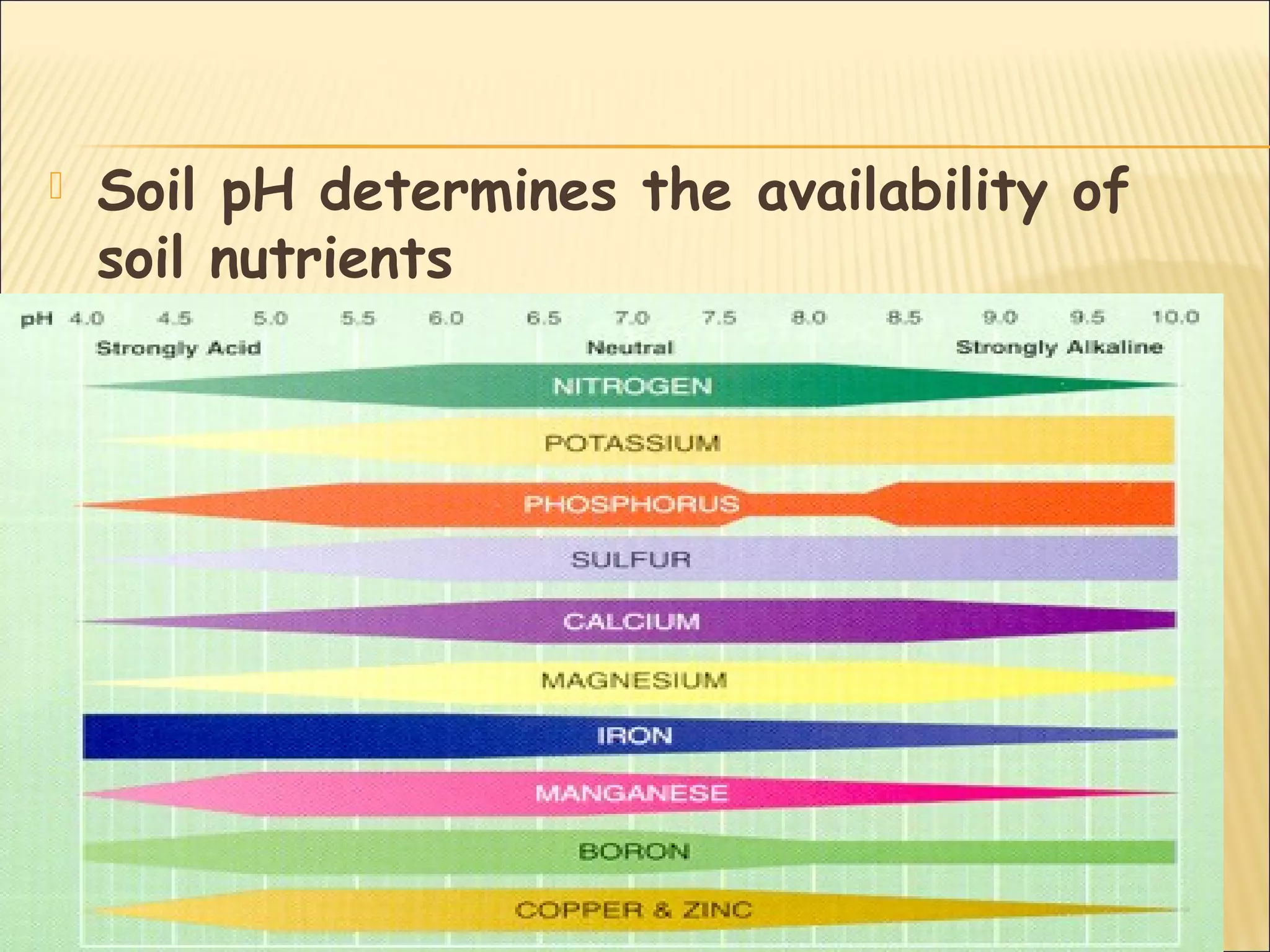
 Soil pH determines the availability of
soil nutrients
 CO2 is produced from decaying organic
matter
 CO2 is also released from the respiring
roots
 It dissolves in water and forms
carbonic acid which lowers the pH of
the soil
 Ammonia and hydrogen sulphide
released from decaying organic matter
ultimately get oxidized to form nitric
acid and sulphuric acid
 When the soil becomes acidic it will
promotes the weathering of rocks that
releases ca, Mg, K and Mn and
increases the solubility of carbonates,
phosphates and sulphate
 There for , the solubility of nutrients
facilitate and are more easily available
to roots
 Major factors that lower the soil pH
are decomposition of organic matter and
the amount of rain fall
 Carbon dioxide is produced as a result
of the decomposition of organic
materials and equilibrates with soil
water in the following reaction:
CO2 +H2O H+HCO3
 This reaction releases hydrogen ions,
lowering the pH of the soil
 In arid regions, the weathering of rocks
releases ca, Mg, K and Mn to soil, but
because of the low rain fall, these ions
do not leach from the upper soil layers,
and the soil remains alkaline
 Iron is absorbed best in acidic soil
whereas molybdenum is absorbed best in
alkaline soils
 Verma.V, (2008) Text book of plant
physiology, published by Ane books india
 Kochhar P.L, KrishnamoorthyH.N,(1985), Text
book of plant physiology ,published by ATMA
RAM and Sons Delhi
 Jain, V.K,(1990)fundamentals of plant
physiology, published by S.Chand and Company
 Lincoln Taize,Eduardo Zeiger, (2002),plant
physiology, 2 nd edition, Sinaeur associates
publishers
S.n p.aswathy viswanath

S.n p.aswathy viswanath

  • 1.
    By, Pillai Aswathy viswanath PG1 Botany St. Thomas college kozhencherry Soil characters influencing nutrient availability
  • 2.
     Plants areunable to grow in pure water, the reason is that in addition to water plants also require a number of mineral elements.These are take up as inorganic ions from the soil solution.  The soil support the plant and it is the main reservoir of water and nutrients for plant.
  • 3.
     The soilis a complex physical, chemical and biological substrate which is made up of mineral matter , air, water and organic materials
  • 4.
     It isa heterogenous material containing solid, liquid and gaseous phase  All of these phase interact with mineral elements  The solid particles may be inorganic, organic or a mixture of both.  Inorganic particles, often called mineral particles  Organic particles was formed by the decay of organism
  • 5.
     The inorganicparticles of solid phases provided a reservoir of pottasium, calcium, magnesium, and iron  Also solid phase are organic compounds containing nitrogen, phosphorus and sulphur  The liquid phase of the soil constitutes the soil solution, which contains dissolved mineral ions
  • 6.
     Plants obtainmost of their oxygen and carbon from the air by photosynthesis and hydrogen is obtained directly or indirectly from the water in the soil  These three element together make up the 90%of fresh plant tissue  How ever plants cannot survive with out the much smaller quantity of essential nutrients
  • 7.
     So thenutrients like nitrogen, phosphorous, pottassium,calcium magnesium and sulphur obtained from the soil  So the characters of the soil play a big part in the plants ability to extract water and nutrients  Soil characters like size , charge of soil particles and soil pH will influence the nutrient availability for plants
  • 8.
    Soil particles areclassed on their size :  Anything over 2mm in diameter is referred to as gravel, pebbles or stones  Particles from 2mm to 0.5mm are called sand particles  0.5mm to 0.002mm are called silt particles  Any particle under 0.002 mm is referred to as clay
  • 9.
     Sand andsilt are similar in composition and are formed by physical and chemical break down of rocks
  • 10.
     The textureof a soil depends on the reletive mixture of sand ,silt and clay particles  Soil texture has an important role in nutrient management because it influences nutrient retention.  For instance, finer textured soils tend to have greater ability to store soil nutrients
  • 11.
     More nutrientscan be adsorbed by gram of clay particles than by a gram of sand or silt particles  Because the clay particles provide a much greater surface area for adsorption  Also soil texture influence in water holding capacity and water infiltrating rates
  • 12.
     In thesoil ,the larger portion of plants nutrients is bound up in complex compounds that are unavailable to plants  The complex compounds are gradually changed in to the simpler compounds by chemical weathering  Thus the fertility of a soil depends in parts on how easily the complex compounds be change to simpler forms this is referred to as the availability of a nutrients
  • 13.
     Plant nutrientsare composed of single elements eg;phosphorus  compound of elements eg; ammonium nitrate  Most of the soil nutrients that a plant take up must be in a soluble form (mixed with water)  When an atom is in water it is usually becomes electrically charged and is called an ion  An ion with positive charge is called a cation  An ion with a negative charge is called an anion
  • 14.
     Cation includesodium ,potassium, calcium magnesium and aluminium  Anions include chloride ,nitrate, sulphate, carbonate and borate  Both organic and inorganic soil particles have predominantly negative charge on their surfaces
  • 15.
     As aresult mineral cations become adsorbed on the negative surface of soil particles  And also found dissolved in the soil solution and it will later absorbed by the
  • 16.
     This cationabsorption is an important factor in the soil fertility  Mineral cation adsorbed on the surface of soil particles are not easily lost when the soil is leached by water and they provide a nutrients reserve available to plants roots
  • 17.
     Mineral nutrientsadsorbed in this way can be replaced by other cations in a process known as cation exchange
  • 18.
     The degreeto which a soil can adsorb and exchange ions is termed its cation exchange capacity and is highly dependent on the soil type  The soil with higher cation exchange capacity generally has a larger reserve of mineral nutrients
  • 19.
     Mineral anionssuch as nitrate and chloride tend to be repelled by the negative charge on the surface of soil particles and remain dissolved in the soil solution  Thus the anion exchange capacity of most agricultural soil is small compared to the cation exchange capacity
  • 20.
     Among anions,sulphate in the presence of calcium forms gypsum  Gypsum is only slightly soluble, but it releases sufficient sulphate to support plant growth  Phosphate ions may bind to soil particles containing aluminum or iron because the positively charged iron and aluminum ions have hydroxyl group that exchange with phosphate
  • 21.
     As aresult, phosphate can tightly bound, and its mobility and availability in soil limit plant growth  Once the nutrients are in the soil solution ,they can be adsorbed by the plant’s roots  The soil solution is the medium by which most soil nutrients are supplied to growing plants
  • 22.
     The soilsolution can be neutral ,acid, or alkaline this is called soil pH  When the soil solution contain more H ions it is acidic  When there are fewer H ions the soil solution is alkaline  The level of the acidity and the alkalinity in a soil affects the availability of soil nutrients
  • 23.
     Hydrogen ionconcentration (pH)is an important property of soil because it affects the growth of plant roots and soil microorganism  Root growth is generally favored in slightly acidic soil,at pH values between 5.5 and 6.5
  • 24.
     Soil pHdetermines the availability of soil nutrients
  • 25.
     CO2 isproduced from decaying organic matter  CO2 is also released from the respiring roots  It dissolves in water and forms carbonic acid which lowers the pH of the soil  Ammonia and hydrogen sulphide released from decaying organic matter ultimately get oxidized to form nitric acid and sulphuric acid
  • 26.
     When thesoil becomes acidic it will promotes the weathering of rocks that releases ca, Mg, K and Mn and increases the solubility of carbonates, phosphates and sulphate  There for , the solubility of nutrients facilitate and are more easily available to roots
  • 27.
     Major factorsthat lower the soil pH are decomposition of organic matter and the amount of rain fall  Carbon dioxide is produced as a result of the decomposition of organic materials and equilibrates with soil water in the following reaction: CO2 +H2O H+HCO3
  • 28.
     This reactionreleases hydrogen ions, lowering the pH of the soil  In arid regions, the weathering of rocks releases ca, Mg, K and Mn to soil, but because of the low rain fall, these ions do not leach from the upper soil layers, and the soil remains alkaline  Iron is absorbed best in acidic soil whereas molybdenum is absorbed best in alkaline soils
  • 29.
     Verma.V, (2008)Text book of plant physiology, published by Ane books india  Kochhar P.L, KrishnamoorthyH.N,(1985), Text book of plant physiology ,published by ATMA RAM and Sons Delhi  Jain, V.K,(1990)fundamentals of plant physiology, published by S.Chand and Company  Lincoln Taize,Eduardo Zeiger, (2002),plant physiology, 2 nd edition, Sinaeur associates publishers

Editor's Notes