



GAS CHROMATOGRAPHY
Chromatography
Definition:
• Chromatography is the separation of a mixture
of compounds (solutes) into separate
components
Presented By:
Masoom Shani
Phases
There are two phases of chromatography:
• Stationary phase.
• Mobile phase.
Stationary Phase
• “A phase, which becomes adsorbed on the filter
media or a surface, is called “stationary phase”.
• It may be a liquid or a solid.
• Examples :
• Silica gel
• Alumina
• Filter paper, etc.
are some important stationary phases
Mobile Phase
• “The phase, which passes over stationary
phase, is called “mobile phase”.
• It may be a liquid or a gas.
• It is also called “eluent.
Examples:
• Alcohol, water, ethanol, acetic acid, acetone
or gas etc. are some important mobile phases
Gas Chromatography
Definition:
• A type of chromatography, in which gaseous
mobile phase is used.
Principle
• Partition of molecules between gas (mobile
phase) and liquid which is coated on to a solid
support is used as stationary phase.
• The mixture of components to be separated is
converted to vapour and mixed with gaseous
mobile phase.
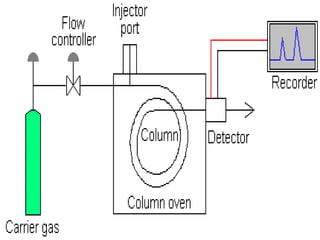
Components
• Carrier gas
- He (common), N2, H2, Argon
• Sample injection port
- micro syringe
• Columns
2-50 m coiled stainless steel/glass/Teflon
• Detectors
-Flame ionization (FID)
-Thermal conductivity (TCD)
-Electron capture (ECD)
-Nitrogen-phosphorus
-Flame photometric (FPD)
-Photo-ionization (PID)
Working
• It involves a sample being vaporized and
injected onto the head of the
chromatographic column. The sample is
transported through the column by the flow
of inert, gaseous mobile phase. The column
itself contains a liquid stationary phase which
is adsorbed onto the surface of an inert solid.
Types
• Two major types
• Gas-solid chromatography
(stationary phase: solid)
• Gas-liquid chromatography
(stationary phase: immobilized
liquid)
Advantages
 Applicable to most compounds.
1) Applicable to most compounds.
2) The sample is not destroyed and hence
used in preparative scale.
3) Simple
4) Easy to maintain
5) Inexpensive is good.
 The sample is not destroyed and hence
used in preparative scale.
Disadvantages
1) Low sensitivity.
2) Affected by fluctuations in temperature
and flow rate.
3) The response is only relative and not
absolute.
4) Biological samples cannot be analysed.
Gas Chromatography By Masoom

Gas Chromatography By Masoom

  • 2.
  • 3.
    Chromatography Definition: • Chromatography isthe separation of a mixture of compounds (solutes) into separate components
  • 4.
  • 5.
    Phases There are twophases of chromatography: • Stationary phase. • Mobile phase.
  • 6.
    Stationary Phase • “Aphase, which becomes adsorbed on the filter media or a surface, is called “stationary phase”. • It may be a liquid or a solid. • Examples : • Silica gel • Alumina • Filter paper, etc. are some important stationary phases
  • 7.
    Mobile Phase • “Thephase, which passes over stationary phase, is called “mobile phase”. • It may be a liquid or a gas. • It is also called “eluent. Examples: • Alcohol, water, ethanol, acetic acid, acetone or gas etc. are some important mobile phases
  • 8.
    Gas Chromatography Definition: • Atype of chromatography, in which gaseous mobile phase is used.
  • 9.
    Principle • Partition ofmolecules between gas (mobile phase) and liquid which is coated on to a solid support is used as stationary phase. • The mixture of components to be separated is converted to vapour and mixed with gaseous mobile phase.
  • 10.
    Components • Carrier gas -He (common), N2, H2, Argon • Sample injection port - micro syringe • Columns 2-50 m coiled stainless steel/glass/Teflon • Detectors -Flame ionization (FID) -Thermal conductivity (TCD) -Electron capture (ECD) -Nitrogen-phosphorus -Flame photometric (FPD) -Photo-ionization (PID)
  • 11.
    Working • It involvesa sample being vaporized and injected onto the head of the chromatographic column. The sample is transported through the column by the flow of inert, gaseous mobile phase. The column itself contains a liquid stationary phase which is adsorbed onto the surface of an inert solid.
  • 13.
    Types • Two majortypes • Gas-solid chromatography (stationary phase: solid) • Gas-liquid chromatography (stationary phase: immobilized liquid)
  • 14.
    Advantages  Applicable tomost compounds. 1) Applicable to most compounds. 2) The sample is not destroyed and hence used in preparative scale. 3) Simple 4) Easy to maintain 5) Inexpensive is good.  The sample is not destroyed and hence used in preparative scale.
  • 15.
    Disadvantages 1) Low sensitivity. 2)Affected by fluctuations in temperature and flow rate. 3) The response is only relative and not absolute. 4) Biological samples cannot be analysed.