Lab #4: Chromatography
Paper Chromatography
Separation of a mixture by taking advantage of the
   differing attractive forces of the substances
   within a mixture with those of a transport
   medium and a solvent.

   Stationary Phase – (the paper) does not move.
   Holds the sample.

   Mobile Phase – (the water) a solvent that rises
   up the paper (stationary phase) and reacts with
   the sample.

Components of the mixture react with both phases.
   The higher a components polarity the faster it
   will react with and move with the water(mobile
   phase). Less polar components will react better
   with the stationary phase (the paper) and travel
   slower.
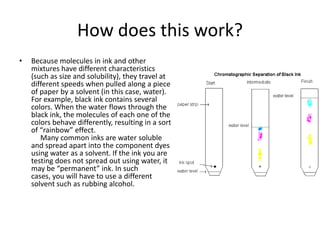
How does this work?
•   Because molecules in ink and other
    mixtures have different characteristics
    (such as size and solubility), they travel at
    different speeds when pulled along a piece
    of paper by a solvent (in this case, water).
    For example, black ink contains several
    colors. When the water flows through the
    black ink, the molecules of each one of the
    colors behave differently, resulting in a sort
    of “rainbow” effect.
       Many common inks are water soluble
    and spread apart into the component dyes
    using water as a solvent. If the ink you are
    testing does not spread out using water, it
    may be “permanent” ink. In such
    cases, you will have to use a different
    solvent such as rubbing alcohol.
Whodunnit?


A picture of this cuddly teddy bear was sent to
his family along with a ransom not that read;

          “I hav the bare.
          If you’s ever wants to
          see him again you’s
          better gives me what I
          asks for. If you’s what
          call the cops thing will
          go very bad.”
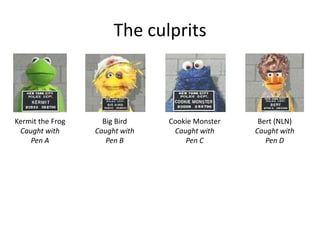
The culprits


Kermit the Frog     Big Bird    Cookie Monster    Bert (NLN)
 Caught with      Caught with    Caught with     Caught with
    Pen A            Pen B          Pen C           Pen D
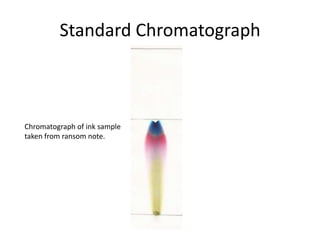
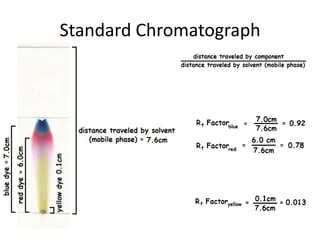
Standard Chromatograph


Chromatograph of ink sample
taken from ransom note.
Standard Chromatograph
Materials
•   Assorted black Pens
•   1000 mL Beaker
•   Chromatography Paper
•   Pencil
•   Ruler
•   Water
Procedure
1.   Acquire a strip of chromatography paper.
2.   Fold the top of the strip and staple it to create a loop.
3.   Draw a line in pencil across the bottom of the strip about 3 cm from the edge and attach a
     paper clip to the bottom of the paper.
4.   Place a dot of ink from each of the four sample pens (A, B, C, D) across the line. Label the
     dots in pencil to identify the pen they came from.
5.   Poke a pencil through the loop you just made. Use the pencil to suspend the strip in a small
     glass or container.
6.   Carefully add water to the glass until it reaches the bottom of the paper strip just below
     the ink dot. Be sure the ink stays above the water and the paper stays in the water.
7.   Allow the water to soak up the strip (20 mins) and watch what happens to the ink drop.
     Record these changes as observations in your lab report
8.   After about 20 minutes remove the strip from the water and mark in pencil where the
     water line has stopped. This indicates the distance traveled by the solvent.
9.   Compare the results of your chromatography paper to the standard chromatograph of the
     sample of ink taken from the ransom note to determine which pen was used to write the
     note.
Conclusion
• From the results of your chromatography
  experiment determine which pen’s ink
  matches the ink sample from the note
• Read pages 662-664 in the text book.
• Answer questions 1, 2, 3, 4, 5
http://mrmartinschemistryblog.blogspot.com/

Lab4 chromatography

  • 1.
  • 2.
    Paper Chromatography Separation ofa mixture by taking advantage of the differing attractive forces of the substances within a mixture with those of a transport medium and a solvent. Stationary Phase – (the paper) does not move. Holds the sample. Mobile Phase – (the water) a solvent that rises up the paper (stationary phase) and reacts with the sample. Components of the mixture react with both phases. The higher a components polarity the faster it will react with and move with the water(mobile phase). Less polar components will react better with the stationary phase (the paper) and travel slower.
  • 3.
    How does thiswork? • Because molecules in ink and other mixtures have different characteristics (such as size and solubility), they travel at different speeds when pulled along a piece of paper by a solvent (in this case, water). For example, black ink contains several colors. When the water flows through the black ink, the molecules of each one of the colors behave differently, resulting in a sort of “rainbow” effect. Many common inks are water soluble and spread apart into the component dyes using water as a solvent. If the ink you are testing does not spread out using water, it may be “permanent” ink. In such cases, you will have to use a different solvent such as rubbing alcohol.
  • 4.
    Whodunnit? A picture ofthis cuddly teddy bear was sent to his family along with a ransom not that read; “I hav the bare. If you’s ever wants to see him again you’s better gives me what I asks for. If you’s what call the cops thing will go very bad.”
  • 5.
    The culprits Kermit theFrog Big Bird Cookie Monster Bert (NLN) Caught with Caught with Caught with Caught with Pen A Pen B Pen C Pen D
  • 6.
    Standard Chromatograph Chromatograph ofink sample taken from ransom note.
  • 7.
  • 8.
    Materials • Assorted black Pens • 1000 mL Beaker • Chromatography Paper • Pencil • Ruler • Water
  • 9.
    Procedure 1. Acquire a strip of chromatography paper. 2. Fold the top of the strip and staple it to create a loop. 3. Draw a line in pencil across the bottom of the strip about 3 cm from the edge and attach a paper clip to the bottom of the paper. 4. Place a dot of ink from each of the four sample pens (A, B, C, D) across the line. Label the dots in pencil to identify the pen they came from. 5. Poke a pencil through the loop you just made. Use the pencil to suspend the strip in a small glass or container. 6. Carefully add water to the glass until it reaches the bottom of the paper strip just below the ink dot. Be sure the ink stays above the water and the paper stays in the water. 7. Allow the water to soak up the strip (20 mins) and watch what happens to the ink drop. Record these changes as observations in your lab report 8. After about 20 minutes remove the strip from the water and mark in pencil where the water line has stopped. This indicates the distance traveled by the solvent. 9. Compare the results of your chromatography paper to the standard chromatograph of the sample of ink taken from the ransom note to determine which pen was used to write the note.
  • 10.
    Conclusion • From theresults of your chromatography experiment determine which pen’s ink matches the ink sample from the note • Read pages 662-664 in the text book. • Answer questions 1, 2, 3, 4, 5
  • 11.