CHROMATOG
RAPHY
CHROMATOGRAPHY

 A laboratory technique in which the
  components of a sample are separated
  based on how they distribute between two
  chemical or physical phases, one of which
  is stationary and other of which is allowed
  to travel through the separation system.
CHROMATOGRAPHY

 Introduced first by the Russian botanist
  Mikhail Semenovich Tswett.
 Mixtures of solutes dissolved in a common
  solvent are separated from one another by
  a differential distribution of the solutes
  between two phases.
PRINCIPLE

 Fractionalism of mixtures of
  substances
 In the operation of the
  chromatogram, a mobile gaseous or
  liquid phase is use to wash the
  substances to be separated through a
  column of a porous material.
PRINCIPLE

 The rate of migration of the solute
 depends upon the rate of interaction
 of the solute with the two phases, one
 being the mobile phases and the
 other stationary phase as the
 compounds travel through the
 supporting medium.
DEFINITION OF TERMS:

 Capillary Action – the movement of
  liquid within the spaces of a material
  due to the forces of
  adhesion, cohesion, and surface
  tension.
 Retention time
 Peak
 Viscosity
DEFINITION OF TERMS:

 VOCs
 Stationary phase
 Mobile phase
COMPONENTS OF A CHROMATOGRAPH

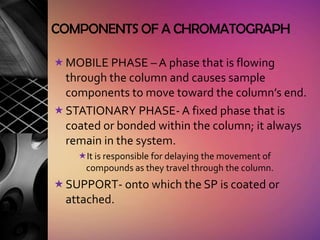
 MOBILE PHASE – A phase that is flowing
  through the column and causes sample
  components to move toward the column’s end.
 STATIONARY PHASE- A fixed phase that is
  coated or bonded within the column; it always
  remain in the system.
    It is responsible for delaying the movement of
     compounds as they travel through the column.
 SUPPORT- onto which the SP is coated or
  attached.
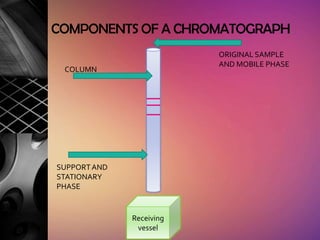
COMPONENTS OF A CHROMATOGRAPH
                          ORIGINAL SAMPLE
                          AND MOBILE PHASE
 COLUMN


SUPPORT AND
STATIONARY
PHASE


              Receiving
               vessel
TYPES OF CHROMATOGRAPHY

   CAN BE CLASSIFIED
    ACCORDING TO:
     ∞MOBILE PHASE
     ∞STATIONARY PHASE
     ∞SUPPORT
GAS CHROMATOGRAPHY

 A type of Chromatography in which the
  mobile phase is a GAS.
 First GC system was developed by Erika
  Cremer
 The presence of a gas mobile phase makes
  GC valuable for separating substances like
  VOCs that occur naturally as gases that can
  easily be placed into gaseous phase.
GAS CHROMATOGRAPHY

 • It can separate nanograms or
    pictograms of volatile substances.

 • It is principally a method for the
    separation and quantitative
    determination of gases and volatile
    liquids and substances.
GAS CHROMATOGRAPHY

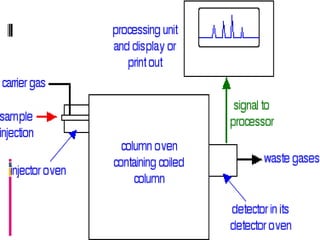
           HOW IS IT PERFORMED?
 A System called Gas Chromatograph is used
  to perform GC.
 COMPONENTS:
          GAS SOURCE
          INJECTION SYSTEM
          COLUMN
          DETECTOR
GAS CHROMATOGRAPHY
∞ GAS SOURCE- supplies the mobile phase. It is
  typically a gas cylinder equipped with
  pressure regulators to deliver the mobile
  phase at a controlled state.

∞ INJECTION SYSTEM- consists of a heated
  loop or port into which the sample is placed
  and converted into a gaseous form.
GAS CHROMATOGRAPHY
∞ COLUMN- contains the stationary phase and
  support material for the separation of
  components in the sample. This column is
  held in an enclosed area known as the column
  oven.
∞ COLUMN OVEN- maintains the temperature
  at a well-defined value.
∞ DETECTOR- monitors sample components as
  they leave the column.
GAS CHROMATOGRAPHY
          FACTORS THAT AFFECT GC:

 Requirements for the Analyte
   Volatility and Thermal Stability
   Chemical Derivatization
GAS CHROMATOGRAPHY
Common Mobile Phases in GC:
 Hydrogen
 Helium
 Nitrogen
 Argon
GAS CHROMATOGRAPHY
          GC SUPPORT MATERIALS
 Packed Column
     filled with small support particles that acts as an
  adsorbent or that are coated with the desired stationary
  phase.


 Open- Tubular Columns
      stationary phase coated on or attached to its interior
  surface.
GAS CHROMATOGRAPHY
           GC STATIONARY PHASES

 Gas- Solid Chromatography ( solid adsorbents)
Gas-Liquid Chromatography (liquids coated on
 solids)
Bonded phases
GAS CHROMATOGRAPHY
◊ Gas-Solid Chromatography
  o Solid adsorbent is used as a stationary phase.
  o Uses the same material as both the support and
    stationary phase, with retention occurring through the
    adsorption of analytes to the support’s surface.
  o Example of support is a MOLECULAR SIEVE.
  o Other supports include:
      o ORGANIC POLYMERS - porous polystyrene
      o INORGANIC SUBSTANCES – Silica or Alumina
GAS CHROMATOGRAPHY

o Increasing the surface area of the GSC support will
  increase the phase ratio and result in higher retention for
  analytes
o Pore size is important because only compounds smaller
  than the pores are able to contact the surface are within
  the space.
o Polarity of Support and its functional groups will also
  affect how analytes will bind to them.
GAS CHROMATOGRAPHY
◊ Gas-Liquid Chromatography


  o A chemical coating or layer is placed onto the support
    and used as the stationary phase.

  o Most Common types of GC.


  o 100% dimethylpolysiloxane, 5%phenyl-95% methyl
    polysiloxane – Examples of liquids that are used as
    Stationary phase.
GAS CHROMATOGRAPHY
◊ Gas-Liquid Chromatography


  o All of these liquids have High boiling points and low
    volatilities, which allows them to stay within the
    column at relatively high temperatures that are often
    used in GC for sample injection and elution.

  o Liquids are also wettable- easy to place onto a support
    in a thin, uniform layer.
GAS CHROMATOGRAPHY
◊ Gas-Liquid Chromatography


  o All of these liquids have High boiling points and low
    volatilities, which allows them to stay within the
    column at relatively high temperatures that are often
    used in GC for sample injection and elution.

  o Liquids are also wettable- easy to place onto a support
    in a thin, uniform layer.
GAS CHROMATOGRAPHY
◊ Bonded Phases
  o Column Bleed- most nonvolatile liquid will slowly
    vaporize or break apart and leave the column over
    time.
  o Column bleed changes the retention characteristics of
    the column.
  o It can also cause some GC detectors to have a high
    background and noisy signal as the stationary phase
    leaves the column and enters the detector.
  o Use of bonded phase minimize column bleed.
GAS CHROMATOGRAPHY
◊ Bonded Phases
  o Produced by reacting groups on a polysiloxane
   stationary phase with silanol groups that are
   located on the surface of a silica support.
GAS CHROMATOGRAPHY
Types of Gas Chromatography Detectors
 General Detectors
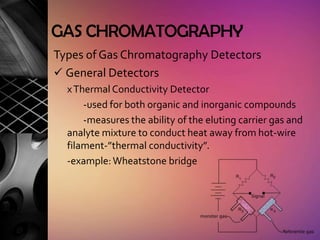
  x Thermal Conductivity Detector
      -used for both organic and inorganic compounds
      -measures the ability of the eluting carrier gas and
  analyte mixture to conduct heat away from hot-wire
  filament-”thermal conductivity”.
  -example: Wheatstone bridge
GAS CHROMATOGRAPHY
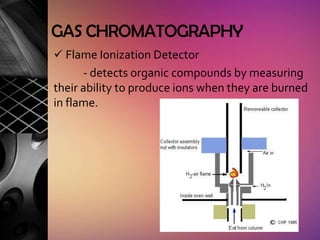
 Flame Ionization Detector
      - detects organic compounds by measuring
their ability to produce ions when they are burned
in flame.
GAS CHROMATOGRAPHY
 Selective Detectors
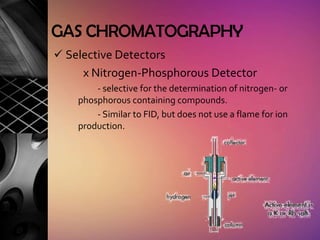
     x Nitrogen-Phosphorous Detector
        - selective for the determination of nitrogen- or
    phosphorous containing compounds.
        - Similar to FID, but does not use a flame for ion
    production.
GAS CHROMATOGRAPHY
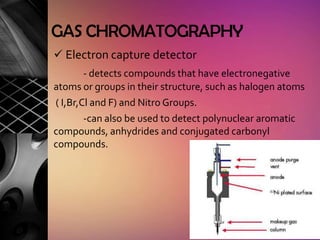
 Electron capture detector
        - detects compounds that have electronegative
atoms or groups in their structure, such as halogen atoms
( I,Br,Cl and F) and Nitro Groups.
        -can also be used to detect polynuclear aromatic
compounds, anhydrides and conjugated carbonyl
compounds.
GAS CHROMATOGRAPHY
Applications:
 Most effectively used for analyses of organic
  compounds, space related, complex mixtures of
  volatile substances at column temperature of
  less than -40 °C to greater than 550° C.
 Geochemical research projects such as
  determination of various environmental
  pollutants at extremely low concentrations.
GAS CHROMATOGRAPHY

ADVANTAGES:                    DISADVANTAGES:
o Ability to provide qualitative o LIMITED to volatile
  information and quantitative samples
  information                     o Not suitable for
o FAST ANALYSIS                     thermally labile samples
o Efficient, providing high       o Fairly difficult for large
  resolution                        preparative samples
o Sensitive                       o Requires spectroscopy
                                    usually mass
o Nondestructive
                                    spectroscopy for
o Requires small samples            confirmation of peak
o Inexpensive                       identity
LIQUID CHROMATOGRAPHY
√ A Chromatographic technique in which the
  mobile phase is a liquid.
√ Originally developed by Russian botanist Mikhail
  Tswett in 1903.
√ Its popularity is due to the ability of this method
  to work directly with liquid samples, which
  makes it valuable in such areas as food testing,
  environmental testing and biotechnology.
LIQUID CHROMATOGRAPHY
      HOW IS LIQUID CHROMATOGRAPHY
                 PERFORMED?
 A System known as a Liquid Chromatograph is
  used to perform LC.
LIQUID CHROMATOGRAPHY
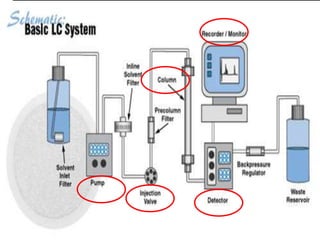
√ Components of the LC System:
   Support – enclosed in a Column
   Stationary phase- enclosed in a Column
   Liquid mobile phase-delivered to Column by means of
    Pump
   Injection device- on analytical applications it is being
    used,to apply samples to the column.
   Collection Device (optional)- placed after the column
    to capture analytes as they elute.
LIQUID CHROMATOGRAPHY
FACTORS THAT AFFECT LIQUID CHROMATOGRAPHY:

*requires both a difference in retention and good efficiency
for it to separate two given chemicals
*Sample
*Analyte Requirements
*Formats
*Role played by the Mobile phase
LIQUID CHROMATOGRAPHY
Requirements for the Analyte:
Must be possible to place this chemical
  into a liquid that can be injected onto the
  column.
There must be a difference in retention
  between the analytes to be prepared.
LIQUID CHROMATOGRAPHY
Types of Liquid Chromatography:
 Adsorption Chromatography
 Partition Chromatography
 Ion-Exchange Chromatography
 Size-Exclusion Chromatography
 Affinity Chromatography
LIQUID CHROMATOGRAPHY
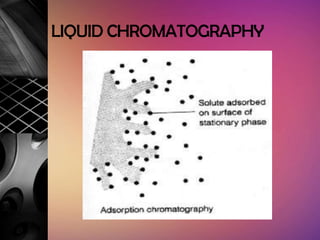
1. ADSORPTION CHROMATOGRAPHY
      A chromatographic technique that separates solutes
based on their adsorption to the surface of a support.
 Also known as Liquid-Solid Chromatography
 Equivalent method in GC is Gas-Solid Chromatography
 Uses the same material as both stationary phase and
  support.
 Retention process can be explained on the ff below:
   A+ n M-Surface    A-Surface + n M
LIQUID CHROMATOGRAPHY
 Elutropic strength- strength of a mobile
  phase in adsorption chromatography
   It is a measure of how strongly a particular
    solvent or liquid mixture will absorb to the
    surface of a given support.
   Examples: silica and Alumina supports
   A liquid with large elutropic strength will
    strongly adsorb to the given support, which
    will prevent the analyte from binding to the
    support.
LIQUID CHROMATOGRAPHY
2. PARTITION CHROMATOGRAPHY
o It is a Liquid Chromatographic technique in
   which solutes are separated based on their
   partitioning between a liquid mobile phase and a
   stationary phase coated on a solid support.
o Support used is usually Silica
o Originally, it involves coating of support with a
   liquid stationary phase that was immiscible with
   the mobile phase
LIQUID CHROMATOGRAPHY
Two Main Categories of Partition Chromatography:
• Normal-phase- uses polar stationary phase


• Reversed phase-uses nonpolar stationary phase
LIQUID CHROMATOGRAPHY
Applications:
 Used in analytical laboratories
 Use of NPLC for separating analytes in organic
  solvents and chemicals that contain polar
  functional groups.
LIQUID CHROMATOGRAPHY
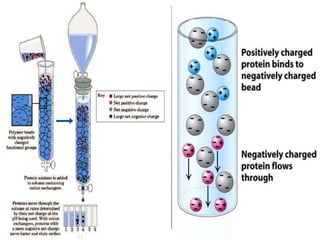
3. ION- EXCHANGE CHROMATOGRAPHY
      Solutes are separated by their adsorption
onto a support containing fixed charges on its
surface.
 Routinely used in Industry for the removal or
   replacement of Ions in products.
 Used for the separation of charged compounds
( inorg. Ions, org. ions, AA, Proteins and Nucleic
Acids)
Chromatography new

Chromatography new

  • 1.
  • 2.
    CHROMATOGRAPHY  A laboratorytechnique in which the components of a sample are separated based on how they distribute between two chemical or physical phases, one of which is stationary and other of which is allowed to travel through the separation system.
  • 3.
    CHROMATOGRAPHY  Introduced firstby the Russian botanist Mikhail Semenovich Tswett.  Mixtures of solutes dissolved in a common solvent are separated from one another by a differential distribution of the solutes between two phases.
  • 4.
    PRINCIPLE  Fractionalism ofmixtures of substances  In the operation of the chromatogram, a mobile gaseous or liquid phase is use to wash the substances to be separated through a column of a porous material.
  • 5.
    PRINCIPLE  The rateof migration of the solute depends upon the rate of interaction of the solute with the two phases, one being the mobile phases and the other stationary phase as the compounds travel through the supporting medium.
  • 6.
    DEFINITION OF TERMS: Capillary Action – the movement of liquid within the spaces of a material due to the forces of adhesion, cohesion, and surface tension.  Retention time  Peak  Viscosity
  • 7.
    DEFINITION OF TERMS: VOCs  Stationary phase  Mobile phase
  • 8.
    COMPONENTS OF ACHROMATOGRAPH  MOBILE PHASE – A phase that is flowing through the column and causes sample components to move toward the column’s end.  STATIONARY PHASE- A fixed phase that is coated or bonded within the column; it always remain in the system. It is responsible for delaying the movement of compounds as they travel through the column.  SUPPORT- onto which the SP is coated or attached.
  • 9.
    COMPONENTS OF ACHROMATOGRAPH ORIGINAL SAMPLE AND MOBILE PHASE COLUMN SUPPORT AND STATIONARY PHASE Receiving vessel
  • 10.
    TYPES OF CHROMATOGRAPHY  CAN BE CLASSIFIED ACCORDING TO: ∞MOBILE PHASE ∞STATIONARY PHASE ∞SUPPORT
  • 11.
    GAS CHROMATOGRAPHY  Atype of Chromatography in which the mobile phase is a GAS.  First GC system was developed by Erika Cremer  The presence of a gas mobile phase makes GC valuable for separating substances like VOCs that occur naturally as gases that can easily be placed into gaseous phase.
  • 12.
    GAS CHROMATOGRAPHY •It can separate nanograms or pictograms of volatile substances. • It is principally a method for the separation and quantitative determination of gases and volatile liquids and substances.
  • 13.
    GAS CHROMATOGRAPHY HOW IS IT PERFORMED?  A System called Gas Chromatograph is used to perform GC.  COMPONENTS: GAS SOURCE INJECTION SYSTEM COLUMN DETECTOR
  • 15.
    GAS CHROMATOGRAPHY ∞ GASSOURCE- supplies the mobile phase. It is typically a gas cylinder equipped with pressure regulators to deliver the mobile phase at a controlled state. ∞ INJECTION SYSTEM- consists of a heated loop or port into which the sample is placed and converted into a gaseous form.
  • 16.
    GAS CHROMATOGRAPHY ∞ COLUMN-contains the stationary phase and support material for the separation of components in the sample. This column is held in an enclosed area known as the column oven. ∞ COLUMN OVEN- maintains the temperature at a well-defined value. ∞ DETECTOR- monitors sample components as they leave the column.
  • 17.
    GAS CHROMATOGRAPHY FACTORS THAT AFFECT GC:  Requirements for the Analyte  Volatility and Thermal Stability  Chemical Derivatization
  • 18.
    GAS CHROMATOGRAPHY Common MobilePhases in GC:  Hydrogen  Helium  Nitrogen  Argon
  • 19.
    GAS CHROMATOGRAPHY GC SUPPORT MATERIALS  Packed Column filled with small support particles that acts as an adsorbent or that are coated with the desired stationary phase.  Open- Tubular Columns stationary phase coated on or attached to its interior surface.
  • 20.
    GAS CHROMATOGRAPHY GC STATIONARY PHASES  Gas- Solid Chromatography ( solid adsorbents) Gas-Liquid Chromatography (liquids coated on solids) Bonded phases
  • 21.
    GAS CHROMATOGRAPHY ◊ Gas-SolidChromatography o Solid adsorbent is used as a stationary phase. o Uses the same material as both the support and stationary phase, with retention occurring through the adsorption of analytes to the support’s surface. o Example of support is a MOLECULAR SIEVE. o Other supports include: o ORGANIC POLYMERS - porous polystyrene o INORGANIC SUBSTANCES – Silica or Alumina
  • 22.
    GAS CHROMATOGRAPHY o Increasingthe surface area of the GSC support will increase the phase ratio and result in higher retention for analytes o Pore size is important because only compounds smaller than the pores are able to contact the surface are within the space. o Polarity of Support and its functional groups will also affect how analytes will bind to them.
  • 23.
    GAS CHROMATOGRAPHY ◊ Gas-LiquidChromatography o A chemical coating or layer is placed onto the support and used as the stationary phase. o Most Common types of GC. o 100% dimethylpolysiloxane, 5%phenyl-95% methyl polysiloxane – Examples of liquids that are used as Stationary phase.
  • 24.
    GAS CHROMATOGRAPHY ◊ Gas-LiquidChromatography o All of these liquids have High boiling points and low volatilities, which allows them to stay within the column at relatively high temperatures that are often used in GC for sample injection and elution. o Liquids are also wettable- easy to place onto a support in a thin, uniform layer.
  • 25.
    GAS CHROMATOGRAPHY ◊ Gas-LiquidChromatography o All of these liquids have High boiling points and low volatilities, which allows them to stay within the column at relatively high temperatures that are often used in GC for sample injection and elution. o Liquids are also wettable- easy to place onto a support in a thin, uniform layer.
  • 26.
    GAS CHROMATOGRAPHY ◊ BondedPhases o Column Bleed- most nonvolatile liquid will slowly vaporize or break apart and leave the column over time. o Column bleed changes the retention characteristics of the column. o It can also cause some GC detectors to have a high background and noisy signal as the stationary phase leaves the column and enters the detector. o Use of bonded phase minimize column bleed.
  • 27.
    GAS CHROMATOGRAPHY ◊ BondedPhases o Produced by reacting groups on a polysiloxane stationary phase with silanol groups that are located on the surface of a silica support.
  • 28.
    GAS CHROMATOGRAPHY Types ofGas Chromatography Detectors  General Detectors x Thermal Conductivity Detector -used for both organic and inorganic compounds -measures the ability of the eluting carrier gas and analyte mixture to conduct heat away from hot-wire filament-”thermal conductivity”. -example: Wheatstone bridge
  • 29.
    GAS CHROMATOGRAPHY  FlameIonization Detector - detects organic compounds by measuring their ability to produce ions when they are burned in flame.
  • 30.
    GAS CHROMATOGRAPHY  SelectiveDetectors x Nitrogen-Phosphorous Detector - selective for the determination of nitrogen- or phosphorous containing compounds. - Similar to FID, but does not use a flame for ion production.
  • 31.
    GAS CHROMATOGRAPHY  Electroncapture detector - detects compounds that have electronegative atoms or groups in their structure, such as halogen atoms ( I,Br,Cl and F) and Nitro Groups. -can also be used to detect polynuclear aromatic compounds, anhydrides and conjugated carbonyl compounds.
  • 32.
    GAS CHROMATOGRAPHY Applications:  Mosteffectively used for analyses of organic compounds, space related, complex mixtures of volatile substances at column temperature of less than -40 °C to greater than 550° C.  Geochemical research projects such as determination of various environmental pollutants at extremely low concentrations.
  • 33.
    GAS CHROMATOGRAPHY ADVANTAGES: DISADVANTAGES: o Ability to provide qualitative o LIMITED to volatile information and quantitative samples information o Not suitable for o FAST ANALYSIS thermally labile samples o Efficient, providing high o Fairly difficult for large resolution preparative samples o Sensitive o Requires spectroscopy usually mass o Nondestructive spectroscopy for o Requires small samples confirmation of peak o Inexpensive identity
  • 34.
    LIQUID CHROMATOGRAPHY √ AChromatographic technique in which the mobile phase is a liquid. √ Originally developed by Russian botanist Mikhail Tswett in 1903. √ Its popularity is due to the ability of this method to work directly with liquid samples, which makes it valuable in such areas as food testing, environmental testing and biotechnology.
  • 35.
    LIQUID CHROMATOGRAPHY HOW IS LIQUID CHROMATOGRAPHY PERFORMED?  A System known as a Liquid Chromatograph is used to perform LC.
  • 36.
    LIQUID CHROMATOGRAPHY √ Componentsof the LC System:  Support – enclosed in a Column  Stationary phase- enclosed in a Column  Liquid mobile phase-delivered to Column by means of Pump  Injection device- on analytical applications it is being used,to apply samples to the column.  Collection Device (optional)- placed after the column to capture analytes as they elute.
  • 38.
    LIQUID CHROMATOGRAPHY FACTORS THATAFFECT LIQUID CHROMATOGRAPHY: *requires both a difference in retention and good efficiency for it to separate two given chemicals *Sample *Analyte Requirements *Formats *Role played by the Mobile phase
  • 39.
    LIQUID CHROMATOGRAPHY Requirements forthe Analyte: Must be possible to place this chemical into a liquid that can be injected onto the column. There must be a difference in retention between the analytes to be prepared.
  • 40.
    LIQUID CHROMATOGRAPHY Types ofLiquid Chromatography:  Adsorption Chromatography  Partition Chromatography  Ion-Exchange Chromatography  Size-Exclusion Chromatography  Affinity Chromatography
  • 41.
    LIQUID CHROMATOGRAPHY 1. ADSORPTIONCHROMATOGRAPHY A chromatographic technique that separates solutes based on their adsorption to the surface of a support.  Also known as Liquid-Solid Chromatography  Equivalent method in GC is Gas-Solid Chromatography  Uses the same material as both stationary phase and support.  Retention process can be explained on the ff below:  A+ n M-Surface A-Surface + n M
  • 42.
    LIQUID CHROMATOGRAPHY  Elutropicstrength- strength of a mobile phase in adsorption chromatography  It is a measure of how strongly a particular solvent or liquid mixture will absorb to the surface of a given support.  Examples: silica and Alumina supports  A liquid with large elutropic strength will strongly adsorb to the given support, which will prevent the analyte from binding to the support.
  • 43.
  • 44.
  • 45.
    LIQUID CHROMATOGRAPHY 2. PARTITIONCHROMATOGRAPHY o It is a Liquid Chromatographic technique in which solutes are separated based on their partitioning between a liquid mobile phase and a stationary phase coated on a solid support. o Support used is usually Silica o Originally, it involves coating of support with a liquid stationary phase that was immiscible with the mobile phase
  • 46.
    LIQUID CHROMATOGRAPHY Two MainCategories of Partition Chromatography: • Normal-phase- uses polar stationary phase • Reversed phase-uses nonpolar stationary phase
  • 47.
    LIQUID CHROMATOGRAPHY Applications:  Usedin analytical laboratories  Use of NPLC for separating analytes in organic solvents and chemicals that contain polar functional groups.
  • 48.
    LIQUID CHROMATOGRAPHY 3. ION-EXCHANGE CHROMATOGRAPHY Solutes are separated by their adsorption onto a support containing fixed charges on its surface.  Routinely used in Industry for the removal or replacement of Ions in products.  Used for the separation of charged compounds ( inorg. Ions, org. ions, AA, Proteins and Nucleic Acids)