SEPARATIONOF PLANT CONSTITUENTSUSING
CHROMATOGRAPHY
GROUP MEMBERS:
 ANEEQA KHAN
 FARHAT WAZIR SATTI
 MARIA ASHRAF
 SAHAR ASHFAQ
 UME-HABIBA
BACKGROUND
 In pharmacognosy we deal with drugs and drug
products obtained from plant, animal and
mineral sources.
 These drugs and drug products need refining:
 to identify
 to differentiate
 to extract the therapeutic constituents from
non-therapeutic constituents
 Chromatography is one of the
extraction procedures
 to identify and
 to separate different
constituents of crude plants,
chemicals, and other
substances etc.
 chromatography is the most
frequently used analytical
technique in pharmaceutical
analysis.
CHROMATOGRAPHY
 “The process of separation of individual components
of a mixture based on their relative affinities
towards the stationary or mobile phase”
OR
 “It is a non-destructive procedure for resolving a
complex mixture into its individual fractions or
compounds”
TERMS USED IN
CHROMATOGRAPHY
 The ANALYTE is the
substance to be
separated during
chromatography.It is also
normally what is needed
from mixture.
 The ELUATE is the
mobile phase leaving the
column.
 The ELUENT is the
solvent that carries the
analyte.
 A STATIONARY PHASE
is the substance fixed in
place for the
chromatography.It may be
a solid or liquid.
 The MOBILE PHASE is
the phase that moves in a
definite direction.It may
be a liquid, a gas, or a
superficial liquid.
 A CHROMATOGRAM is
the visual output of the
chromatography.
GENERAL PROCEDURE
 In chromatography a mixture is dissolved in a
fluid called the mobile phase which carries it
through a structure holding another material
called the stationary phase.
 The various constituents of mixture travel at
different speeds, causing them to separate.
 The separation is based on differential
partitioning between the mobile and
stationary phases depending upon the Rf
values.
Rf value
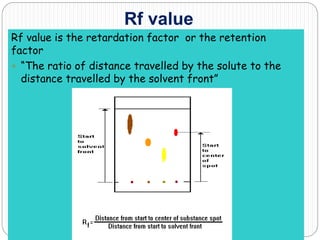
Rf value is the retardation factor or the retention
factor
 “The ratio of distance travelled by the solute to the
distance travelled by the solvent front”
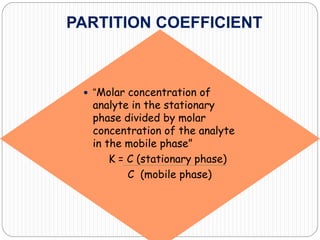
PARTITION COEFFICIENT
 “Molar concentration of
analyte in the stationary
phase divided by molar
concentration of the analyte
in the mobile phase”
K = C (stationary phase)
C (mobile phase)
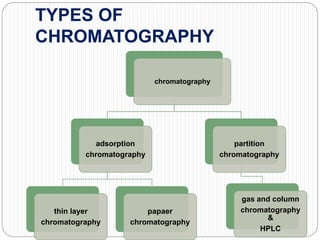
TYPES OF
CHROMATOGRAPHY
chromatography
adsorption
chromatography
thin layer
chromatography
papaer
chromatography
partition
chromatography
gas and column
chromatography
&
HPLC
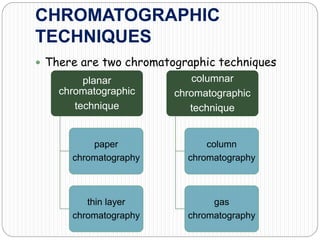
CHROMATOGRAPHIC
TECHNIQUES
 There are two chromatographic techniques
planar
chromatographic
technique
paper
chromatography
thin layer
chromatography
columnar
chromatographic
technique
column
chromatography
gas
chromatography
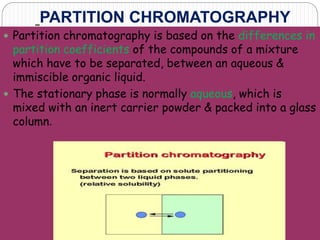
PARTITION CHROMATOGRAPHY
 Partition chromatography is based on the differences in
partition coefficients of the compounds of a mixture
which have to be separated, between an aqueous &
immiscible organic liquid.
 The stationary phase is normally aqueous, which is
mixed with an inert carrier powder & packed into a glass
column.
PROCEDURE:
 The mixture to be separated is dissolved in an
organic solvent, & is introduced into the column & the
chromatogram developed with more solvent, on
different solvents of increasing eluting power.
 Diffusion of the mobile phase through the stationary
phase occurs, & the different rates of travel of the
constituents of the mixture are directly related to
their partition coefficients between the mobile
organic & stationary aqueous phase.
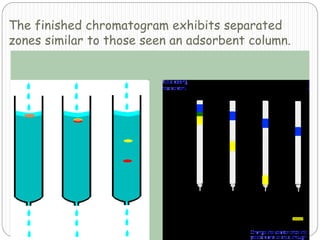
The finished chromatogram exhibits separated
zones similar to those seen an adsorbent column.
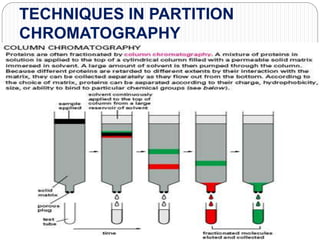
TECHNIQUES IN PARTITION
CHROMATOGRAPHY
USES
 preparative
 separation of plant
pigments
 Purify individual chemical
compounds
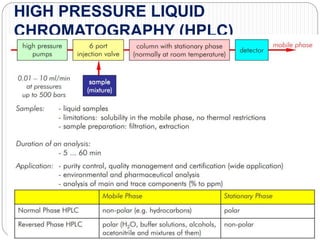
HIGH PRESSURE LIQUID
CHROMATOGRAPHY (HPLC)
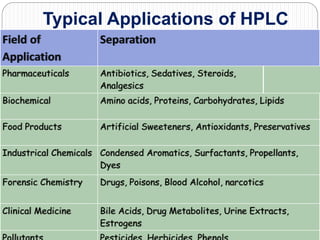
Typical Applications of HPLC
Field of
Application
Separation
Pharmaceuticals Antibiotics, Sedatives, Steroids,
Analgesics
Biochemical Amino acids, Proteins, Carbohydrates, Lipids
Food Products Artificial Sweeteners, Antioxidants, Preservatives
Industrical Chemicals Condensed Aromatics, Surfactants, Propellants,
Dyes
Forensic Chemistry Drugs, Poisons, Blood Alcohol, narcotics
Clinical Medicine Bile Acids, Drug Metabolites, Urine Extracts,
Estrogens
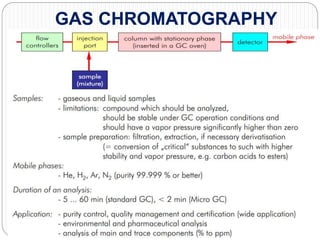
GAS CHROMATOGRAPHY
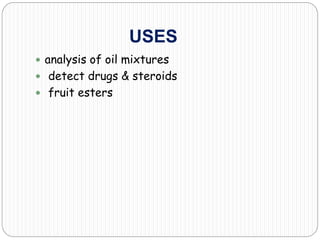
USES
 analysis of oil mixtures
 detect drugs & steroids
 fruit esters
ADSORPTION
CHROMATOGRAPGY
PRINCIPLE
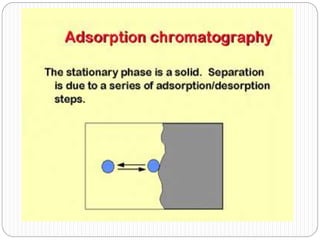
 The surface phenomenon of adsorption is utilized.
 The finely-divided solids are capable of selective
adsorption of other substances.
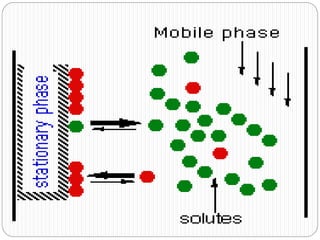
 The components of a mixture introduced onto a column
of adsorbent are more or less strong adsorbed.
 Those which are least strongly adsorbed are carried
down the column by the passage of solvent, & are the
1st to be eluted from the bottom of the column.
 The passage of the more strongly adsorbed substances
is slower, & these are the last to elute.
 The fractions of eluant containing each component of
the original mixture can then be separately analyzed.
ADSORPTION
CHROMATOGRAPHY
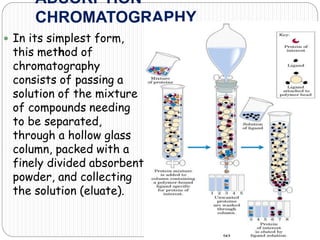
 In its simplest form,
this method of
chromatography
consists of passing a
solution of the mixture
of compounds needing
to be separated,
through a hollow glass
column, packed with a
finely divided absorbent
powder, and collecting
the solution (eluate).
TECHNIQUES OF ADSORPTION
CHROMATOGRAPHY
 PAPER CHROMATOGRAPHY:
“It is a chromatographic analytical
separation technique for complex mixtures
involving the progressive adsorption of the
dissolved component onto a special grade of
paper.”
PRINCIPLE
 The certain solvent are used to separate a
mixture e.g., water, alcohol.
 With capillary action the solvent will move up to
filter paper.
 Movement of a solvent will bring together
component that are separated from the mixture.
 Every component that are separated will move to
several velocity
 The moving components are depend on :
a. Solubility solute in solvent
b. Intermolecule forces
c. Pore size of filter paper
d. Size of solute
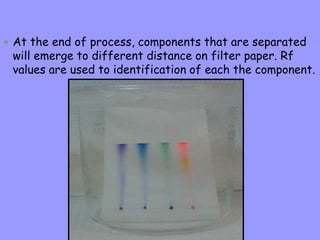
 At the end of process, components that are separated
will emerge to different distance on filter paper. Rf
values are used to identification of each the component.
Spot Detection
 Color spot  observed by naked
eye
 Non – color spot  color reagent
will give specific colors for
different compound.
 Example:
Ninhydrin – amino acids
USES OF PAPER
CHROMATOGRAPHY
 To isolate plant pigment from root and leaves.
 To isolate amino acid mixtures.
 To isolate food colors or dyes.
THIN LAYER
CHROMATOGRAPHY(TLC)
 TLC is an example of adsorption chromatography,
the stationary phase being a thin layer adsorbent
held on a suitable backing.
PRINCIPLE:
 Separation of the compounds present in the plant
extract depends on the differences in their
adsorptive/desorptive behaviour in respect of the
stationary phase.
PROCEDURE
 TLC involves a thin layer of adsorbent, mixed with
a binder such as, which is spread on a glass plate
& allowed to dry.
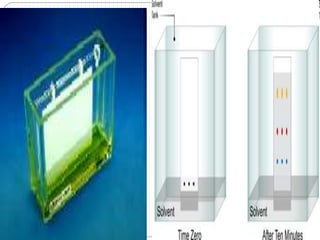
 The plant mixture to be separated is applied as a
spot near the base of the plate, which is then
placed in a closed glass tank containing a layer of
developing solvent.
 Now separated components of the mixture appear
as spots on the finished plate (chromatogram),
corresponding to the bands of the adsorbent
column.
COMPONENTS OF THE TLC
SYSTEM
There are three components
 THE ADSORBENT – Stationary Phase
 THE ELUENT (THE DEVELOPING
SOLVENT) – Mobile Phase
 THE SUBSTANCE REQUIRING
SEPARATION – Plant Sample
GENERAL RULE FOR TLC
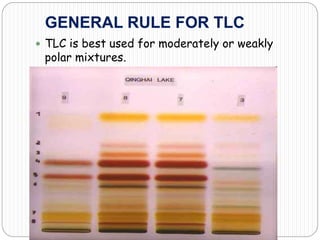
 TLC is best used for moderately or weakly
polar mixtures.
VISIBILITY OF SPOTS OR
BANDS (COMPOUNDS)
 If the spots or bands are invisible on the developed
chromatogram they are made visible either by;
 Heating for a specific period
 Examining under U.V light (if substances are florescent).
 Spraying the finished chromatogram with a suitable reagent
e.g. iodine & Dragendorff’s reagent are used as sprays for
the general detection of alkaloids(although they are not
specific for alkaloids).
 Ninhydrin solution – amino acids
 Ferric chloride solution – phenols
 Alkali – anthraquinones
 Antimony trichloride in chloroform – steroids & some volatile
oil components
 Aniline hydrogen phthalate reagent - sugars
TLC Advantages over paper
 Its faster
 It gives a better separation.
 It is more versatile as the solid on the plate can
be varied.
USES:
 To detect amino acids.
 To check composition of dyes and food colors.
SEPARATION OF ALKALOIDS
 Alkaloids need a moderately polar solvent for
good separation (e.g. ether/ethanol: 95/5).
 A more polar solvent (e.g. pure methanol), would
be preferentially adsorbed, & the alkaloids would
be carried along by the passage of the solvent 
resulting in poor separation.
 On the other hand, a non-polar solvent (e.g.
cyclohexane) would be unable to displace the
alkaloids from the adsorbent layer & they would
then remain at or near the base of origin.
ADDITIONAL FACTOR FOR
SEPARATING ALKALOIDS
 If using an aluminium thin
layer (neutral), a neutral
solvent should be used.
 If using Silica-gel
(slightly acidic due to the
method of preparation),
and alkaline solvent such
as
acetone/water/25%ammo
nia: 90/7/3 makes for
good separation.
SEPARATION OF VOLATILE
OILS
 The constituents of volatile oils are mainly non-
polar (terpenes) & are therefore best separated
with corresponding non-polar solvents such as
chloroform/benzene mixtures.
 Certain oils may need more polar solvents (e.g.
clove oil – phenolic).
SEPARATION OF SUGARS &
SUGAR ACID MIXTURES
 These mixtures are produced by hydrolysing
starch & gums. They are strongly polar & are
therefore strongly adsorbed onto silica &
aluminium layers.
 Although strongly polar solvents are used,
separation on these thin layers is not generally
satisfactory & better results are obtained using
weakly polar adsorbents such as cellulose & a
polar solvent such as butanol/ethanol/water:
5:4:1. Alternatively, paper chromatography could
be used.

Chromatography ppt( beloved frnds)from hina

  • 1.
  • 2.
    GROUP MEMBERS:  ANEEQAKHAN  FARHAT WAZIR SATTI  MARIA ASHRAF  SAHAR ASHFAQ  UME-HABIBA
  • 3.
    BACKGROUND  In pharmacognosywe deal with drugs and drug products obtained from plant, animal and mineral sources.  These drugs and drug products need refining:  to identify  to differentiate  to extract the therapeutic constituents from non-therapeutic constituents
  • 4.
     Chromatography isone of the extraction procedures  to identify and  to separate different constituents of crude plants, chemicals, and other substances etc.  chromatography is the most frequently used analytical technique in pharmaceutical analysis.
  • 5.
    CHROMATOGRAPHY  “The processof separation of individual components of a mixture based on their relative affinities towards the stationary or mobile phase” OR  “It is a non-destructive procedure for resolving a complex mixture into its individual fractions or compounds”
  • 6.
    TERMS USED IN CHROMATOGRAPHY The ANALYTE is the substance to be separated during chromatography.It is also normally what is needed from mixture.  The ELUATE is the mobile phase leaving the column.  The ELUENT is the solvent that carries the analyte.  A STATIONARY PHASE is the substance fixed in place for the chromatography.It may be a solid or liquid.  The MOBILE PHASE is the phase that moves in a definite direction.It may be a liquid, a gas, or a superficial liquid.  A CHROMATOGRAM is the visual output of the chromatography.
  • 7.
    GENERAL PROCEDURE  Inchromatography a mixture is dissolved in a fluid called the mobile phase which carries it through a structure holding another material called the stationary phase.  The various constituents of mixture travel at different speeds, causing them to separate.  The separation is based on differential partitioning between the mobile and stationary phases depending upon the Rf values.
  • 8.
    Rf value Rf valueis the retardation factor or the retention factor  “The ratio of distance travelled by the solute to the distance travelled by the solvent front”
  • 9.
    PARTITION COEFFICIENT  “Molarconcentration of analyte in the stationary phase divided by molar concentration of the analyte in the mobile phase” K = C (stationary phase) C (mobile phase)
  • 10.
  • 11.
    CHROMATOGRAPHIC TECHNIQUES  There aretwo chromatographic techniques planar chromatographic technique paper chromatography thin layer chromatography columnar chromatographic technique column chromatography gas chromatography
  • 12.
    PARTITION CHROMATOGRAPHY  Partitionchromatography is based on the differences in partition coefficients of the compounds of a mixture which have to be separated, between an aqueous & immiscible organic liquid.  The stationary phase is normally aqueous, which is mixed with an inert carrier powder & packed into a glass column.
  • 13.
    PROCEDURE:  The mixtureto be separated is dissolved in an organic solvent, & is introduced into the column & the chromatogram developed with more solvent, on different solvents of increasing eluting power.  Diffusion of the mobile phase through the stationary phase occurs, & the different rates of travel of the constituents of the mixture are directly related to their partition coefficients between the mobile organic & stationary aqueous phase.
  • 14.
    The finished chromatogramexhibits separated zones similar to those seen an adsorbent column.
  • 15.
  • 16.
    USES  preparative  separationof plant pigments  Purify individual chemical compounds
  • 17.
  • 18.
    Typical Applications ofHPLC Field of Application Separation Pharmaceuticals Antibiotics, Sedatives, Steroids, Analgesics Biochemical Amino acids, Proteins, Carbohydrates, Lipids Food Products Artificial Sweeteners, Antioxidants, Preservatives Industrical Chemicals Condensed Aromatics, Surfactants, Propellants, Dyes Forensic Chemistry Drugs, Poisons, Blood Alcohol, narcotics Clinical Medicine Bile Acids, Drug Metabolites, Urine Extracts, Estrogens
  • 19.
  • 20.
    USES  analysis ofoil mixtures  detect drugs & steroids  fruit esters
  • 21.
  • 24.
    PRINCIPLE  The surfacephenomenon of adsorption is utilized.  The finely-divided solids are capable of selective adsorption of other substances.  The components of a mixture introduced onto a column of adsorbent are more or less strong adsorbed.  Those which are least strongly adsorbed are carried down the column by the passage of solvent, & are the 1st to be eluted from the bottom of the column.  The passage of the more strongly adsorbed substances is slower, & these are the last to elute.  The fractions of eluant containing each component of the original mixture can then be separately analyzed.
  • 25.
    ADSORPTION CHROMATOGRAPHY  In itssimplest form, this method of chromatography consists of passing a solution of the mixture of compounds needing to be separated, through a hollow glass column, packed with a finely divided absorbent powder, and collecting the solution (eluate).
  • 26.
    TECHNIQUES OF ADSORPTION CHROMATOGRAPHY PAPER CHROMATOGRAPHY: “It is a chromatographic analytical separation technique for complex mixtures involving the progressive adsorption of the dissolved component onto a special grade of paper.”
  • 27.
    PRINCIPLE  The certainsolvent are used to separate a mixture e.g., water, alcohol.  With capillary action the solvent will move up to filter paper.  Movement of a solvent will bring together component that are separated from the mixture.  Every component that are separated will move to several velocity  The moving components are depend on : a. Solubility solute in solvent b. Intermolecule forces c. Pore size of filter paper d. Size of solute
  • 28.
     At theend of process, components that are separated will emerge to different distance on filter paper. Rf values are used to identification of each the component.
  • 29.
    Spot Detection  Colorspot  observed by naked eye  Non – color spot  color reagent will give specific colors for different compound.  Example: Ninhydrin – amino acids
  • 30.
    USES OF PAPER CHROMATOGRAPHY To isolate plant pigment from root and leaves.  To isolate amino acid mixtures.  To isolate food colors or dyes.
  • 31.
    THIN LAYER CHROMATOGRAPHY(TLC)  TLCis an example of adsorption chromatography, the stationary phase being a thin layer adsorbent held on a suitable backing. PRINCIPLE:  Separation of the compounds present in the plant extract depends on the differences in their adsorptive/desorptive behaviour in respect of the stationary phase.
  • 32.
    PROCEDURE  TLC involvesa thin layer of adsorbent, mixed with a binder such as, which is spread on a glass plate & allowed to dry.  The plant mixture to be separated is applied as a spot near the base of the plate, which is then placed in a closed glass tank containing a layer of developing solvent.  Now separated components of the mixture appear as spots on the finished plate (chromatogram), corresponding to the bands of the adsorbent column.
  • 34.
    COMPONENTS OF THETLC SYSTEM There are three components  THE ADSORBENT – Stationary Phase  THE ELUENT (THE DEVELOPING SOLVENT) – Mobile Phase  THE SUBSTANCE REQUIRING SEPARATION – Plant Sample
  • 35.
    GENERAL RULE FORTLC  TLC is best used for moderately or weakly polar mixtures.
  • 36.
    VISIBILITY OF SPOTSOR BANDS (COMPOUNDS)  If the spots or bands are invisible on the developed chromatogram they are made visible either by;  Heating for a specific period  Examining under U.V light (if substances are florescent).  Spraying the finished chromatogram with a suitable reagent e.g. iodine & Dragendorff’s reagent are used as sprays for the general detection of alkaloids(although they are not specific for alkaloids).  Ninhydrin solution – amino acids  Ferric chloride solution – phenols  Alkali – anthraquinones  Antimony trichloride in chloroform – steroids & some volatile oil components  Aniline hydrogen phthalate reagent - sugars
  • 37.
    TLC Advantages overpaper  Its faster  It gives a better separation.  It is more versatile as the solid on the plate can be varied. USES:  To detect amino acids.  To check composition of dyes and food colors.
  • 38.
  • 39.
     Alkaloids needa moderately polar solvent for good separation (e.g. ether/ethanol: 95/5).  A more polar solvent (e.g. pure methanol), would be preferentially adsorbed, & the alkaloids would be carried along by the passage of the solvent  resulting in poor separation.  On the other hand, a non-polar solvent (e.g. cyclohexane) would be unable to displace the alkaloids from the adsorbent layer & they would then remain at or near the base of origin.
  • 40.
    ADDITIONAL FACTOR FOR SEPARATINGALKALOIDS  If using an aluminium thin layer (neutral), a neutral solvent should be used.  If using Silica-gel (slightly acidic due to the method of preparation), and alkaline solvent such as acetone/water/25%ammo nia: 90/7/3 makes for good separation.
  • 41.
  • 42.
     The constituentsof volatile oils are mainly non- polar (terpenes) & are therefore best separated with corresponding non-polar solvents such as chloroform/benzene mixtures.  Certain oils may need more polar solvents (e.g. clove oil – phenolic).
  • 43.
    SEPARATION OF SUGARS& SUGAR ACID MIXTURES
  • 44.
     These mixturesare produced by hydrolysing starch & gums. They are strongly polar & are therefore strongly adsorbed onto silica & aluminium layers.  Although strongly polar solvents are used, separation on these thin layers is not generally satisfactory & better results are obtained using weakly polar adsorbents such as cellulose & a polar solvent such as butanol/ethanol/water: 5:4:1. Alternatively, paper chromatography could be used.