
LIMIT
GAUGES
Name:- Patel Shrikunj C.
Enrollment NO. :- 126540319070
What is a Gauge?
 Gauge is an inspection tool used to check
product dimension with reference to it’s
maximum and minimum acceptable limit. It is
generally used to segregate acceptable and
non acceptable product in mass production,
without knowing exact value of dimension.
Classification of limit gauge.
•According to type / use 1) Standard gauge.
2) Limit gauge.
•According to application 1) Work shop gauge.
2) Inspection gauge.
3) Master / Reference gauge.
•According to form 1) Plug gauge.
2) Snap and ring gauge.
•According to design /
construction
1) Fixed limit gauge.
2) Indicating gauge.
3) Combination gauge.
•According to specific application 1) Screw pitch gauge.
2) Radius gauge.
3) Filler gauge.
4) Taper gauge.
Advantages of gauging:-
 Faster checking regarding whether product is
within its specified limit or not can be done.
 Less dependence on operator skill and hence
result are not getting affected by operator
judgment.
 More than one dimension of product can be
checked at a time as well as properties such
as roundness, taper etc. as can be checked at
a time.
 Gauges are economical then measuring
instruments.
Limitations of limit gauges:-
 Exact value of product dimension can not be
known.
 Accuracy of gauges is getting affected due to
wear and tear with passage of time.
 It is useful only for similar product because its
difficult to manufacture and maintain large size
gauges.
Instruments used for gauging:-
 Snap and ring gauge.
 Combined gauge.
 Plug gauge.
 Radius gauge.
 Filler gauge.
 Screw pitch gauge.
 Template and form gauge.
 Taper gauge.
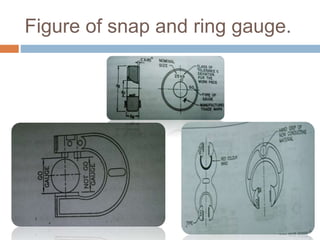
Snap and ring gauge.
 The gauge used to check eternal details of the
product such as diameter of a shaft, thickness
of block etc. it is called snap and ring gauge.
Snap gauge is used for cylindrical as well as
non-cylindrical work-pieces whereas ring
gauge is used only for cylindrical work-pieces.
 Go member of snap / ring gauge will have
dimension equal to higher limit of shaft and not
go member will have dimension equal to lower
limit of the shaft diameter.
Figure of snap and ring gauge.
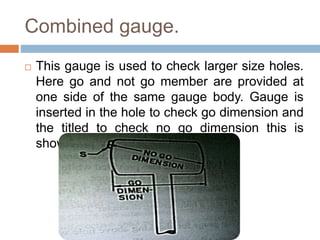
Combined gauge.
 This gauge is used to check larger size holes.
Here go and not go member are provided at
one side of the same gauge body. Gauge is
inserted in the hole to check go dimension and
the titled to check no go dimension this is
shown in figure below.
Plug gauge.
 The gauges are used to check internal details
of the product, such as hole diameter. As per
IS-3484 plug gauges should be manufactured
from hardened steel, which can resists wear
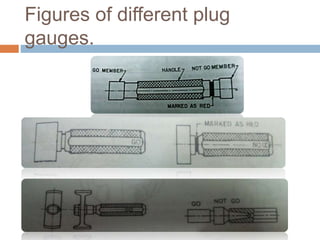
and tear during checking. Figures below
indicates different varieties of plug gauge.
 Go member of the plug gauge will have
dimension equal to lower limit of the hole
dimension and not go member will have
dimension equal to higher limit of the hole
dimension.
Figures of different plug
gauges.
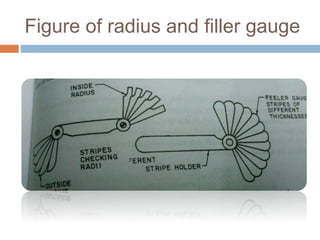
Radius gauge and Filler gauge.
 To measure and check internal and external
radius curvature of product radius gauge is
used. As shown in figure below it consists of
many strips having different size of radius from
on it.
 It is used to measure the small gap between
surface two mating part our slot width as
shown in figure it is also consisting of different
strips of different thickness.
Figure of radius and filler gauge
Limit gauges

Limit gauges

  • 1.
    LIMIT GAUGES Name:- Patel ShrikunjC. Enrollment NO. :- 126540319070
  • 2.
    What is aGauge?  Gauge is an inspection tool used to check product dimension with reference to it’s maximum and minimum acceptable limit. It is generally used to segregate acceptable and non acceptable product in mass production, without knowing exact value of dimension.
  • 3.
    Classification of limitgauge. •According to type / use 1) Standard gauge. 2) Limit gauge. •According to application 1) Work shop gauge. 2) Inspection gauge. 3) Master / Reference gauge. •According to form 1) Plug gauge. 2) Snap and ring gauge. •According to design / construction 1) Fixed limit gauge. 2) Indicating gauge. 3) Combination gauge. •According to specific application 1) Screw pitch gauge. 2) Radius gauge. 3) Filler gauge. 4) Taper gauge.
  • 4.
    Advantages of gauging:- Faster checking regarding whether product is within its specified limit or not can be done.  Less dependence on operator skill and hence result are not getting affected by operator judgment.  More than one dimension of product can be checked at a time as well as properties such as roundness, taper etc. as can be checked at a time.  Gauges are economical then measuring instruments.
  • 5.
    Limitations of limitgauges:-  Exact value of product dimension can not be known.  Accuracy of gauges is getting affected due to wear and tear with passage of time.  It is useful only for similar product because its difficult to manufacture and maintain large size gauges.
  • 6.
    Instruments used forgauging:-  Snap and ring gauge.  Combined gauge.  Plug gauge.  Radius gauge.  Filler gauge.  Screw pitch gauge.  Template and form gauge.  Taper gauge.
  • 7.
    Snap and ringgauge.  The gauge used to check eternal details of the product such as diameter of a shaft, thickness of block etc. it is called snap and ring gauge. Snap gauge is used for cylindrical as well as non-cylindrical work-pieces whereas ring gauge is used only for cylindrical work-pieces.  Go member of snap / ring gauge will have dimension equal to higher limit of shaft and not go member will have dimension equal to lower limit of the shaft diameter.
  • 8.
    Figure of snapand ring gauge.
  • 9.
    Combined gauge.  Thisgauge is used to check larger size holes. Here go and not go member are provided at one side of the same gauge body. Gauge is inserted in the hole to check go dimension and the titled to check no go dimension this is shown in figure below.
  • 10.
    Plug gauge.  Thegauges are used to check internal details of the product, such as hole diameter. As per IS-3484 plug gauges should be manufactured from hardened steel, which can resists wear and tear during checking. Figures below indicates different varieties of plug gauge.  Go member of the plug gauge will have dimension equal to lower limit of the hole dimension and not go member will have dimension equal to higher limit of the hole dimension.
  • 11.
  • 12.
    Radius gauge andFiller gauge.  To measure and check internal and external radius curvature of product radius gauge is used. As shown in figure below it consists of many strips having different size of radius from on it.  It is used to measure the small gap between surface two mating part our slot width as shown in figure it is also consisting of different strips of different thickness.
  • 13.
    Figure of radiusand filler gauge