Limit Gauges
Dr.S.BENJAMIN FRANKLIN
Associate Professor Gr1
Department of Mechanical Engineering
Sri Ramakrishna Institute of Technology
Limit Gauges
• Limit gauge is not a measuring gauge
• They are used as inspection gauges
• These are also called NO and NOGO gauges.
• They are used to the limit size of the work to
be measured.
Purposes of using limit gauges
Components are manufactured as per the
specified tolerance limits such as upper limit
and lower limit.
Limit Gauges
• The dimensions of each component should be
within the upper and lower limits
• If the dimensions are outside these limits, the
components will be rejected
• If any measuring instruments are used to
check these dimensions, the process
consumes more time.
Classifications of slip gauges
1.Based on the consistency in manufacturing and
inspection
• Working gauge – Gauges are used on the bench
or machine
• Inspection gauge – Gauges are used by the
inspection personnel to inspect the
manufactured parts
• Reference or Master gauge – Gauges are used
only for checking the size or condition of other
gauges
Classifications of slip gauges
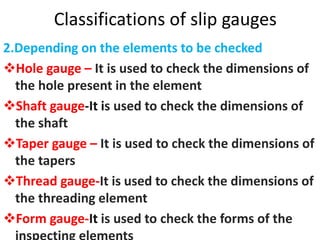
2.Depending on the elements to be checked
Hole gauge – It is used to check the dimensions of
the hole present in the element
Shaft gauge-It is used to check the dimensions of
the shaft
Taper gauge – It is used to check the dimensions of
the tapers
Thread gauge-It is used to check the dimensions of
the threading element
Form gauge-It is used to check the forms of the
Classifications of slip gauges
3.According to shape or purpose for which each is
used
 Plug gauge
 Ring gauge
 Snap gauge
 Taper gauge
 Thread gauge
 Form gauge
 Thickness gauge or Peeler gauge
 Indicating gauge
 Air-operated gauge
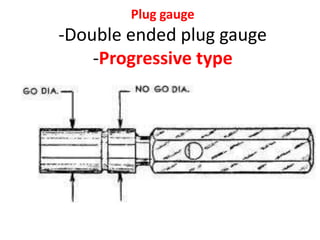
Plug gauge
-Double ended plug gauge
-Progressive type
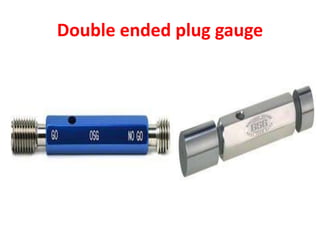
Double ended plug gauge
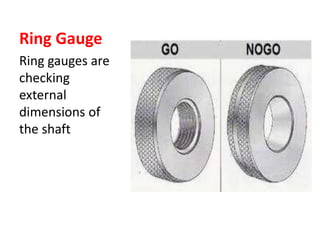
Ring Gauge
Ring gauges are
checking
external
dimensions of
the shaft
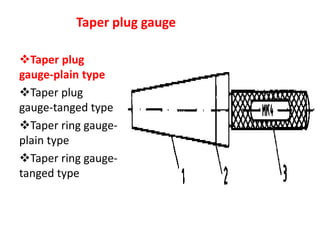
Taper plug gauge
Taper plug
gauge-plain type
Taper plug
gauge-tanged type
Taper ring gauge-
plain type
Taper ring gauge-
tanged type
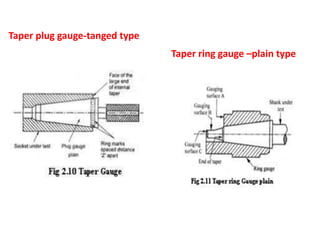
Taper plug gauge-tanged type
Taper ring gauge –plain type
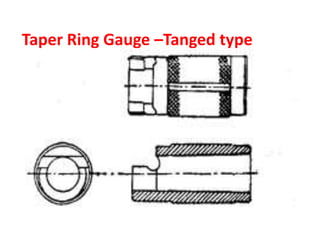
Taper Ring Gauge –Tanged type
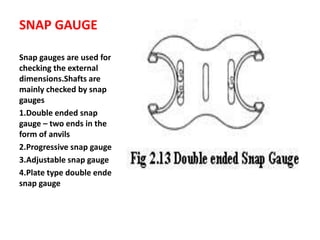
SNAP GAUGE
Snap gauges are used for
checking the external
dimensions.Shafts are
mainly checked by snap
gauges
1.Double ended snap
gauge – two ends in the
form of anvils
2.Progressive snap gauge
3.Adjustable snap gauge
4.Plate type double ended
snap gauge
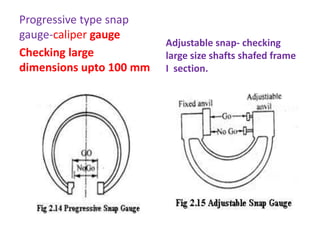
Progressive type snap
gauge-caliper gauge
Checking large
dimensions upto 100 mm
Adjustable snap- checking
large size shafts shafed frame
I section.
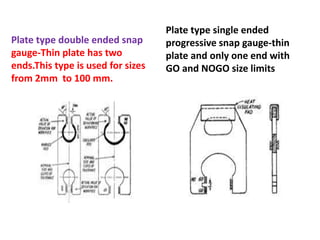
Plate type double ended snap
gauge-Thin plate has two
ends.This type is used for sizes
from 2mm to 100 mm.
Plate type single ended
progressive snap gauge-thin
plate and only one end with
GO and NOGO size limits
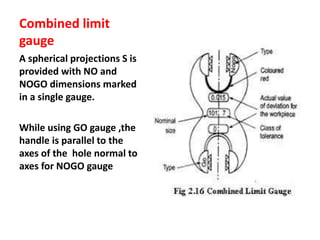
Combined limit
gauge
A spherical projections S is
provided with NO and
NOGO dimensions marked
in a single gauge.
While using GO gauge ,the
handle is parallel to the
axes of the hole normal to
axes for NOGO gauge
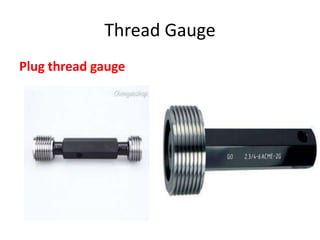
Thread Gauge
Plug thread gauge
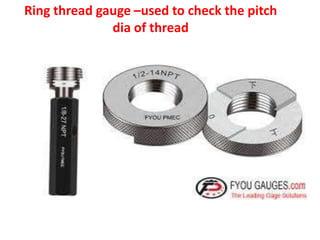
Ring thread gauge –used to check the pitch
dia of thread
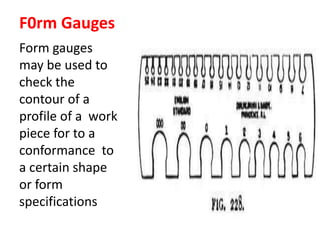
F0rm Gauges
Form gauges
may be used to
check the
contour of a
profile of a work
piece for to a
conformance to
a certain shape
or form
specifications
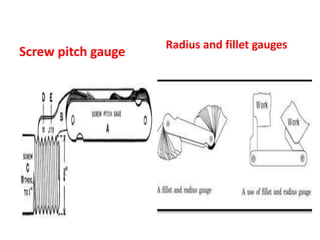
Screw pitch gauge
Radius and fillet gauges
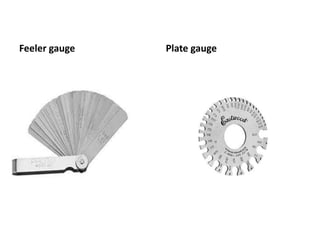
Feeler gauge Plate gauge
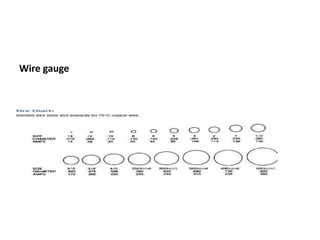
Wire gauge

Limit gauges

  • 1.
    Limit Gauges Dr.S.BENJAMIN FRANKLIN AssociateProfessor Gr1 Department of Mechanical Engineering Sri Ramakrishna Institute of Technology
  • 2.
    Limit Gauges • Limitgauge is not a measuring gauge • They are used as inspection gauges • These are also called NO and NOGO gauges. • They are used to the limit size of the work to be measured. Purposes of using limit gauges Components are manufactured as per the specified tolerance limits such as upper limit and lower limit.
  • 3.
    Limit Gauges • Thedimensions of each component should be within the upper and lower limits • If the dimensions are outside these limits, the components will be rejected • If any measuring instruments are used to check these dimensions, the process consumes more time.
  • 4.
    Classifications of slipgauges 1.Based on the consistency in manufacturing and inspection • Working gauge – Gauges are used on the bench or machine • Inspection gauge – Gauges are used by the inspection personnel to inspect the manufactured parts • Reference or Master gauge – Gauges are used only for checking the size or condition of other gauges
  • 5.
    Classifications of slipgauges 2.Depending on the elements to be checked Hole gauge – It is used to check the dimensions of the hole present in the element Shaft gauge-It is used to check the dimensions of the shaft Taper gauge – It is used to check the dimensions of the tapers Thread gauge-It is used to check the dimensions of the threading element Form gauge-It is used to check the forms of the
  • 6.
    Classifications of slipgauges 3.According to shape or purpose for which each is used  Plug gauge  Ring gauge  Snap gauge  Taper gauge  Thread gauge  Form gauge  Thickness gauge or Peeler gauge  Indicating gauge  Air-operated gauge
  • 7.
    Plug gauge -Double endedplug gauge -Progressive type
  • 8.
  • 9.
    Ring Gauge Ring gaugesare checking external dimensions of the shaft
  • 10.
    Taper plug gauge Taperplug gauge-plain type Taper plug gauge-tanged type Taper ring gauge- plain type Taper ring gauge- tanged type
  • 11.
    Taper plug gauge-tangedtype Taper ring gauge –plain type
  • 12.
    Taper Ring Gauge–Tanged type
  • 13.
    SNAP GAUGE Snap gaugesare used for checking the external dimensions.Shafts are mainly checked by snap gauges 1.Double ended snap gauge – two ends in the form of anvils 2.Progressive snap gauge 3.Adjustable snap gauge 4.Plate type double ended snap gauge
  • 14.
    Progressive type snap gauge-calipergauge Checking large dimensions upto 100 mm Adjustable snap- checking large size shafts shafed frame I section.
  • 15.
    Plate type doubleended snap gauge-Thin plate has two ends.This type is used for sizes from 2mm to 100 mm. Plate type single ended progressive snap gauge-thin plate and only one end with GO and NOGO size limits
  • 16.
    Combined limit gauge A sphericalprojections S is provided with NO and NOGO dimensions marked in a single gauge. While using GO gauge ,the handle is parallel to the axes of the hole normal to axes for NOGO gauge
  • 17.
  • 18.
    Ring thread gauge–used to check the pitch dia of thread
  • 19.
    F0rm Gauges Form gauges maybe used to check the contour of a profile of a work piece for to a conformance to a certain shape or form specifications
  • 20.
    Screw pitch gauge Radiusand fillet gauges
  • 21.
  • 22.