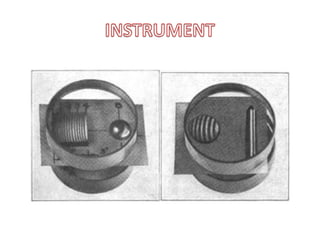
Optical flats are cylindrical in form with the
working surfaces flat.
An optical flat may be of any transparent
material usually glass with two highly polished
surfaces.
There are two types of optical flats.
Type A
It has only one surface flat.The working surface
of this type of flat is indicated by an arrow
head on the cylindrical surface pointing
towards the working surface.
This type of flat are used for testing the
flatness of precision measuring surfaces of
flats,slips etc.
• Type B
It has both surfaces flat and parallel to each
other.
This type of flat are used for testing
measuring surfaces of micrometers,measuring
anvils.
• Optical flats are made of fused quartz(whose
coefficient of linear expansion not more than
0.6*10^(-6) /degree at standard temperature of
20 centigrade) or borosilicate glass(at S T of 20
degrees ,C O L E is not more than 3.6*10^(-6)
/degree.)
• This glass is clear and colourless.
• The cylindrical surfaces of the optical flats are
finished by grinding and the working surfaces are
finished by lapping and polishing process.
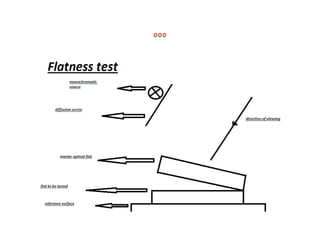
• The flatness of the working surface of an
optical flat is tested by comparing its flatness
with a master flat of known flatness.
• The testing is usually carried out by observing
the interference fringes using monochromatic
light source.
• If the optical flat under test has a perfectly flat
surface then the fringes observed will be
straight line.
• The parallelism of working surfaces of type B optical
flats can be tested by Fizeau Interferometer method.
• In this method light from mercury vapour lamp is
focussed on to an opening in the eyepiece and is partly
reflected by beam splitter .
• The reflected light strikes the collimating lens which
collimates it and throws it further on the flat under
test. The flat under the test is placed on the table
provided.
• The table is arranged such that beam strikes the
surfaces of the flats perpendicularly.
…
• After reflection from the two surfaces of the flat
under test , the beam retrace its path.
• Due to interference of the light reflected at the
two parallel surfaces of the optical flat,
interference fringes are formed which can be
observed from the eyepiece of the auto-
collimator
• These interference fringes helps in determining
the degree of flatness of two surfaces of the flat.
• Before using the optical flat , it should be
ensured that both flat and work piece are
clean and free from dust ,oil, dirt and finger
prints.
• The flat should only be rested carefully on the
workpiece.

Optical flats

  • 2.
    Optical flats arecylindrical in form with the working surfaces flat. An optical flat may be of any transparent material usually glass with two highly polished surfaces.
  • 4.
    There are twotypes of optical flats. Type A It has only one surface flat.The working surface of this type of flat is indicated by an arrow head on the cylindrical surface pointing towards the working surface. This type of flat are used for testing the flatness of precision measuring surfaces of flats,slips etc.
  • 5.
    • Type B Ithas both surfaces flat and parallel to each other. This type of flat are used for testing measuring surfaces of micrometers,measuring anvils.
  • 6.
    • Optical flatsare made of fused quartz(whose coefficient of linear expansion not more than 0.6*10^(-6) /degree at standard temperature of 20 centigrade) or borosilicate glass(at S T of 20 degrees ,C O L E is not more than 3.6*10^(-6) /degree.) • This glass is clear and colourless. • The cylindrical surfaces of the optical flats are finished by grinding and the working surfaces are finished by lapping and polishing process.
  • 7.
    • The flatnessof the working surface of an optical flat is tested by comparing its flatness with a master flat of known flatness. • The testing is usually carried out by observing the interference fringes using monochromatic light source. • If the optical flat under test has a perfectly flat surface then the fringes observed will be straight line.
  • 9.
    • The parallelismof working surfaces of type B optical flats can be tested by Fizeau Interferometer method. • In this method light from mercury vapour lamp is focussed on to an opening in the eyepiece and is partly reflected by beam splitter . • The reflected light strikes the collimating lens which collimates it and throws it further on the flat under test. The flat under the test is placed on the table provided. • The table is arranged such that beam strikes the surfaces of the flats perpendicularly.
  • 10.
    … • After reflectionfrom the two surfaces of the flat under test , the beam retrace its path. • Due to interference of the light reflected at the two parallel surfaces of the optical flat, interference fringes are formed which can be observed from the eyepiece of the auto- collimator • These interference fringes helps in determining the degree of flatness of two surfaces of the flat.
  • 12.
    • Before usingthe optical flat , it should be ensured that both flat and work piece are clean and free from dust ,oil, dirt and finger prints. • The flat should only be rested carefully on the workpiece.