Future of
Animal
Biotechnology
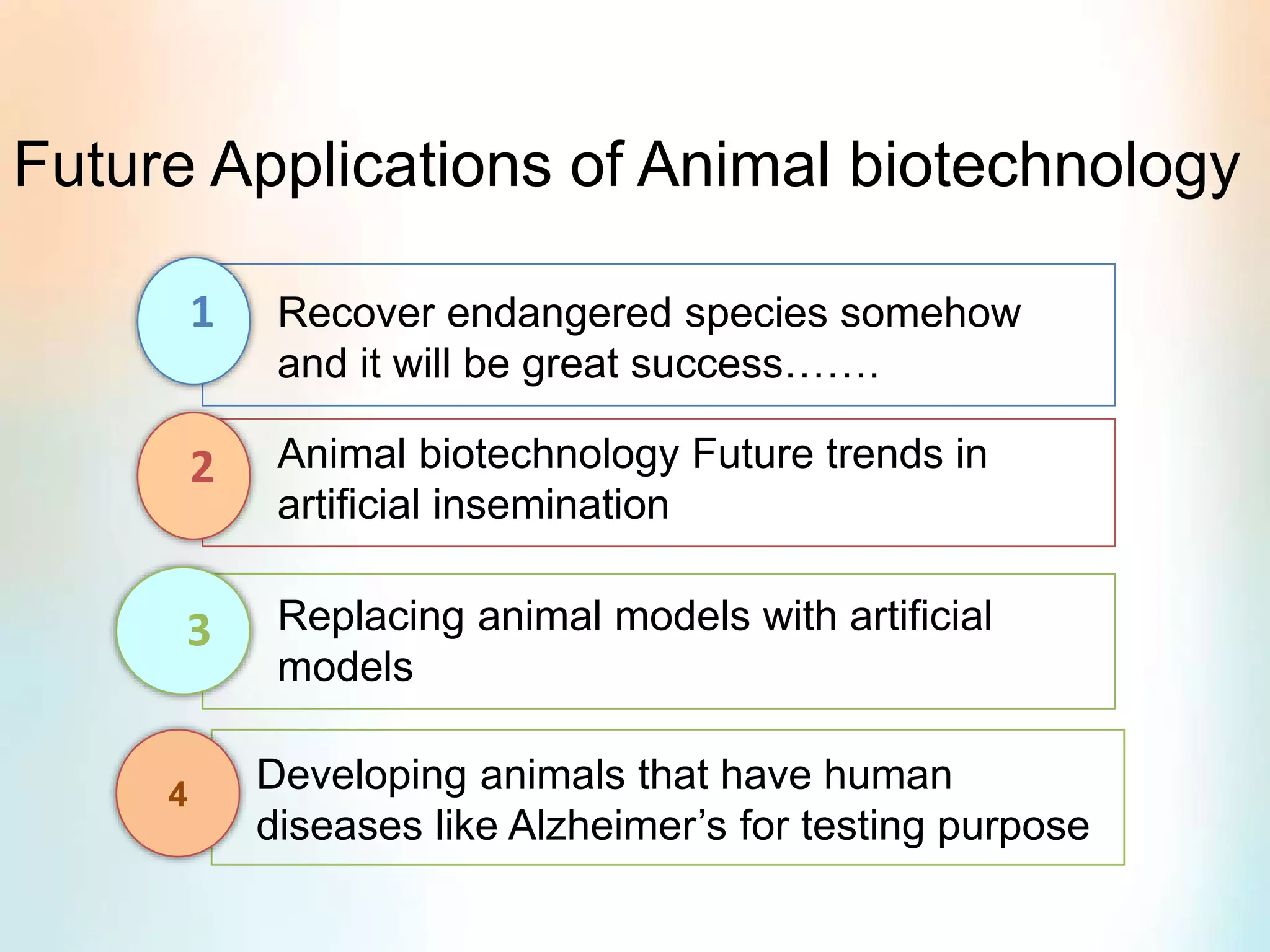
Future Applications of Animal biotechnology
Recover endangered species somehow
and it will be great success…….
1
Animal biotechnology Future trends in
artificial insemination
2
3 Replacing animal models with artificial
models
4
Developing animals that have human
diseases like Alzheimer’s for testing purpose
Recovering endangered species:
• Humans are one of about 1.75 million
species that have been identified by science,
and many believe that 30 million species or
more inhabit this world.
• Experts predict that at least one of every four
of these life-forms may become extinct by the
year 2050. We are facing a global crisis in
biodiversity loss.
• In a recent edition of the prestigious journal
Science, the current rate of worldwide animal
and plant specie has been estimated to be one
specie lost every fifteen minutes.
• This translates into 96 dying species per day, or 672 per
week, or approximately 35,000 extinct species per year.
•Reproductive Technologies:
 Cloning could be a game-changer when it comes to
helping recovering mammals. Cloning bio-banked cell
lines could help restore genetic diversity to endangered
species.
The last male northern white rhinoceros, Sudan, died
leaving only two females alive.
In an effort to save the species, scientists at the San Diego
Zoo Global are developing stem cell technologies
to create a new generation of northern white rhinos.
Recovering species
• Since the early 2000s, researchers cloned several endangered and
even extinct mammals but they died due to some reasons.
• One of the newest reproductive tools is genome editing. Using
CRISPR-Cas9 technology, University of California, Davis scientists
have bred a generation of hornless dairy cattle.
• "Once cloning of endangered animals is properly established, it will be
a very powerful tool," Loi says. "If something can be done, it will be
done in 10 years."
BIOBANKING:
Biobanks store biological samples for research and as a
backup resource to preserve genetic diversity. Examples
include the San Diego Frozen Zoo and Frozen Ark projects,
and numerous seed banks. Samples provides tissues, cell
lines, and genetic information for recovering endangered
species through reproductive technologies.
.
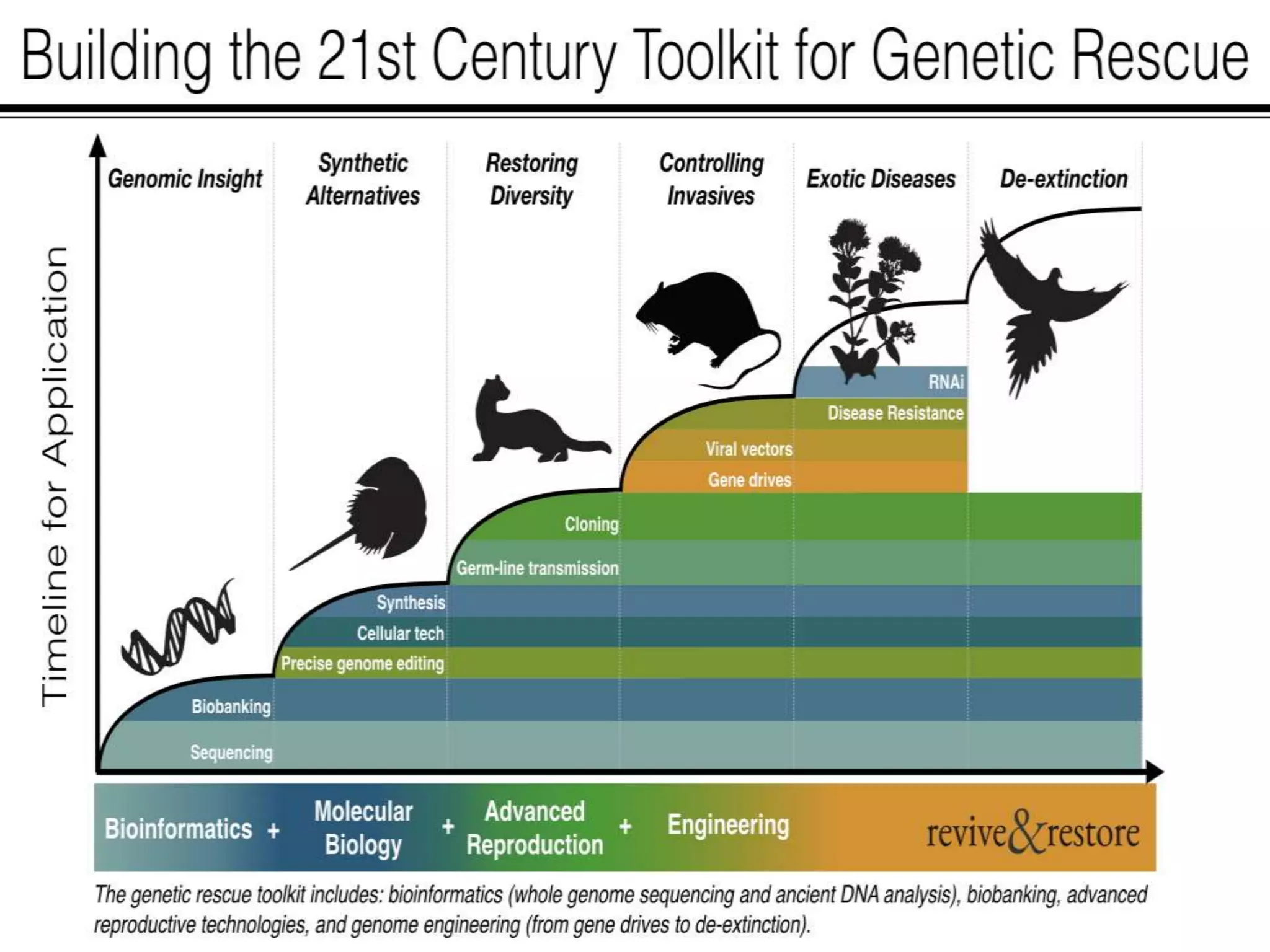
Genomics:
• The genomes of extinct species such as the woolly
mammoth, thylacine and passenger pigeon are also
attainable due to improved techniques.
• This growing database of genomes, combined with
advances in big data and artificial intelligence, allows
researchers to screen entire communities through DNA left in
their environments , establishing non-invasive means of
tracking species.
• All this bioinformatic information provides genomic insight
to improve monitoring, management, and restoration of
endangered wildlife.
• The latest DNA sequencing tools bring the science into the
field for real-time results and will one day make data-based
decisions possible in actionable timeframes.
Future trends in Artificial Insemination:
It is highly probable that the use of AI in livestock will continue
to increase. AI not only facilitates more effective and efficient
livestock production.
But can also be coupled to other developing biotechnologies,
such as cryopreservation, selection of robust spermatozoa by
single layer centrifugation, and sperm sex selection.
Improve livestock
production:
The use of AI in
sheep and goats in the
future, with an
emphasis on improving
production traits by the
introduction of superior
genes.
One disadvantage of AI is that natural selection
within the female reproductive tract to select best
spermatozoa may be bypassed when AI is utilized.
Several in vitro procedures have been suggested that could
be used to mimic selection of good quality spermatozoa in
female reproductive tract. (fit biomimetric def)
Biomimetic sperm selection:
These include sperm processing procedures such as
swim-up, sperm migration, filtration and colloid
centrifugation. Colloid centrifugation is most widely used
technique.
Replacing animal models for testing:
• As we know, in today world animal testing has been used
excessively for measuring the efficacy and safety of new
treatments.
• And somehow, it concerns ethical issues because no matter
how and why we are using them but the matter of fact is that we
are brutally torturing them for our benefits and annually large
number of animals lost their life and in most cases the research
does not provide the expected result.
• Like according to one report of FDA 95% of drugs after animal
testing were rejected and cannot be launched in market because
the environment is another factor that how metabolism of
organism behave.
• As one strain of mice show different effect of drug than the
other strain of same specie live in different environment. So, it is
our major concern to maintain certain limits and rights for use of
animal testing.
Replacing animal models for testing:
The vast majority of animal research is not testing drugs but
doing basic research and producing genetically modified
mice. Half of all animal experiments are now conducted at
universities.
 Eye Irritancy, Acute Toxicity, Repeated Dose Toxicity, Skin Irritation,
Skin Sensitization, Dermal Penetration and include forcing mice and
rats to inhale toxic fumes, force-feeding dogs pesticides, and dripping
corrosive chemicals into rabbits' sensitive eyes.
Over 100 million animals are burned, crippled, poisoned, and
abused in US labs every year. 92% of experimental drugs that are
safe and effective in animals fail in human clinical trials because
they are too dangerous or don't work.
 These alternatives to animal testing include sophisticated tests using
human cells and tissues (also known as in vitro methods), advanced
computer-modeling techniques (often referred to as in silico models),
and studies with human volunteers.
Replacing animal models for testing:
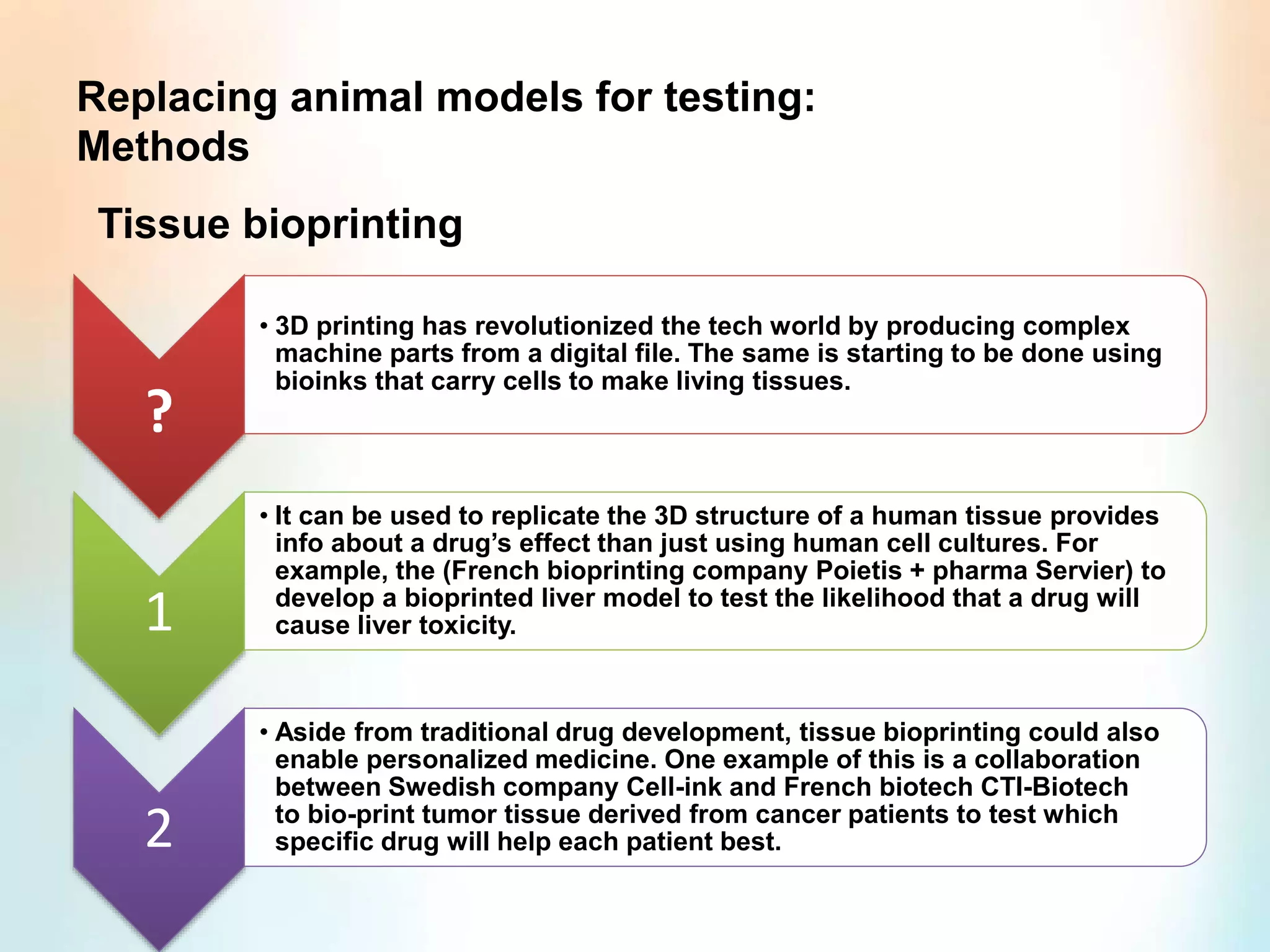
Methods
?
• 3D printing has revolutionized the tech world by producing complex
machine parts from a digital file. The same is starting to be done using
bioinks that carry cells to make living tissues.
1
• It can be used to replicate the 3D structure of a human tissue provides
info about a drug’s effect than just using human cell cultures. For
example, the (French bioprinting company Poietis + pharma Servier) to
develop a bioprinted liver model to test the likelihood that a drug will
cause liver toxicity.
2
• Aside from traditional drug development, tissue bioprinting could also
enable personalized medicine. One example of this is a collaboration
between Swedish company Cell-ink and French biotech CTI-Biotech
to bio-print tumor tissue derived from cancer patients to test which
specific drug will help each patient best.
Tissue bioprinting
Organoids:
 One alternative way could be miniature organs, called organoids. These 3D
organoids are grown using stem cells, which, with the right cocktail of nutrients
and treatments, can become the organ of choice.
 Like with bioprinting, organoid research is still in its early stages, but several
companies like Sun Bioscience in Switzerland is using organoids to model the
intestine and study the affect of genetic condition cystic fibrosis and Netherlands
develops organoids to model different types of cancer.
Organ-on-a-chip
It consists of growing cells inside of tiny chips
that mimic the structure and behavior of human
organs. It can test drugs more quickly and
cheaply than in animals.
It is used to model all sorts of organs and chips
can then be connected to each other to model
how a drug affects different organs as it travels
through the bloodstream. UK company CN Bio
trying to incorporates 10 organs on a single
chip.
 With advances in biotechnology, we’re now
able to better mimic human organs and
physiology. If these technologies prove better
than animal testing, they could eventually
replace some of the animal testing.
 But, can never be replaced fully, It is only
reducing our reliance on animal models.
Because, the information in each of our cell is
staggered.
 The human genome contains 20,000 to
25,000 genes, and we don’t know what all of
them do so, studying one gene is only small
part of story. We need to know how the
proteins encoded by those genes interact
with each other to generate metabolism.
 The only way to do that is to take the body
of an animal and look inside. So, we need
animal models still for research.
Thank you
ANY QUESTION?

Future of animal biotechnology

  • 1.
  • 2.
    Future Applications ofAnimal biotechnology Recover endangered species somehow and it will be great success……. 1 Animal biotechnology Future trends in artificial insemination 2 3 Replacing animal models with artificial models 4 Developing animals that have human diseases like Alzheimer’s for testing purpose
  • 3.
    Recovering endangered species: •Humans are one of about 1.75 million species that have been identified by science, and many believe that 30 million species or more inhabit this world. • Experts predict that at least one of every four of these life-forms may become extinct by the year 2050. We are facing a global crisis in biodiversity loss. • In a recent edition of the prestigious journal Science, the current rate of worldwide animal and plant specie has been estimated to be one specie lost every fifteen minutes.
  • 4.
    • This translatesinto 96 dying species per day, or 672 per week, or approximately 35,000 extinct species per year. •Reproductive Technologies:  Cloning could be a game-changer when it comes to helping recovering mammals. Cloning bio-banked cell lines could help restore genetic diversity to endangered species. The last male northern white rhinoceros, Sudan, died leaving only two females alive. In an effort to save the species, scientists at the San Diego Zoo Global are developing stem cell technologies to create a new generation of northern white rhinos. Recovering species
  • 6.
    • Since theearly 2000s, researchers cloned several endangered and even extinct mammals but they died due to some reasons. • One of the newest reproductive tools is genome editing. Using CRISPR-Cas9 technology, University of California, Davis scientists have bred a generation of hornless dairy cattle. • "Once cloning of endangered animals is properly established, it will be a very powerful tool," Loi says. "If something can be done, it will be done in 10 years." BIOBANKING: Biobanks store biological samples for research and as a backup resource to preserve genetic diversity. Examples include the San Diego Frozen Zoo and Frozen Ark projects, and numerous seed banks. Samples provides tissues, cell lines, and genetic information for recovering endangered species through reproductive technologies.
  • 8.
    . Genomics: • The genomesof extinct species such as the woolly mammoth, thylacine and passenger pigeon are also attainable due to improved techniques. • This growing database of genomes, combined with advances in big data and artificial intelligence, allows researchers to screen entire communities through DNA left in their environments , establishing non-invasive means of tracking species. • All this bioinformatic information provides genomic insight to improve monitoring, management, and restoration of endangered wildlife. • The latest DNA sequencing tools bring the science into the field for real-time results and will one day make data-based decisions possible in actionable timeframes.
  • 10.
    Future trends inArtificial Insemination: It is highly probable that the use of AI in livestock will continue to increase. AI not only facilitates more effective and efficient livestock production. But can also be coupled to other developing biotechnologies, such as cryopreservation, selection of robust spermatozoa by single layer centrifugation, and sperm sex selection. Improve livestock production: The use of AI in sheep and goats in the future, with an emphasis on improving production traits by the introduction of superior genes.
  • 11.
    One disadvantage ofAI is that natural selection within the female reproductive tract to select best spermatozoa may be bypassed when AI is utilized. Several in vitro procedures have been suggested that could be used to mimic selection of good quality spermatozoa in female reproductive tract. (fit biomimetric def) Biomimetic sperm selection: These include sperm processing procedures such as swim-up, sperm migration, filtration and colloid centrifugation. Colloid centrifugation is most widely used technique.
  • 12.
    Replacing animal modelsfor testing: • As we know, in today world animal testing has been used excessively for measuring the efficacy and safety of new treatments. • And somehow, it concerns ethical issues because no matter how and why we are using them but the matter of fact is that we are brutally torturing them for our benefits and annually large number of animals lost their life and in most cases the research does not provide the expected result. • Like according to one report of FDA 95% of drugs after animal testing were rejected and cannot be launched in market because the environment is another factor that how metabolism of organism behave. • As one strain of mice show different effect of drug than the other strain of same specie live in different environment. So, it is our major concern to maintain certain limits and rights for use of animal testing.
  • 13.
    Replacing animal modelsfor testing: The vast majority of animal research is not testing drugs but doing basic research and producing genetically modified mice. Half of all animal experiments are now conducted at universities.  Eye Irritancy, Acute Toxicity, Repeated Dose Toxicity, Skin Irritation, Skin Sensitization, Dermal Penetration and include forcing mice and rats to inhale toxic fumes, force-feeding dogs pesticides, and dripping corrosive chemicals into rabbits' sensitive eyes. Over 100 million animals are burned, crippled, poisoned, and abused in US labs every year. 92% of experimental drugs that are safe and effective in animals fail in human clinical trials because they are too dangerous or don't work.  These alternatives to animal testing include sophisticated tests using human cells and tissues (also known as in vitro methods), advanced computer-modeling techniques (often referred to as in silico models), and studies with human volunteers.
  • 14.
    Replacing animal modelsfor testing: Methods ? • 3D printing has revolutionized the tech world by producing complex machine parts from a digital file. The same is starting to be done using bioinks that carry cells to make living tissues. 1 • It can be used to replicate the 3D structure of a human tissue provides info about a drug’s effect than just using human cell cultures. For example, the (French bioprinting company Poietis + pharma Servier) to develop a bioprinted liver model to test the likelihood that a drug will cause liver toxicity. 2 • Aside from traditional drug development, tissue bioprinting could also enable personalized medicine. One example of this is a collaboration between Swedish company Cell-ink and French biotech CTI-Biotech to bio-print tumor tissue derived from cancer patients to test which specific drug will help each patient best. Tissue bioprinting
  • 15.
    Organoids:  One alternativeway could be miniature organs, called organoids. These 3D organoids are grown using stem cells, which, with the right cocktail of nutrients and treatments, can become the organ of choice.  Like with bioprinting, organoid research is still in its early stages, but several companies like Sun Bioscience in Switzerland is using organoids to model the intestine and study the affect of genetic condition cystic fibrosis and Netherlands develops organoids to model different types of cancer. Organ-on-a-chip It consists of growing cells inside of tiny chips that mimic the structure and behavior of human organs. It can test drugs more quickly and cheaply than in animals. It is used to model all sorts of organs and chips can then be connected to each other to model how a drug affects different organs as it travels through the bloodstream. UK company CN Bio trying to incorporates 10 organs on a single chip.
  • 16.
     With advancesin biotechnology, we’re now able to better mimic human organs and physiology. If these technologies prove better than animal testing, they could eventually replace some of the animal testing.  But, can never be replaced fully, It is only reducing our reliance on animal models. Because, the information in each of our cell is staggered.  The human genome contains 20,000 to 25,000 genes, and we don’t know what all of them do so, studying one gene is only small part of story. We need to know how the proteins encoded by those genes interact with each other to generate metabolism.  The only way to do that is to take the body of an animal and look inside. So, we need animal models still for research.
  • 17.