M.Sc. II
Roll No. 12
Introduction
 Cell culture is the process of obtaining cells from A plant or
animal and then growing them in an artificial environment.
 Contamination of cell culture is common problem in cell
culture labs.
 Cell culture contaminants can be divided into two categories:
 Chemical contaminants
 Biological / microbial contaminants
 Contamination frequency can be reduced by
 Following good aseptic techniques.
 Understanding sources of contamination.
Source of Contamination
 Failure in sterilization procedure for glassware and
pipettes
 Turbulence and particulates in the air.
 In room poorly maintained incubators and refrigerators.
Types of Microbial Contamination
 Bacteria
 Molds
 Mycoplasma
 Yeast
 Viruses
Bacterial Contamination
 Large, ubiquitous group of unicellular
microorganisms.
 Size - few micrometers in diameter
 Shape - variety of shapes
 Can grow along with yeast and molds.
 Visible microbial contamination
 It is most commonly found contaminants.
SIGNS-
 Infected cultures usually appear cloudy.
 May form thin film on surface.
 Sudden drop in pH of the culture medium.
 Visible under a low-power microscope as tiny, moving
granules.
 Higher magnification, bacteria variety of shapes of
bacteria.
Yeast Contamination
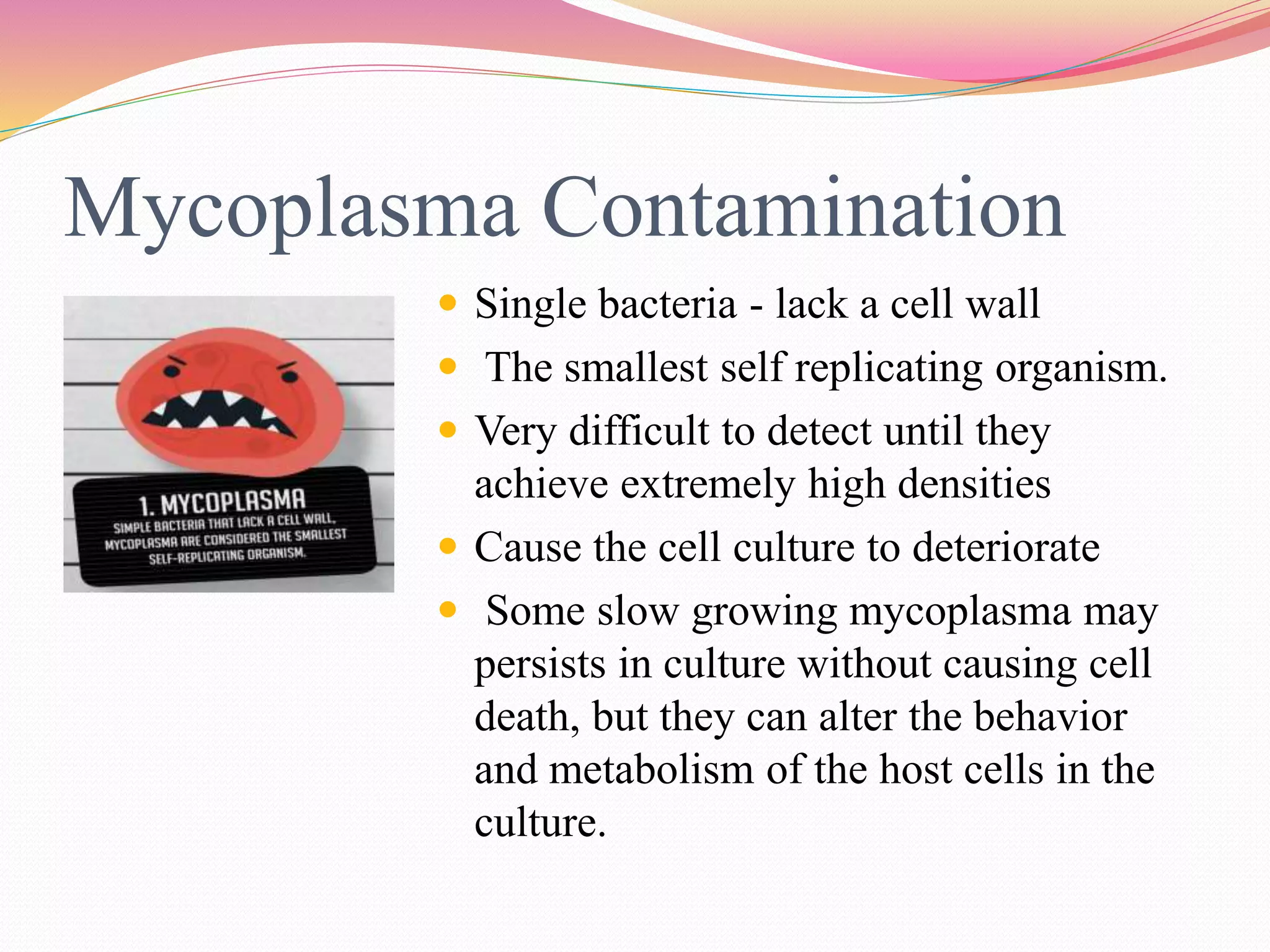
 Unicellular eukaryotic
microorganism in kingdom of
fungi.
 Size - few - 40 micrometers.
 Cause quick contamination.
 Easy to identify due to large size
SIGNS-
 Infected culture become
turbid.
 Very little change in pH until
contamination become heavy,
then pH usually increase.
 Under microscope, yeast
appears as oval or spherical
particles that may show
budding of smaller particles.
Stimulated phase contrast
image of cells in culture
contaminated with yeast.
Mold Contamination
 Molds are eukaryotes in the kingdom of
fungi.
 Grow as multicellular filaments called
hyphae.
 Spores can servive in extreme harsh
condition, dormant stage.
 Activated when found suitable growth
conditions.
SIGNS-
 Infected culture remain clear
until culture becomes heavily
infected and media become
turbid.
 pH remains stable during
initial infection, then rapidly
increase.
 Under a microscope ,
mycelia appears as thin
filamentous, sometimes with
a denser cluster of spores.
 With some toxic infection
sine deterioration of the cells
will be apparent.
Viral Contamination
 Viruses are microscopic infectious
agents that uses the host cells
machinery to reproduce.
 Detection is difficult due to extremely
small size.(20-400nanometer)
 Virally infected cell cultures can cause
serious health hazard to the laboratory
personnel.
 Not particularly common
SIGNS-
 No observable signs apart from
adverse effects on culture.
 Can be detected by electronic
microscopy, ELISA, or PCR with
appropriate viral primers.
Mycoplasma Contamination
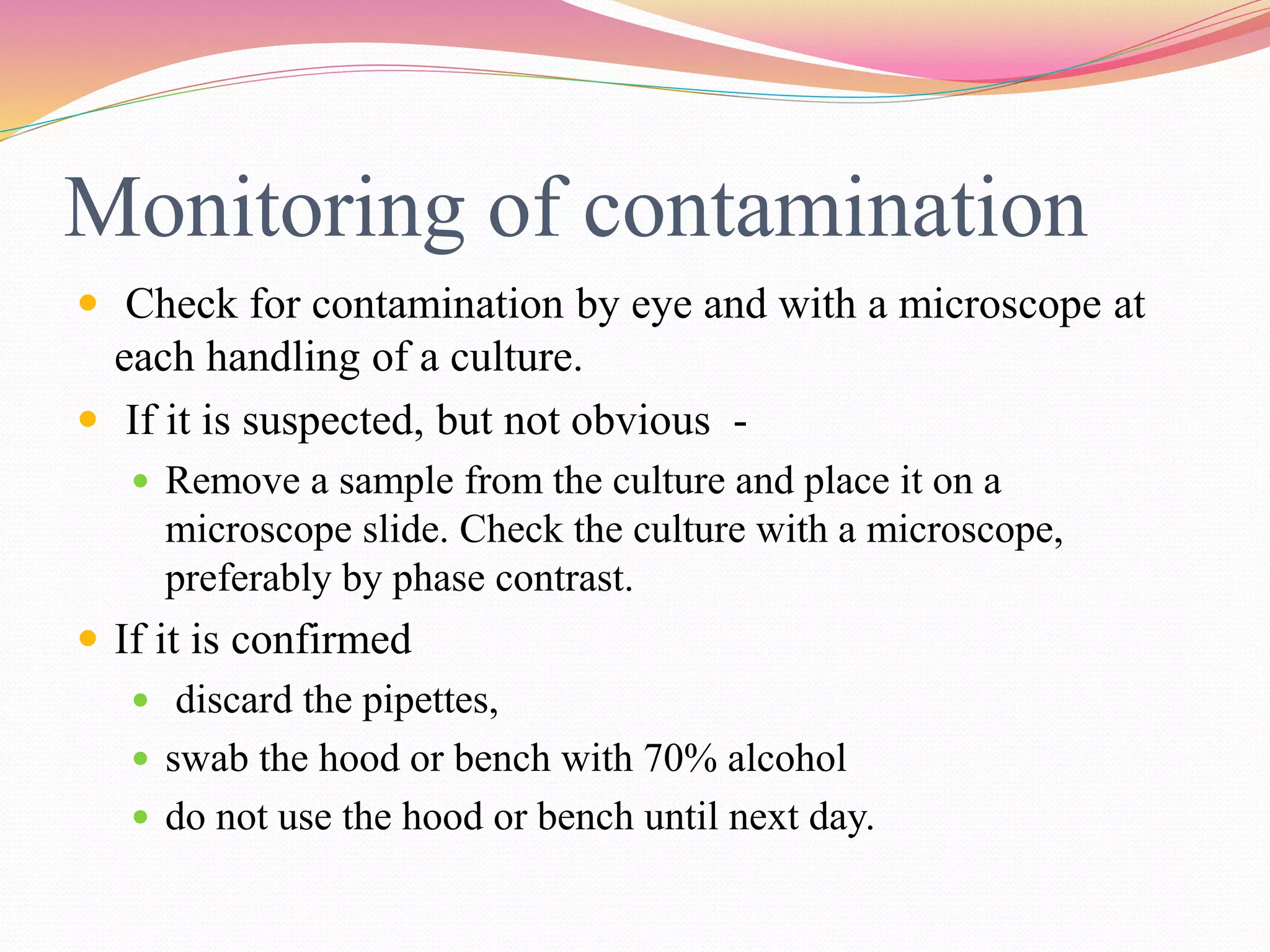
 Single bacteria - lack a cell wall
 The smallest self replicating organism.
 Very difficult to detect until they
achieve extremely high densities
 Cause the cell culture to deteriorate
 Some slow growing mycoplasma may
persists in culture without causing cell
death, but they can alter the behavior
and metabolism of the host cells in the
culture.
SIGNS-
 Decreased rate of cell proliferation,
reduced saturation density, and
agglutination in suspension cultures
 Detected by Fluorescent staining,
ELISA, PCR, autoradiography or
microbiological assays.
 Un-visible Microbial Contamination
Monitoring of contamination
 Check for contamination by eye and with a microscope at
each handling of a culture.
 If it is suspected, but not obvious -
 Remove a sample from the culture and place it on a
microscope slide. Check the culture with a microscope,
preferably by phase contrast.
 If it is confirmed
 discard the pipettes,
 swab the hood or bench with 70% alcohol
 do not use the hood or bench until next day.
 Record the nature of contamination.
 If the contamination is new and not widespread
 discard the culture, media feeding bottles, other
components (trypsin)
 If contamination is new and widespread (i.e. in at least
two different cultures) , discard all media, stock solution,
trypsin, etc.
 If the contamination is widespread, multispecific and
repeated, check the laboratory's sterilization procedure
Cross-contamination
 The transfer of different cells- directly or indirectly into
the cell culture is called as cross contamination.
 They have very short doubling times and high plating
efficiencies.
 Although these properties makes such cell lines valuable
experimental material, they also make them potentially
hazardous for cross-infection other cell line. Such HeLa
cell line.
To Avoid Cross-Contamination
 Obtain cell line from a reputable cell bank.
 Handle rapidly growing lines.
 Never use the same pipette for different cell lines.
 Never use the same bottle of medium, trypsin etc. for different
cell lines.
 Do not put pipette back into a bottle of medium, trypsin, etc.
 Add medium and any other reagents to the flask first and then
add cells last.
 Check the characteristics of the culture regularly and suspect
any sudden change in morphology, growth rate , etc.
 Cross-contamination or its absence may be confirmed by DNA
fingerprinting, karyotype,etc.
References
 Cell Culture Contamination: Sources, Consequences,
Prevention, and Elimination
Carolyn Kay Lincoln and Michael G. Gabridget
 Understanding and Managing Cell Culture
Contamination
John Ryan, Ph.D.
Contamination in Cultured Cells

Contamination in Cultured Cells

  • 1.
  • 2.
    Introduction  Cell cultureis the process of obtaining cells from A plant or animal and then growing them in an artificial environment.  Contamination of cell culture is common problem in cell culture labs.  Cell culture contaminants can be divided into two categories:  Chemical contaminants  Biological / microbial contaminants  Contamination frequency can be reduced by  Following good aseptic techniques.  Understanding sources of contamination.
  • 3.
    Source of Contamination Failure in sterilization procedure for glassware and pipettes  Turbulence and particulates in the air.  In room poorly maintained incubators and refrigerators. Types of Microbial Contamination  Bacteria  Molds  Mycoplasma  Yeast  Viruses
  • 4.
    Bacterial Contamination  Large,ubiquitous group of unicellular microorganisms.  Size - few micrometers in diameter  Shape - variety of shapes  Can grow along with yeast and molds.  Visible microbial contamination  It is most commonly found contaminants.
  • 5.
    SIGNS-  Infected culturesusually appear cloudy.  May form thin film on surface.  Sudden drop in pH of the culture medium.  Visible under a low-power microscope as tiny, moving granules.  Higher magnification, bacteria variety of shapes of bacteria.
  • 6.
    Yeast Contamination  Unicellulareukaryotic microorganism in kingdom of fungi.  Size - few - 40 micrometers.  Cause quick contamination.  Easy to identify due to large size
  • 7.
    SIGNS-  Infected culturebecome turbid.  Very little change in pH until contamination become heavy, then pH usually increase.  Under microscope, yeast appears as oval or spherical particles that may show budding of smaller particles. Stimulated phase contrast image of cells in culture contaminated with yeast.
  • 8.
    Mold Contamination  Moldsare eukaryotes in the kingdom of fungi.  Grow as multicellular filaments called hyphae.  Spores can servive in extreme harsh condition, dormant stage.  Activated when found suitable growth conditions.
  • 9.
    SIGNS-  Infected cultureremain clear until culture becomes heavily infected and media become turbid.  pH remains stable during initial infection, then rapidly increase.  Under a microscope , mycelia appears as thin filamentous, sometimes with a denser cluster of spores.  With some toxic infection sine deterioration of the cells will be apparent.
  • 10.
    Viral Contamination  Virusesare microscopic infectious agents that uses the host cells machinery to reproduce.  Detection is difficult due to extremely small size.(20-400nanometer)  Virally infected cell cultures can cause serious health hazard to the laboratory personnel.  Not particularly common SIGNS-  No observable signs apart from adverse effects on culture.  Can be detected by electronic microscopy, ELISA, or PCR with appropriate viral primers.
  • 11.
    Mycoplasma Contamination  Singlebacteria - lack a cell wall  The smallest self replicating organism.  Very difficult to detect until they achieve extremely high densities  Cause the cell culture to deteriorate  Some slow growing mycoplasma may persists in culture without causing cell death, but they can alter the behavior and metabolism of the host cells in the culture.
  • 12.
    SIGNS-  Decreased rateof cell proliferation, reduced saturation density, and agglutination in suspension cultures  Detected by Fluorescent staining, ELISA, PCR, autoradiography or microbiological assays.  Un-visible Microbial Contamination
  • 13.
    Monitoring of contamination Check for contamination by eye and with a microscope at each handling of a culture.  If it is suspected, but not obvious -  Remove a sample from the culture and place it on a microscope slide. Check the culture with a microscope, preferably by phase contrast.  If it is confirmed  discard the pipettes,  swab the hood or bench with 70% alcohol  do not use the hood or bench until next day.
  • 14.
     Record thenature of contamination.  If the contamination is new and not widespread  discard the culture, media feeding bottles, other components (trypsin)  If contamination is new and widespread (i.e. in at least two different cultures) , discard all media, stock solution, trypsin, etc.  If the contamination is widespread, multispecific and repeated, check the laboratory's sterilization procedure
  • 15.
    Cross-contamination  The transferof different cells- directly or indirectly into the cell culture is called as cross contamination.  They have very short doubling times and high plating efficiencies.  Although these properties makes such cell lines valuable experimental material, they also make them potentially hazardous for cross-infection other cell line. Such HeLa cell line.
  • 16.
    To Avoid Cross-Contamination Obtain cell line from a reputable cell bank.  Handle rapidly growing lines.  Never use the same pipette for different cell lines.  Never use the same bottle of medium, trypsin etc. for different cell lines.  Do not put pipette back into a bottle of medium, trypsin, etc.  Add medium and any other reagents to the flask first and then add cells last.  Check the characteristics of the culture regularly and suspect any sudden change in morphology, growth rate , etc.  Cross-contamination or its absence may be confirmed by DNA fingerprinting, karyotype,etc.
  • 17.
    References  Cell CultureContamination: Sources, Consequences, Prevention, and Elimination Carolyn Kay Lincoln and Michael G. Gabridget  Understanding and Managing Cell Culture Contamination John Ryan, Ph.D.