Cell Culture Based Vaccines
Shashank Patil
171233
M.Sc. Biotechnology-II
Introduction
Vaccine and Vaccination
Vaccine can be defined as the weakened or attenuated form of viral antigenic structures
which provoke the adaptive immune system against specific infections.
Vaccination involves the administration of vaccine into the affected individual prior to the
exposure to actual infection.
Types of Vaccines
 Live-attenuated Vaccines
E.g. Measles, Mumps, Smallpox etc.
 Inactivated Vaccines
E.g. Hepatitis A, Rabies etc.
 Subunit, Recombinant, Polysaccharide & Conjugate Vaccines
E.g. Hepatitis B, HPV, Shingles etc.
 Toxoid Vaccines
Diphtheria, Tetanus etc.
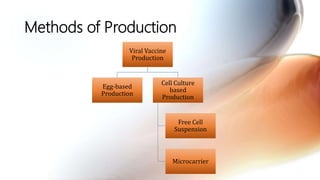
Methods of Production
Viral Vaccine
Production
Egg-based
Production
Cell Culture
based
Production
Free Cell
Suspension
Microcarrier
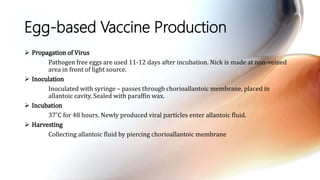
Egg-based Vaccine Production
 Propagation of Virus
Pathogen free eggs are used 11-12 days after incubation. Nick is made at non-veined
area in front of light source.
 Inoculation
Inoculated with syringe – passes through chorioallantoic membrane, placed in
allantoic cavity. Sealed with paraffin wax.
 Incubation
37˚C for 48 hours. Newly produced viral particles enter allantoic fluid.
 Harvesting
Collecting allantoic fluid by piercing chorioallantoic membrane
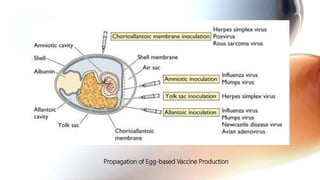
Propagation of Egg-based Vaccine Production
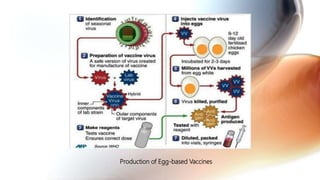
Production of Egg-based Vaccines
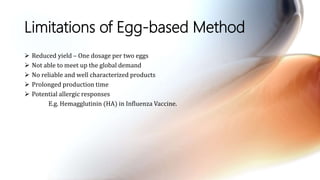
Limitations of Egg-based Method
 Reduced yield – One dosage per two eggs
 Not able to meet up the global demand
 No reliable and well characterized products
 Prolonged production time
 Potential allergic responses
E.g. Hemagglutinin (HA) in Influenza Vaccine.
Importance of Cell Culture based Method
 No embryonated chicken eggs needed
 Reduce the time by 4-6 months spent on egg supply
 High initial purity
 Reduced contamination in viable and non-viable parts
 Could supply for multiple strain changes
 Suitable for large scale manufacture
 Parameters can be ramped up routinely
 Cost effective
 Sufficient production at the time of pandemic
Types of Cells Used
 Primary Cells
From safe animals or embryos
Protease used for dissociation
First practiced in 1959 to produced IPV vaccine
From the kidney of clinically healthy monkeys
 Diploid Cell Lines
Human Diploid Cell (HDC)
Produced as an alternative to kidney cells
WI-38 and MRC-5 were selected by EU and other NHA’s
Key cell lines in the evolution of different cell lines
US Regulatory Agency: WI-38 for Polio – 1972
: WI-38 for Rubella - 1977
 Continuous Cell Lines
Normal cells enter senescence phase
Transformation phenomenon becomes beneficial
Immortalization achieved by mutagenesis
Mutagens - QT35 and LMH
Vero cells isolated from African green monkeys
Most widely accepted
 Insect and Avian Cells
Established from lepidopterans
Spodoptera frugiperda Sf9 and Trichoplusiani Hi-5
Susceptible to Autographa califomica multi-capsid NPV
Swine Fever Virus (CSFV) Vaccine – Pioneer Vaccine
Stable Duck cell line EB66 from ESC’s by immortalization
Found to be stable and having ES-specific markers on their cell surface
Able to express telomerase activity
 Stem Cells
Differ from other cells
Predominant stem cell – produce cell progenitors of
Differentiated cell types
Pluripotent
Different tissue specific cells can be developed for virus productivity
Non-transformed nature is considered as pre-requisite
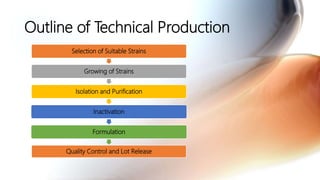
Outline of Technical Production
Selection of Suitable Strains
Growing of Strains
Isolation and Purification
Inactivation
Formulation
Quality Control and Lot Release
Process of Technical Production
 Selection of Suitable Strain
Depends on efficiency and secondary effects
Should be obtained from recognized culture with documented provenance
Should grow in a chemically defined synthetic medium that does not contain animal-derived
components
Suitable for industrial processes
History of the strain, including details of its isolation, identification, and maintenance for
product registration
 Serum-Based Media: Typical acceptance criteria for serum can vary as much as ¹20 percent.
 Contribute to batch-to-batch variations during fermentation.
 Contamination of serum with adventitious agents is always possible.
 If the target protein is functionally, biochemically, or physically related to a serum protein, it
can be difficult to separate the target protein from the serum protein during purification.
 A serum-based medium is not always available, especially for largescale cell-culture use.
 Serum Free Media
 They are much better defined than serum-based media.
 The potential source of infectious agents has been removed.
 There is much less lot-to-lot variability than for serum-based media.
 The purification of the desired protein is easier, requires fewer steps, and costs less.
 Serum free media contain readily available components that are usually non-animal derived
and have relatively easy storage requirements.
 Shortages are unlikely.
 Bulk Production
 Begins with selection of suitable strains. Bulk production involves fermenter equipped with
numerous parameters to control physiological factors.
 Microcarrier Method
Microbeads anchored with cells – allowed to growth – surface area – two rounds of
growth.
 Free Cell Suspension Method
With the same principle and large amount of media – cells are freely suspended
 Easier scaling of the system and no limit of the volume.
 Stringent Regulatory Requirements of Bulk Production
 Based on establishing a pure and accurate production of vaccine
 Residual host – Cell DNA concentrations must be <10ng
 Host cell protein concentration are controlled
 Proteins in new vaccine must be <1¾g per dose
 Assays to analyse protein concentration - immunoassay, immunoblot,
HPLC, enzyme activity, flow cytometry, and optical biosensors.
 Effects of changes in fermentation conditions
 Intracellular aggregation, Proteolysis, Post-transcriptional modifications and differences in
relative impurity levels.
 They can have a signicant impact on downstream processing and the quality of the nal
product.
 Isolation and Purification
Product isolation is the removal of those components whose properties vary markedly from
that of the desired product.
Purification selectively separates and retains the desired product at the highest purity per its
pre-determined specification (Remove unwanted compounds)
Centrifugation is used to separation and purification of pathogenic viral antigens and other
agents used in the production of vaccine.
Centrifugation is also used to remove dead cells, cell debris etc.
Differential and Density Gradient Centrifugation
Filtration and Ultrafiltration
Ion exchange and Affinity Chromatography are also practiced
 Virus Inactivation
Viruses can be lipid-coated(enveloped) or non-enveloped.
Virus inactivation involves dismantling a virus’s ability to infect cells without actually
eliminating the virus.
Virus inactivation works by one of the following two mechanisms
By attacking the viral envelope or capsid and destroying its ability to infect or interact with
cells.
By disrupting the viral DNA or RNA and preventing replication.
Mechanisms of Virus Inactivation
 Solvent/detergent (S/D) inactivation
Effective with lipid-coated viruses.
The detergents used in this method, Disrupts the interactions between molecules in the lipid
coat , rendering the coat dysfunctional and impeding replication.
Detergent: Triton-X 100
 Pasteurization
Effective for both non-lipid and lipid-coated viruses. Involves increasing the temperature of
solution to a value that will sufficiently denature the virus (at 600 C for 10 hours)
 Acidic pH inactivation (Low pH Treatment)
Most effective with lipid-coated viruses.
Acidic conditions deactivate virus.
Incubation typically occurs at a pH of 4 and lasts anywhere between 6 hours and 21 days.
 Ultraviolet (UV) inactivation
UV rays can be used to inactivate viruses since virus particles are small and the UV rays can
reach the genetic material, inducing the dimerization of nucleic acids.
Once the DNA dimerized, the virus particles cannot replicate their genetic material.
 Extraction of Nucleic acids, Membrane and Capsule also plays an important role on the
inactivation of viruses.
 For the extraction of above elements either Chromatographic or Solvent extraction methods
are preferred.
 Addition of Adjuvants
Substances added to vaccines to improve antibody production and the immune response of
the recipient or to decrease the amount of antigen (dose size) required in the vaccine
 Most effective way to increase global vaccine manufacturing capacity
E.g. MF59 and M9
 Formulation
Formulation chiefly involves determination of the final output format of the vaccine – Whole
Virus, Subunit or Split Vaccine
For example, most egg-based vaccines are split or subunit vaccines. A vaccine for pandemic
influenza is most likely to be a whole-virus vaccine.
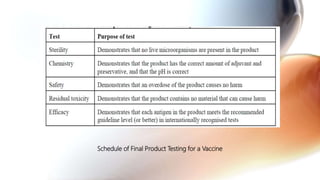
Schedule of Final Product Testing for a Vaccine
 Quality Control
 Increase in virulence tests
Organism might be shed from the host and transmitted to contact animals, causing disease if it
retains residual virulence or reverts to virulence.
 Assessing risk to the environment
The ability of each live vaccine to shed, to spread to contact target and non-target animals, and
to persist in the environment must be evaluated to provide information for assessing the risk of
the vaccine to the environment, taking into account human health.
 Interference tests
For products with two or more antigenic components, tests must confirm that there is no
interference between individual components, that is, one component causing a decrease in
the protective immunological response to another component.
 Consistency of production
Prior to marketing approval of any new product, each establishment should produce in its
facilities three consecutive production batches/serials of completed product to evaluate the
consistency of production.
Stability tests
Stability studies (based on an acceptable potency test) are required to establish the validity
of the expiry date that appears on the product package.
 Lot Release
 Batch/serial release for distribution
Prior to release, the manufacturer must test each batch/serial for purity, safety, and potency.
Batch/serial purity test
Purity is determined by testing for a variety of contaminants.
Tests to detect contaminants are performed on: master seeds, primary cells, MCSs
(Master cell stock), ingredients of animal origin if not subjected to sterilization (e.g.
fetal bovine serum, bovine albumin, or trypsin), and each batch of final product
prior to release.
Batch/serial safety test
Batches are considered satisfactory if local and systemic reactions to vaccination
with the batch to be released are in line with those described in the registration
dossier and product literature.
Batch/serial potency test
Batch/serial potency tests, required for each batch prior to release, are designed to
correlate with the host animal vaccination–challenge efficacy studies.
 Other tests
 Depending on the form of vaccine being produced, certain tests may be indicated.
These tests may concern - The level of moisture contained in desiccated products,
The level of residual inactivate in killed products,
The complete inactivation of killed products,
pH Value
The level of preservatives and permitted antibiotics,
Physical stability of adjuvant,
Retention of vacuum in desiccated products,
A general physical examination of the final vaccine
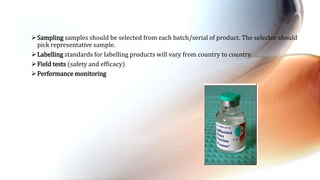
Sampling samples should be selected from each batch/serial of product. The selector should
pick representative sample.
Labelling standards for labelling products will vary from country to country.
Field tests (safety and efficacy)
Performance monitoring
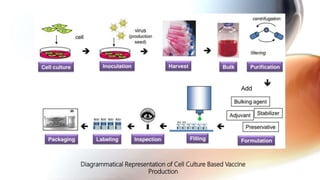
Diagrammatical Representation of Cell Culture Based Vaccine
Production
Different Vaccines Produced
 Influenza A
Classified based on the presence of surface antigens; Hemagglutinin (HA) and Neuraminidase
(NA).
E.g. H1N1 and H3N2 etc.
 Influenza B
Classified into two lineages - B/Yamagata and B/Victoria
 Cells used are MDCK and Vero Cells
 Trade name of vaccine – Influvac – Developed from Cytodex 3 Microcarriers
 Licensed in Netherlands
 E.g. Flucelvax, Celvapan and Preflucel
Japanese Encephalitis
 Mosquito-borne viral disease that produces inflammation in the CNS.
Some East Asian and African regions have been considered as endemic parts of the world
 More frequent in South Asian countries
 Inactivated by Formalin and grown in Mouse brain cells
 Various adverse effects are present
 Rabies
 Rabies vaccine was derived from nervous tissue.
 Currently prepared by cultivating rabies virus in Vero and BHK-21 Cells.
 WHO recommended vaccine is manufactured in Vero cell lines.
 Cell culture based vaccines along with Immunoglobulins are preferred
 Combined vaccine of DNA of rabies and different dilutions of rabies virus vaccine yields
higher level of neutralizing antibodies
 Dengue
 Currently, there is no potent treatment available for dengue, apart from supportive measures
for infected patients
 Many attempts had been made to develop a vaccine since 1930s
 There is no licensed vaccine available for the treatment of the disease
 Two vaccines are in developmental stages, which are live attenuated vaccines based on Vero
cell line
 One of these two vaccines have been developed by Bloomberg School of Public Health (USA)
and the NIH (USA) by using DEN-4 mutated serotype.
 A Phase III trial is now planned for this vaccine.
 Ebola
 Affects both human and non-human primates.
 Exhibits high degree of pathogenicity and transmissibility
 Could be used as bioterrorism agent
 First vaccine produced in 1980 – tested in guinea pigs and showed protection
 Subsequent productions by inactivation through formalin, heat or gamma radiations
 Ineffective to provide protection in nonhuman primates
Conclusion
 Cell culture based vaccines have the potential to replace egg-based vaccines
 It is compulsory to explore the most appropriate combination for a candidate cell line for a
specific isolate
 Impact of new cell lines and vaccine potency are crucial issues that must be evaluated
 Can be manufactured in less amount of time for diverse pandemics
 The currently adapted procedures for the virus isolation and subsequent passaging in
eggs/cells should be critically assessed
Future Perspectives
A lot of research work needs to be done to ensure complete human safety according to
FDA/EU/WHO guidelines.
Innovative methodologies to both formulation manufacturing procedures based on cell lines
Most encouraging approaches in development are those targeting the most immunogenic
viral epitopes
Acknowledging the above methodologies may improve the status of vaccines for human and
animal viral diseases
References
1. Zahoor, M.A. et.al. Cell culture-based viral vaccines: current status and future prospects,
Future Virol. 10.2217/fvl-2016-0006, ISSN 1746-0794.
2. Matthews, J. Egg-Based Production of Influenza Vaccine: 30 Years of Commercial
Experience, The Bridge, 36:3, 17-24, 2006.
3. Rappuoli, R. Cell-Culture-Based Vaccine Production: Technological Options, The Bridge,
36:3, 25-30, 2006.
4. Wadman, M. The vaccine race: science, politics, and the human costs of defining disease,
Culture Research, Viking Publishers, New York, 448, 2017.
5. Understanding vaccines, vaccine development and production; a consumer guide by
Health Sciences Authority (HSA), Government of Malaysia, November 2009.

Cell culture based vaccines

  • 1.
    Cell Culture BasedVaccines Shashank Patil 171233 M.Sc. Biotechnology-II
  • 2.
    Introduction Vaccine and Vaccination Vaccinecan be defined as the weakened or attenuated form of viral antigenic structures which provoke the adaptive immune system against specific infections. Vaccination involves the administration of vaccine into the affected individual prior to the exposure to actual infection.
  • 3.
    Types of Vaccines Live-attenuated Vaccines E.g. Measles, Mumps, Smallpox etc.  Inactivated Vaccines E.g. Hepatitis A, Rabies etc.  Subunit, Recombinant, Polysaccharide & Conjugate Vaccines E.g. Hepatitis B, HPV, Shingles etc.  Toxoid Vaccines Diphtheria, Tetanus etc.
  • 4.
    Methods of Production ViralVaccine Production Egg-based Production Cell Culture based Production Free Cell Suspension Microcarrier
  • 5.
    Egg-based Vaccine Production Propagation of Virus Pathogen free eggs are used 11-12 days after incubation. Nick is made at non-veined area in front of light source.  Inoculation Inoculated with syringe – passes through chorioallantoic membrane, placed in allantoic cavity. Sealed with paraffin wax.  Incubation 37˚C for 48 hours. Newly produced viral particles enter allantoic fluid.  Harvesting Collecting allantoic fluid by piercing chorioallantoic membrane
  • 6.
    Propagation of Egg-basedVaccine Production
  • 7.
  • 8.
    Limitations of Egg-basedMethod  Reduced yield – One dosage per two eggs  Not able to meet up the global demand  No reliable and well characterized products  Prolonged production time  Potential allergic responses E.g. Hemagglutinin (HA) in Influenza Vaccine.
  • 9.
    Importance of CellCulture based Method  No embryonated chicken eggs needed  Reduce the time by 4-6 months spent on egg supply  High initial purity  Reduced contamination in viable and non-viable parts  Could supply for multiple strain changes  Suitable for large scale manufacture  Parameters can be ramped up routinely  Cost effective  Sufficient production at the time of pandemic
  • 10.
    Types of CellsUsed  Primary Cells From safe animals or embryos Protease used for dissociation First practiced in 1959 to produced IPV vaccine From the kidney of clinically healthy monkeys
  • 11.
     Diploid CellLines Human Diploid Cell (HDC) Produced as an alternative to kidney cells WI-38 and MRC-5 were selected by EU and other NHA’s Key cell lines in the evolution of different cell lines US Regulatory Agency: WI-38 for Polio – 1972 : WI-38 for Rubella - 1977
  • 12.
     Continuous CellLines Normal cells enter senescence phase Transformation phenomenon becomes beneficial Immortalization achieved by mutagenesis Mutagens - QT35 and LMH Vero cells isolated from African green monkeys Most widely accepted
  • 13.
     Insect andAvian Cells Established from lepidopterans Spodoptera frugiperda Sf9 and Trichoplusiani Hi-5 Susceptible to Autographa califomica multi-capsid NPV Swine Fever Virus (CSFV) Vaccine – Pioneer Vaccine Stable Duck cell line EB66 from ESC’s by immortalization Found to be stable and having ES-specific markers on their cell surface Able to express telomerase activity
  • 14.
     Stem Cells Differfrom other cells Predominant stem cell – produce cell progenitors of Differentiated cell types Pluripotent Different tissue specific cells can be developed for virus productivity Non-transformed nature is considered as pre-requisite
  • 15.
    Outline of TechnicalProduction Selection of Suitable Strains Growing of Strains Isolation and Purification Inactivation Formulation Quality Control and Lot Release
  • 16.
    Process of TechnicalProduction  Selection of Suitable Strain Depends on efficiency and secondary effects Should be obtained from recognized culture with documented provenance Should grow in a chemically defined synthetic medium that does not contain animal-derived components Suitable for industrial processes History of the strain, including details of its isolation, identification, and maintenance for product registration
  • 17.
     Serum-Based Media:Typical acceptance criteria for serum can vary as much as ¹20 percent.  Contribute to batch-to-batch variations during fermentation.  Contamination of serum with adventitious agents is always possible.  If the target protein is functionally, biochemically, or physically related to a serum protein, it can be difficult to separate the target protein from the serum protein during purification.  A serum-based medium is not always available, especially for largescale cell-culture use.  Serum Free Media  They are much better defined than serum-based media.  The potential source of infectious agents has been removed.  There is much less lot-to-lot variability than for serum-based media.  The purification of the desired protein is easier, requires fewer steps, and costs less.  Serum free media contain readily available components that are usually non-animal derived and have relatively easy storage requirements.  Shortages are unlikely.
  • 18.
     Bulk Production Begins with selection of suitable strains. Bulk production involves fermenter equipped with numerous parameters to control physiological factors.  Microcarrier Method Microbeads anchored with cells – allowed to growth – surface area – two rounds of growth.  Free Cell Suspension Method With the same principle and large amount of media – cells are freely suspended  Easier scaling of the system and no limit of the volume.
  • 19.
     Stringent RegulatoryRequirements of Bulk Production  Based on establishing a pure and accurate production of vaccine  Residual host – Cell DNA concentrations must be <10ng  Host cell protein concentration are controlled  Proteins in new vaccine must be <1µg per dose  Assays to analyse protein concentration - immunoassay, immunoblot, HPLC, enzyme activity, flow cytometry, and optical biosensors.  Effects of changes in fermentation conditions  Intracellular aggregation, Proteolysis, Post-transcriptional modifications and differences in relative impurity levels.  They can have a significant impact on downstream processing and the quality of the final product.
  • 20.
     Isolation andPurification Product isolation is the removal of those components whose properties vary markedly from that of the desired product. Purification selectively separates and retains the desired product at the highest purity per its pre-determined specification (Remove unwanted compounds) Centrifugation is used to separation and purification of pathogenic viral antigens and other agents used in the production of vaccine. Centrifugation is also used to remove dead cells, cell debris etc. Differential and Density Gradient Centrifugation Filtration and Ultrafiltration Ion exchange and Affinity Chromatography are also practiced
  • 21.
     Virus Inactivation Virusescan be lipid-coated(enveloped) or non-enveloped. Virus inactivation involves dismantling a virus’s ability to infect cells without actually eliminating the virus. Virus inactivation works by one of the following two mechanisms By attacking the viral envelope or capsid and destroying its ability to infect or interact with cells. By disrupting the viral DNA or RNA and preventing replication.
  • 22.
    Mechanisms of VirusInactivation  Solvent/detergent (S/D) inactivation Effective with lipid-coated viruses. The detergents used in this method, Disrupts the interactions between molecules in the lipid coat , rendering the coat dysfunctional and impeding replication. Detergent: Triton-X 100  Pasteurization Effective for both non-lipid and lipid-coated viruses. Involves increasing the temperature of solution to a value that will sufficiently denature the virus (at 600 C for 10 hours)
  • 23.
     Acidic pHinactivation (Low pH Treatment) Most effective with lipid-coated viruses. Acidic conditions deactivate virus. Incubation typically occurs at a pH of 4 and lasts anywhere between 6 hours and 21 days.  Ultraviolet (UV) inactivation UV rays can be used to inactivate viruses since virus particles are small and the UV rays can reach the genetic material, inducing the dimerization of nucleic acids. Once the DNA dimerized, the virus particles cannot replicate their genetic material.  Extraction of Nucleic acids, Membrane and Capsule also plays an important role on the inactivation of viruses.  For the extraction of above elements either Chromatographic or Solvent extraction methods are preferred.
  • 24.
     Addition ofAdjuvants Substances added to vaccines to improve antibody production and the immune response of the recipient or to decrease the amount of antigen (dose size) required in the vaccine  Most effective way to increase global vaccine manufacturing capacity E.g. MF59 and M9  Formulation Formulation chiefly involves determination of the final output format of the vaccine – Whole Virus, Subunit or Split Vaccine For example, most egg-based vaccines are split or subunit vaccines. A vaccine for pandemic influenza is most likely to be a whole-virus vaccine.
  • 25.
    Schedule of FinalProduct Testing for a Vaccine
  • 26.
     Quality Control Increase in virulence tests Organism might be shed from the host and transmitted to contact animals, causing disease if it retains residual virulence or reverts to virulence.  Assessing risk to the environment The ability of each live vaccine to shed, to spread to contact target and non-target animals, and to persist in the environment must be evaluated to provide information for assessing the risk of the vaccine to the environment, taking into account human health.
  • 27.
     Interference tests Forproducts with two or more antigenic components, tests must confirm that there is no interference between individual components, that is, one component causing a decrease in the protective immunological response to another component.  Consistency of production Prior to marketing approval of any new product, each establishment should produce in its facilities three consecutive production batches/serials of completed product to evaluate the consistency of production. Stability tests Stability studies (based on an acceptable potency test) are required to establish the validity of the expiry date that appears on the product package.
  • 28.
     Lot Release Batch/serial release for distribution Prior to release, the manufacturer must test each batch/serial for purity, safety, and potency. Batch/serial purity test Purity is determined by testing for a variety of contaminants. Tests to detect contaminants are performed on: master seeds, primary cells, MCSs (Master cell stock), ingredients of animal origin if not subjected to sterilization (e.g. fetal bovine serum, bovine albumin, or trypsin), and each batch of final product prior to release. Batch/serial safety test Batches are considered satisfactory if local and systemic reactions to vaccination with the batch to be released are in line with those described in the registration dossier and product literature. Batch/serial potency test Batch/serial potency tests, required for each batch prior to release, are designed to correlate with the host animal vaccination–challenge efficacy studies.
  • 29.
     Other tests Depending on the form of vaccine being produced, certain tests may be indicated. These tests may concern - The level of moisture contained in desiccated products, The level of residual inactivate in killed products, The complete inactivation of killed products, pH Value The level of preservatives and permitted antibiotics, Physical stability of adjuvant, Retention of vacuum in desiccated products, A general physical examination of the final vaccine
  • 30.
    Sampling samples shouldbe selected from each batch/serial of product. The selector should pick representative sample. Labelling standards for labelling products will vary from country to country. Field tests (safety and efficacy) Performance monitoring
  • 31.
    Diagrammatical Representation ofCell Culture Based Vaccine Production
  • 32.
    Different Vaccines Produced Influenza A Classified based on the presence of surface antigens; Hemagglutinin (HA) and Neuraminidase (NA). E.g. H1N1 and H3N2 etc.  Influenza B Classified into two lineages - B/Yamagata and B/Victoria  Cells used are MDCK and Vero Cells  Trade name of vaccine – Influvac – Developed from Cytodex 3 Microcarriers  Licensed in Netherlands  E.g. Flucelvax, Celvapan and Preflucel
  • 33.
    Japanese Encephalitis  Mosquito-borneviral disease that produces inflammation in the CNS. Some East Asian and African regions have been considered as endemic parts of the world  More frequent in South Asian countries  Inactivated by Formalin and grown in Mouse brain cells  Various adverse effects are present
  • 34.
     Rabies  Rabiesvaccine was derived from nervous tissue.  Currently prepared by cultivating rabies virus in Vero and BHK-21 Cells.  WHO recommended vaccine is manufactured in Vero cell lines.  Cell culture based vaccines along with Immunoglobulins are preferred  Combined vaccine of DNA of rabies and different dilutions of rabies virus vaccine yields higher level of neutralizing antibodies
  • 35.
     Dengue  Currently,there is no potent treatment available for dengue, apart from supportive measures for infected patients  Many attempts had been made to develop a vaccine since 1930s  There is no licensed vaccine available for the treatment of the disease  Two vaccines are in developmental stages, which are live attenuated vaccines based on Vero cell line  One of these two vaccines have been developed by Bloomberg School of Public Health (USA) and the NIH (USA) by using DEN-4 mutated serotype.  A Phase III trial is now planned for this vaccine.
  • 36.
     Ebola  Affectsboth human and non-human primates.  Exhibits high degree of pathogenicity and transmissibility  Could be used as bioterrorism agent  First vaccine produced in 1980 – tested in guinea pigs and showed protection  Subsequent productions by inactivation through formalin, heat or gamma radiations  Ineffective to provide protection in nonhuman primates
  • 37.
    Conclusion  Cell culturebased vaccines have the potential to replace egg-based vaccines  It is compulsory to explore the most appropriate combination for a candidate cell line for a specific isolate  Impact of new cell lines and vaccine potency are crucial issues that must be evaluated  Can be manufactured in less amount of time for diverse pandemics  The currently adapted procedures for the virus isolation and subsequent passaging in eggs/cells should be critically assessed
  • 38.
    Future Perspectives A lotof research work needs to be done to ensure complete human safety according to FDA/EU/WHO guidelines. Innovative methodologies to both formulation manufacturing procedures based on cell lines Most encouraging approaches in development are those targeting the most immunogenic viral epitopes Acknowledging the above methodologies may improve the status of vaccines for human and animal viral diseases
  • 39.
    References 1. Zahoor, M.A.et.al. Cell culture-based viral vaccines: current status and future prospects, Future Virol. 10.2217/fvl-2016-0006, ISSN 1746-0794. 2. Matthews, J. Egg-Based Production of Influenza Vaccine: 30 Years of Commercial Experience, The Bridge, 36:3, 17-24, 2006. 3. Rappuoli, R. Cell-Culture-Based Vaccine Production: Technological Options, The Bridge, 36:3, 25-30, 2006. 4. Wadman, M. The vaccine race: science, politics, and the human costs of defining disease, Culture Research, Viking Publishers, New York, 448, 2017. 5. Understanding vaccines, vaccine development and production; a consumer guide by Health Sciences Authority (HSA), Government of Malaysia, November 2009.