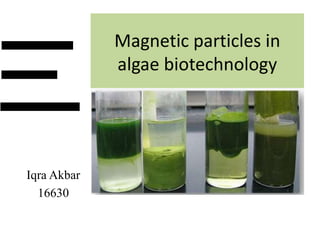
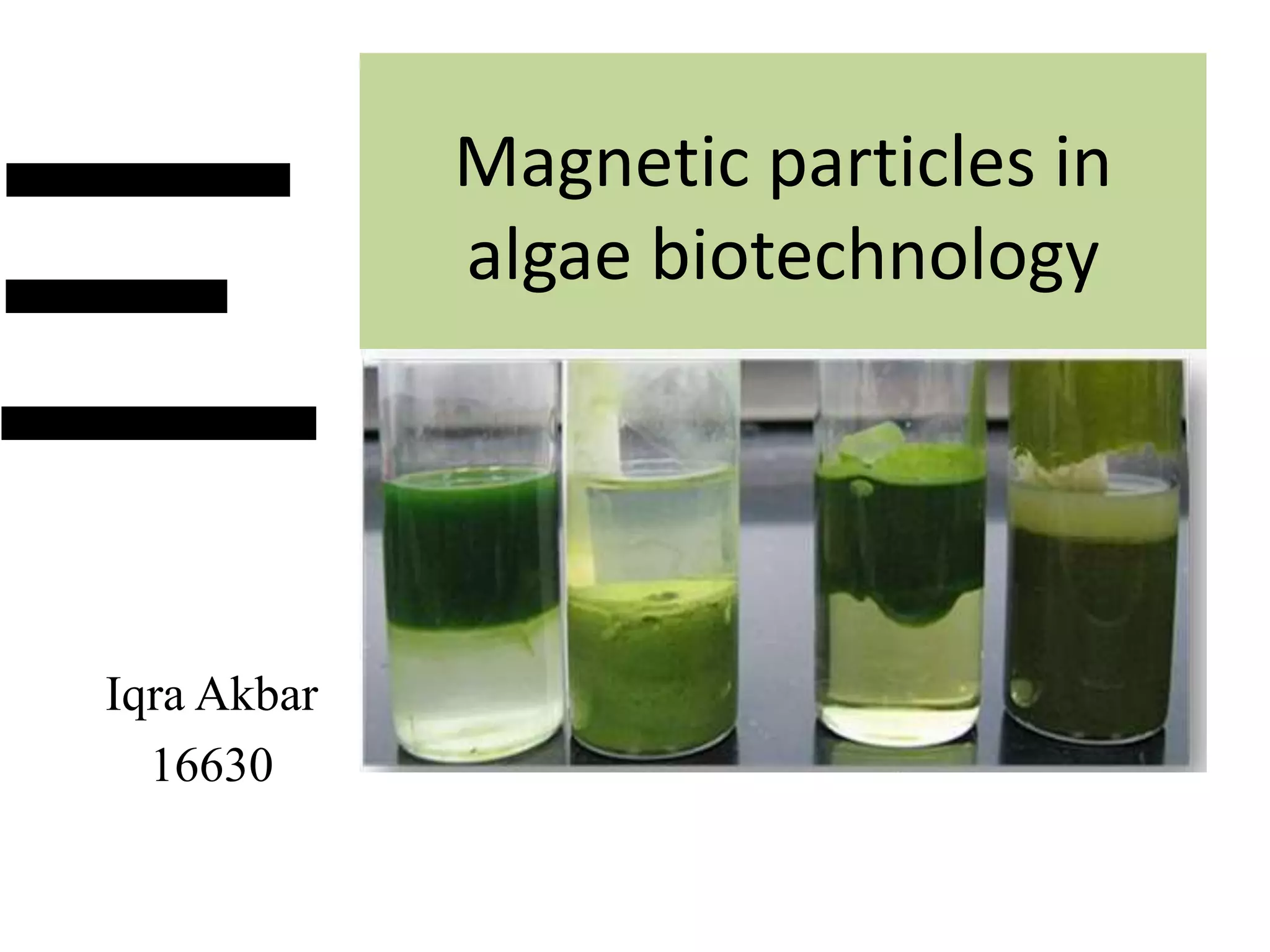
Magnetic particles in
algae biotechnology
Iqra Akbar
16630
Introduction
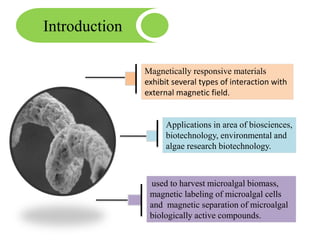
Magnetically responsive materials
exhibit several types of interaction with
external magnetic field.
Applications in area of biosciences,
biotechnology, environmental and
algae research biotechnology.
used to harvest microalgal biomass,
magnetic labeling of microalgal cells
and magnetic separation of microalgal
biologically active compounds.
1
• magnetic detection of algae toxins, and preparation of
magnetically responsive catalysts for different
applications.
2.
• Magnetically modified microalgal used as efficient bio-
sorbents of important pollutants or part of whole-cell
biosensors.
3.
• Greatly employing the magnetic particles for microalgae
separation from large volumes.
• Other areas not fully used these particles.
Purpose of study?
study focus on use of magnetic particles
in combination with micro- and
macroalgae.
Newly published data from 2016–2019
is summarized.
Goals of the study
 This paper will stimulate the
microalgae and macroalgae research
community in finding further
progressive applications of magnetically
responsive materials.
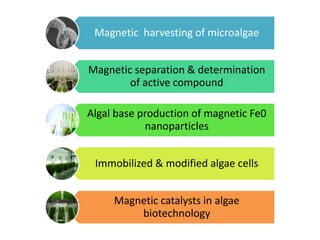
Magnetic harvesting of microalgae
Magnetic separation & determination
of active compound
Algal base production of magnetic Fe0
nanoparticles
Immobilized & modified algae cells
Magnetic catalysts in algae
biotechnology
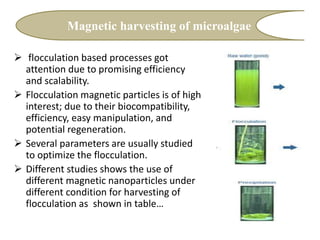
 flocculation based processes got
attention due to promising efficiency
and scalability.
 Flocculation magnetic particles is of high
interest; due to their biocompatibility,
efficiency, easy manipulation, and
potential regeneration.
 Several parameters are usually studied
to optimize the flocculation.
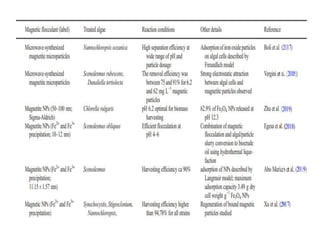
 Different studies shows the use of
different magnetic nanoparticles under
different condition for harvesting of
flocculation as shown in table…
Magnetic harvesting of microalgae
Magnetic separation & determination of
active compound
• Specific group of
isolation techniques is
based on
magnetically
responsive materials.
• There are many
procedures describing
isolation and
separation of
bioactive compounds
from algae.
Magnetic solid-phase
extraction (MSPE),
developed in 1999 by
(Safarikova) has
become a very useful
tool for the pre-
concentration and
separation of large
amount of biologically
active compounds,
pollutants, heavy
metal ions, etc.
A novel nanohybrid
material, namely
magnetic
nanosilicate platelet
(MNSP), was
prepared and used
for the removal of
microcystin toxins.
Algae-based production of magnetic iron oxide
nanoparticles
Biosynthesis of metal and metal oxide NPs using biological materials
is currently of high interest. This process is including in clean
technology.
The synthesis of nanoparticles can usually utilize plant tissues, plant
extracts, exudates, and other parts of living and dead plants.
Green biosynthesis of iron oxide nanoparticles employs the bottom-up
approach where the iron atoms assemble to form clusters and then
eventually the nanoparticles.
Biological material act as capping agents. Biosynthesized iron oxide
magnetic NPs have been applied for specific applications.
Immobilized and modified algae cells
• An absolute majority of prokaryotic and eukaryotic cells is
diamagnetic.
• To add a response to external magnetic field several
modification procedures can be used such as the non specific
attachment of magnetic nanoparticles.
• Recently, C. vulgaris cells were modified with magnetite
nanoparticles.
• The impact of various concentrations of magnetic
nanoparticles was investigated over 12 days.
• high concentration of magnetic particles caused toxicity in
microalgal cells damaging their organelles, mitochondria, and
chloroplasts
After more than 6 days of
exposure to stress
generating concentrations
of magnetic nanoparticles,
it was found that
microalgae could overcome
the resulted damages.
Therefore, in the aspect of the
biotechnological process and
environmental concerns caused
by long-term exposure to
magnetic nanoparticles,
potential harmful toxic effects
should only be expected during
the initial day
Magnetic catalysts in algae biotechnology
Magnetically responsive (bio)catalysts can be reused after their
simple magnetic recovery, thus avoiding the filtration or
centrifugation separation processes.
Magnetic catalyst based on Fe2O3 “core” particles was prepared by
precipitation; subsequently, it was coated by porous silica and
combined with clinoptilolite.
This magnetic catalyst showed good performance for Chlorella
hydrothermal liquefaction and derived bio-crude upgrading.
In 320–350 °C regime and under subcritical water, palmitic acid
conversion was improved by 14–29% with the catalyst. Methyl
palmitate conversion was 56% and de-carboxylation selectivity to
pentadecane was improved to 62%.
Conclusion
Any questions

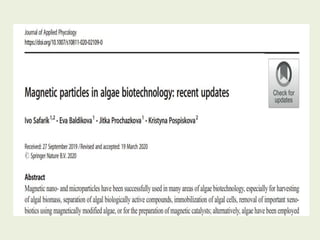
Magnetic particles in algae biotechnology

  • 1.
    Magnetic particles in algaebiotechnology Iqra Akbar 16630
  • 3.
    Introduction Magnetically responsive materials exhibitseveral types of interaction with external magnetic field. Applications in area of biosciences, biotechnology, environmental and algae research biotechnology. used to harvest microalgal biomass, magnetic labeling of microalgal cells and magnetic separation of microalgal biologically active compounds.
  • 4.
    1 • magnetic detectionof algae toxins, and preparation of magnetically responsive catalysts for different applications. 2. • Magnetically modified microalgal used as efficient bio- sorbents of important pollutants or part of whole-cell biosensors. 3. • Greatly employing the magnetic particles for microalgae separation from large volumes. • Other areas not fully used these particles.
  • 5.
    Purpose of study? studyfocus on use of magnetic particles in combination with micro- and macroalgae. Newly published data from 2016–2019 is summarized. Goals of the study  This paper will stimulate the microalgae and macroalgae research community in finding further progressive applications of magnetically responsive materials.
  • 6.
    Magnetic harvesting ofmicroalgae Magnetic separation & determination of active compound Algal base production of magnetic Fe0 nanoparticles Immobilized & modified algae cells Magnetic catalysts in algae biotechnology
  • 7.
     flocculation basedprocesses got attention due to promising efficiency and scalability.  Flocculation magnetic particles is of high interest; due to their biocompatibility, efficiency, easy manipulation, and potential regeneration.  Several parameters are usually studied to optimize the flocculation.  Different studies shows the use of different magnetic nanoparticles under different condition for harvesting of flocculation as shown in table… Magnetic harvesting of microalgae
  • 9.
    Magnetic separation &determination of active compound • Specific group of isolation techniques is based on magnetically responsive materials. • There are many procedures describing isolation and separation of bioactive compounds from algae. Magnetic solid-phase extraction (MSPE), developed in 1999 by (Safarikova) has become a very useful tool for the pre- concentration and separation of large amount of biologically active compounds, pollutants, heavy metal ions, etc. A novel nanohybrid material, namely magnetic nanosilicate platelet (MNSP), was prepared and used for the removal of microcystin toxins.
  • 10.
    Algae-based production ofmagnetic iron oxide nanoparticles Biosynthesis of metal and metal oxide NPs using biological materials is currently of high interest. This process is including in clean technology. The synthesis of nanoparticles can usually utilize plant tissues, plant extracts, exudates, and other parts of living and dead plants. Green biosynthesis of iron oxide nanoparticles employs the bottom-up approach where the iron atoms assemble to form clusters and then eventually the nanoparticles. Biological material act as capping agents. Biosynthesized iron oxide magnetic NPs have been applied for specific applications.
  • 11.
    Immobilized and modifiedalgae cells • An absolute majority of prokaryotic and eukaryotic cells is diamagnetic. • To add a response to external magnetic field several modification procedures can be used such as the non specific attachment of magnetic nanoparticles. • Recently, C. vulgaris cells were modified with magnetite nanoparticles. • The impact of various concentrations of magnetic nanoparticles was investigated over 12 days. • high concentration of magnetic particles caused toxicity in microalgal cells damaging their organelles, mitochondria, and chloroplasts
  • 12.
    After more than6 days of exposure to stress generating concentrations of magnetic nanoparticles, it was found that microalgae could overcome the resulted damages. Therefore, in the aspect of the biotechnological process and environmental concerns caused by long-term exposure to magnetic nanoparticles, potential harmful toxic effects should only be expected during the initial day
  • 13.
    Magnetic catalysts inalgae biotechnology Magnetically responsive (bio)catalysts can be reused after their simple magnetic recovery, thus avoiding the filtration or centrifugation separation processes. Magnetic catalyst based on Fe2O3 “core” particles was prepared by precipitation; subsequently, it was coated by porous silica and combined with clinoptilolite. This magnetic catalyst showed good performance for Chlorella hydrothermal liquefaction and derived bio-crude upgrading. In 320–350 °C regime and under subcritical water, palmitic acid conversion was improved by 14–29% with the catalyst. Methyl palmitate conversion was 56% and de-carboxylation selectivity to pentadecane was improved to 62%.
  • 14.
  • 15.

Editor's Notes

  • #8 Ideal magnetic particles should be of low cost, easy to prepare, stable, and reusable. And
  • #10 Direct competitive enzyme-linked immunomagnetic colorimetric assays (ELIMC) have been developed for the determination of domoic acid, okadaic acid and saxitoxin in seawater.