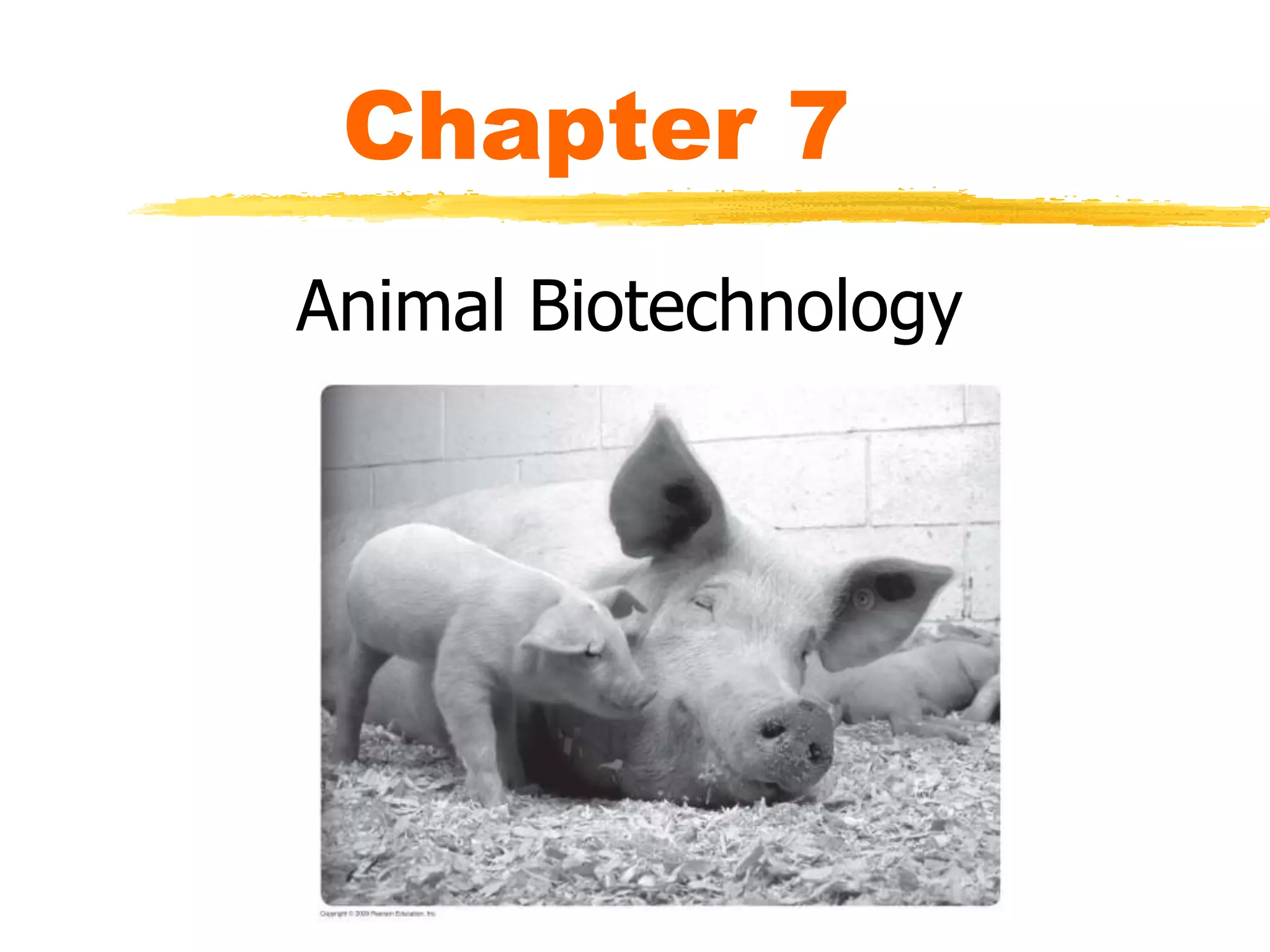
Chapter 7
Animal Biotechnology
Animals in Research
B1
B4
B2
B3
Animals in Research
Animals in Research
Animation of
Drug
Development
Process
z Animal Models
• Mice
• Rats
• Zebrafish (3 month generation time,
200 progeny, complete embryogenesis
in 120 hrs)
• Dogs (lungs and cardiovascular
system)
• Cats
• Pigs (PPL Therapeutics- delete a gene
which causes hyperacute rejection of
pig-to-human organ transplantation)
• Primates (HIV and AIDs research,
geriatric research)
Animals in Research
z Alternatives to Animal Models
• Cell culture devices
• Researchers use cell cultures and computer-generated
models whenever possible, but this doesn’t work for looking
at an organ or entire animal
Animals in Research
z Regulation of Animal Research
• The “Three Rs”
• Reduce the number of higher species (cats, dogs,
primates) used
• Replace animals with alternative models whenever
possible
• Refine tests and experiments to ensure the most
humane conditions possible
Animals in Research
z Veterinary Medicine as Clinical Trials
• Treatments for humans may also be useful for
treatments with animals (e.g. the BRCA1 gene found
in 65% of human breast tumors is similar to the
BRCA1 gene in dogs)
• Hyperthermia + radiation = more effective at killing
tumors
• Stimulation of cytokines for curing skin cancers
Animals in Research
z Bioengineering Mosquitoes to Prevent Malaria
• Cloned in a gene that prevents the parasite from
traversing the midgut; blocking the continuation of its
life cycle
• Developed an antibody that prevents the parasite
from entering the mosquito’s salivary gland
Animals in Research
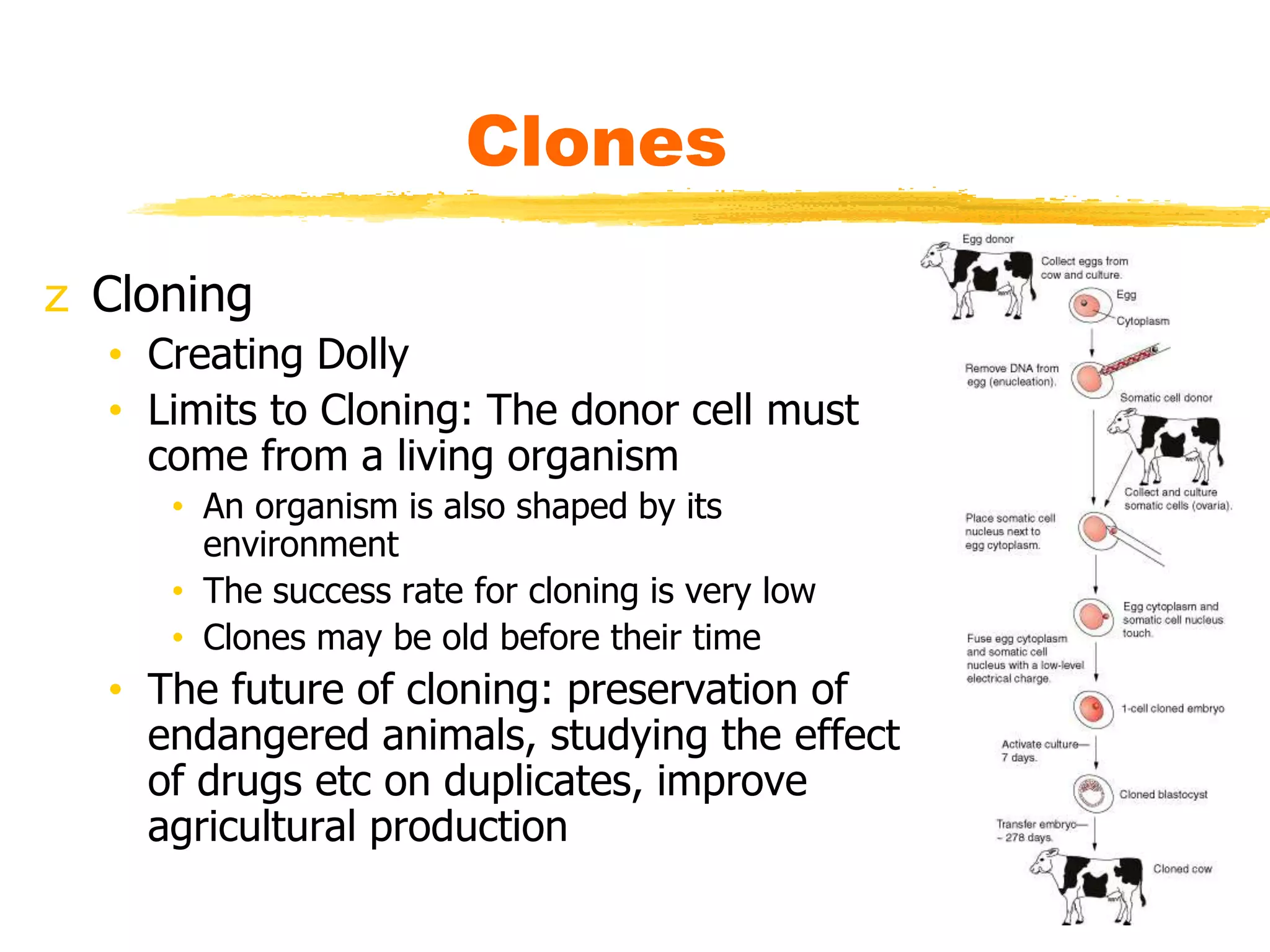
Clones
z Cloning
• Creating Dolly
• Limits to Cloning: The donor cell must
come from a living organism
• An organism is also shaped by its
environment
• The success rate for cloning is very low
• Clones may be old before their time
• The future of cloning: preservation of
endangered animals, studying the effect
of drugs etc on duplicates, improve
agricultural production
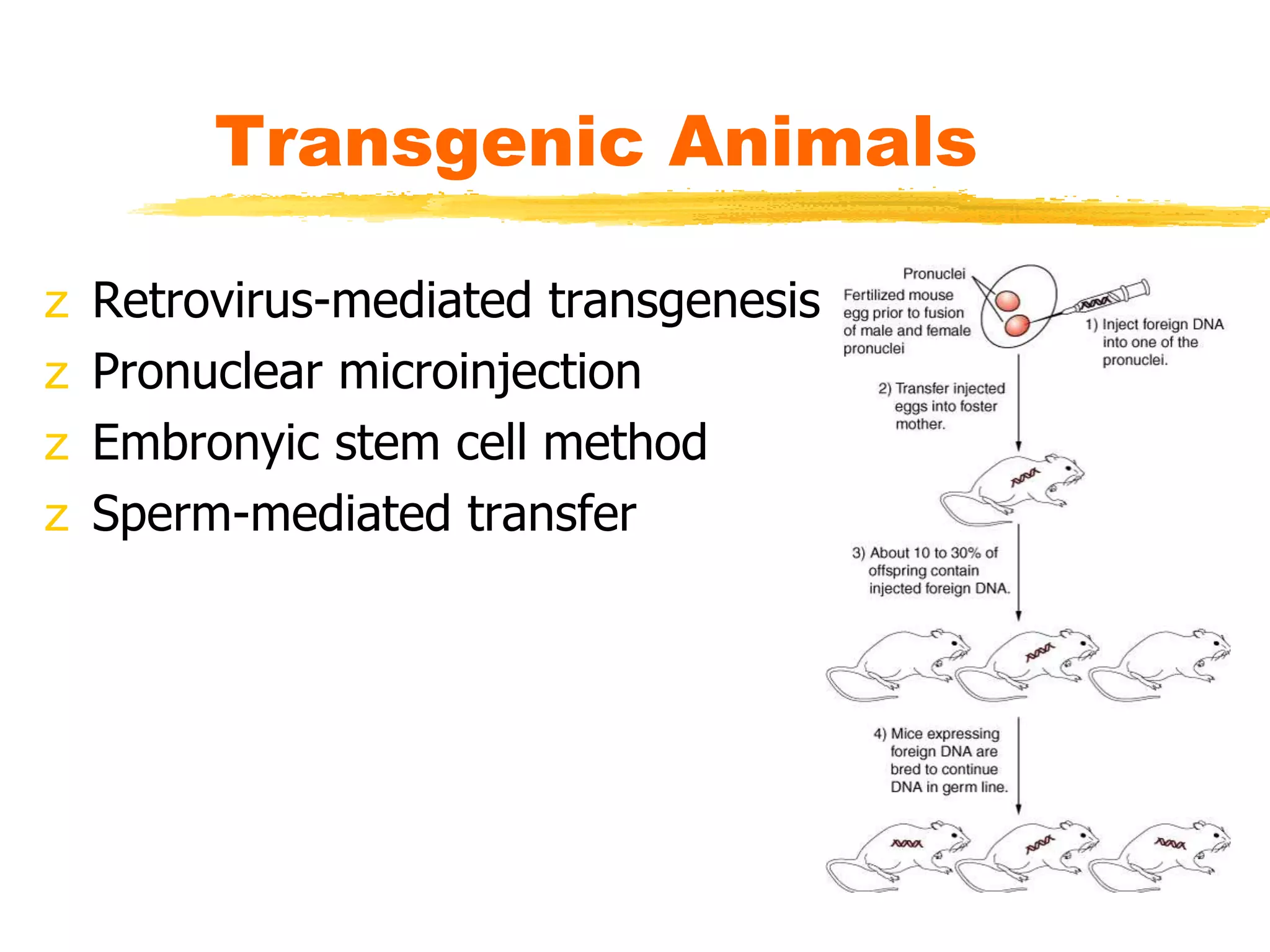
Transgenic Animals
z Retrovirus-mediated transgenesis
z Pronuclear microinjection
z Embronyic stem cell method
z Sperm-mediated transfer
z Improving Agricultural Products
with Transgenics
• Faster growth rates or leaner
growth patterns (improve the
product), more product
• Increase nutritional content-
lactoferrin
• Turning the animals into efficient
grazers
• Transfer antimicrobial genes to
farm animals
Transgenic Animals
z Transgenic Animals as Bioreactors
• Biosteel otherwise known as spider silk, cloned into
goat milk (“silkmilk” goats)
• Goats reproduce faster than cows and are cheaper than
cows
• Hens also make good bioreactors in that they are cheap
and a lot of eggs are produced at one time
Transgenic Animals
z Knock-outs: A Special Case of
Transgenesis
• A specific gene is disrupted or
removed such that it is not expressed
• Procedure: DNA is modified, it is
added to embryonic stem cells,
where it undergoes homologous
recombination. The modified ES cells
are then introduced into normal
embryo. The embryo is implanted in
an incubator mother. The offspring is
a chimera. It may take several
generations of crossbreeding are
required to produce animals that are
complete knock-outs.
• Breast cancer mouse
Transgenic Animals
Producing Human Antibodies in
Animals
z Production of Monoclonal
antibodies (Mabs)
• Used to treat cancer, heart
disease, and transplant
rejection
• HUMANIZED monoclonal
antibodies were developed
to prevent the human anti-
mouse antibody (HAMA)
response
Animal Biotechnology

Animal Biotechnology

  • 1.
  • 2.
  • 3.
  • 4.
    Animals in Research Animationof Drug Development Process
  • 5.
    z Animal Models •Mice • Rats • Zebrafish (3 month generation time, 200 progeny, complete embryogenesis in 120 hrs) • Dogs (lungs and cardiovascular system) • Cats • Pigs (PPL Therapeutics- delete a gene which causes hyperacute rejection of pig-to-human organ transplantation) • Primates (HIV and AIDs research, geriatric research) Animals in Research
  • 6.
    z Alternatives toAnimal Models • Cell culture devices • Researchers use cell cultures and computer-generated models whenever possible, but this doesn’t work for looking at an organ or entire animal Animals in Research
  • 7.
    z Regulation ofAnimal Research • The “Three Rs” • Reduce the number of higher species (cats, dogs, primates) used • Replace animals with alternative models whenever possible • Refine tests and experiments to ensure the most humane conditions possible Animals in Research
  • 8.
    z Veterinary Medicineas Clinical Trials • Treatments for humans may also be useful for treatments with animals (e.g. the BRCA1 gene found in 65% of human breast tumors is similar to the BRCA1 gene in dogs) • Hyperthermia + radiation = more effective at killing tumors • Stimulation of cytokines for curing skin cancers Animals in Research
  • 9.
    z Bioengineering Mosquitoesto Prevent Malaria • Cloned in a gene that prevents the parasite from traversing the midgut; blocking the continuation of its life cycle • Developed an antibody that prevents the parasite from entering the mosquito’s salivary gland Animals in Research
  • 10.
    Clones z Cloning • CreatingDolly • Limits to Cloning: The donor cell must come from a living organism • An organism is also shaped by its environment • The success rate for cloning is very low • Clones may be old before their time • The future of cloning: preservation of endangered animals, studying the effect of drugs etc on duplicates, improve agricultural production
  • 11.
    Transgenic Animals z Retrovirus-mediatedtransgenesis z Pronuclear microinjection z Embronyic stem cell method z Sperm-mediated transfer
  • 12.
    z Improving AgriculturalProducts with Transgenics • Faster growth rates or leaner growth patterns (improve the product), more product • Increase nutritional content- lactoferrin • Turning the animals into efficient grazers • Transfer antimicrobial genes to farm animals Transgenic Animals
  • 13.
    z Transgenic Animalsas Bioreactors • Biosteel otherwise known as spider silk, cloned into goat milk (“silkmilk” goats) • Goats reproduce faster than cows and are cheaper than cows • Hens also make good bioreactors in that they are cheap and a lot of eggs are produced at one time Transgenic Animals
  • 14.
    z Knock-outs: ASpecial Case of Transgenesis • A specific gene is disrupted or removed such that it is not expressed • Procedure: DNA is modified, it is added to embryonic stem cells, where it undergoes homologous recombination. The modified ES cells are then introduced into normal embryo. The embryo is implanted in an incubator mother. The offspring is a chimera. It may take several generations of crossbreeding are required to produce animals that are complete knock-outs. • Breast cancer mouse Transgenic Animals
  • 16.
    Producing Human Antibodiesin Animals z Production of Monoclonal antibodies (Mabs) • Used to treat cancer, heart disease, and transplant rejection • HUMANIZED monoclonal antibodies were developed to prevent the human anti- mouse antibody (HAMA) response