120
Accounting and Finance
for Managers LESSON
7
FUND FLOW STATEMENT ANALYSIS
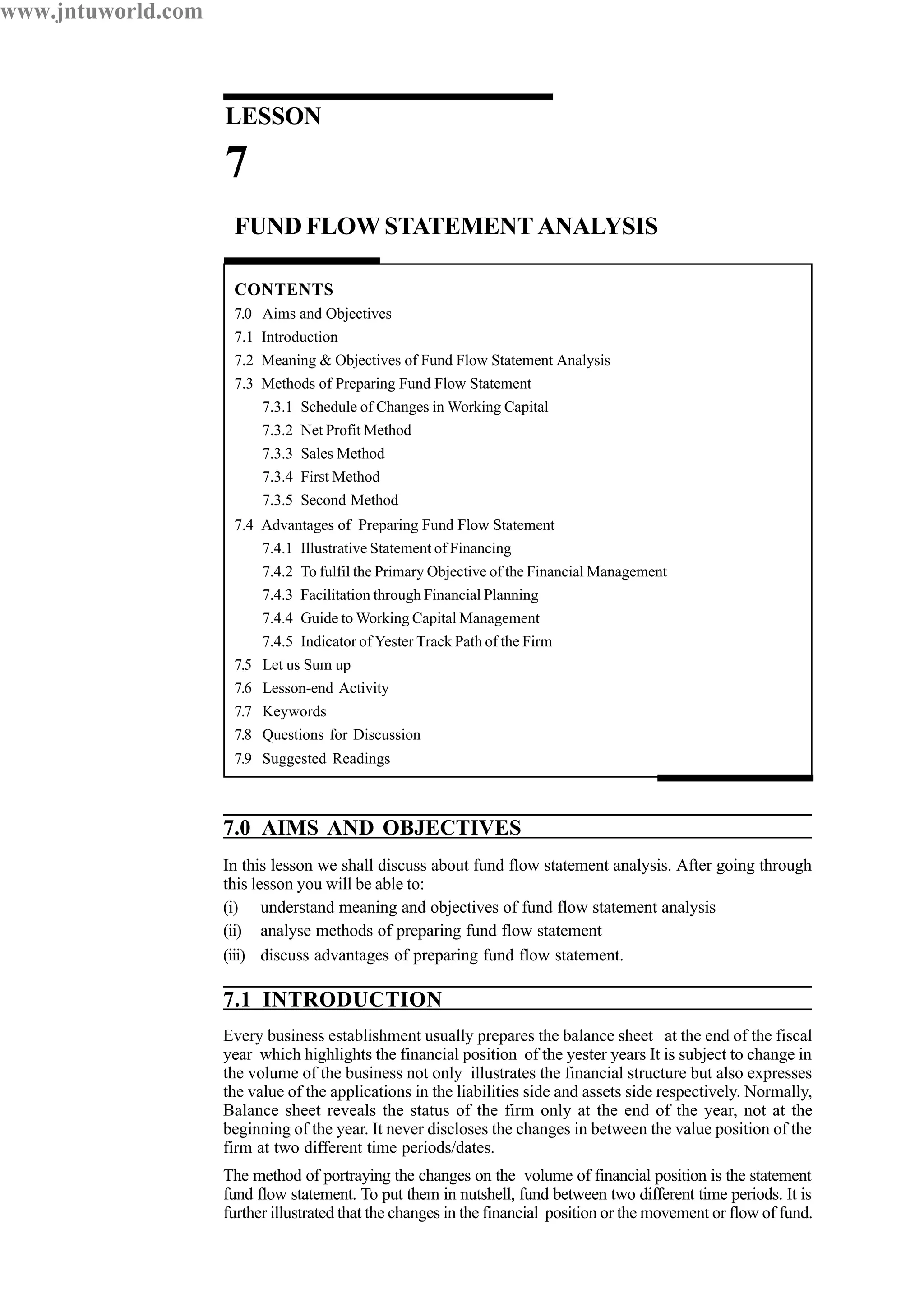
CONTENTS
7.0 Aims and Objectives
7.1 Introduction
7.2 Meaning & Objectives of Fund Flow Statement Analysis
7.3 Methods of Preparing Fund Flow Statement
7.3.1 Schedule of Changes in Working Capital
7.3.2 Net Profit Method
7.3.3 Sales Method
7.3.4 First Method
7.3.5 Second Method
7.4 Advantages of Preparing Fund Flow Statement
7.4.1 Illustrative Statement of Financing
7.4.2 To fulfil the Primary Objective of the Financial Management
7.4.3 Facilitation through Financial Planning
7.4.4 Guide to Working Capital Management
7.4.5 Indicator of Yester Track Path of the Firm
7.5 Let us Sum up
7.6 Lesson-end Activity
7.7 Keywords
7.8 Questions for Discussion
7.9 Suggested Readings
7.0 AIMS AND OBJECTIVES
In this lesson we shall discuss about fund flow statement analysis. After going through
this lesson you will be able to:
(i) understand meaning and objectives of fund flow statement analysis
(ii) analyse methods of preparing fund flow statement
(iii) discuss advantages of preparing fund flow statement.
7.1 INTRODUCTION
Every business establishment usually prepares the balance sheet at the end of the fiscal
year which highlights the financial position of the yester years It is subject to change in
the volume of the business not only illustrates the financial structure but also expresses
the value of the applications in the liabilities side and assets side respectively. Normally,
Balance sheet reveals the status of the firm only at the end of the year, not at the
beginning of the year. It never discloses the changes in between the value position of the
firm at two different time periods/dates.
The method of portraying the changes on the volume of financial position is the statement
fund flow statement. To put them in nutshell, fund between two different time periods. It is
further illustrated that the changes in the financial position or the movement or flow of fund.
www.jntuworld.com
121
Fund Flow Statement Analysis
7.2 MEANING & OBJECTIVES OF FUND FLOW
STATEMENT ANALYSIS
A report on the movement of funds or working capital. In a narrow sense the term fund
means cash and the fund flow statement depicts the cash receipts and cash disbursements/
payments. It highlights the changes in the cash receipts and payments as a cash flow
statement in addition to the cash balances i.e., opening cash balance and closing cash
balance. Contrary to the earlier, the fund means working capital i.e., the differences
between the current assets and current liabilities.
The term flow denotes the change. Flow of funds means the change in funds or in
working capital. The change on the working capital leads to the net changes taken place
on the working capital i.e., especially due to either increase or decrease in the working
capital. The change in the volume of the working capital due to numerous transactions.
Some of the transactions may lead to increase or decrease the volume of working
capital. Some other transactions neither registers an increase nor decrease in the volume
of working capital.
AccordingFoulkeโ€œAstatementofsourceandapplicationoffundsisatechnicaldevicedesigned
to analyse the changes to the financial condition of a business enterprise in between two datesโ€
Various Facets of Fund flow statement are as follows:
l Statement of sources and application of funds
l Statement changes in financial position
l Analysis of working capital changes and
l Movement of funds statement
Objectives of fund flow statement analysis:
(1) It pinpoints the mobilization of resources and the further utilization of resources
(2) It highlights the financing of the general expansion of the business firms
(3) It exemplifies the utilization of debt finance in the structure of financing
(4) It portrays the relationship between the financing, investment, liquidity and dividend
decision of the firm during the given point of time.
7.3 METHODS OF PREPARING FUND FLOW
STATEMENT
Steps in the preparation of Fund Flow Statement:
l First and fore most method is to prepare the statement of changes in working
capital i.e., to identify the flow of fund / movement of fund through the detection
of changes in the volume of working capital.
l Second step is the preparation of Non- Current A/c items-Changes in the volume
of Non current a/cs have to be prepared only in order to quantify the flow fund i-e
either sources or application of fund.
l Third step is the preparation Adjusted Profit& Loss A/c, which already elaborately
discussed in the early part of the chapter.
l Last step is the preparation of fund flow statement.
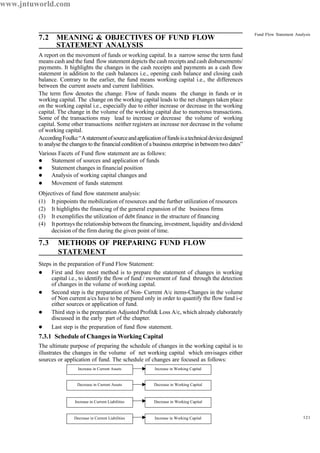
7.3.1 Schedule of Changes in Working Capital
The ultimate purpose of preparing the schedule of changes in the working capital is to
illustrates the changes in the volume of net working capital which envisages either
sources or application of fund. The schedule of changes are focused as follows:
Increase in Current Assets
Decrease in Current Assets
Increase in Current Liabilities
Decrease in Current Liabilities
Increase in Working Capital
Decrease in Working Capital
Increase in Working Capital
www.jntuworld.com
122
Accounting and Finance
for Managers
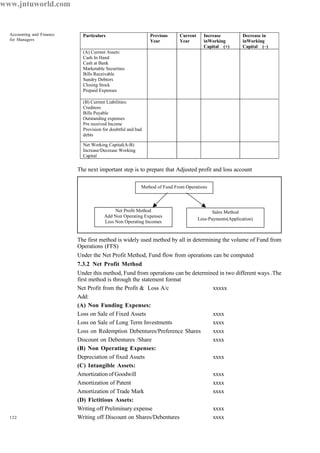
The next important step is to prepare that Adjusted profit and loss account
The first method is widely used method by all in determining the volume of Fund from
Operations (FFS)
Under the Net Profit Method, Fund flow from operations can be computed
7.3.2 Net Profit Method
Under this method, Fund from operations can be determined in two different ways .The
first method is through the statement format
Net Profit from the Profit & Loss A/c xxxxx
Add:
(A) Non Funding Expenses:
Loss on Sale of Fixed Assets xxxx
Loss on Sale of Long Term Investments xxxx
Loss on Redemption Debentures/Preference Shares xxxx
Discount on Debentures /Share xxxx
(B) Non Operating Expenses:
Depreciation of fixed Assets xxxx
(C) Intangible Assets:
Amortization of Goodwill xxxx
Amortization of Patent xxxx
Amortization of Trade Mark xxxx
(D) Fictitious Assets:
Writing off Preliminary expense xxxx
Writing off Discount on Shares/Debentures xxxx
Method of Fund From Operations
Net Profit Method
Add Non Operating Expenses
Less Non Operating Incomes
Sales Method
Less-Payments(Application)
Particulars Previous
Year
Current
Year
Increase
inWorking
Capital (+)
Decrease in
inWorking
Capital (โ€“)
(A) Current Assets:
Cash In Hand
Cash at Bank
Marketable Securities
Bills Receivable
Sundry Debtors
Closing Stock
Prepaid Expenses
(B) Current Liabilities:
Creditors
Bills Payable
Outstanding expenses
Pre received Income
Provision for doubtful and bad
debts
Net Working Capital(A-B)
Increase/Decrease Working
Capital
www.jntuworld.com
123
Fund Flow Statement Analysis(E) Profit Appropriation
Transfer to General Reserve xxxx
Less:
(F) Non funding Profits:
Profit on Sale of Fixed Assets xxxx
Profit on Sale of Long Term Investments xxxx
Profit on Redemption Debentures/Preference Shares xxxx
(G) Non Operating Incomes:
Dividend Received xxxx
Interest Received xxxx
Rent Received xxxx
Fund From operations / Fund Lost in Operations xxxxx
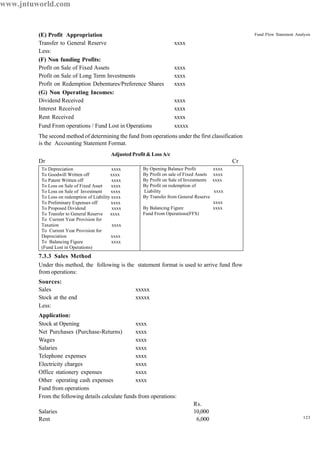
The second method of determining the fund from operations under the first classification
is the Accounting Statement Format.
Adjusted Profit & Loss A/c
Dr Cr
7.3.3 Sales Method
Under this method, the following is the statement format is used to arrive fund flow
from operations:
Sources:
Sales xxxxx
Stock at the end xxxxx
Less:
Application:
Stock at Opening xxxx
Net Purchases (Purchase-Returns) xxxx
Wages xxxx
Salaries xxxx
Telephone expenses xxxx
Electricity charges xxxx
Office stationery expenses xxxx
Other operating cash expenses xxxx
Fund from operations
From the following details calculate funds from operations:
Rs.
Salaries 10,000
Rent 6,000
To Depreciation xxxx
To Goodwill Written off xxxx
To Patent Written off xxxx
To Loss on Sale of Fixed Asset xxxx
To Loss on Sale of Investment xxxx
To Loss on redemption of Liability xxxx
To Preliminary Expenses off xxxx
To Proposed Dividend xxxx
To Transfer to General Reserve xxxx
To Current Year Provision for
Taxation xxxx
To Current Year Provision for
Depreciation xxxx
To Balancing Figure xxxx
(Fund Lost in Operations)
By Opening Balance Profit xxxx
By Profit on sale of Fixed Assets xxxx
By Profit on Sale of Investments xxxx
By Profit on redemption of
Liability xxxx
By Transfer from General Reserve
xxxx
By Balancing Figure xxxx
Fund From Operations(FFS)
www.jntuworld.com
124
Accounting and Finance
for Managers
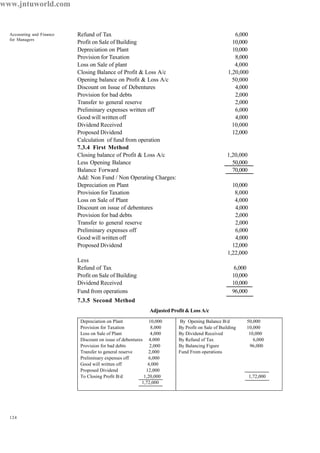
Refund of Tax 6,000
Profit on Sale of Building 10,000
Depreciation on Plant 10,000
Provision for Taxation 8,000
Loss on Sale of plant 4,000
Closing Balance of Profit & Loss A/c 1,20,000
Opening balance on Profit & Loss A/c 50,000
Discount on Issue of Debentures 4,000
Provision for bad debts 2,000
Transfer to general reserve 2,000
Preliminary expenses written off 6,000
Good will written off 4,000
Dividend Received 10,000
Proposed Dividend 12,000
Calculation of fund from operation
7.3.4 First Method
Closing balance of Profit & Loss A/c 1,20,000
Less Opening Balance 50,000
Balance Forward 70,000
Add: Non Fund / Non Operating Charges:
Depreciation on Plant 10,000
Provision for Taxation 8,000
Loss on Sale of Plant 4,000
Discount on issue of debentures 4,000
Provision for bad debts 2,000
Transfer to general reserve 2,000
Preliminary expenses off 6,000
Good will written off 4,000
Proposed Dividend 12,000
1,22,000
Less
Refund of Tax 6,000
Profit on Sale of Building 10,000
Dividend Received 10,000
Fund from operations 96,000
7.3.5 Second Method
Adjusted Profit & Loss A/c
Depreciation on Plant 10,000
Provision for Taxation 8,000
Loss on Sale of Plant 4,000
Discount on issue of debentures 4,000
Provision for bad debts 2,000
Transfer to general reserve 2,000
Preliminary expenses off 6,000
Good will written off 4,000
Proposed Dividend 12,000
To Closing Profit B/d 1,20,000
1,72,000
By Opening Balance B/d 50,000
By Profit on Sale of Building 10,000
By Dividend Received 10,000
By Refund of Tax 6,000
By Balancing Figure 96,000
Fund From operations
1,72,000
www.jntuworld.com
125
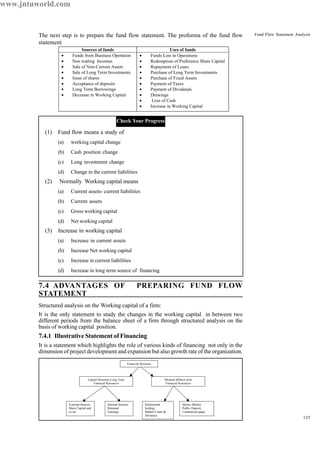
Fund Flow Statement AnalysisThe next step is to prepare the fund flow statement. The proforma of the fund flow
statement
Check Your Progress
(1) Fund flow means a study of
(a) working capital change
(b) Cash position change
(c) Long investment change
(d) Change in the current liabilities
(2) Normally Working capital means
(a) Current assets- current liabilities
(b) Current assets
(c) Gross working capital
(d) Net working capital
(3) Increase in working capital
(a) Increase in current assets
(b) Increase Net working capital
(c) Increase in current liabilities
(d) Increase in long term source of financing
7.4 ADVANTAGES OF PREPARING FUND FLOW
STATEMENT
Structured analysis on the Working capital of a firm:
It is the only statement to study the changes in the working capital in between two
different periods from the balance sheet of a firm through structured analysis on the
basis of working capital position.
7.4.1 Illustrative Statement of Financing
It is a statement which highlights the role of various kinds of financing not only in the
dimension of project development and expansion but also growth rate of the organization.
Sources of funds Uses of funds
โ€ข Funds from Business Operation
โ€ข Non trading Incomes
โ€ข Sale of Non-Current Assets
โ€ข Sale of Long Term Investments
โ€ข Issue of shares
โ€ข Acceptance of deposits
โ€ข Long Term Borrowings
โ€ข Decrease in Working Capital
โ€ข Funds Lost in Operations
โ€ข Redemption of Preference Share Capital
โ€ข Repayment of Loans
โ€ข Purchase of Long Term Investments
โ€ข Purchase of Fixed Assets
โ€ข Payment of Taxes
โ€ข Payment of Dividends
โ€ข Drawings
โ€ข Loss of Cash
โ€ข Increase in Working Capital
Financial Structure
Capital Structure-Long Term
Financial Resources
Medium &Short term
Financial Resources
Institutional
lending:
Banker-Loans &
Advances
Money Market:
Public Deposit,
Commercial paper
External Sources
Share Capital and
so on
Internal Sources:
Retained
Earnings
www.jntuworld.com
126
Accounting and Finance
for Managers
7.4.2 To fulfil the Primary Objective of the Financial Management
It not only elucidates the mode of financing but also the application of resources after
raising. It answers to the following queries viz:
l How the outsider's liabilities are redeemed?
l What is the role of the fund from operation generated?
l How the raised funds applied into business?
l How the decrease in working capital was applied?
l What is the mode of raising of financial resources for an increase in the working
capital?
7.4.3 Facilitation through Financial Planning
The projected fund flow statement from the past performance facilitates the firm to
anticipate the future requirement of financial resources. It guides the management to
prioritize the application in the future to the tune of scarce resources.
7.4.4 Guide to Working Capital Management
It acts as a guide to the management to maintain the working capital at optimum level
through either purchase or sale of marketable securities during the periods of adequate
and inadequate working capital respectively.
7.4.5 Indicator of Yester Track Path of the Firm
The insight on the financial performance of the firm can be had by the lending institutions
through fund flow statement at the time of extending financial assistance to the firm.
Limitations:
l It is an extension of financial statements but it cannot be leveled with the emphasis
of them.
l It is not a resultant of the transaction instead it is an arrangement of among the
available information.
l Projected fund flow statement ever only to the tune of financial statements which
are historic in feature.
Check Your Progress
(1) Adjusted profit and loss account is prepared for
(a) Determining the fund from operations
(b) Determining the fund lost in operations
(c) (a) or (b)
(d) None of the above
(2) Fund flow statement is categorized into two parts
(a) Fund in flow & Fund out flow
(b) Cash in flow & Cash out flow
(c) Sources & Applications
(d) None of the above
(3) Fund from operations is
(a) Sources of the firm
(b) Applications of the firm
(c) Neither sources nor applications
(d) None of the above
www.jntuworld.com
127
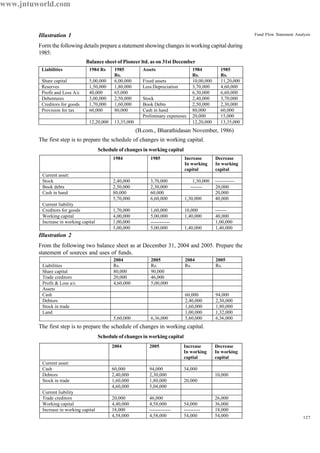
Fund Flow Statement AnalysisIllustration 1
Form the following details prepare a statement showing changes in working capital during
1985:
Balance sheet of Pioneer ltd. as on 31st December
(B.com., Bharathidasan November, 1986)
The first step is to prepare the schedule of changes in working capital.
Schedule of changes in working capital
Illustration 2
From the following two balance sheet as at December 31, 2004 and 2005. Prepare the
statement of sources and uses of funds.
The first step is to prepare the schedule of changes in working capital.
Schedule of changes in working capital
Liabilities 1984 Rs 1985
Rs.
Assets 1984
Rs.
1985
Rs.
Share capital 5,00,000 6,00,000 Fixed assets 10,00,000 11,20,000
Reserves 1,50,000 1,80,000 Less:Depreciation 3,70,000 4,60,000
Profit and Loss A/c 40,000 65,000 6,30,000 6,60,000
Debentures 3,00,000 2,50,000 Stock 2,40,000 3,70,000
Creditors for goods 1,70,000 1,60,000 Book Debts 2,50,000 2,30,000
Provision for tax 60,000 80,000 Cash in hand 80,000 60,000
Preliminary expeneses 20,000 15,000
12,20,000 13,35,000 12,20,000 13,35,000
1984 1985 Increase
In working
capital
Decrease
In working
capital
Current asset:
Stock 2,40,000 3,70,000 1,30,000 ------------
Book debts 2,50,000 2,30,000 ------- 20,000
Cash in hand 80,000 60,000 20,000
5,70,000 6,60,000 1,30,000 40,000
Current liability
Creditors for goods 1,70,000 1,60,000 10,000 -------
Working capital 4,00,000 5,00,000 1,40,000 40,000
Increase in working capital 1,00,000 ------------ 1,00,000
5,00,000 5,00,000 1,40,000 1,40,000
2004 2005 2004 2005
Liabilities Rs. Rs. Rs. Rs.
Share capital 80,000 90,000
Trade creditors 20,000 46,000
Profit & Loss a/c 4,60,000 5,00,000
Assets
Cash 60,000 94,000
Debtors 2,40,000 2,30,000
Stock in trade 1,60,000 1,80,000
Land 1,00,000 1,32,000
5,60,000 6,36,000 5,60,000 6,36,000
2004 2005 Increase
In working
captial
Decrease
In working
capital
Current asset:
Cash 60,000 94,000 34,000
Debtors 2,40,000 2,30,000 10,000
Stock in trade 1,60,000 1,80,000 20,000
4,60,000 5,04,000
Current liability
Trade creditors 20,000 46,000 26,000
Working capital 4,40,000 4,58,000 54,000 36,000
Increase in working capital 18,000 ------------- ---------- 18,000
4,58,000 4,58,000 54,000 54,000
www.jntuworld.com
128
Accounting and Finance
for Managers
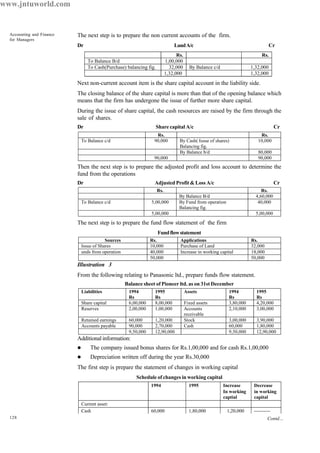
The next step is to prepare the non current accounts of the firm.
Dr LandA/c Cr
Next non-current account item is the share capital account in the liability side.
The closing balance of the share capital is more than that of the opening balance which
means that the firm has undergone the issue of further more share capital.
During the issue of share capital, the cash resources are raised by the firm through the
sale of shares.
Dr Share capital A/c Cr
Then the next step is to prepare the adjusted profit and loss account to determine the
fund from the operations
Dr Adjusted Profit & Loss A/c Cr
The next step is to prepare the fund flow statement of the firm
Fundflowstatement
Illustration 3
From the following relating to Panasonic ltd., prepare funds flow statement.
Balance sheet of Pioneer ltd. as on 31st December
Additionalinformation:
l The company issued bonus shares for Rs.1,00,000 and for cash Rs.1,00,000
l Depreciation written off during the year Rs.30,000
The first step is prepare the statement of changes in working capital
Schedule of changes in working capital
Rs. Rs.
To Balance B/d 1,00,000
To Cash(Purchase) balancing fig. 32,000 By Balance c/d 1,32,000
1,32,000 1,32,000
Rs. Rs.
To Balance c/d 90,000 By Cash( Issue of shares)
Balancing fig.
10,000
By Balance b/d 80,000
90,000 90,000
Rs. Rs.
By Balance B/d 4,60,000
To Balance c/d 5,00,000 By Fund from operation
Balancing fig.
40,000
5,00,000 5,00,000
Sources Rs. Applications Rs.
Issue of Shares 10,000 Purchase of Land 32,000
unds from operation 40,000 Increase in working capital 18,000
50,000 50,000
Liabilities 1994
Rs
1995
Rs
Assets 1994
Rs
1995
Rs
Share capital 6,00,000 8,00,000 Fixed assets 3,80,000 4,20,000
Reserves 2,00,000 1,00,000 Accounts
receivable
2,10,000 3,00,000
Retained earnings 60,000 1,20,000 Stock 3,00,000 3,90,000
Accounts payable 90,000 2,70,000 Cash 60,000 1,80,000
9,50,000 12,90,000 9,50,000 12,90,000
Contd...
1994 1995 Increase
In working
captial
Decrease
in working
capital
Current asset:
Cash 60,000 1,80,000 1,20,000 ----------
www.jntuworld.com
129
Fund Flow Statement Analysis
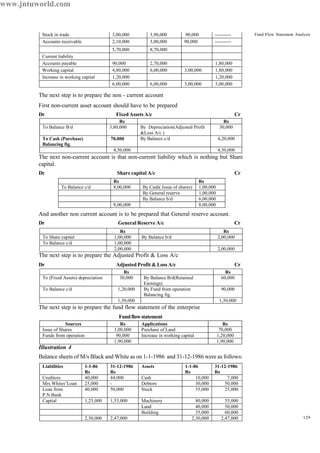
The next step is to prepare the non - current account
First non-current asset account should have to be prepared
Dr Fixed Assets A/c Cr
The next non-current account is that non-current liability which is nothing but Share
capital.
Dr Share capital A/c Cr
And another non current account is to be prepared that General reserve account.
Dr General Reserve A/c Cr
The next step is to prepare the Adjusted Profit & Loss A/c
Dr Adjusted Profit & Loss A/c Cr
The next step is to prepare the fund flow statement of the enterprise
Fundflowstatement
Illustration 4
Balance sheets of M/s Black and White as on 1-1-1986 and 31-12-1986 were as follows:
Stock in trade 3,00,000 3,90,000 90,000 ----------
Accounts receivable 2,10,000 3,00,000 90,000 ----------
5,70,000 8,70,000
Current liability
Accounts payable 90,000 2,70,000 1,80,000
Working capital 4,80,000 6,00,000 3,00,000 1,80,000
Increase in working capital 1,20,000 1,20,000
6,00,000 6,00,000 3,00,000 3,00,000
Rs Rs
To Balance B/d 3,80,000 By Depreciation(Adjusted Profit
&Loss A/c )
30,000
To Cash (Purchase)
Balancing fig.
70,000 By Balance c/d 4,20,000
4,50,000 4,50,000
Rs Rs
To Balance c/d 8,00,000 By Cash( Issue of shares) 1,00,000
By General reserve 1,00,000
By Balance b/d 6,00,000
8,00,000 8,00,000
Rs Rs
To Share capital 1,00,000 By Balance b/d 2,00,000
To Balance c/d 1,00,000
2,00,000 2,00,000
Rs Rs
To (Fixed Assets) depreciation 30,000 By Balance B/d(Retained
Earnings)
60,000
To Balance c/d 1,20,000 By Fund from operation
Balancing fig.
90,000
1,50,000 1,50,000
Sources Rs Applications Rs
Issue of Shares 1,00,000 Purchase of Land 70,000
Funds from operation 90,000 Increase in working capital 1,20,000
1,90,000 1,90,000
Liabilities 1-1-86
Rs
31-12-1986
Rs
Assets 1-1-86
Rs
31-12-1986
Rs
Creditors 40,000 44,000 Cash 10,000 7,000
Mrs.Whitesโ€™Loan 25,000 - Debtors 30,000 50,000
Loan from
P.N.Bank
40,000 50,000 Stock 35,000 25,000
Captial 1,25,000 1,53,000 Machinery 80,000 55,000
Land 40,000 50,000
Building 35,000 60,000
2,30,000 2,47,000 2,30,000 2,47,000
www.jntuworld.com
130
Accounting and Finance
for Managers
Additional information
During the year machine costing Rs.10,000 (accumulated depreciation Rs.3,000) was
sold for Rs.5,000 . The provision for depreciation against machinery as on 1-1-1986 was
Rs.25,000 and on 31-12-1986 Rs.40,000 Net profit for the year 1986 amounted to
Rs.45,000. You are required to prepare funds flow statement (M.Com MKU April 1980).
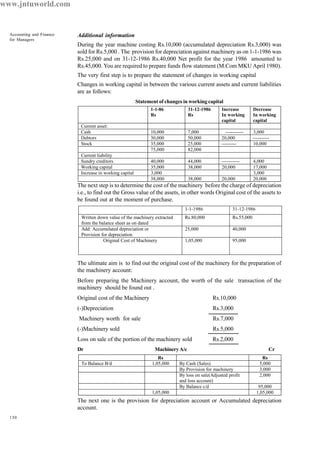
The very first step is to prepare the statement of changes in working capital
Changes in working capital in between the various current assets and current liabilities
are as follows:
Statement of changes in working capital
The next step is to determine the cost of the machinery before the charge of depreciation
i.e., to find out the Gross value of the assets, in other words Original cost of the assets to
be found out at the moment of purchase.
The ultimate aim is to find out the original cost of the machinery for the preparation of
the machinery account:
Before preparing the Machinery account, the worth of the sale transaction of the
machinery should be found out .
Original cost of the Machinery Rs.10,000
(-)Depreciation Rs.3,000
Machinery worth for sale Rs.7,000
(-)Machinery sold Rs.5,000
Loss on sale of the portion of the machinery sold Rs.2,000
Dr MachineryA/c Cr
The next one is the provision for depreciation account or Accumulated depreciation
account.
1-1-86
Rs
31-12-1986
Rs
Increase
In working
capital
Decrease
In working
capital
Current asset:
Cash 10,000 7,000 ----------- 3,000
Debtors 30,000 50,000 20,000 ----------
Stock 35,000 25,000 --------- 10,000
75,000 82,000
Current liability
Sundry creditors 40,000 44,000 ----------- 4,000
Working capital 35,000 38,000 20,000 17,000
Increase in working capital 3,000 3,000
38,000 38,000 20,000 20,000
1-1-1986 31-12-1986
Written down value of the machinery extracted
from the balance sheet as on dated
Rs.80,000 Rs.55,000
Add: Accumulated depreciation or
Provision for depreciation
25,000 40,000
Original Cost of Machinery 1,05,000 95,000
Rs Rs
To Balance B/d 1,05,000 By Cash (Sales) 5,000
By Provision for machinery 3,000
By loss on sale(Adjusted profit
and loss account)
2,000
By Balance c/d 95,000
1,05,000 1,05,000
www.jntuworld.com
131
Fund Flow Statement AnalysisDr Provision for Depreciation A/c Cr
Dr CapitalA/c Cr
Dr LoanP.N.Bank Cr
Dr Mr. White's A/c Cr
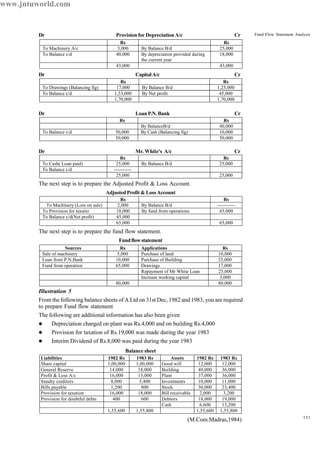
The next step is to prepare the Adjusted Profit & Loss Account.
Adjusted Profit & Loss Account
The next step is to prepare the fund flow statement.
Fundflowstatement
Illustration 5
From the following balance sheets of A Ltd on 31st Dec, 1982 and 1983, you are required
to prepare Fund flow statement
The following are additional information has also been given
l Depreciation charged on plant was Rs.4,000 and on building Rs.4,000
l Provision for taxation of Rs.19,000 was made during the year 1983
l Interim Dividend of Rs.8,000 was paid during the year 1983
Balance sheet
(M.Com.Madras,1984)
Rs Rs
To Machinery A/c 3,000 By Balance B/d 25,000
To Balance c/d 40,000 By depreciation provided during
the current year
18,000
43,000 43,000
Rs Rs
To Drawings (Balancing fig) 17,000 By Balance B/d 1,25,000
To Balance c/d 1,53,000 By Net profit 45,000
1,70,000 1,70,000
Rs Rs
By BalanceB/d 40,000
To Balance c/d 50,000 By Cash (Balancing fig) 10,000
50,000 50,000
Rs Rs
To Cash( Loan paid) 25,000 By Balance B/d 25,000
To Balance c/d -----------
25,000 25,000
Rs Rs
To Machinery (Loss on sale) 2,000 By Balance B/d -----------
To Provision for taxatio 18,000 By fund from operations 65,000
To Balance c/d(Net profit) 45,000
65,000 65,000
Sources Rs Applications Rs
Sale of machinery 5,000 Purchase of land 10,000
Loan from P.N.Bank 10,000 Purchase of Building 25,000
Fund from operation 65,000 Drawings 17,000
Repayment of Mr White Loan 25,000
Increase working capital 3,000
80,000 80,000
Liabilities 1982 Rs 1983 Rs Assets 1982 Rs 1983 Rs
Share capital 1,00,000 1,00,000 Good will 12,000 12,000
General Reserve 14,000 18,000 Building 40,000 36,000
Profit & Loss A/c 16,000 13,000 Plant 37,000 36,000
Sundry creditors 8,000 5,400 Investments 10,000 11,000
Bills payable 1,200 800 Stock 30,000 23,400
Provision for taxation 16,000 18,000 Bill receivable 2,000 3,200
Provision for doubtful debts 400 600 Debtors 18,000 19,000
Cash 6,600 15,200
1,55,600 1,55,800 1,55,600 1,55,800
www.jntuworld.com
132
Accounting and Finance
for Managers
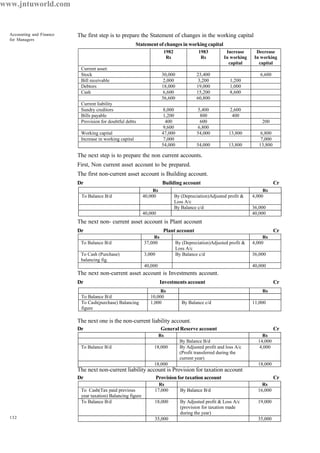
The first step is to prepare the Statement of changes in the working capital
Statement of changes in working capital
The next step is to prepare the non current accounts.
First, Non current asset account to be prepared.
The first non-current asset account is Building account.
Dr Building account Cr
The next non- current asset account is Plant account
Dr Plant account Cr
The next non-current asset account is Investments account.
Dr Investments account Cr
The next one is the non-current liability account.
Dr General Reserve account Cr
The next non-current liability account is Provision for taxation account
Dr Provision for taxation account Cr
1982
Rs
1983
Rs
Increase
In working
capital
Decrease
In working
capital
Current asset:
Stock 30,000 23,400 6,600
Bill receivable 2,000 3,200 1,200
Debtors 18,000 19,000 1,000
Cash 6,600 15,200 8,600
56,600 60,800
Current liability
Sundry creditors 8,000 5,400 2,600
Bills payable 1,200 800 400
Provision for doubtful debts 400 600 200
9,600 6,800
Working capital 47,000 54,000 13,800 6,800
Increase in working capital 7,000 7,000
54,000 54,000 13,800 13,800
Rs Rs
To Balance B/d 40,000 By (Depreciation)Adjusted profit &
Loss A/c
4,000
By Balance c/d 36,000
40,000 40,000
Rs Rs
To Balance B/d 37,000 By (Depreciation)Adjusted profit &
Loss A/c
4,000
To Cash (Purchase)
balancing fig.
3,000 By Balance c/d 36,000
40,000 40,000
Rs Rs
To Balance B/d 10,000
To Cash(purchase) Balancing
figure
1,000 By Balance c/d 11,000
Rs Rs
By Balance B/d 14,000
To Balance B/d 18,000 By Adjusted profit and loss A/c
(Profit transferred during the
current year)
4,000
18,000 18,000
Rs Rs
To Cash(Tax paid previous
year taxation) Balancing figure
17,000 By Balance B/d 16,000
To Balance B/d 18,000 By Adjusted profit & Loss A/c
(provision for taxation made
during the year)
19,000
35,000 35,000
www.jntuworld.com
133
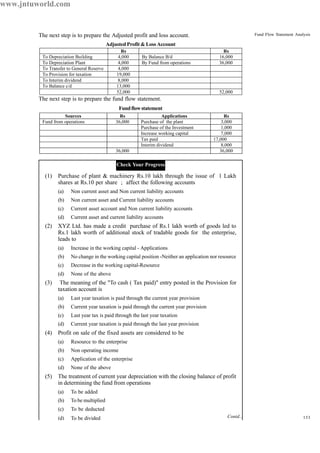
Fund Flow Statement AnalysisThe next step is to prepare the Adjusted profit and loss account.
Adjusted Profit & Loss Account
The next step is to prepare the fund flow statement.
Fundflowstatement
Check Your Progress
(1) Purchase of plant & machinery Rs.10 lakh through the issue of 1 Lakh
shares at Rs.10 per share ; affect the following accounts
(a) Non current asset and Non current liability accounts
(b) Non current asset and Current liability accounts
(c) Current asset account and Non current liability accounts
(d) Current asset and current liability accounts
(2) XYZ Ltd. has made a credit purchase of Rs.1 lakh worth of goods led to
Rs.1 lakh worth of additional stock of tradable goods for the enterprise,
leads to
(a) Increase in the working capital - Applications
(b) No change in the working capital position -Neither an application nor resource
(c) Decrease in the working capital-Resource
(d) None of the above
(3) The meaning of the "To cash ( Tax paid)" entry posted in the Provision for
taxation account is
(a) Last year taxation is paid through the current year provision
(b) Current year taxation is paid through the current year provision
(c) Last year tax is paid through the last year taxation
(d) Current year taxation is paid through the last year provision
(4) Profit on sale of the fixed assets are considered to be
(a) Resource to the enterprise
(b) Non operating income
(c) Application of the enterprise
(d) None of the above
(5) The treatment of current year depreciation with the closing balance of profit
in determining the fund from operations
(a) To be added
(b) To be multiplied
(c) To be deducted
(d) To be divided
Rs Rs
To Depreciation Building 4,000 By Balance B/d 16,000
To Depreciation Plant 4,000 By Fund from operations 36,000
To Transfer to General Reserve 4,000
To Provision for taxation 19,000
To Interim dividend 8,000
To Balance c/d 13,000
52,000 52,000
Sources Rs Applications Rs
Fund from operations 36,000 Purchase of the plant 3,000
Purchase of the Investment 1,000
Increase working capital 7,000
Tax paid 17,000
Interim dividend 8,000
36,000 36,000
Contd...
www.jntuworld.com
134
Accounting and Finance
for Managers
(6) The redemption bank term loan leads to change in the
(a) Non current liability account and current asset account
(b) Current asset account and current liability account
(c) Non current asset account and current liability account
(d) Non current asset account and current liability account
7.5 LET US SUM UP
Normally, Balance sheet reveals the status of the firm only at the end of the year, not at
the beginning of the year. It never discloses the changes in between the value position of
the firm at two different time periods/ dates. A report on the movement of funds or
working capital. In a narrow sense, the term fund means cash and the fund flow
statement depicts the cash receipts and cash disbursements/payments. The projected
fund flow statement from the past performance facilitates the firm to anticipate the
future requirement of financial resources. It guides the management to prioritize the
application in the future to the tune of scarce resources.
7.6 LESSON-END ACTIVITY
In the long run, is it more important for a business to have positive cash flows from its
operating activities, investing activities, or financing activities? Why? Give your opinion.
7.7 KEYWORDS
Fund: Fund means working capital
Flow: Flow means changes occurred in between two different time periods
Statement of changes in working capital: Enlisting the changes taken place in between
the Current assets and current liabilities of two different time horizons
Current assets: Assets which are in the form of cash, equivalent to cash or easily
convertible into cash .
Current liabilities: Short term financial resources of the firm
Non-current assets: Long term assets
Non current liabilities: Long term financial resources
Increase in working capital: Increase in Net working capital i.e. Excess of current
assets over the current liabilities- Applications side of the fund flow
Decrease in working capital: Decrease in Net working capital i.e. Excess of current
liabilities over the current assets - Resources side of the fund flow
Fund from operations: Income generated from only operations
Fund lost in operations: Loss incurred in the operations
7.8 QUESTIONS FOR DISCUSSION
1. Define fund.
2. Define flow.
3. What is meant by fund flow ?
4. List out the various objectives of preparing the fund flow statement.
www.jntuworld.com
135
Fund Flow Statement Analysis
5. Enumerate the various advantages in the preparation of fund flow statement.
6. Briefly explain the limitations of fund flow statement.
7. What are the steps involved in the process of fund flow statement ?
8. Explain the various methods of determining the fund from/lost (in ) operations.
9. Explain the process of preparing the statement of changes in working capital.
10. Draft the pro forma of the Fund flow statement.
11. Explain any non current account transactions affecting the fund position of the
firm.
7.9 SUGGESTED READINGS
R.L. Gupta and Radhaswamy, "Advanced Accountancy".
V.K. Goyal, "Financial Accounting", Excel Books, New Delhi.
Khan and Jain, "Management Accounting".
S.N. Maheswari, "Management Accounting".
S. Bhat, "Financial Management", Excel Books, New Delhi.
Prasanna Chandra, "Financial Management - Theory and Practice", Tata McGraw
Hill, New Delhi (1994).
I.M. Pandey, "Financial Management", Vikas Publishing, New Delhi.
Nitin Balwani, "Accounting & Finance for Managers", Excel Books, New Delhi.
www.jntuworld.com

Funds flow

  • 1.
    120 Accounting and Finance forManagers LESSON 7 FUND FLOW STATEMENT ANALYSIS CONTENTS 7.0 Aims and Objectives 7.1 Introduction 7.2 Meaning & Objectives of Fund Flow Statement Analysis 7.3 Methods of Preparing Fund Flow Statement 7.3.1 Schedule of Changes in Working Capital 7.3.2 Net Profit Method 7.3.3 Sales Method 7.3.4 First Method 7.3.5 Second Method 7.4 Advantages of Preparing Fund Flow Statement 7.4.1 Illustrative Statement of Financing 7.4.2 To fulfil the Primary Objective of the Financial Management 7.4.3 Facilitation through Financial Planning 7.4.4 Guide to Working Capital Management 7.4.5 Indicator of Yester Track Path of the Firm 7.5 Let us Sum up 7.6 Lesson-end Activity 7.7 Keywords 7.8 Questions for Discussion 7.9 Suggested Readings 7.0 AIMS AND OBJECTIVES In this lesson we shall discuss about fund flow statement analysis. After going through this lesson you will be able to: (i) understand meaning and objectives of fund flow statement analysis (ii) analyse methods of preparing fund flow statement (iii) discuss advantages of preparing fund flow statement. 7.1 INTRODUCTION Every business establishment usually prepares the balance sheet at the end of the fiscal year which highlights the financial position of the yester years It is subject to change in the volume of the business not only illustrates the financial structure but also expresses the value of the applications in the liabilities side and assets side respectively. Normally, Balance sheet reveals the status of the firm only at the end of the year, not at the beginning of the year. It never discloses the changes in between the value position of the firm at two different time periods/dates. The method of portraying the changes on the volume of financial position is the statement fund flow statement. To put them in nutshell, fund between two different time periods. It is further illustrated that the changes in the financial position or the movement or flow of fund. www.jntuworld.com
  • 2.
    121 Fund Flow StatementAnalysis 7.2 MEANING & OBJECTIVES OF FUND FLOW STATEMENT ANALYSIS A report on the movement of funds or working capital. In a narrow sense the term fund means cash and the fund flow statement depicts the cash receipts and cash disbursements/ payments. It highlights the changes in the cash receipts and payments as a cash flow statement in addition to the cash balances i.e., opening cash balance and closing cash balance. Contrary to the earlier, the fund means working capital i.e., the differences between the current assets and current liabilities. The term flow denotes the change. Flow of funds means the change in funds or in working capital. The change on the working capital leads to the net changes taken place on the working capital i.e., especially due to either increase or decrease in the working capital. The change in the volume of the working capital due to numerous transactions. Some of the transactions may lead to increase or decrease the volume of working capital. Some other transactions neither registers an increase nor decrease in the volume of working capital. AccordingFoulkeโ€œAstatementofsourceandapplicationoffundsisatechnicaldevicedesigned to analyse the changes to the financial condition of a business enterprise in between two datesโ€ Various Facets of Fund flow statement are as follows: l Statement of sources and application of funds l Statement changes in financial position l Analysis of working capital changes and l Movement of funds statement Objectives of fund flow statement analysis: (1) It pinpoints the mobilization of resources and the further utilization of resources (2) It highlights the financing of the general expansion of the business firms (3) It exemplifies the utilization of debt finance in the structure of financing (4) It portrays the relationship between the financing, investment, liquidity and dividend decision of the firm during the given point of time. 7.3 METHODS OF PREPARING FUND FLOW STATEMENT Steps in the preparation of Fund Flow Statement: l First and fore most method is to prepare the statement of changes in working capital i.e., to identify the flow of fund / movement of fund through the detection of changes in the volume of working capital. l Second step is the preparation of Non- Current A/c items-Changes in the volume of Non current a/cs have to be prepared only in order to quantify the flow fund i-e either sources or application of fund. l Third step is the preparation Adjusted Profit& Loss A/c, which already elaborately discussed in the early part of the chapter. l Last step is the preparation of fund flow statement. 7.3.1 Schedule of Changes in Working Capital The ultimate purpose of preparing the schedule of changes in the working capital is to illustrates the changes in the volume of net working capital which envisages either sources or application of fund. The schedule of changes are focused as follows: Increase in Current Assets Decrease in Current Assets Increase in Current Liabilities Decrease in Current Liabilities Increase in Working Capital Decrease in Working Capital Decrease in Working Capital Increase in Working Capital www.jntuworld.com
  • 3.
    122 Accounting and Finance forManagers The next important step is to prepare that Adjusted profit and loss account The first method is widely used method by all in determining the volume of Fund from Operations (FFS) Under the Net Profit Method, Fund flow from operations can be computed 7.3.2 Net Profit Method Under this method, Fund from operations can be determined in two different ways .The first method is through the statement format Net Profit from the Profit & Loss A/c xxxxx Add: (A) Non Funding Expenses: Loss on Sale of Fixed Assets xxxx Loss on Sale of Long Term Investments xxxx Loss on Redemption Debentures/Preference Shares xxxx Discount on Debentures /Share xxxx (B) Non Operating Expenses: Depreciation of fixed Assets xxxx (C) Intangible Assets: Amortization of Goodwill xxxx Amortization of Patent xxxx Amortization of Trade Mark xxxx (D) Fictitious Assets: Writing off Preliminary expense xxxx Writing off Discount on Shares/Debentures xxxx Method of Fund From Operations Net Profit Method Add Non Operating Expenses Less Non Operating Incomes Sales Method Less-Payments(Application) Particulars Previous Year Current Year Increase inWorking Capital (+) Decrease in inWorking Capital (โ€“) (A) Current Assets: Cash In Hand Cash at Bank Marketable Securities Bills Receivable Sundry Debtors Closing Stock Prepaid Expenses (B) Current Liabilities: Creditors Bills Payable Outstanding expenses Pre received Income Provision for doubtful and bad debts Net Working Capital(A-B) Increase/Decrease Working Capital www.jntuworld.com
  • 4.
    123 Fund Flow StatementAnalysis(E) Profit Appropriation Transfer to General Reserve xxxx Less: (F) Non funding Profits: Profit on Sale of Fixed Assets xxxx Profit on Sale of Long Term Investments xxxx Profit on Redemption Debentures/Preference Shares xxxx (G) Non Operating Incomes: Dividend Received xxxx Interest Received xxxx Rent Received xxxx Fund From operations / Fund Lost in Operations xxxxx The second method of determining the fund from operations under the first classification is the Accounting Statement Format. Adjusted Profit & Loss A/c Dr Cr 7.3.3 Sales Method Under this method, the following is the statement format is used to arrive fund flow from operations: Sources: Sales xxxxx Stock at the end xxxxx Less: Application: Stock at Opening xxxx Net Purchases (Purchase-Returns) xxxx Wages xxxx Salaries xxxx Telephone expenses xxxx Electricity charges xxxx Office stationery expenses xxxx Other operating cash expenses xxxx Fund from operations From the following details calculate funds from operations: Rs. Salaries 10,000 Rent 6,000 To Depreciation xxxx To Goodwill Written off xxxx To Patent Written off xxxx To Loss on Sale of Fixed Asset xxxx To Loss on Sale of Investment xxxx To Loss on redemption of Liability xxxx To Preliminary Expenses off xxxx To Proposed Dividend xxxx To Transfer to General Reserve xxxx To Current Year Provision for Taxation xxxx To Current Year Provision for Depreciation xxxx To Balancing Figure xxxx (Fund Lost in Operations) By Opening Balance Profit xxxx By Profit on sale of Fixed Assets xxxx By Profit on Sale of Investments xxxx By Profit on redemption of Liability xxxx By Transfer from General Reserve xxxx By Balancing Figure xxxx Fund From Operations(FFS) www.jntuworld.com
  • 5.
    124 Accounting and Finance forManagers Refund of Tax 6,000 Profit on Sale of Building 10,000 Depreciation on Plant 10,000 Provision for Taxation 8,000 Loss on Sale of plant 4,000 Closing Balance of Profit & Loss A/c 1,20,000 Opening balance on Profit & Loss A/c 50,000 Discount on Issue of Debentures 4,000 Provision for bad debts 2,000 Transfer to general reserve 2,000 Preliminary expenses written off 6,000 Good will written off 4,000 Dividend Received 10,000 Proposed Dividend 12,000 Calculation of fund from operation 7.3.4 First Method Closing balance of Profit & Loss A/c 1,20,000 Less Opening Balance 50,000 Balance Forward 70,000 Add: Non Fund / Non Operating Charges: Depreciation on Plant 10,000 Provision for Taxation 8,000 Loss on Sale of Plant 4,000 Discount on issue of debentures 4,000 Provision for bad debts 2,000 Transfer to general reserve 2,000 Preliminary expenses off 6,000 Good will written off 4,000 Proposed Dividend 12,000 1,22,000 Less Refund of Tax 6,000 Profit on Sale of Building 10,000 Dividend Received 10,000 Fund from operations 96,000 7.3.5 Second Method Adjusted Profit & Loss A/c Depreciation on Plant 10,000 Provision for Taxation 8,000 Loss on Sale of Plant 4,000 Discount on issue of debentures 4,000 Provision for bad debts 2,000 Transfer to general reserve 2,000 Preliminary expenses off 6,000 Good will written off 4,000 Proposed Dividend 12,000 To Closing Profit B/d 1,20,000 1,72,000 By Opening Balance B/d 50,000 By Profit on Sale of Building 10,000 By Dividend Received 10,000 By Refund of Tax 6,000 By Balancing Figure 96,000 Fund From operations 1,72,000 www.jntuworld.com
  • 6.
    125 Fund Flow StatementAnalysisThe next step is to prepare the fund flow statement. The proforma of the fund flow statement Check Your Progress (1) Fund flow means a study of (a) working capital change (b) Cash position change (c) Long investment change (d) Change in the current liabilities (2) Normally Working capital means (a) Current assets- current liabilities (b) Current assets (c) Gross working capital (d) Net working capital (3) Increase in working capital (a) Increase in current assets (b) Increase Net working capital (c) Increase in current liabilities (d) Increase in long term source of financing 7.4 ADVANTAGES OF PREPARING FUND FLOW STATEMENT Structured analysis on the Working capital of a firm: It is the only statement to study the changes in the working capital in between two different periods from the balance sheet of a firm through structured analysis on the basis of working capital position. 7.4.1 Illustrative Statement of Financing It is a statement which highlights the role of various kinds of financing not only in the dimension of project development and expansion but also growth rate of the organization. Sources of funds Uses of funds โ€ข Funds from Business Operation โ€ข Non trading Incomes โ€ข Sale of Non-Current Assets โ€ข Sale of Long Term Investments โ€ข Issue of shares โ€ข Acceptance of deposits โ€ข Long Term Borrowings โ€ข Decrease in Working Capital โ€ข Funds Lost in Operations โ€ข Redemption of Preference Share Capital โ€ข Repayment of Loans โ€ข Purchase of Long Term Investments โ€ข Purchase of Fixed Assets โ€ข Payment of Taxes โ€ข Payment of Dividends โ€ข Drawings โ€ข Loss of Cash โ€ข Increase in Working Capital Financial Structure Capital Structure-Long Term Financial Resources Medium &Short term Financial Resources Institutional lending: Banker-Loans & Advances Money Market: Public Deposit, Commercial paper External Sources Share Capital and so on Internal Sources: Retained Earnings www.jntuworld.com
  • 7.
    126 Accounting and Finance forManagers 7.4.2 To fulfil the Primary Objective of the Financial Management It not only elucidates the mode of financing but also the application of resources after raising. It answers to the following queries viz: l How the outsider's liabilities are redeemed? l What is the role of the fund from operation generated? l How the raised funds applied into business? l How the decrease in working capital was applied? l What is the mode of raising of financial resources for an increase in the working capital? 7.4.3 Facilitation through Financial Planning The projected fund flow statement from the past performance facilitates the firm to anticipate the future requirement of financial resources. It guides the management to prioritize the application in the future to the tune of scarce resources. 7.4.4 Guide to Working Capital Management It acts as a guide to the management to maintain the working capital at optimum level through either purchase or sale of marketable securities during the periods of adequate and inadequate working capital respectively. 7.4.5 Indicator of Yester Track Path of the Firm The insight on the financial performance of the firm can be had by the lending institutions through fund flow statement at the time of extending financial assistance to the firm. Limitations: l It is an extension of financial statements but it cannot be leveled with the emphasis of them. l It is not a resultant of the transaction instead it is an arrangement of among the available information. l Projected fund flow statement ever only to the tune of financial statements which are historic in feature. Check Your Progress (1) Adjusted profit and loss account is prepared for (a) Determining the fund from operations (b) Determining the fund lost in operations (c) (a) or (b) (d) None of the above (2) Fund flow statement is categorized into two parts (a) Fund in flow & Fund out flow (b) Cash in flow & Cash out flow (c) Sources & Applications (d) None of the above (3) Fund from operations is (a) Sources of the firm (b) Applications of the firm (c) Neither sources nor applications (d) None of the above www.jntuworld.com
  • 8.
    127 Fund Flow StatementAnalysisIllustration 1 Form the following details prepare a statement showing changes in working capital during 1985: Balance sheet of Pioneer ltd. as on 31st December (B.com., Bharathidasan November, 1986) The first step is to prepare the schedule of changes in working capital. Schedule of changes in working capital Illustration 2 From the following two balance sheet as at December 31, 2004 and 2005. Prepare the statement of sources and uses of funds. The first step is to prepare the schedule of changes in working capital. Schedule of changes in working capital Liabilities 1984 Rs 1985 Rs. Assets 1984 Rs. 1985 Rs. Share capital 5,00,000 6,00,000 Fixed assets 10,00,000 11,20,000 Reserves 1,50,000 1,80,000 Less:Depreciation 3,70,000 4,60,000 Profit and Loss A/c 40,000 65,000 6,30,000 6,60,000 Debentures 3,00,000 2,50,000 Stock 2,40,000 3,70,000 Creditors for goods 1,70,000 1,60,000 Book Debts 2,50,000 2,30,000 Provision for tax 60,000 80,000 Cash in hand 80,000 60,000 Preliminary expeneses 20,000 15,000 12,20,000 13,35,000 12,20,000 13,35,000 1984 1985 Increase In working capital Decrease In working capital Current asset: Stock 2,40,000 3,70,000 1,30,000 ------------ Book debts 2,50,000 2,30,000 ------- 20,000 Cash in hand 80,000 60,000 20,000 5,70,000 6,60,000 1,30,000 40,000 Current liability Creditors for goods 1,70,000 1,60,000 10,000 ------- Working capital 4,00,000 5,00,000 1,40,000 40,000 Increase in working capital 1,00,000 ------------ 1,00,000 5,00,000 5,00,000 1,40,000 1,40,000 2004 2005 2004 2005 Liabilities Rs. Rs. Rs. Rs. Share capital 80,000 90,000 Trade creditors 20,000 46,000 Profit & Loss a/c 4,60,000 5,00,000 Assets Cash 60,000 94,000 Debtors 2,40,000 2,30,000 Stock in trade 1,60,000 1,80,000 Land 1,00,000 1,32,000 5,60,000 6,36,000 5,60,000 6,36,000 2004 2005 Increase In working captial Decrease In working capital Current asset: Cash 60,000 94,000 34,000 Debtors 2,40,000 2,30,000 10,000 Stock in trade 1,60,000 1,80,000 20,000 4,60,000 5,04,000 Current liability Trade creditors 20,000 46,000 26,000 Working capital 4,40,000 4,58,000 54,000 36,000 Increase in working capital 18,000 ------------- ---------- 18,000 4,58,000 4,58,000 54,000 54,000 www.jntuworld.com
  • 9.
    128 Accounting and Finance forManagers The next step is to prepare the non current accounts of the firm. Dr LandA/c Cr Next non-current account item is the share capital account in the liability side. The closing balance of the share capital is more than that of the opening balance which means that the firm has undergone the issue of further more share capital. During the issue of share capital, the cash resources are raised by the firm through the sale of shares. Dr Share capital A/c Cr Then the next step is to prepare the adjusted profit and loss account to determine the fund from the operations Dr Adjusted Profit & Loss A/c Cr The next step is to prepare the fund flow statement of the firm Fundflowstatement Illustration 3 From the following relating to Panasonic ltd., prepare funds flow statement. Balance sheet of Pioneer ltd. as on 31st December Additionalinformation: l The company issued bonus shares for Rs.1,00,000 and for cash Rs.1,00,000 l Depreciation written off during the year Rs.30,000 The first step is prepare the statement of changes in working capital Schedule of changes in working capital Rs. Rs. To Balance B/d 1,00,000 To Cash(Purchase) balancing fig. 32,000 By Balance c/d 1,32,000 1,32,000 1,32,000 Rs. Rs. To Balance c/d 90,000 By Cash( Issue of shares) Balancing fig. 10,000 By Balance b/d 80,000 90,000 90,000 Rs. Rs. By Balance B/d 4,60,000 To Balance c/d 5,00,000 By Fund from operation Balancing fig. 40,000 5,00,000 5,00,000 Sources Rs. Applications Rs. Issue of Shares 10,000 Purchase of Land 32,000 unds from operation 40,000 Increase in working capital 18,000 50,000 50,000 Liabilities 1994 Rs 1995 Rs Assets 1994 Rs 1995 Rs Share capital 6,00,000 8,00,000 Fixed assets 3,80,000 4,20,000 Reserves 2,00,000 1,00,000 Accounts receivable 2,10,000 3,00,000 Retained earnings 60,000 1,20,000 Stock 3,00,000 3,90,000 Accounts payable 90,000 2,70,000 Cash 60,000 1,80,000 9,50,000 12,90,000 9,50,000 12,90,000 Contd... 1994 1995 Increase In working captial Decrease in working capital Current asset: Cash 60,000 1,80,000 1,20,000 ---------- www.jntuworld.com
  • 10.
    129 Fund Flow StatementAnalysis The next step is to prepare the non - current account First non-current asset account should have to be prepared Dr Fixed Assets A/c Cr The next non-current account is that non-current liability which is nothing but Share capital. Dr Share capital A/c Cr And another non current account is to be prepared that General reserve account. Dr General Reserve A/c Cr The next step is to prepare the Adjusted Profit & Loss A/c Dr Adjusted Profit & Loss A/c Cr The next step is to prepare the fund flow statement of the enterprise Fundflowstatement Illustration 4 Balance sheets of M/s Black and White as on 1-1-1986 and 31-12-1986 were as follows: Stock in trade 3,00,000 3,90,000 90,000 ---------- Accounts receivable 2,10,000 3,00,000 90,000 ---------- 5,70,000 8,70,000 Current liability Accounts payable 90,000 2,70,000 1,80,000 Working capital 4,80,000 6,00,000 3,00,000 1,80,000 Increase in working capital 1,20,000 1,20,000 6,00,000 6,00,000 3,00,000 3,00,000 Rs Rs To Balance B/d 3,80,000 By Depreciation(Adjusted Profit &Loss A/c ) 30,000 To Cash (Purchase) Balancing fig. 70,000 By Balance c/d 4,20,000 4,50,000 4,50,000 Rs Rs To Balance c/d 8,00,000 By Cash( Issue of shares) 1,00,000 By General reserve 1,00,000 By Balance b/d 6,00,000 8,00,000 8,00,000 Rs Rs To Share capital 1,00,000 By Balance b/d 2,00,000 To Balance c/d 1,00,000 2,00,000 2,00,000 Rs Rs To (Fixed Assets) depreciation 30,000 By Balance B/d(Retained Earnings) 60,000 To Balance c/d 1,20,000 By Fund from operation Balancing fig. 90,000 1,50,000 1,50,000 Sources Rs Applications Rs Issue of Shares 1,00,000 Purchase of Land 70,000 Funds from operation 90,000 Increase in working capital 1,20,000 1,90,000 1,90,000 Liabilities 1-1-86 Rs 31-12-1986 Rs Assets 1-1-86 Rs 31-12-1986 Rs Creditors 40,000 44,000 Cash 10,000 7,000 Mrs.Whitesโ€™Loan 25,000 - Debtors 30,000 50,000 Loan from P.N.Bank 40,000 50,000 Stock 35,000 25,000 Captial 1,25,000 1,53,000 Machinery 80,000 55,000 Land 40,000 50,000 Building 35,000 60,000 2,30,000 2,47,000 2,30,000 2,47,000 www.jntuworld.com
  • 11.
    130 Accounting and Finance forManagers Additional information During the year machine costing Rs.10,000 (accumulated depreciation Rs.3,000) was sold for Rs.5,000 . The provision for depreciation against machinery as on 1-1-1986 was Rs.25,000 and on 31-12-1986 Rs.40,000 Net profit for the year 1986 amounted to Rs.45,000. You are required to prepare funds flow statement (M.Com MKU April 1980). The very first step is to prepare the statement of changes in working capital Changes in working capital in between the various current assets and current liabilities are as follows: Statement of changes in working capital The next step is to determine the cost of the machinery before the charge of depreciation i.e., to find out the Gross value of the assets, in other words Original cost of the assets to be found out at the moment of purchase. The ultimate aim is to find out the original cost of the machinery for the preparation of the machinery account: Before preparing the Machinery account, the worth of the sale transaction of the machinery should be found out . Original cost of the Machinery Rs.10,000 (-)Depreciation Rs.3,000 Machinery worth for sale Rs.7,000 (-)Machinery sold Rs.5,000 Loss on sale of the portion of the machinery sold Rs.2,000 Dr MachineryA/c Cr The next one is the provision for depreciation account or Accumulated depreciation account. 1-1-86 Rs 31-12-1986 Rs Increase In working capital Decrease In working capital Current asset: Cash 10,000 7,000 ----------- 3,000 Debtors 30,000 50,000 20,000 ---------- Stock 35,000 25,000 --------- 10,000 75,000 82,000 Current liability Sundry creditors 40,000 44,000 ----------- 4,000 Working capital 35,000 38,000 20,000 17,000 Increase in working capital 3,000 3,000 38,000 38,000 20,000 20,000 1-1-1986 31-12-1986 Written down value of the machinery extracted from the balance sheet as on dated Rs.80,000 Rs.55,000 Add: Accumulated depreciation or Provision for depreciation 25,000 40,000 Original Cost of Machinery 1,05,000 95,000 Rs Rs To Balance B/d 1,05,000 By Cash (Sales) 5,000 By Provision for machinery 3,000 By loss on sale(Adjusted profit and loss account) 2,000 By Balance c/d 95,000 1,05,000 1,05,000 www.jntuworld.com
  • 12.
    131 Fund Flow StatementAnalysisDr Provision for Depreciation A/c Cr Dr CapitalA/c Cr Dr LoanP.N.Bank Cr Dr Mr. White's A/c Cr The next step is to prepare the Adjusted Profit & Loss Account. Adjusted Profit & Loss Account The next step is to prepare the fund flow statement. Fundflowstatement Illustration 5 From the following balance sheets of A Ltd on 31st Dec, 1982 and 1983, you are required to prepare Fund flow statement The following are additional information has also been given l Depreciation charged on plant was Rs.4,000 and on building Rs.4,000 l Provision for taxation of Rs.19,000 was made during the year 1983 l Interim Dividend of Rs.8,000 was paid during the year 1983 Balance sheet (M.Com.Madras,1984) Rs Rs To Machinery A/c 3,000 By Balance B/d 25,000 To Balance c/d 40,000 By depreciation provided during the current year 18,000 43,000 43,000 Rs Rs To Drawings (Balancing fig) 17,000 By Balance B/d 1,25,000 To Balance c/d 1,53,000 By Net profit 45,000 1,70,000 1,70,000 Rs Rs By BalanceB/d 40,000 To Balance c/d 50,000 By Cash (Balancing fig) 10,000 50,000 50,000 Rs Rs To Cash( Loan paid) 25,000 By Balance B/d 25,000 To Balance c/d ----------- 25,000 25,000 Rs Rs To Machinery (Loss on sale) 2,000 By Balance B/d ----------- To Provision for taxatio 18,000 By fund from operations 65,000 To Balance c/d(Net profit) 45,000 65,000 65,000 Sources Rs Applications Rs Sale of machinery 5,000 Purchase of land 10,000 Loan from P.N.Bank 10,000 Purchase of Building 25,000 Fund from operation 65,000 Drawings 17,000 Repayment of Mr White Loan 25,000 Increase working capital 3,000 80,000 80,000 Liabilities 1982 Rs 1983 Rs Assets 1982 Rs 1983 Rs Share capital 1,00,000 1,00,000 Good will 12,000 12,000 General Reserve 14,000 18,000 Building 40,000 36,000 Profit & Loss A/c 16,000 13,000 Plant 37,000 36,000 Sundry creditors 8,000 5,400 Investments 10,000 11,000 Bills payable 1,200 800 Stock 30,000 23,400 Provision for taxation 16,000 18,000 Bill receivable 2,000 3,200 Provision for doubtful debts 400 600 Debtors 18,000 19,000 Cash 6,600 15,200 1,55,600 1,55,800 1,55,600 1,55,800 www.jntuworld.com
  • 13.
    132 Accounting and Finance forManagers The first step is to prepare the Statement of changes in the working capital Statement of changes in working capital The next step is to prepare the non current accounts. First, Non current asset account to be prepared. The first non-current asset account is Building account. Dr Building account Cr The next non- current asset account is Plant account Dr Plant account Cr The next non-current asset account is Investments account. Dr Investments account Cr The next one is the non-current liability account. Dr General Reserve account Cr The next non-current liability account is Provision for taxation account Dr Provision for taxation account Cr 1982 Rs 1983 Rs Increase In working capital Decrease In working capital Current asset: Stock 30,000 23,400 6,600 Bill receivable 2,000 3,200 1,200 Debtors 18,000 19,000 1,000 Cash 6,600 15,200 8,600 56,600 60,800 Current liability Sundry creditors 8,000 5,400 2,600 Bills payable 1,200 800 400 Provision for doubtful debts 400 600 200 9,600 6,800 Working capital 47,000 54,000 13,800 6,800 Increase in working capital 7,000 7,000 54,000 54,000 13,800 13,800 Rs Rs To Balance B/d 40,000 By (Depreciation)Adjusted profit & Loss A/c 4,000 By Balance c/d 36,000 40,000 40,000 Rs Rs To Balance B/d 37,000 By (Depreciation)Adjusted profit & Loss A/c 4,000 To Cash (Purchase) balancing fig. 3,000 By Balance c/d 36,000 40,000 40,000 Rs Rs To Balance B/d 10,000 To Cash(purchase) Balancing figure 1,000 By Balance c/d 11,000 Rs Rs By Balance B/d 14,000 To Balance B/d 18,000 By Adjusted profit and loss A/c (Profit transferred during the current year) 4,000 18,000 18,000 Rs Rs To Cash(Tax paid previous year taxation) Balancing figure 17,000 By Balance B/d 16,000 To Balance B/d 18,000 By Adjusted profit & Loss A/c (provision for taxation made during the year) 19,000 35,000 35,000 www.jntuworld.com
  • 14.
    133 Fund Flow StatementAnalysisThe next step is to prepare the Adjusted profit and loss account. Adjusted Profit & Loss Account The next step is to prepare the fund flow statement. Fundflowstatement Check Your Progress (1) Purchase of plant & machinery Rs.10 lakh through the issue of 1 Lakh shares at Rs.10 per share ; affect the following accounts (a) Non current asset and Non current liability accounts (b) Non current asset and Current liability accounts (c) Current asset account and Non current liability accounts (d) Current asset and current liability accounts (2) XYZ Ltd. has made a credit purchase of Rs.1 lakh worth of goods led to Rs.1 lakh worth of additional stock of tradable goods for the enterprise, leads to (a) Increase in the working capital - Applications (b) No change in the working capital position -Neither an application nor resource (c) Decrease in the working capital-Resource (d) None of the above (3) The meaning of the "To cash ( Tax paid)" entry posted in the Provision for taxation account is (a) Last year taxation is paid through the current year provision (b) Current year taxation is paid through the current year provision (c) Last year tax is paid through the last year taxation (d) Current year taxation is paid through the last year provision (4) Profit on sale of the fixed assets are considered to be (a) Resource to the enterprise (b) Non operating income (c) Application of the enterprise (d) None of the above (5) The treatment of current year depreciation with the closing balance of profit in determining the fund from operations (a) To be added (b) To be multiplied (c) To be deducted (d) To be divided Rs Rs To Depreciation Building 4,000 By Balance B/d 16,000 To Depreciation Plant 4,000 By Fund from operations 36,000 To Transfer to General Reserve 4,000 To Provision for taxation 19,000 To Interim dividend 8,000 To Balance c/d 13,000 52,000 52,000 Sources Rs Applications Rs Fund from operations 36,000 Purchase of the plant 3,000 Purchase of the Investment 1,000 Increase working capital 7,000 Tax paid 17,000 Interim dividend 8,000 36,000 36,000 Contd... www.jntuworld.com
  • 15.
    134 Accounting and Finance forManagers (6) The redemption bank term loan leads to change in the (a) Non current liability account and current asset account (b) Current asset account and current liability account (c) Non current asset account and current liability account (d) Non current asset account and current liability account 7.5 LET US SUM UP Normally, Balance sheet reveals the status of the firm only at the end of the year, not at the beginning of the year. It never discloses the changes in between the value position of the firm at two different time periods/ dates. A report on the movement of funds or working capital. In a narrow sense, the term fund means cash and the fund flow statement depicts the cash receipts and cash disbursements/payments. The projected fund flow statement from the past performance facilitates the firm to anticipate the future requirement of financial resources. It guides the management to prioritize the application in the future to the tune of scarce resources. 7.6 LESSON-END ACTIVITY In the long run, is it more important for a business to have positive cash flows from its operating activities, investing activities, or financing activities? Why? Give your opinion. 7.7 KEYWORDS Fund: Fund means working capital Flow: Flow means changes occurred in between two different time periods Statement of changes in working capital: Enlisting the changes taken place in between the Current assets and current liabilities of two different time horizons Current assets: Assets which are in the form of cash, equivalent to cash or easily convertible into cash . Current liabilities: Short term financial resources of the firm Non-current assets: Long term assets Non current liabilities: Long term financial resources Increase in working capital: Increase in Net working capital i.e. Excess of current assets over the current liabilities- Applications side of the fund flow Decrease in working capital: Decrease in Net working capital i.e. Excess of current liabilities over the current assets - Resources side of the fund flow Fund from operations: Income generated from only operations Fund lost in operations: Loss incurred in the operations 7.8 QUESTIONS FOR DISCUSSION 1. Define fund. 2. Define flow. 3. What is meant by fund flow ? 4. List out the various objectives of preparing the fund flow statement. www.jntuworld.com
  • 16.
    135 Fund Flow StatementAnalysis 5. Enumerate the various advantages in the preparation of fund flow statement. 6. Briefly explain the limitations of fund flow statement. 7. What are the steps involved in the process of fund flow statement ? 8. Explain the various methods of determining the fund from/lost (in ) operations. 9. Explain the process of preparing the statement of changes in working capital. 10. Draft the pro forma of the Fund flow statement. 11. Explain any non current account transactions affecting the fund position of the firm. 7.9 SUGGESTED READINGS R.L. Gupta and Radhaswamy, "Advanced Accountancy". V.K. Goyal, "Financial Accounting", Excel Books, New Delhi. Khan and Jain, "Management Accounting". S.N. Maheswari, "Management Accounting". S. Bhat, "Financial Management", Excel Books, New Delhi. Prasanna Chandra, "Financial Management - Theory and Practice", Tata McGraw Hill, New Delhi (1994). I.M. Pandey, "Financial Management", Vikas Publishing, New Delhi. Nitin Balwani, "Accounting & Finance for Managers", Excel Books, New Delhi. www.jntuworld.com