Presented By:- D.B.Bharghav Reddy (1st sem PGDM)
 Micro Finance is the supply of loans, savings, and other basic financial 
service to the poor . 
- CGAP 
 To most, micro finance means providing very poor families with very small 
loans (micro credit) to help them engage in productive activities or grow their 
tiny businesses. 
- Financial Gateway 
 Microfinance refers to small-scale financial services including both credits 
and deposits provided to people who farm or fish or herd; operate small or 
microenterprises where goods are produced, recycled, repaired, or traded; 
provide services; work for wages or commissions; gain income from renting 
out small amounts of land, vehicles, draft animals, or machinery and tools; in 
both rural and urban areas.
 “Microfinance is an economic development tool whose 
objective is to assist the poor to work their way out of 
poverty. It covers a range of services which include, in 
addition to the provision of credit, many other services 
such as savings, insurance, money transfers, 
counseling, etc.” 
– Reserve Bank of 
India 
 In simple words, Microfinance serves as a tool for 
providing financial services to the low-income 
population., which do not have access to the 
mainstream financial services.
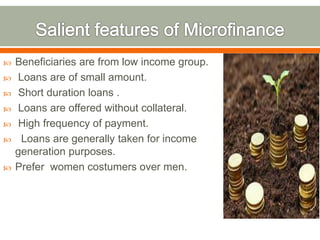
 Beneficiaries are from low income group. 
 Loans are of small amount. 
 Short duration loans . 
 Loans are offered without collateral. 
 High frequency of payment. 
 Loans are generally taken for income 
generation purposes. 
 Prefer women costumers over men.
 Traditionally , Macro-financial institutes like banks have been 
reluctant to provide financial services to clients with little or 
no cash income, because of various reasons – 
1. ‘Break Even Point‘ in providing loans. 
2. Few assets to be secured as collateral. 
3. Lack of loan and other financial services from banks and 
other institutes forces them to rely heavily on relatives or local 
money lenders at the time of need . 
Usually interest rate of moneylenders are very high.
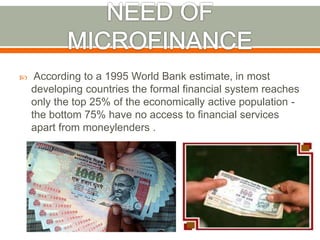
 According to a 1995 World Bank estimate, in most 
developing countries the formal financial system reaches 
only the top 25% of the economically active population - 
the bottom 75% have no access to financial services 
apart from moneylenders .
 Micro-Credit movement started in 1970’s countries like 
Bangladesh ( Grameen Bank led by Muhammad Yunus) 
, Pakistan , Vietnam etc. 
 2005 is Declared as International year of Microcredit by 
The Economic and Social Council of the United Nations. 
 In Bangladesh microfinance has successfully enabled 
extremely impoverished people to engage in self-employment 
projects that allow them to generate an 
income and, in many cases, begin to build wealth and 
exit poverty.
 1974 – Establishment of Self-Employed Women’s Association 
(SEWA) in Gujarat. 
 Sep 26, 1975 – Rural bank Ordinance was passed. 
 Oct 02, 1975 – Prathama bank (first RRB) came into existence. 
 1976 – Ordinance was replaced by Regional Rural Bank Act. 
 July 12, 1982 – NABARD was established on the recommendations 
of Shivaraman Committee, by an act of Parliament to implement the 
National Bank for Agriculture and Rural Development Act 1981.
 Apr 02, 1990 – SIDBI was established through Small Industries 
Development Bank of India Act 1989. 
 1992 – NABARD launched SHGs-Bank Linkage program. 
 1999 – SIDBI created Microcredit (SFMC) to create a national 
network of strong, viable and sustainable Microfinance 
Institutions from the informal and formal financial sector to 
provide microfinance services to the poor, especially women’’. 
 2006 – NABARD launched the ‘Micro-Enterprise Development 
Programme’ (MEDP) for skill development.
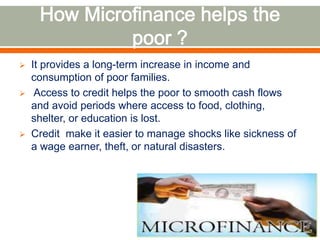
 It provides a long-term increase in income and 
consumption of poor families. 
 Access to credit helps the poor to smooth cash flows 
and avoid periods where access to food, clothing, 
shelter, or education is lost. 
 Credit make it easier to manage shocks like sickness of 
a wage earner, theft, or natural disasters.
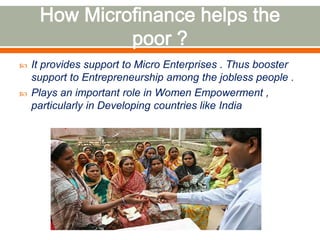
 It provides support to Micro Enterprises . Thus booster 
support to Entrepreneurship among the jobless people . 
 Plays an important role in Women Empowerment , 
particularly in Developing countries like India
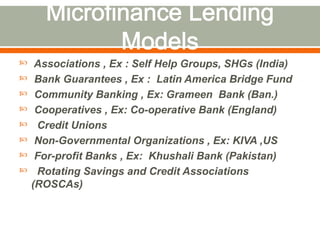
 Associations , Ex : Self Help Groups, SHGs (India) 
 Bank Guarantees , Ex : Latin America Bridge Fund 
 Community Banking , Ex: Grameen Bank (Ban.) 
 Cooperatives , Ex: Co-operative Bank (England) 
 Credit Unions 
 Non-Governmental Organizations , Ex: KIVA ,US 
 For-profit Banks , Ex: Khushali Bank (Pakistan) 
 Rotating Savings and Credit Associations 
(ROSCAs)
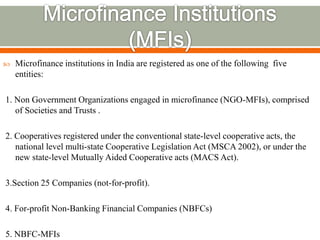
 Microfinance institutions in India are registered as one of the following five 
entities: 
1. Non Government Organizations engaged in microfinance (NGO-MFIs), comprised 
of Societies and Trusts . 
2. Cooperatives registered under the conventional state-level cooperative acts, the 
national level multi-state Cooperative Legislation Act (MSCA 2002), or under the 
new state-level Mutually Aided Cooperative acts (MACS Act). 
3.Section 25 Companies (not-for-profit). 
4. For-profit Non-Banking Financial Companies (NBFCs) 
5. NBFC-MFIs
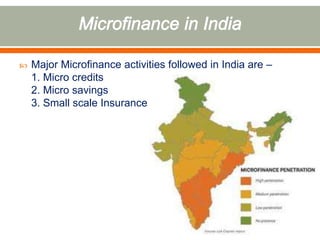
 Major Microfinance activities followed in India are – 
1. Micro credits 
2. Micro savings 
3. Small scale Insurance
 What are NGOs? 
>NGOs are voluntary social work organization who renders 
help to government and society for improvement of quality of 
life people 
>Help in the formation of SHGs 
>To reduce the smaller transaction NGOs help banks 
>Over the last quarter century, a few organizations, outside the 
purview of the public sector, have succeeded in effective 
poverty alleviation through micro-credit 
>Main objective is to draw attention about microfinance by 
conduction meetings in rural areas
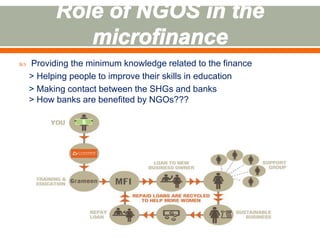
 Providing the minimum knowledge related to the finance 
> Helping people to improve their skills in education 
> Making contact between the SHGs and banks 
> How banks are benefited by NGOs???
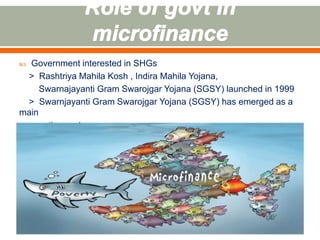
 Government interested in SHGs 
> Rashtriya Mahila Kosh , Indira Mahila Yojana, 
Swarnajayanti Gram Swarojgar Yojana (SGSY) launched in 1999 
> Swarnjayanti Gram Swarojgar Yojana (SGSY) has emerged as a 
main 
anti-poverty programme
Providing refinance to lending institutions in rural 
areas 
Bringing about or promoting institutional 
development . 
Evaluating, monitoring and inspecting the client 
banks 
Acts as a coordinator in the operations of rural credit 
institutions.
Vision: 
Empowerment of rural poor by improving their access to the formal 
credit system through various MF innovations in a cost effective 
and sustainable manner . 
Mission: 
Promoting sustainable and equitable agriculture and rural development 
through effective credit support, related services, institution building 
and other innovative initiatives.
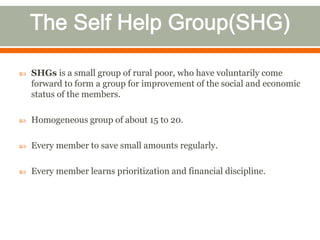
 SHGs is a small group of rural poor, who have voluntarily come 
forward to form a group for improvement of the social and economic 
status of the members. 
 Homogeneous group of about 15 to 20. 
 Every member to save small amounts regularly. 
 Every member learns prioritization and financial discipline.
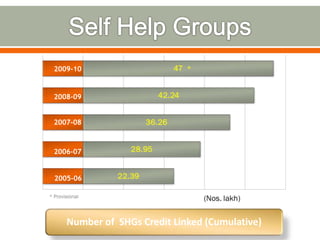
2009-10 
2008-09 
2007-08 
2006-07 
2005-06 
Number of SHGs Credit Linked (Cumulative)
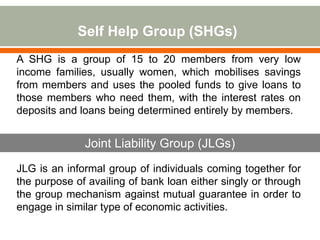
Self Help Group (SHGs) 
A SHG is a group of 15 to 20 members from very low 
income families, usually women, which mobilises savings 
from members and uses the pooled funds to give loans to 
those members who need them, with the interest rates on 
deposits and loans being determined entirely by members. 
Joint Liability Group (JLGs) 
JLG is an informal group of individuals coming together for 
the purpose of availing of bank loan either singly or through 
the group mechanism against mutual guarantee in order to 
engage in similar type of economic activities.
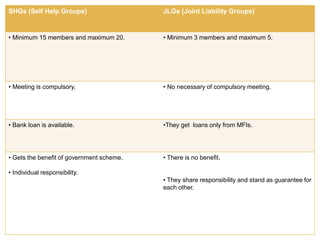
SHGs (Self Help Groups) JLGs (Joint Liability Groups) 
• Minimum 15 members and maximum 20. • Minimum 3 members and maximum 5. 
• Meeting is compulsory. • No necessary of compulsory meeting. 
• Bank loan is available. •They get loans only from MFIs. 
• Gets the benefit of government scheme. 
• Individual responsibility. 
• There is no benefit. 
• They share responsibility and stand as guarantee for 
each other.
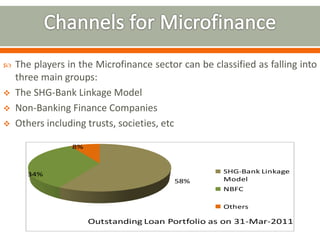
 The players in the Microfinance sector can be classified as falling into 
three main groups: 
 The SHG-Bank Linkage Model 
 Non-Banking Finance Companies 
 Others including trusts, societies, etc 
58% 
34% 
8% 
SHG-Bank Linkage 
Model 
NBFC 
Others 
Outstanding Loan Portfolio as on 31-Mar-2011
 The SHG-Bank Linkage Model was pioneered by NABARD in 1992. 
 Under this model, women in a village are encouraged to form a Self help Group (SHG) and 
members of the Group regularly contribute small savings to the Group. 
 These savings which form an ever growing nucleus are lent by the group to members, and 
are later supplemented by loans provided by banks for income-generating activities and 
other purposes for sustainable livelihood promotion. 
 The Group has weekly/monthly meetings at which new savings come in, and recoveries are 
made from members towards their loans from the SHGs, their federations, and banks. 
 NABARD provides grants, training and capacity building assistance to Self Help Promoting 
Institutions (SHPI), which in turn act as facilitators/ intermediaries for the formation and 
credit linkage of the SHGs.
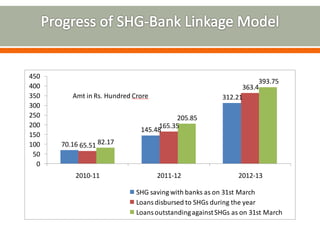
Amt in Rs. Hundred Crore 
70.16 
145.48 
312.21 
65.51 
165.35 
363.4 
82.17 
205.85 
393.75 
450 
400 
350 
300 
250 
200 
150 
100 
50 
0 
2010-11 2011-12 2012-13 
SHG saving with banks as on 31st March 
Loans disbursed to SHGs during the year 
Loans outstanding against SHGs as on 31st March
 Under the NBFC model, NBFCs encourage villagers to form Joint Liability Groups (JLG) and 
give loans to the individual members of the JLG. 
 The individual loans are jointly and severally guaranteed by the other members of the 
Group. 
 Many of the NBFCs operating this model started off as non-profit entities providing micro-credit 
and other services to the poor. 
 However, as they found themselves unable to raise adequate resources for a rapid growth of 
the activity, they converted themselves into for-profit NBFCs. 
 Others entered the field directly as for-profit NBFCs seeing this as a viable business 
proposition. 
 Significant amounts of private equity funds have consequently been attracted to this sector.
 Initiative taken by govt of A.P to enhance the profit of shg 
members 
 Loans are at 2.5 % interest 
 Achieved great response from poor 
 Presently there are 1.15 lakh DWCRA groups and 2.19 
lakh SHG groups in Andhra Pradesh with a membership 
of 46 lakh women having a savings of Rs.300 crores.
 It is the state that have only microfinance as tool 
eliminate the poor. 
 In Orissa Mission shakti , a government driven 
programme, formed in 2001 with a target to organize 2 
lakhs WSHGs(women self help group) covering all 
revenue villages of the State. The main aim is to provide 
supports to different stakeholders working in the field of 
women empowerment such as Banks, NGOs, MFIs and 
other institutions.
 There are around 35 MFIs registered in the state out of 
which 8-10 are functional, with the recovery rate of these 
institutions being around 95%.. 
 Micro-Finance Institutions (MFIs) operating in Orissa 
have advanced loans worth Rs 1500 crore in the past 
three to four years, reaching out to more than two million 
customers in the state
 Annapurna Microfinance Pvt Ltd 
 BSS Microfinance Pvt Ltd 
 Cashpor Micro Credit 
 Disha Microfin Pvt Ltd 
 Equitas Microfinance Pvt Ltd 
 Fusion Microfinance Pvt Ltd 
 Grameen Financial Services Pvt Ltd 
 Janalakshmi Financial Services Pvt Ltd 
 SKS Microfinance Ltd 
 Sonata Finance Pvt Ltd 
 Suryoday Micro Finance Pvt Ltd 
 Ujjivan Financial Services Pvt Ltd
 Estimated that in next five years, 65% of the poor people will have 
excess to MFIs. 
 Many Pvt. Banks and Foreign Banks would enter this business 
segment, because of very low NPAs. 
 Estimated that 5 % of the number of people below the poverty line 
will get reduced in the next 5 years.(World Bank report)
 In India micro-finance has succeeded with repayment rates upto 
90% reported all across the country ( from the states like AP, Tamil 
Nadu, Karnataka, Kerala ,West Bengal and Orissa etc. ) 
 This tells us that micro finance has certainly has the capacity to 
reduce poverty by a great margin
Any 
Questions
 

Microfinance in India

  • 2.
    Presented By:- D.B.BharghavReddy (1st sem PGDM)
  • 3.
     Micro Financeis the supply of loans, savings, and other basic financial service to the poor . - CGAP  To most, micro finance means providing very poor families with very small loans (micro credit) to help them engage in productive activities or grow their tiny businesses. - Financial Gateway  Microfinance refers to small-scale financial services including both credits and deposits provided to people who farm or fish or herd; operate small or microenterprises where goods are produced, recycled, repaired, or traded; provide services; work for wages or commissions; gain income from renting out small amounts of land, vehicles, draft animals, or machinery and tools; in both rural and urban areas.
  • 4.
     “Microfinance isan economic development tool whose objective is to assist the poor to work their way out of poverty. It covers a range of services which include, in addition to the provision of credit, many other services such as savings, insurance, money transfers, counseling, etc.” – Reserve Bank of India  In simple words, Microfinance serves as a tool for providing financial services to the low-income population., which do not have access to the mainstream financial services.
  • 5.
     Beneficiaries arefrom low income group.  Loans are of small amount.  Short duration loans .  Loans are offered without collateral.  High frequency of payment.  Loans are generally taken for income generation purposes.  Prefer women costumers over men.
  • 6.
     Traditionally ,Macro-financial institutes like banks have been reluctant to provide financial services to clients with little or no cash income, because of various reasons – 1. ‘Break Even Point‘ in providing loans. 2. Few assets to be secured as collateral. 3. Lack of loan and other financial services from banks and other institutes forces them to rely heavily on relatives or local money lenders at the time of need . Usually interest rate of moneylenders are very high.
  • 7.
     According toa 1995 World Bank estimate, in most developing countries the formal financial system reaches only the top 25% of the economically active population - the bottom 75% have no access to financial services apart from moneylenders .
  • 8.
     Micro-Credit movementstarted in 1970’s countries like Bangladesh ( Grameen Bank led by Muhammad Yunus) , Pakistan , Vietnam etc.  2005 is Declared as International year of Microcredit by The Economic and Social Council of the United Nations.  In Bangladesh microfinance has successfully enabled extremely impoverished people to engage in self-employment projects that allow them to generate an income and, in many cases, begin to build wealth and exit poverty.
  • 9.
     1974 –Establishment of Self-Employed Women’s Association (SEWA) in Gujarat.  Sep 26, 1975 – Rural bank Ordinance was passed.  Oct 02, 1975 – Prathama bank (first RRB) came into existence.  1976 – Ordinance was replaced by Regional Rural Bank Act.  July 12, 1982 – NABARD was established on the recommendations of Shivaraman Committee, by an act of Parliament to implement the National Bank for Agriculture and Rural Development Act 1981.
  • 10.
     Apr 02,1990 – SIDBI was established through Small Industries Development Bank of India Act 1989.  1992 – NABARD launched SHGs-Bank Linkage program.  1999 – SIDBI created Microcredit (SFMC) to create a national network of strong, viable and sustainable Microfinance Institutions from the informal and formal financial sector to provide microfinance services to the poor, especially women’’.  2006 – NABARD launched the ‘Micro-Enterprise Development Programme’ (MEDP) for skill development.
  • 11.
     It providesa long-term increase in income and consumption of poor families.  Access to credit helps the poor to smooth cash flows and avoid periods where access to food, clothing, shelter, or education is lost.  Credit make it easier to manage shocks like sickness of a wage earner, theft, or natural disasters.
  • 12.
     It providessupport to Micro Enterprises . Thus booster support to Entrepreneurship among the jobless people .  Plays an important role in Women Empowerment , particularly in Developing countries like India
  • 13.
     Associations ,Ex : Self Help Groups, SHGs (India)  Bank Guarantees , Ex : Latin America Bridge Fund  Community Banking , Ex: Grameen Bank (Ban.)  Cooperatives , Ex: Co-operative Bank (England)  Credit Unions  Non-Governmental Organizations , Ex: KIVA ,US  For-profit Banks , Ex: Khushali Bank (Pakistan)  Rotating Savings and Credit Associations (ROSCAs)
  • 14.
     Microfinance institutionsin India are registered as one of the following five entities: 1. Non Government Organizations engaged in microfinance (NGO-MFIs), comprised of Societies and Trusts . 2. Cooperatives registered under the conventional state-level cooperative acts, the national level multi-state Cooperative Legislation Act (MSCA 2002), or under the new state-level Mutually Aided Cooperative acts (MACS Act). 3.Section 25 Companies (not-for-profit). 4. For-profit Non-Banking Financial Companies (NBFCs) 5. NBFC-MFIs
  • 15.
     Major Microfinanceactivities followed in India are – 1. Micro credits 2. Micro savings 3. Small scale Insurance
  • 16.
     What areNGOs? >NGOs are voluntary social work organization who renders help to government and society for improvement of quality of life people >Help in the formation of SHGs >To reduce the smaller transaction NGOs help banks >Over the last quarter century, a few organizations, outside the purview of the public sector, have succeeded in effective poverty alleviation through micro-credit >Main objective is to draw attention about microfinance by conduction meetings in rural areas
  • 17.
     Providing theminimum knowledge related to the finance > Helping people to improve their skills in education > Making contact between the SHGs and banks > How banks are benefited by NGOs???
  • 18.
     Government interestedin SHGs > Rashtriya Mahila Kosh , Indira Mahila Yojana, Swarnajayanti Gram Swarojgar Yojana (SGSY) launched in 1999 > Swarnjayanti Gram Swarojgar Yojana (SGSY) has emerged as a main anti-poverty programme
  • 19.
    Providing refinance tolending institutions in rural areas Bringing about or promoting institutional development . Evaluating, monitoring and inspecting the client banks Acts as a coordinator in the operations of rural credit institutions.
  • 20.
    Vision: Empowerment ofrural poor by improving their access to the formal credit system through various MF innovations in a cost effective and sustainable manner . Mission: Promoting sustainable and equitable agriculture and rural development through effective credit support, related services, institution building and other innovative initiatives.
  • 21.
     SHGs isa small group of rural poor, who have voluntarily come forward to form a group for improvement of the social and economic status of the members.  Homogeneous group of about 15 to 20.  Every member to save small amounts regularly.  Every member learns prioritization and financial discipline.
  • 22.
    2009-10 2008-09 2007-08 2006-07 2005-06 Number of SHGs Credit Linked (Cumulative)
  • 23.
    Self Help Group(SHGs) A SHG is a group of 15 to 20 members from very low income families, usually women, which mobilises savings from members and uses the pooled funds to give loans to those members who need them, with the interest rates on deposits and loans being determined entirely by members. Joint Liability Group (JLGs) JLG is an informal group of individuals coming together for the purpose of availing of bank loan either singly or through the group mechanism against mutual guarantee in order to engage in similar type of economic activities.
  • 24.
    SHGs (Self HelpGroups) JLGs (Joint Liability Groups) • Minimum 15 members and maximum 20. • Minimum 3 members and maximum 5. • Meeting is compulsory. • No necessary of compulsory meeting. • Bank loan is available. •They get loans only from MFIs. • Gets the benefit of government scheme. • Individual responsibility. • There is no benefit. • They share responsibility and stand as guarantee for each other.
  • 25.
     The playersin the Microfinance sector can be classified as falling into three main groups:  The SHG-Bank Linkage Model  Non-Banking Finance Companies  Others including trusts, societies, etc 58% 34% 8% SHG-Bank Linkage Model NBFC Others Outstanding Loan Portfolio as on 31-Mar-2011
  • 26.
     The SHG-BankLinkage Model was pioneered by NABARD in 1992.  Under this model, women in a village are encouraged to form a Self help Group (SHG) and members of the Group regularly contribute small savings to the Group.  These savings which form an ever growing nucleus are lent by the group to members, and are later supplemented by loans provided by banks for income-generating activities and other purposes for sustainable livelihood promotion.  The Group has weekly/monthly meetings at which new savings come in, and recoveries are made from members towards their loans from the SHGs, their federations, and banks.  NABARD provides grants, training and capacity building assistance to Self Help Promoting Institutions (SHPI), which in turn act as facilitators/ intermediaries for the formation and credit linkage of the SHGs.
  • 27.
    Amt in Rs.Hundred Crore 70.16 145.48 312.21 65.51 165.35 363.4 82.17 205.85 393.75 450 400 350 300 250 200 150 100 50 0 2010-11 2011-12 2012-13 SHG saving with banks as on 31st March Loans disbursed to SHGs during the year Loans outstanding against SHGs as on 31st March
  • 28.
     Under theNBFC model, NBFCs encourage villagers to form Joint Liability Groups (JLG) and give loans to the individual members of the JLG.  The individual loans are jointly and severally guaranteed by the other members of the Group.  Many of the NBFCs operating this model started off as non-profit entities providing micro-credit and other services to the poor.  However, as they found themselves unable to raise adequate resources for a rapid growth of the activity, they converted themselves into for-profit NBFCs.  Others entered the field directly as for-profit NBFCs seeing this as a viable business proposition.  Significant amounts of private equity funds have consequently been attracted to this sector.
  • 29.
     Initiative takenby govt of A.P to enhance the profit of shg members  Loans are at 2.5 % interest  Achieved great response from poor  Presently there are 1.15 lakh DWCRA groups and 2.19 lakh SHG groups in Andhra Pradesh with a membership of 46 lakh women having a savings of Rs.300 crores.
  • 30.
     It isthe state that have only microfinance as tool eliminate the poor.  In Orissa Mission shakti , a government driven programme, formed in 2001 with a target to organize 2 lakhs WSHGs(women self help group) covering all revenue villages of the State. The main aim is to provide supports to different stakeholders working in the field of women empowerment such as Banks, NGOs, MFIs and other institutions.
  • 31.
     There arearound 35 MFIs registered in the state out of which 8-10 are functional, with the recovery rate of these institutions being around 95%..  Micro-Finance Institutions (MFIs) operating in Orissa have advanced loans worth Rs 1500 crore in the past three to four years, reaching out to more than two million customers in the state
  • 32.
     Annapurna MicrofinancePvt Ltd  BSS Microfinance Pvt Ltd  Cashpor Micro Credit  Disha Microfin Pvt Ltd  Equitas Microfinance Pvt Ltd  Fusion Microfinance Pvt Ltd  Grameen Financial Services Pvt Ltd  Janalakshmi Financial Services Pvt Ltd  SKS Microfinance Ltd  Sonata Finance Pvt Ltd  Suryoday Micro Finance Pvt Ltd  Ujjivan Financial Services Pvt Ltd
  • 33.
     Estimated thatin next five years, 65% of the poor people will have excess to MFIs.  Many Pvt. Banks and Foreign Banks would enter this business segment, because of very low NPAs.  Estimated that 5 % of the number of people below the poverty line will get reduced in the next 5 years.(World Bank report)
  • 34.
     In Indiamicro-finance has succeeded with repayment rates upto 90% reported all across the country ( from the states like AP, Tamil Nadu, Karnataka, Kerala ,West Bengal and Orissa etc. )  This tells us that micro finance has certainly has the capacity to reduce poverty by a great margin
  • 35.
  • 36.