Module 5.2
Fund Flow Analysis
Session Objectives
•Purpose of Funds Flow Statement
•Meaning of Funds Flow
•Funds Flow Statement on Total Resource Basis
•Funds Flow Statement on Cash Basis
•Funds Flow Statement on Working Capital Basis
•Uses Funds Flow Statement
•Limitation of Fund Flow Statement
Purpose of Funds Flow Statement
• The two basic financial statements of a firm are;
– The Balance Sheet
– The Profit and Loss
• Balance sheet gives a static view of the sources and uses of funds
and does not indicate the movement of funds.
• The profit and loss account does not indicate any change in
owner’s equity due to factors like additional investments or
withdrawal of profits.
• Therefore, an additional statement is needed to show the changes
in the assets, liabilities and owner’s equity between dates of two
balance sheets.
• This requirement is fulfilled by a funds flow statement.
Concepts of Funds Flow Statement
• Meaning of :
Fund means “Working Capital”
Flow means transfer of economic values from one asset or equity to another
• Flow of fund refers to movement of funds which cause a change in working
capital of the organization.
• In other words, increase or decrease in working capital reflects flow of funds.
• When a transaction increases working capital it is a known as ‘Source of Fund’
and when it decreases the working capital, it is termed as ‘ Use of fund’.
• When a business transaction does not affect working capital, no flow of fund
take place.
Meaning of Fund Flow Statement
• Funds Flow statement is
“a statement that summarizes the sources from which
funds were obtained by the firm and the specific uses to
which the sources were applied.”
Questions answered by FFS
• What is the amount of funds generated from operations?
• How were the Fixed Assets of the organizations financed?
• What is the extent of dependence on external sources of finance?
• Whether the liquidity position of the organization increased?
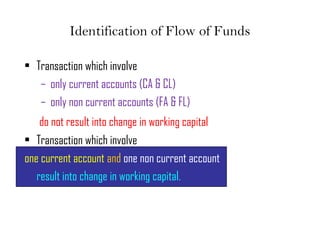
Identification of Flow of Funds
• Transaction which involve
– only current accounts (CA & CL)
– only non current accounts (FA & FL)
do not result into change in working capital
• Transaction which involve
one current account and one non current account
result into change in working capital.
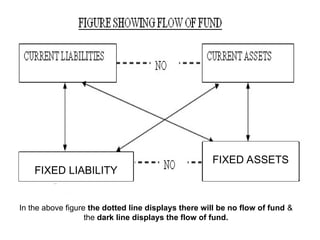
In the above figure the dotted line displays there will be no flow of fund &
the dark line displays the flow of fund.
FIXED ASSETS
FIXED LIABILITY
Examples
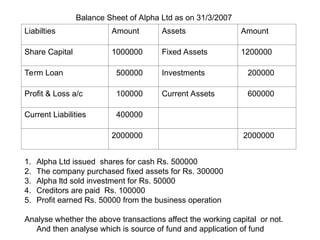
Liabilties Amount Assets Amount
Share Capital 1000000 Fixed Assets 1200000
Term Loan 500000 Investments 200000
Profit & Loss a/c 100000 Current Assets 600000
Current Liabilities 400000
2000000 2000000
Balance Sheet of Alpha Ltd as on 31/3/2007
1. Alpha Ltd issued shares for cash Rs. 500000
2. The company purchased fixed assets for Rs. 300000
3. Alpha ltd sold investment for Rs. 50000
4. Creditors are paid Rs. 100000
5. Profit earned Rs. 50000 from the business operation
Analyse whether the above transactions affect the working capital or not.
And then analyse which is source of fund and application of fund
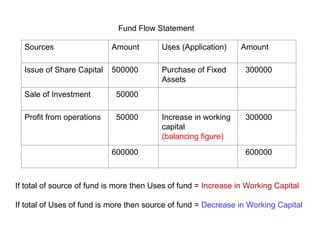
Sources Amount Uses (Application) Amount
Issue of Share Capital 500000 Purchase of Fixed
Assets
300000
Sale of Investment 50000
Profit from operations 50000 Increase in working
capital
(balancing figure)
300000
600000 600000
Fund Flow Statement
If total of source of fund is more then Uses of fund = Increase in Working Capital
If total of Uses of fund is more then source of fund = Decrease in Working Capital
Approaches
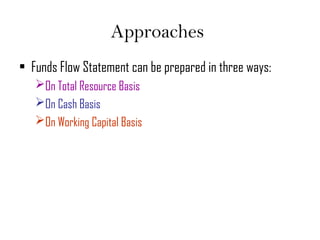
• Funds Flow Statement can be prepared in three ways:
On Total Resource Basis
On Cash Basis
On Working Capital Basis
Fund Flow Statement on Total Resource Basis
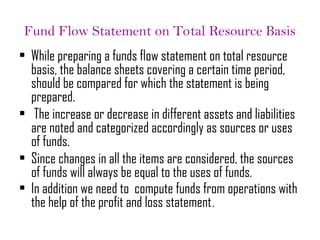
• While preparing a funds flow statement on total resource
basis, the balance sheets covering a certain time period,
should be compared for which the statement is being
prepared.
• The increase or decrease in different assets and liabilities
are noted and categorized accordingly as sources or uses
of funds.
• Since changes in all the items are considered, the sources
of funds will always be equal to the uses of funds.
• In addition we need to compute funds from operations with
the help of the profit and loss statement.
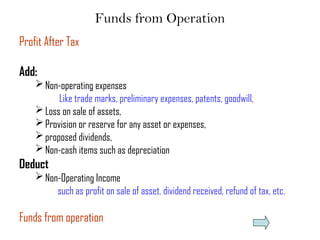
Funds from Operation
Profit After Tax
Add:
Non-operating expenses
Like trade marks, preliminary expenses, patents, goodwill,
Loss on sale of assets,
Provision or reserve for any asset or expenses,
proposed dividends,
Non-cash items such as depreciation
Deduct
Non-Operating Income
such as profit on sale of asset, dividend received, refund of tax, etc.
Funds from operation
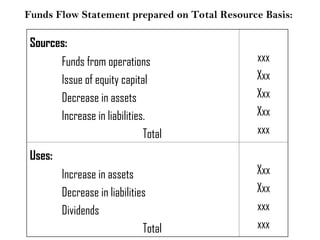
Funds Flow Statement prepared on Total Resource Basis:
Sources:
Funds from operations
Issue of equity capital
Decrease in assets
Increase in liabilities.
Total
xxx
Xxx
Xxx
Xxx
xxx
Uses:
Increase in assets
Decrease in liabilities
Dividends
Total
Xxx
Xxx
xxx
xxx
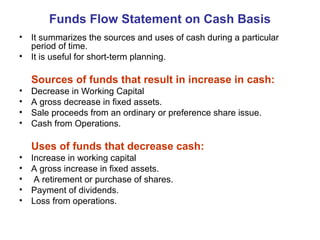
Funds Flow Statement on Cash Basis
• It summarizes the sources and uses of cash during a particular
period of time.
• It is useful for short-term planning.
Sources of funds that result in increase in cash:
• Decrease in Working Capital
• A gross decrease in fixed assets.
• Sale proceeds from an ordinary or preference share issue.
• Cash from Operations.
Uses of funds that decrease cash:
• Increase in working capital
• A gross increase in fixed assets.
• A retirement or purchase of shares.
• Payment of dividends.
• Loss from operations.
Funds Flow Statement on Working Capital Basis
• Working capital can be defined as the difference between
current assets and current liabilities.
• The preparation of funds flow statement on working
capital basis consists of the following steps:
1. Preparation of Schedule of Changes in Working Capital
2. Preparation of Funds Flow Statement
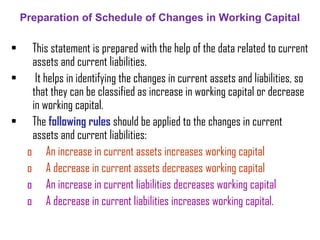
Preparation of Schedule of Changes in Working Capital
• This statement is prepared with the help of the data related to current
assets and current liabilities.
• It helps in identifying the changes in current assets and liabilities, so
that they can be classified as increase in working capital or decrease
in working capital.
• The following rules should be applied to the changes in current
assets and current liabilities:
o An increase in current assets increases working capital
o A decrease in current assets decreases working capital
o An increase in current liabilities decreases working capital
o A decrease in current liabilities increases working capital.
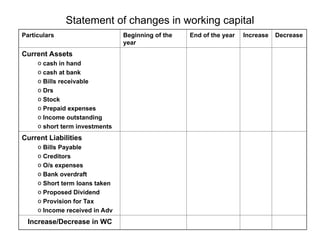
Statement of changes in working capital
Particulars Beginning of the
year
End of the year Increase Decrease
Current Assets
o cash in hand
o cash at bank
o Bills receivable
o Drs
o Stock
o Prepaid expenses
o Income outstanding
o short term investments
Current Liabilities
o Bills Payable
o Creditors
o O/s expenses
o Bank overdraft
o Short term loans taken
o Proposed Dividend
o Provision for Tax
o Income received in Adv
Increase/Decrease in WC
Preparation of Funds Flow Statement
On working capital basis
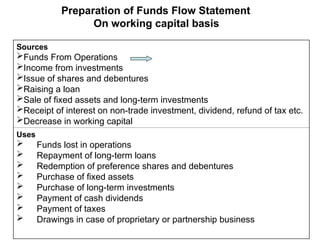
Sources
Funds From Operations
Income from investments
Issue of shares and debentures
Raising a loan
Sale of fixed assets and long-term investments
Receipt of interest on non-trade investment, dividend, refund of tax etc.
Decrease in working capital
Uses
 Funds lost in operations
 Repayment of long-term loans
 Redemption of preference shares and debentures
 Purchase of fixed assets
 Purchase of long-term investments
 Payment of cash dividends
 Payment of taxes
 Drawings in case of proprietary or partnership business
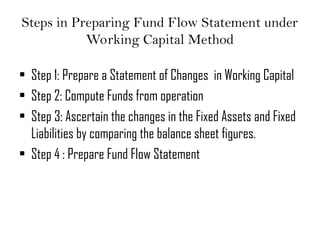
Steps in Preparing Fund Flow Statement under
Working Capital Method
• Step 1: Prepare a Statement of Changes in Working Capital
• Step 2: Compute Funds from operation
• Step 3: Ascertain the changes in the Fixed Assets and Fixed
Liabilities by comparing the balance sheet figures.
• Step 4 : Prepare Fund Flow Statement
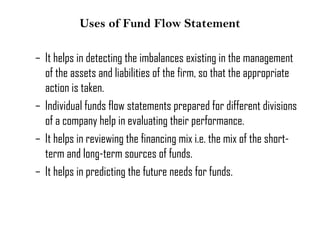
Uses of Fund Flow Statement
– It helps in detecting the imbalances existing in the management
of the assets and liabilities of the firm, so that the appropriate
action is taken.
– Individual funds flow statements prepared for different divisions
of a company help in evaluating their performance.
– It helps in reviewing the financing mix i.e. the mix of the short-
term and long-term sources of funds.
– It helps in predicting the future needs for funds.
Limitation
• Funds flow statement can be interpreted only in conjunction
with the other financial statements.
• By itself, it cannot provide a complete analysis of the
financial position and changes therein.
Thank U

module 5.2 Fund flow statement Analysis.ppt

  • 1.
    Module 5.2 Fund FlowAnalysis Session Objectives •Purpose of Funds Flow Statement •Meaning of Funds Flow •Funds Flow Statement on Total Resource Basis •Funds Flow Statement on Cash Basis •Funds Flow Statement on Working Capital Basis •Uses Funds Flow Statement •Limitation of Fund Flow Statement
  • 2.
    Purpose of FundsFlow Statement • The two basic financial statements of a firm are; – The Balance Sheet – The Profit and Loss • Balance sheet gives a static view of the sources and uses of funds and does not indicate the movement of funds. • The profit and loss account does not indicate any change in owner’s equity due to factors like additional investments or withdrawal of profits. • Therefore, an additional statement is needed to show the changes in the assets, liabilities and owner’s equity between dates of two balance sheets. • This requirement is fulfilled by a funds flow statement.
  • 3.
    Concepts of FundsFlow Statement • Meaning of : Fund means “Working Capital” Flow means transfer of economic values from one asset or equity to another • Flow of fund refers to movement of funds which cause a change in working capital of the organization. • In other words, increase or decrease in working capital reflects flow of funds. • When a transaction increases working capital it is a known as ‘Source of Fund’ and when it decreases the working capital, it is termed as ‘ Use of fund’. • When a business transaction does not affect working capital, no flow of fund take place.
  • 4.
    Meaning of FundFlow Statement • Funds Flow statement is “a statement that summarizes the sources from which funds were obtained by the firm and the specific uses to which the sources were applied.”
  • 5.
    Questions answered byFFS • What is the amount of funds generated from operations? • How were the Fixed Assets of the organizations financed? • What is the extent of dependence on external sources of finance? • Whether the liquidity position of the organization increased?
  • 6.
    Identification of Flowof Funds • Transaction which involve – only current accounts (CA & CL) – only non current accounts (FA & FL) do not result into change in working capital • Transaction which involve one current account and one non current account result into change in working capital.
  • 7.
    In the abovefigure the dotted line displays there will be no flow of fund & the dark line displays the flow of fund. FIXED ASSETS FIXED LIABILITY
  • 8.
  • 9.
    Liabilties Amount AssetsAmount Share Capital 1000000 Fixed Assets 1200000 Term Loan 500000 Investments 200000 Profit & Loss a/c 100000 Current Assets 600000 Current Liabilities 400000 2000000 2000000 Balance Sheet of Alpha Ltd as on 31/3/2007 1. Alpha Ltd issued shares for cash Rs. 500000 2. The company purchased fixed assets for Rs. 300000 3. Alpha ltd sold investment for Rs. 50000 4. Creditors are paid Rs. 100000 5. Profit earned Rs. 50000 from the business operation Analyse whether the above transactions affect the working capital or not. And then analyse which is source of fund and application of fund
  • 10.
    Sources Amount Uses(Application) Amount Issue of Share Capital 500000 Purchase of Fixed Assets 300000 Sale of Investment 50000 Profit from operations 50000 Increase in working capital (balancing figure) 300000 600000 600000 Fund Flow Statement If total of source of fund is more then Uses of fund = Increase in Working Capital If total of Uses of fund is more then source of fund = Decrease in Working Capital
  • 11.
    Approaches • Funds FlowStatement can be prepared in three ways: On Total Resource Basis On Cash Basis On Working Capital Basis
  • 12.
    Fund Flow Statementon Total Resource Basis • While preparing a funds flow statement on total resource basis, the balance sheets covering a certain time period, should be compared for which the statement is being prepared. • The increase or decrease in different assets and liabilities are noted and categorized accordingly as sources or uses of funds. • Since changes in all the items are considered, the sources of funds will always be equal to the uses of funds. • In addition we need to compute funds from operations with the help of the profit and loss statement.
  • 13.
    Funds from Operation ProfitAfter Tax Add: Non-operating expenses Like trade marks, preliminary expenses, patents, goodwill, Loss on sale of assets, Provision or reserve for any asset or expenses, proposed dividends, Non-cash items such as depreciation Deduct Non-Operating Income such as profit on sale of asset, dividend received, refund of tax, etc. Funds from operation
  • 14.
    Funds Flow Statementprepared on Total Resource Basis: Sources: Funds from operations Issue of equity capital Decrease in assets Increase in liabilities. Total xxx Xxx Xxx Xxx xxx Uses: Increase in assets Decrease in liabilities Dividends Total Xxx Xxx xxx xxx
  • 15.
    Funds Flow Statementon Cash Basis • It summarizes the sources and uses of cash during a particular period of time. • It is useful for short-term planning. Sources of funds that result in increase in cash: • Decrease in Working Capital • A gross decrease in fixed assets. • Sale proceeds from an ordinary or preference share issue. • Cash from Operations. Uses of funds that decrease cash: • Increase in working capital • A gross increase in fixed assets. • A retirement or purchase of shares. • Payment of dividends. • Loss from operations.
  • 16.
    Funds Flow Statementon Working Capital Basis • Working capital can be defined as the difference between current assets and current liabilities. • The preparation of funds flow statement on working capital basis consists of the following steps: 1. Preparation of Schedule of Changes in Working Capital 2. Preparation of Funds Flow Statement
  • 17.
    Preparation of Scheduleof Changes in Working Capital • This statement is prepared with the help of the data related to current assets and current liabilities. • It helps in identifying the changes in current assets and liabilities, so that they can be classified as increase in working capital or decrease in working capital. • The following rules should be applied to the changes in current assets and current liabilities: o An increase in current assets increases working capital o A decrease in current assets decreases working capital o An increase in current liabilities decreases working capital o A decrease in current liabilities increases working capital.
  • 18.
    Statement of changesin working capital Particulars Beginning of the year End of the year Increase Decrease Current Assets o cash in hand o cash at bank o Bills receivable o Drs o Stock o Prepaid expenses o Income outstanding o short term investments Current Liabilities o Bills Payable o Creditors o O/s expenses o Bank overdraft o Short term loans taken o Proposed Dividend o Provision for Tax o Income received in Adv Increase/Decrease in WC
  • 19.
    Preparation of FundsFlow Statement On working capital basis Sources Funds From Operations Income from investments Issue of shares and debentures Raising a loan Sale of fixed assets and long-term investments Receipt of interest on non-trade investment, dividend, refund of tax etc. Decrease in working capital Uses  Funds lost in operations  Repayment of long-term loans  Redemption of preference shares and debentures  Purchase of fixed assets  Purchase of long-term investments  Payment of cash dividends  Payment of taxes  Drawings in case of proprietary or partnership business
  • 20.
    Steps in PreparingFund Flow Statement under Working Capital Method • Step 1: Prepare a Statement of Changes in Working Capital • Step 2: Compute Funds from operation • Step 3: Ascertain the changes in the Fixed Assets and Fixed Liabilities by comparing the balance sheet figures. • Step 4 : Prepare Fund Flow Statement
  • 21.
    Uses of FundFlow Statement – It helps in detecting the imbalances existing in the management of the assets and liabilities of the firm, so that the appropriate action is taken. – Individual funds flow statements prepared for different divisions of a company help in evaluating their performance. – It helps in reviewing the financing mix i.e. the mix of the short- term and long-term sources of funds. – It helps in predicting the future needs for funds.
  • 22.
    Limitation • Funds flowstatement can be interpreted only in conjunction with the other financial statements. • By itself, it cannot provide a complete analysis of the financial position and changes therein.
  • 23.