Stockmarket. Valuation and Analysis Alexander Gilles, CFA
Part 1 Valuation and Discount Factors
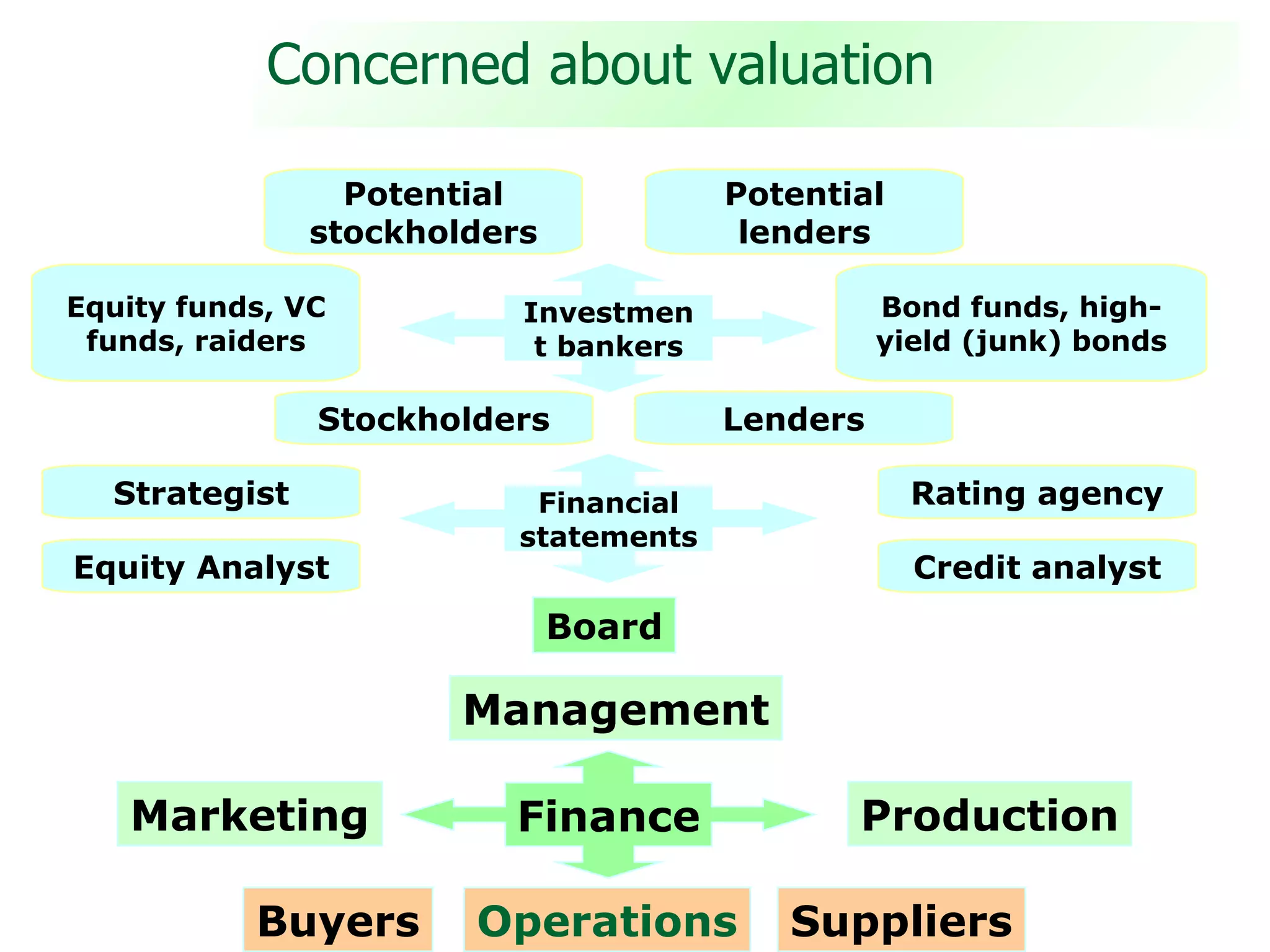
Concerned about valuation Board Management Marketing Production Operations Buyers Suppliers Finance Equity Analyst Credit analyst Strategist Rating agency Stockholders Lenders Equity funds, VC funds, raiders Potential stockholders Potential lenders Bond funds, high-yield (junk) bonds Financial statements Investment bankers
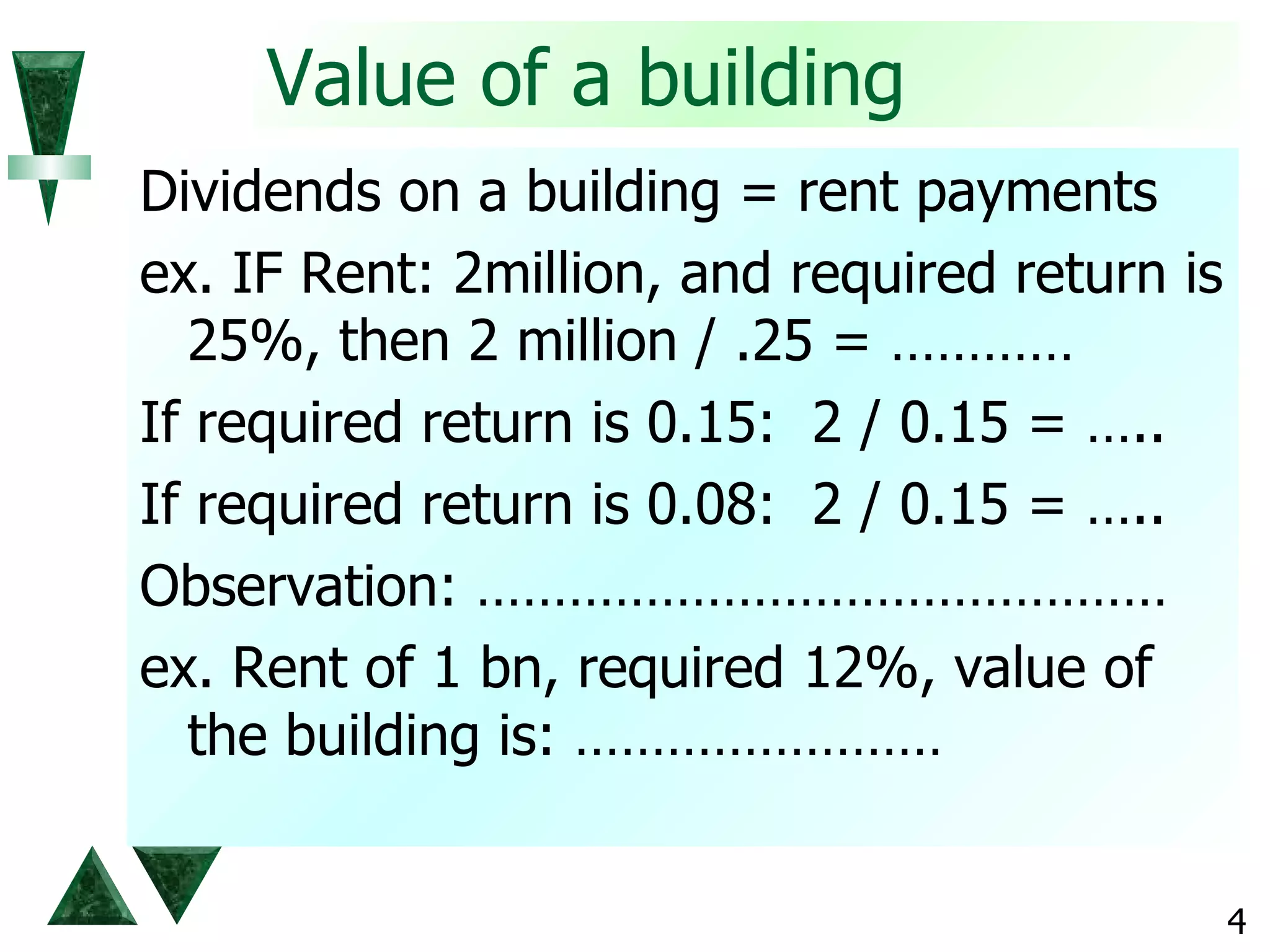
Value of a building  Dividends on a building = rent payments ex. IF Rent: 2million, and required return is 25%, then 2 million / .25 = …………  If required return is 0.15:  2 / 0.15 = …..  If required return is 0.08:  2 / 0.15 = ….. Observation: ………………………………………  ex. Rent of 1 bn, required 12%, value of the building is: ……………………
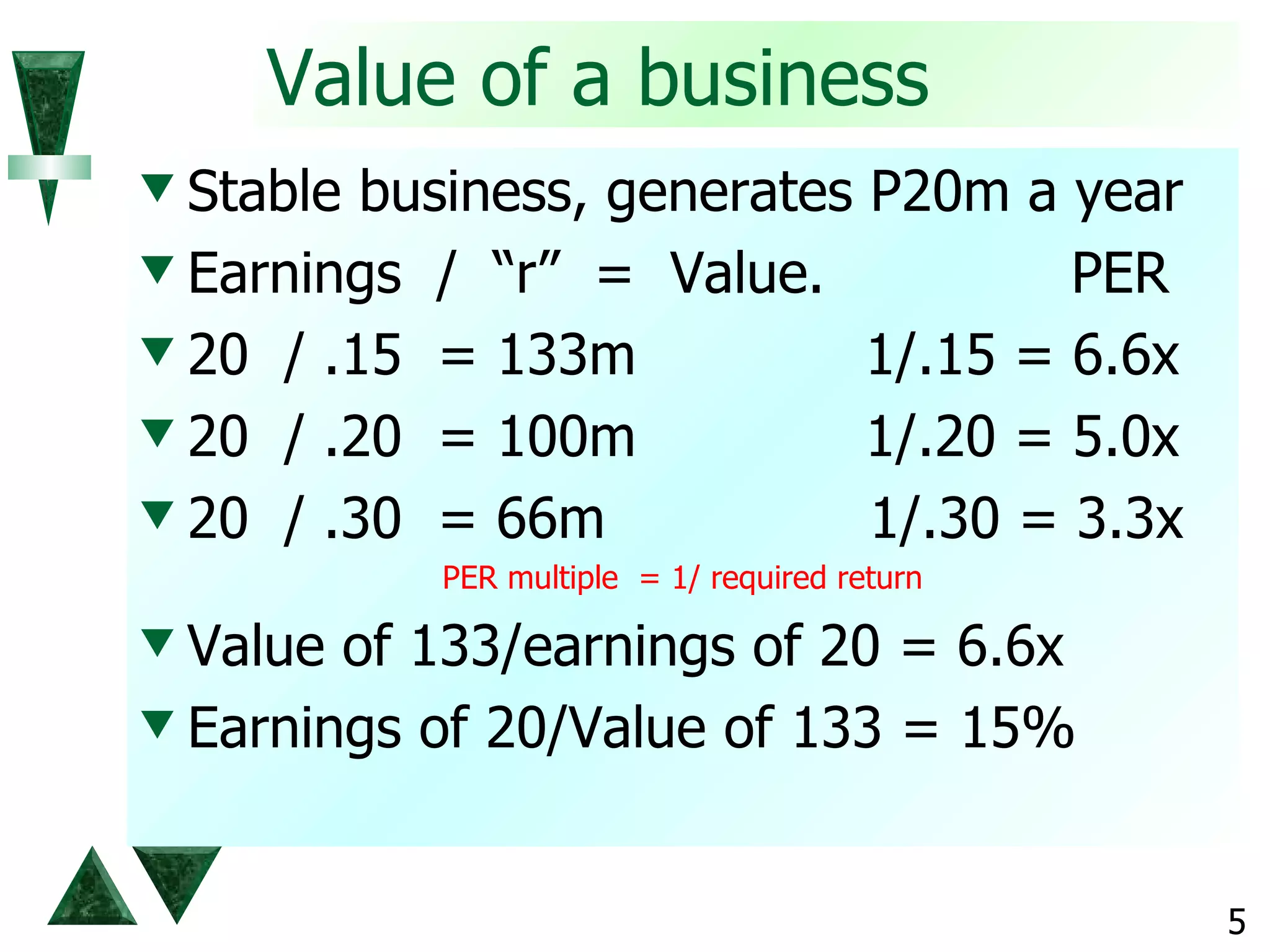
Value of a business  Stable business, generates P20m a year Earnings  /  “r”  =  Value.  PER 20  / .15  = 133m  1/.15 = 6.6x 20  / .20  = 100m  1/.20 = 5.0x 20  / .30  = 66m  1/.30 = 3.3x PER multiple  = 1/ required return Value of 133/earnings of 20 = 6.6x  Earnings of 20/Value of 133 = 15%
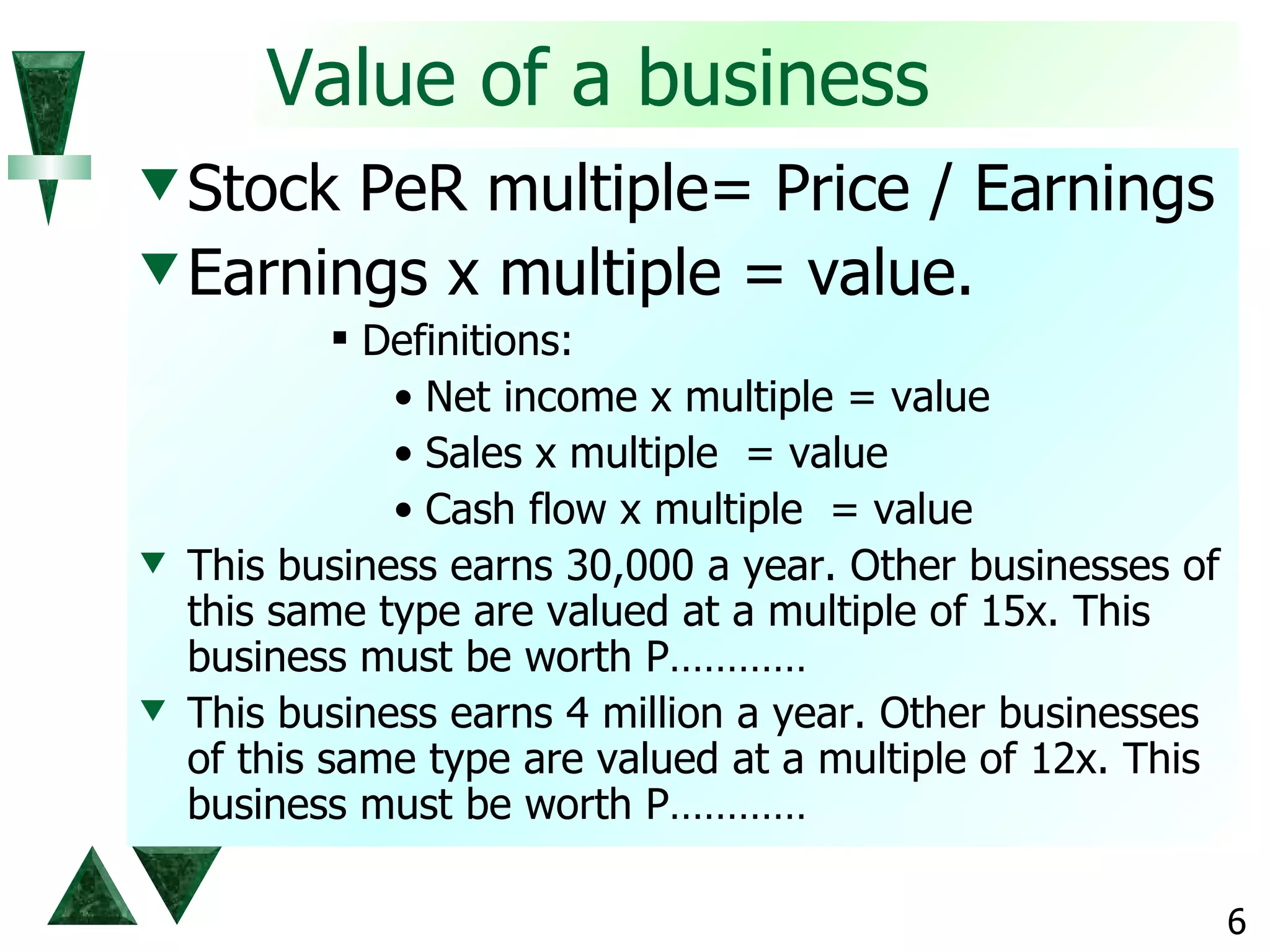
Value of a business  Stock PeR multiple= Price / Earnings Earnings x multiple = value. Definitions:  Net income x multiple = value Sales x multiple  = value Cash flow x multiple  = value This business earns 30,000 a year. Other businesses of this same type are valued at a multiple of 15x. This business must be worth P…………  This business earns 4 million a year. Other businesses of this same type are valued at a multiple of 12x. This business must be worth P…………
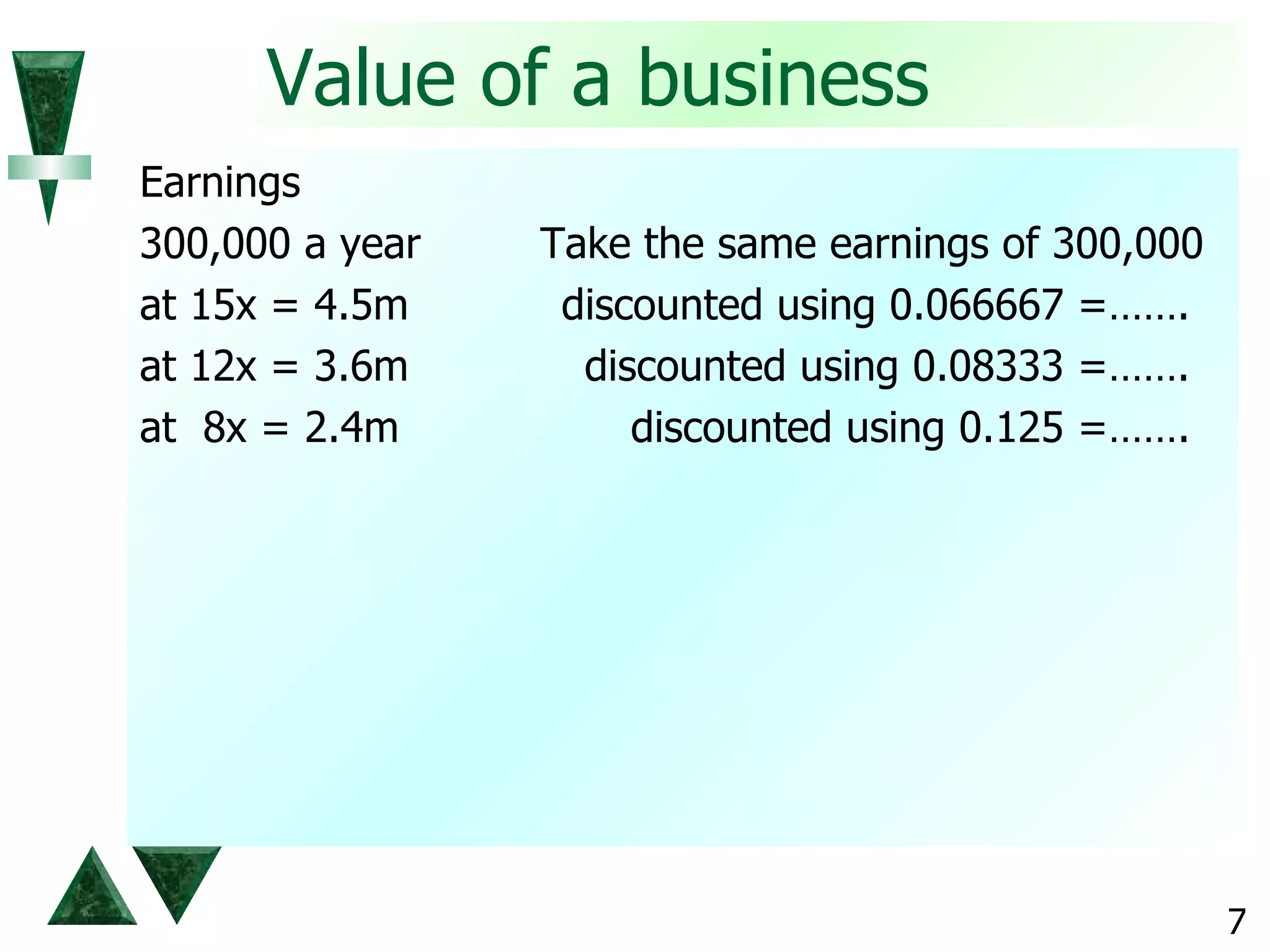
Value of a business Earnings 300,000 a year  Take the same earnings of 300,000 at 15x = 4.5m   discounted using 0.066667 =…….  at 12x = 3.6m  discounted using 0.08333 =…….  at  8x = 2.4m  discounted using 0.125 =…….
Part 2 Company analysis
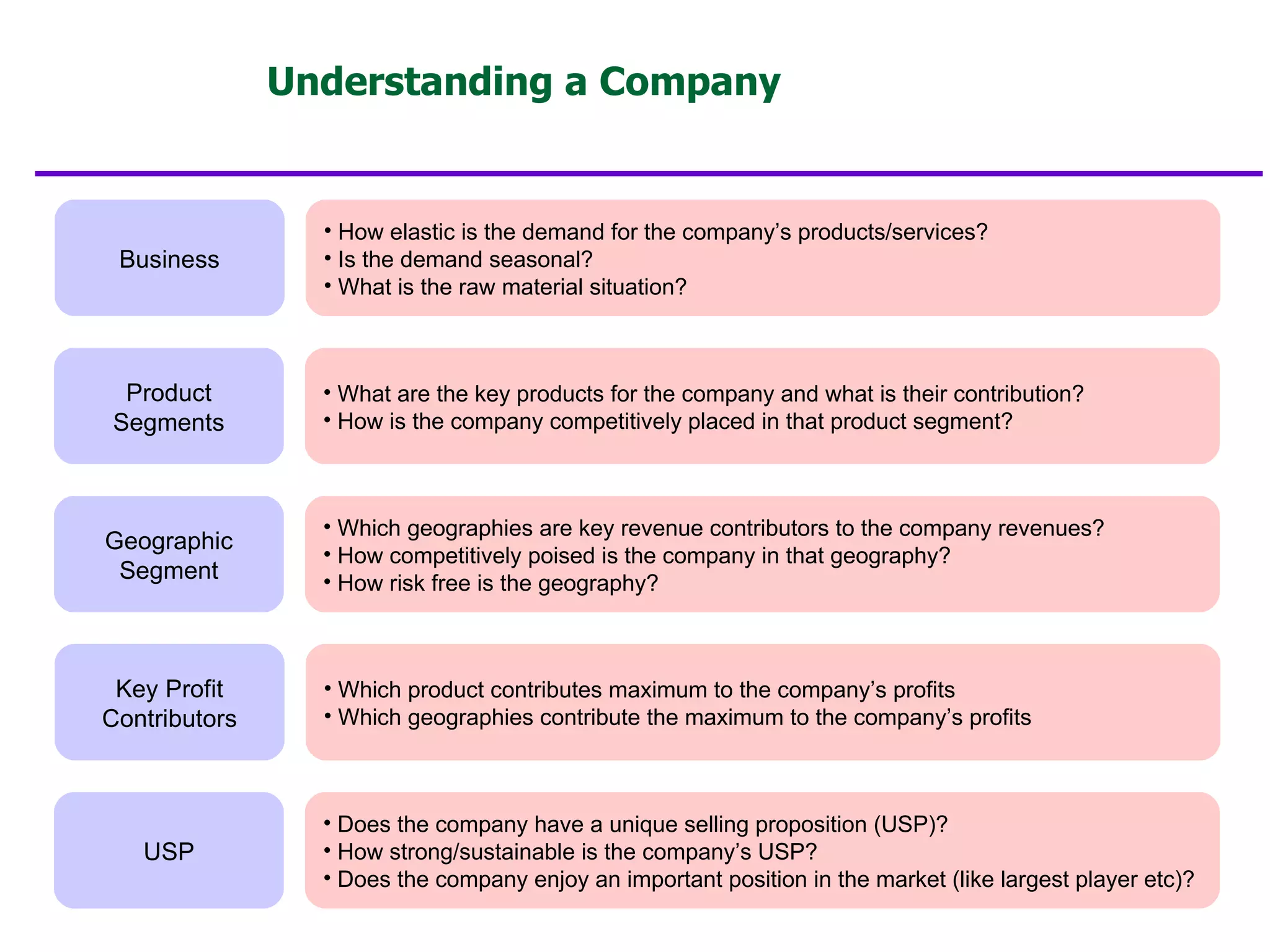
Understanding a Company How elastic is the demand for the company’s products/services? Is the demand seasonal? What is the raw material situation? What are the key products for the company and what is their contribution? How is the company competitively placed in that product segment? Which geographies are key revenue contributors to the company revenues? How competitively poised is the company in that geography? How risk free is the geography? Which product contributes maximum to the company’s profits Which geographies contribute the maximum to the company’s profits Does the company have a unique selling proposition (USP)? How strong/sustainable is the company’s USP? Does the company enjoy an important position in the market (like largest player etc)? Business  Product Segments Geographic Segment Key Profit Contributors USP
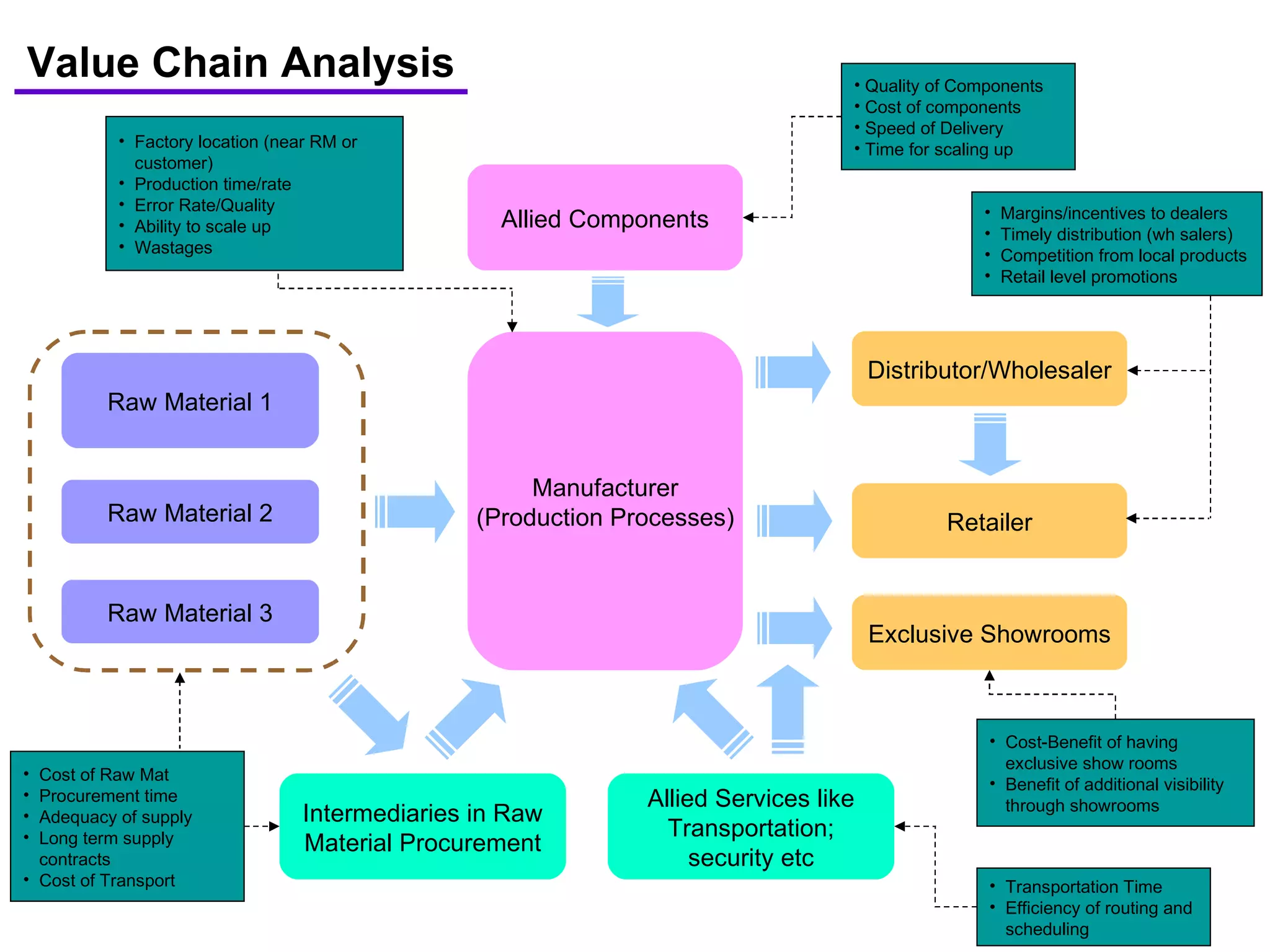
Raw Material 1 Raw Material 2 Raw Material 3 Manufacturer (Production Processes) Distributor/Wholesaler Retailer Allied Components Allied Services like Transportation; security etc Exclusive Showrooms Intermediaries in Raw Material Procurement Value Chain Analysis Quality of Components Cost of components Speed of Delivery Time for scaling up Factory location (near RM or customer)  Production time/rate Error Rate/Quality Ability to scale up Wastages Transportation Time Efficiency of routing and scheduling Cost-Benefit of having exclusive show rooms Benefit of additional visibility through showrooms Margins/incentives to dealers Timely distribution (wh salers) Competition from local products Retail level promotions Cost of Raw Mat  Procurement time Adequacy of supply Long term supply contracts Cost of Transport
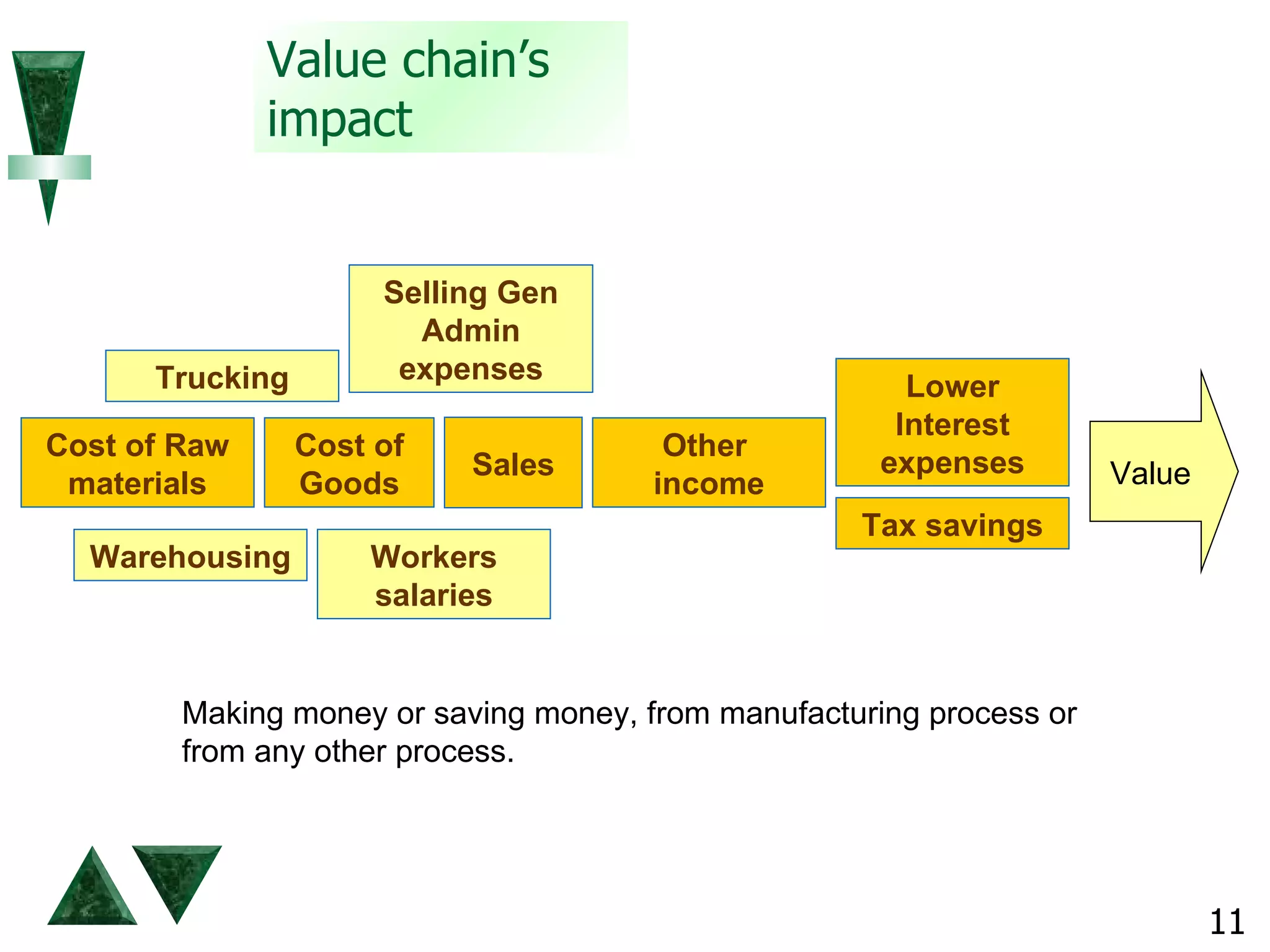
Value chain’s impact Cost of Raw materials Warehousing Trucking Cost of Goods Sales Other  income Workers salaries Selling Gen Admin expenses Tax savings Lower Interest expenses Making money or saving money, from manufacturing process or from any other process. Value
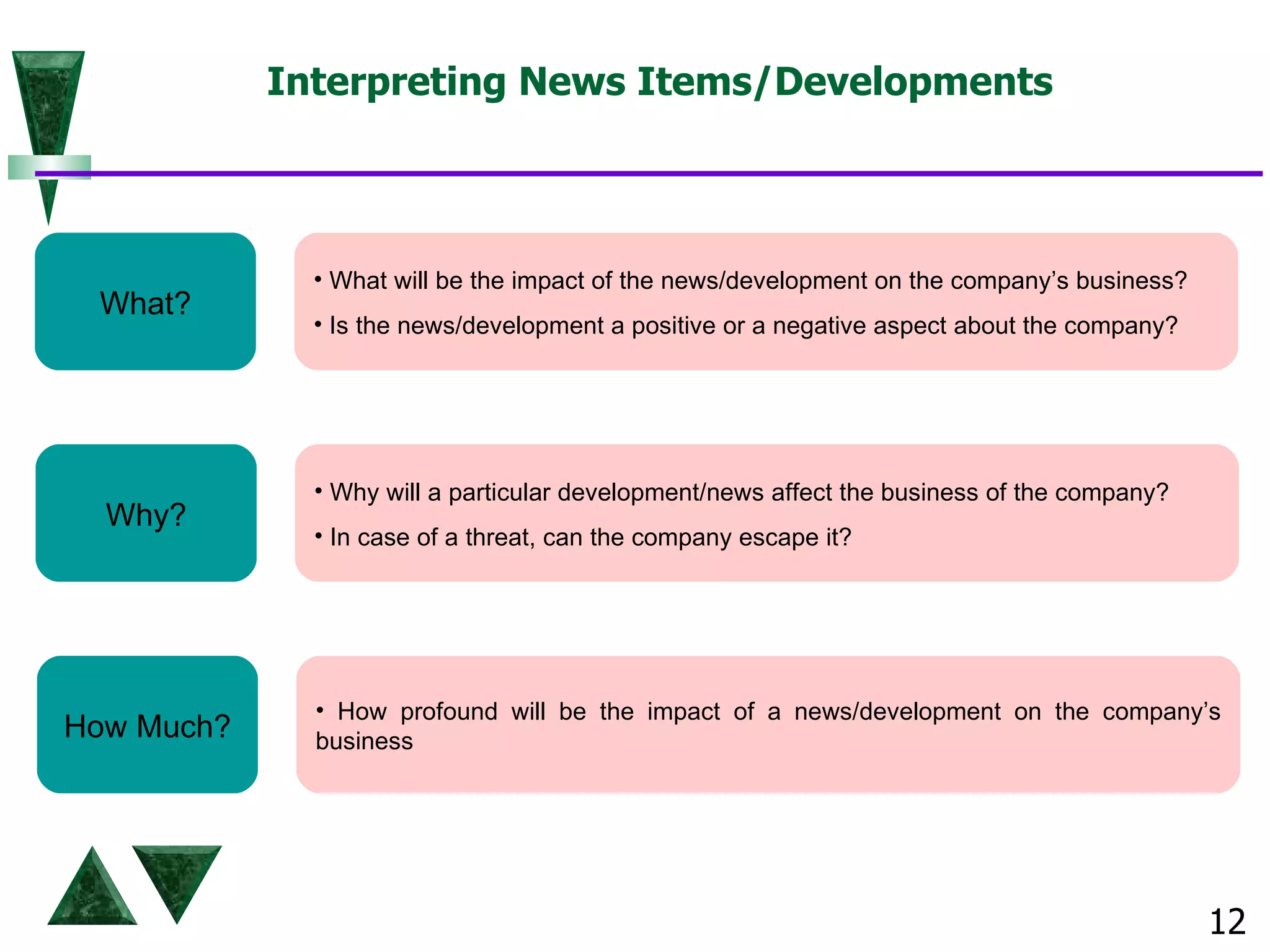
Interpreting News Items/Developments What will be the impact of the news/development on the company’s business? Is the news/development a positive or a negative aspect about the company? Why will a particular development/news affect the business of the company? In case of a threat, can the company escape it? How profound will be the impact of a news/development on the company’s business What? Why? How Much?
Part 3 Financial statement analysis
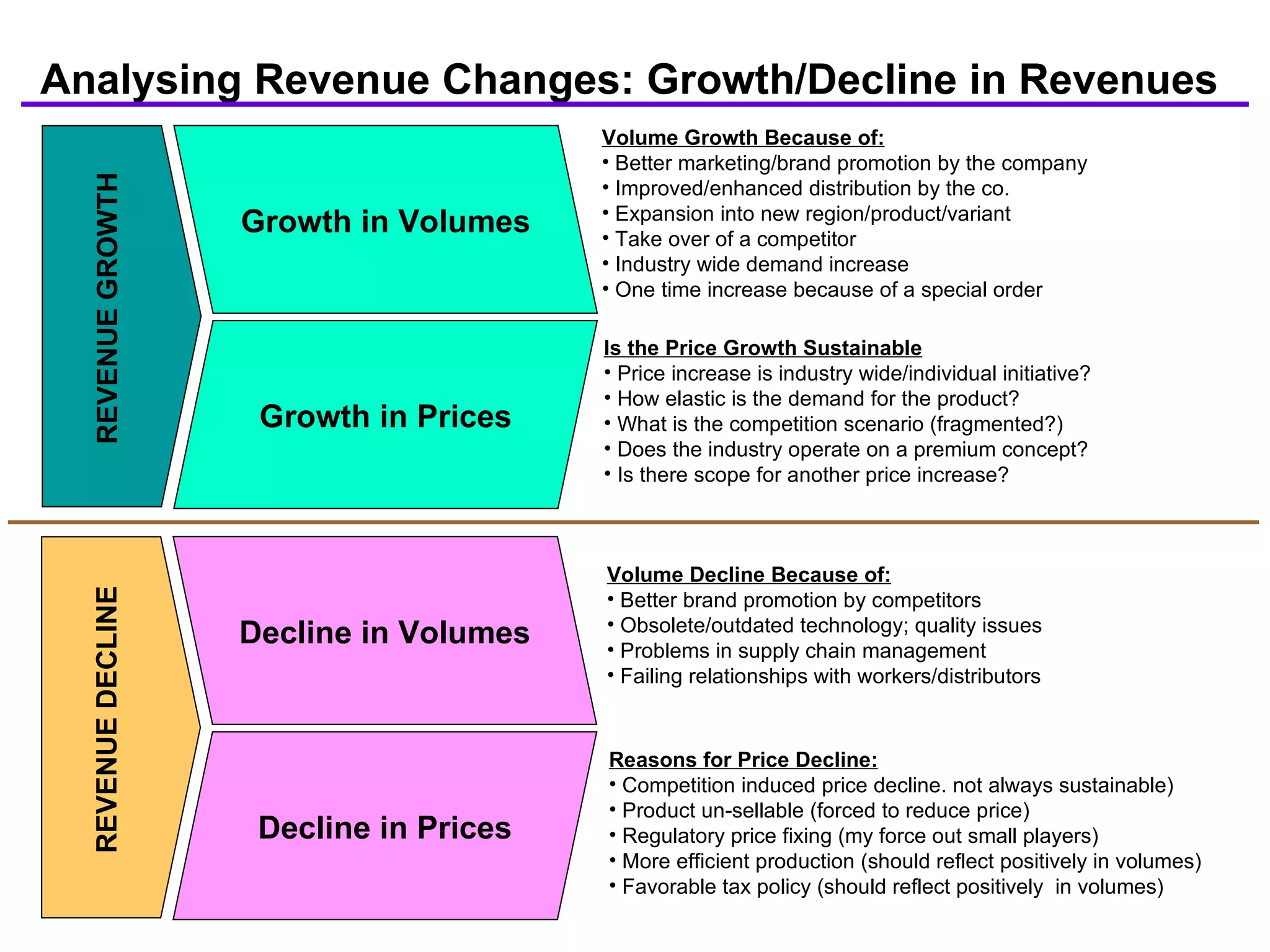
Growth in Prices Growth in Volumes REVENUE GROWTH Volume Growth Because of: Better marketing/brand promotion by the company Improved/enhanced distribution by the co. Expansion into new region/product/variant Take over of a competitor Industry wide demand increase One time increase because of a special order Is the Price Growth Sustainable Price increase is industry wide/individual initiative? How elastic is the demand for the product? What is the competition scenario (fragmented?) Does the industry operate on a premium concept? Is there scope for another price increase? Decline in Prices Decline in Volumes REVENUE DECLINE Volume Decline Because of: Better brand promotion by competitors Obsolete/outdated technology; quality issues Problems in supply chain management Failing relationships with workers/distributors Reasons for Price Decline: Competition induced price decline. not always sustainable) Product un-sellable (forced to reduce price) Regulatory price fixing (my force out small players) More efficient production (should reflect positively in volumes) Favorable tax policy (should reflect positively  in volumes) Analysing Revenue Changes: Growth/Decline in Revenues
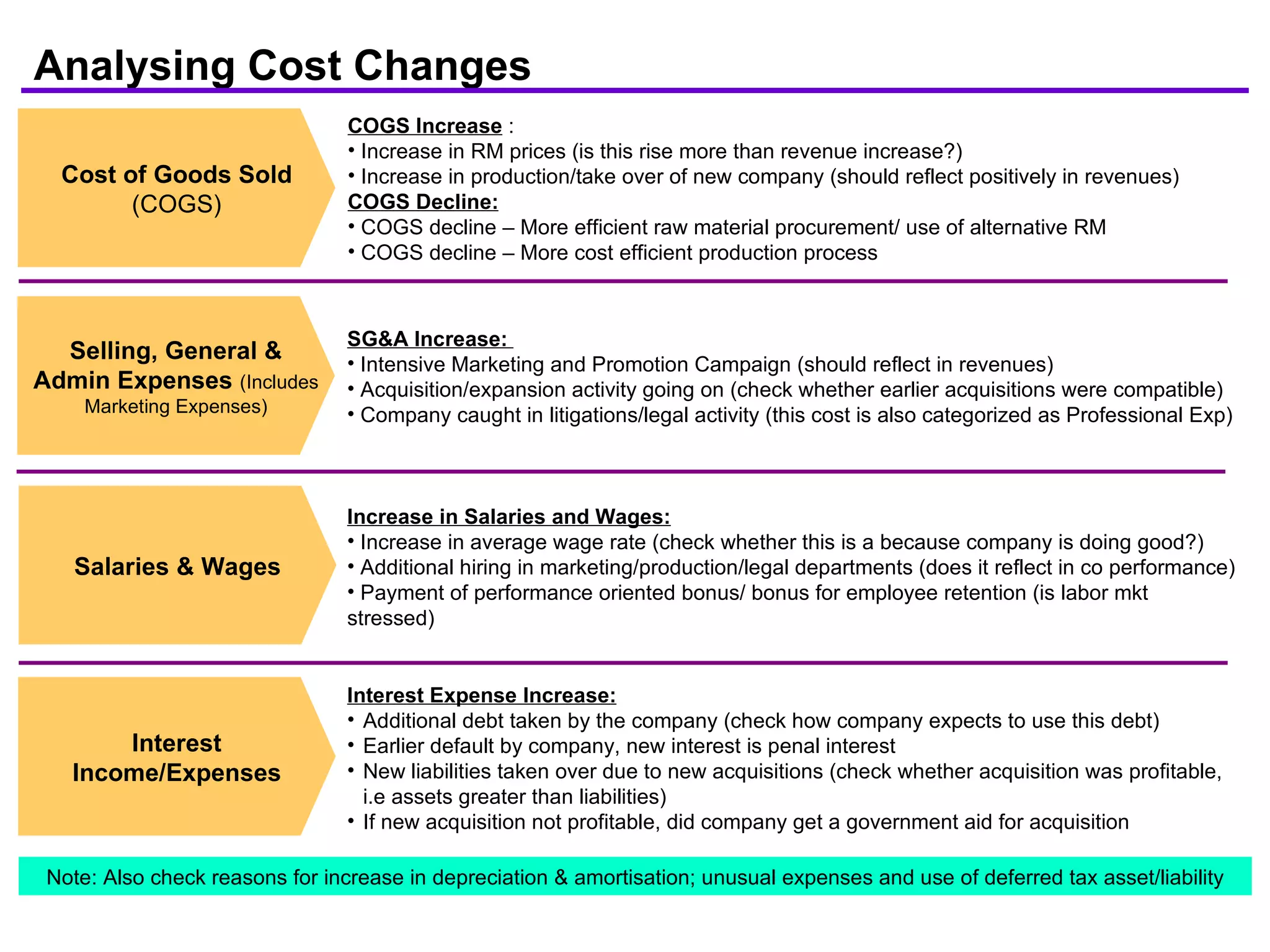
Cost of Goods Sold  (COGS) Selling, General & Admin Expenses   (Includes Marketing Expenses) Salaries & Wages Interest Income/Expenses COGS Increase  : Increase in RM prices (is this rise more than revenue increase?) Increase in production/take over of new company (should reflect positively in revenues) COGS Decline: COGS decline – More efficient raw material procurement/ use of alternative RM COGS decline – More cost efficient production process SG&A Increase:  Intensive Marketing and Promotion Campaign (should reflect in revenues) Acquisition/expansion activity going on (check whether earlier acquisitions were compatible) Company caught in litigations/legal activity (this cost is also categorized as Professional Exp)  Increase in Salaries and Wages: Increase in average wage rate (check whether this is a because company is doing good?) Additional hiring in marketing/production/legal departments (does it reflect in co performance) Payment of performance oriented bonus/ bonus for employee retention (is  labor mkt stressed) Interest Expense Increase: Additional debt taken by the company (check how company expects to use this debt) Earlier default by company, new interest is penal interest New liabilities taken over due to new acquisitions (check whether acquisition was profitable, i.e assets greater than liabilities) If new acquisition not profitable, did company get a government aid for acquisition Analysing Cost Changes Note: Also check reasons for increase in depreciation & amortisation; unusual expenses and use of deferred tax asset/liability
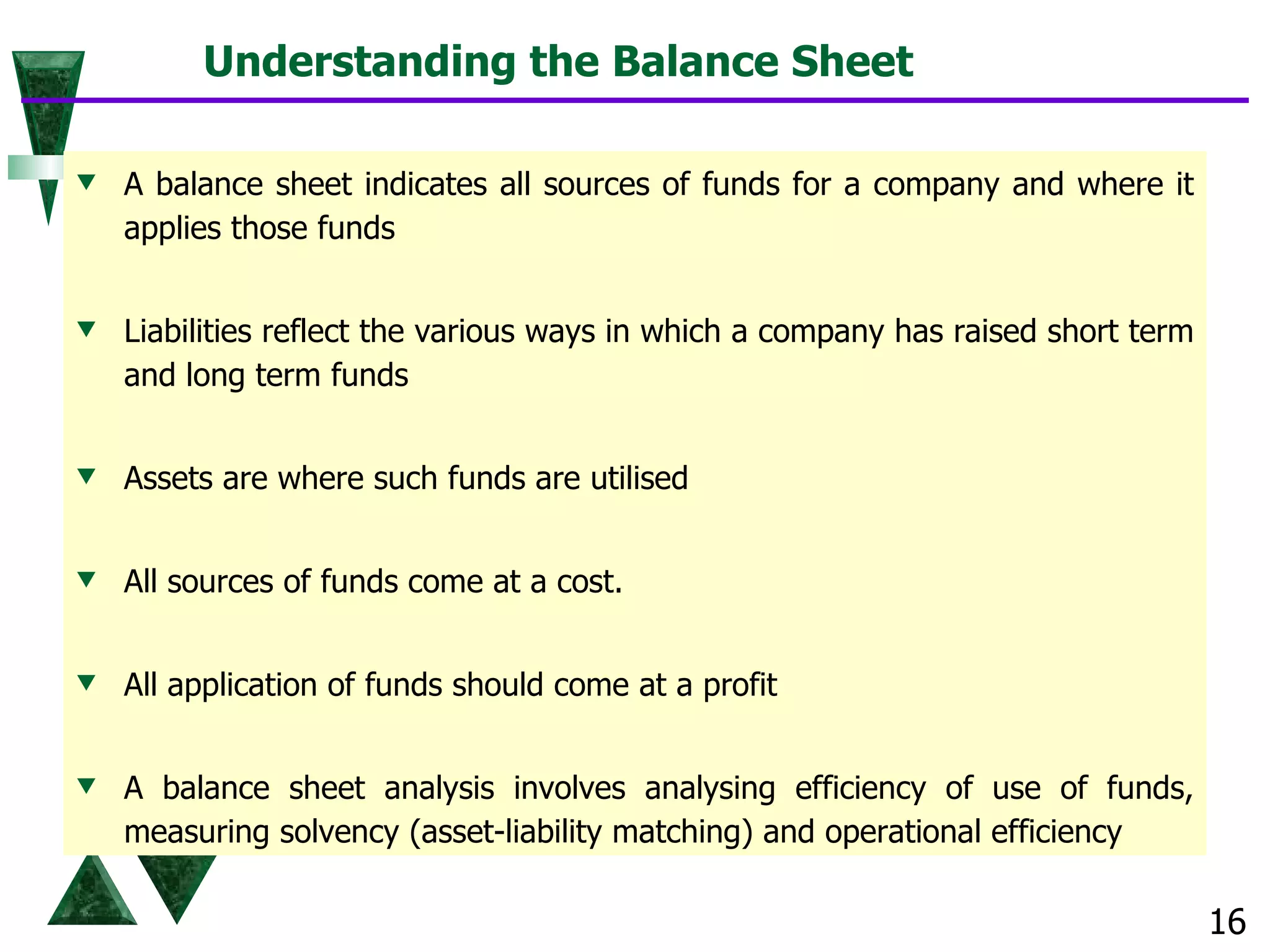
Understanding the Balance Sheet A balance sheet indicates all sources of funds for a company and where it applies those funds Liabilities reflect the various ways in which a company has raised short term and long term funds Assets are where such funds are utilised All sources of funds come at a cost.  All application of funds should come at a profit A balance sheet analysis involves analysing efficiency of use of funds, measuring solvency (asset-liability matching) and operational efficiency
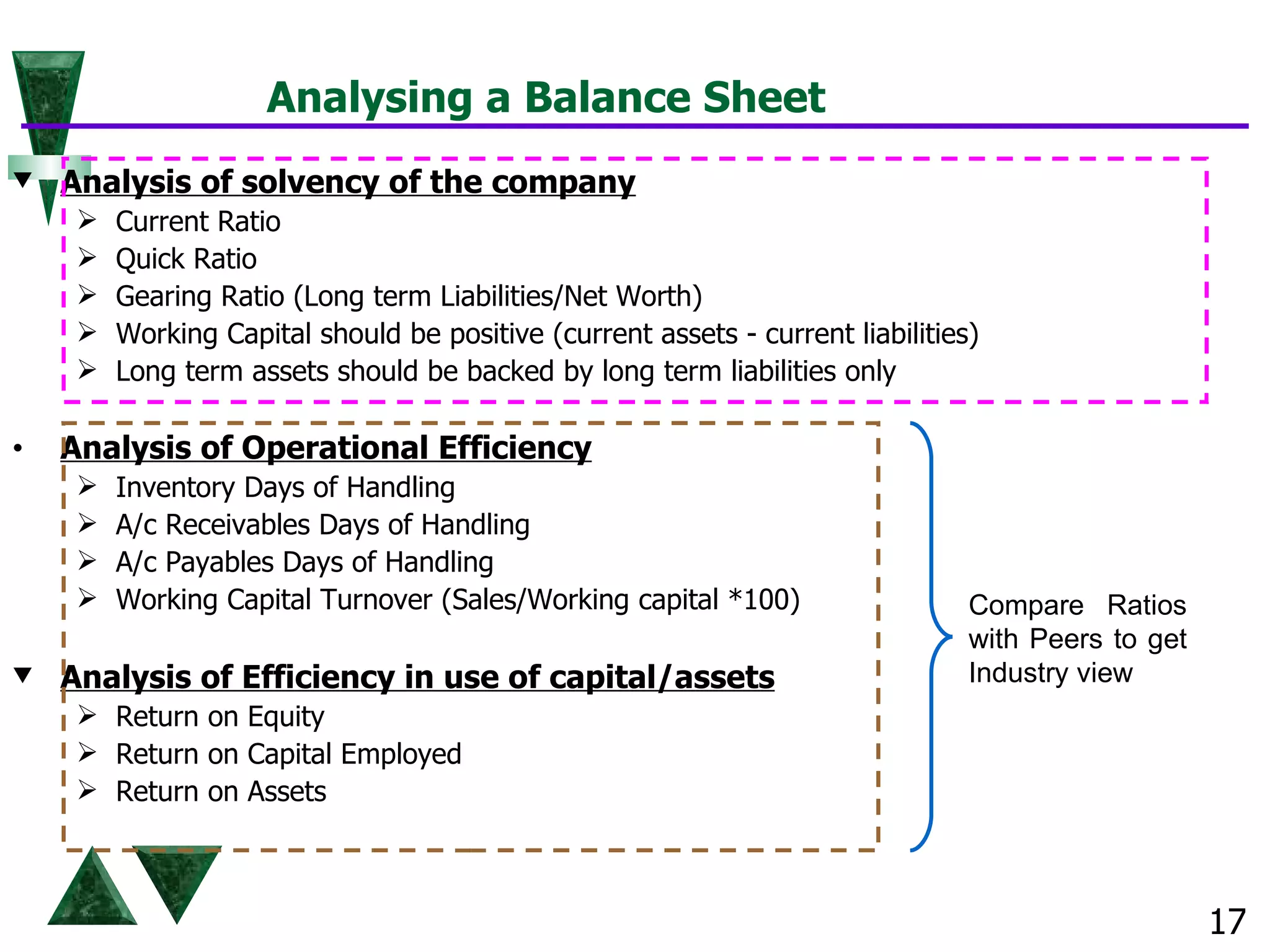
Analysing a Balance Sheet Analysis of solvency of the company Current Ratio Quick Ratio Gearing Ratio (Long term Liabilities/Net Worth) Working Capital should be positive (current assets - current liabilities) Long term assets should be backed by long term liabilities only Analysis of Operational Efficiency   Inventory Days of Handling A/c Receivables Days of Handling A/c Payables Days of Handling Working Capital Turnover (Sales/Working capital *100) Analysis of Efficiency in use of capital/assets Return on Equity Return on Capital Employed Return on Assets Compare Ratios with Peers to get Industry view
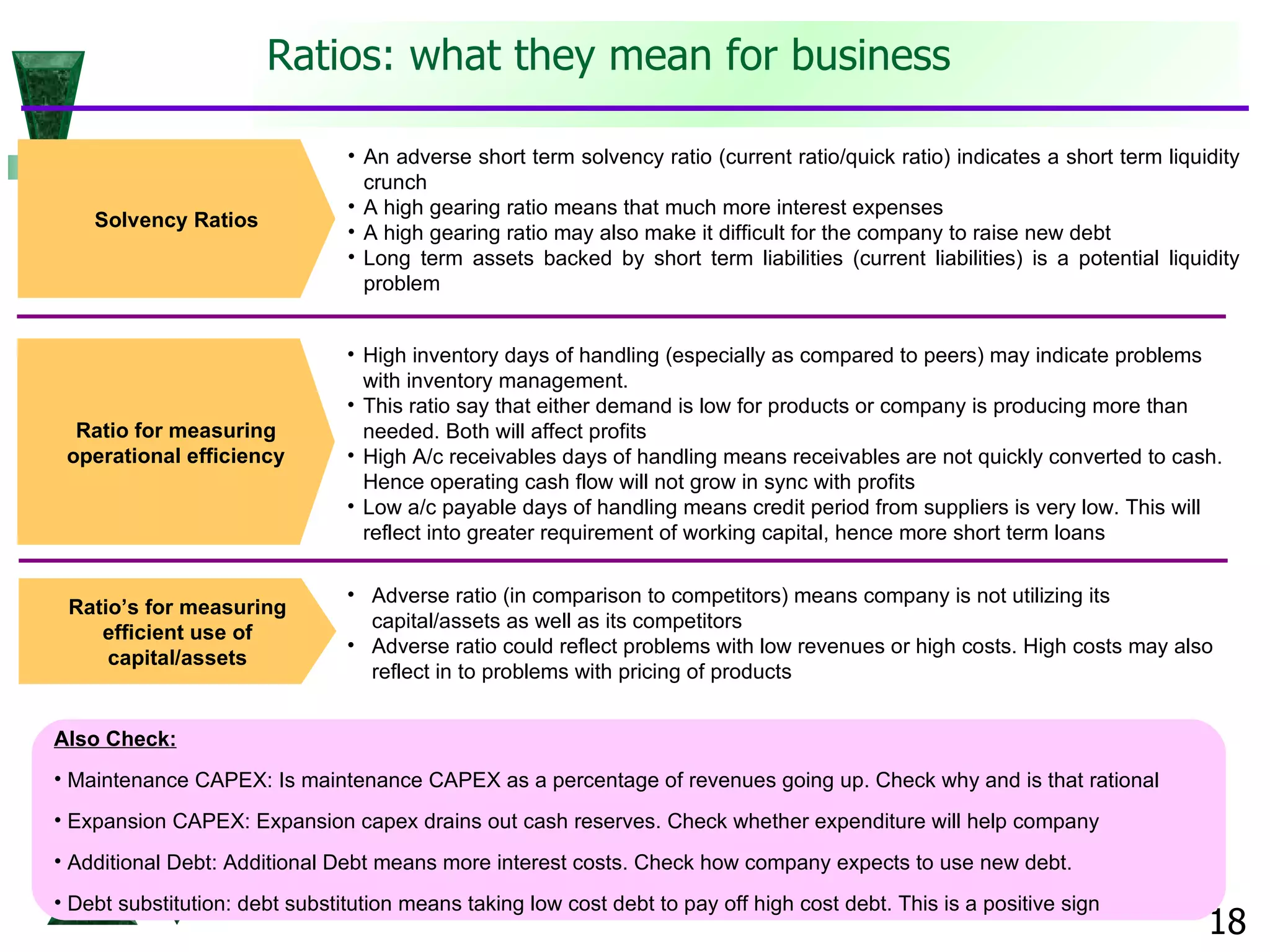
Ratios: what they mean for business Solvency Ratios Ratio for measuring operational efficiency Ratio’s for measuring efficient use of capital/assets An adverse short term solvency ratio (current ratio/quick ratio) indicates a short term liquidity crunch A high gearing ratio means that much more interest expenses A high gearing ratio may also make it difficult for the company to raise new debt Long term assets backed by short term liabilities (current liabilities) is a potential liquidity problem High inventory days of handling (especially as compared to peers) may indicate problems with inventory management.  This ratio say that either demand is low for products or company is producing more than needed. Both will affect profits High A/c receivables days of handling means receivables are not quickly converted to cash. Hence operating cash flow will not grow in sync with profits Low a/c payable days of handling means credit period from suppliers is very low. This will reflect into greater requirement of working capital, hence more short term loans Adverse ratio (in comparison to competitors) means company is not utilizing its capital/assets as well as its competitors Adverse ratio could reflect problems with low revenues or high costs. High costs may also reflect in to problems with pricing of products Also Check:   Maintenance CAPEX: Is maintenance CAPEX as a percentage of revenues going up. Check why and is that rational Expansion CAPEX: Expansion capex drains out cash reserves. Check whether expenditure will help company Additional Debt: Additional Debt means more interest costs. Check how company expects to use new debt. Debt substitution: debt substitution means taking low cost debt to pay off high cost debt. This is a positive sign

Step-by-Step: How To Analyze A Company

  • 1.
    Stockmarket. Valuation andAnalysis Alexander Gilles, CFA
  • 2.
    Part 1 Valuationand Discount Factors
  • 3.
    Concerned about valuationBoard Management Marketing Production Operations Buyers Suppliers Finance Equity Analyst Credit analyst Strategist Rating agency Stockholders Lenders Equity funds, VC funds, raiders Potential stockholders Potential lenders Bond funds, high-yield (junk) bonds Financial statements Investment bankers
  • 4.
    Value of abuilding Dividends on a building = rent payments ex. IF Rent: 2million, and required return is 25%, then 2 million / .25 = ………… If required return is 0.15: 2 / 0.15 = ….. If required return is 0.08: 2 / 0.15 = ….. Observation: ……………………………………… ex. Rent of 1 bn, required 12%, value of the building is: ……………………
  • 5.
    Value of abusiness Stable business, generates P20m a year Earnings / “r” = Value. PER 20 / .15 = 133m 1/.15 = 6.6x 20 / .20 = 100m 1/.20 = 5.0x 20 / .30 = 66m 1/.30 = 3.3x PER multiple = 1/ required return Value of 133/earnings of 20 = 6.6x Earnings of 20/Value of 133 = 15%
  • 6.
    Value of abusiness Stock PeR multiple= Price / Earnings Earnings x multiple = value. Definitions: Net income x multiple = value Sales x multiple = value Cash flow x multiple = value This business earns 30,000 a year. Other businesses of this same type are valued at a multiple of 15x. This business must be worth P………… This business earns 4 million a year. Other businesses of this same type are valued at a multiple of 12x. This business must be worth P…………
  • 7.
    Value of abusiness Earnings 300,000 a year Take the same earnings of 300,000 at 15x = 4.5m discounted using 0.066667 =……. at 12x = 3.6m discounted using 0.08333 =……. at 8x = 2.4m discounted using 0.125 =…….
  • 8.
  • 9.
    Understanding a CompanyHow elastic is the demand for the company’s products/services? Is the demand seasonal? What is the raw material situation? What are the key products for the company and what is their contribution? How is the company competitively placed in that product segment? Which geographies are key revenue contributors to the company revenues? How competitively poised is the company in that geography? How risk free is the geography? Which product contributes maximum to the company’s profits Which geographies contribute the maximum to the company’s profits Does the company have a unique selling proposition (USP)? How strong/sustainable is the company’s USP? Does the company enjoy an important position in the market (like largest player etc)? Business Product Segments Geographic Segment Key Profit Contributors USP
  • 10.
    Raw Material 1Raw Material 2 Raw Material 3 Manufacturer (Production Processes) Distributor/Wholesaler Retailer Allied Components Allied Services like Transportation; security etc Exclusive Showrooms Intermediaries in Raw Material Procurement Value Chain Analysis Quality of Components Cost of components Speed of Delivery Time for scaling up Factory location (near RM or customer) Production time/rate Error Rate/Quality Ability to scale up Wastages Transportation Time Efficiency of routing and scheduling Cost-Benefit of having exclusive show rooms Benefit of additional visibility through showrooms Margins/incentives to dealers Timely distribution (wh salers) Competition from local products Retail level promotions Cost of Raw Mat Procurement time Adequacy of supply Long term supply contracts Cost of Transport
  • 11.
    Value chain’s impactCost of Raw materials Warehousing Trucking Cost of Goods Sales Other income Workers salaries Selling Gen Admin expenses Tax savings Lower Interest expenses Making money or saving money, from manufacturing process or from any other process. Value
  • 12.
    Interpreting News Items/DevelopmentsWhat will be the impact of the news/development on the company’s business? Is the news/development a positive or a negative aspect about the company? Why will a particular development/news affect the business of the company? In case of a threat, can the company escape it? How profound will be the impact of a news/development on the company’s business What? Why? How Much?
  • 13.
    Part 3 Financialstatement analysis
  • 14.
    Growth in PricesGrowth in Volumes REVENUE GROWTH Volume Growth Because of: Better marketing/brand promotion by the company Improved/enhanced distribution by the co. Expansion into new region/product/variant Take over of a competitor Industry wide demand increase One time increase because of a special order Is the Price Growth Sustainable Price increase is industry wide/individual initiative? How elastic is the demand for the product? What is the competition scenario (fragmented?) Does the industry operate on a premium concept? Is there scope for another price increase? Decline in Prices Decline in Volumes REVENUE DECLINE Volume Decline Because of: Better brand promotion by competitors Obsolete/outdated technology; quality issues Problems in supply chain management Failing relationships with workers/distributors Reasons for Price Decline: Competition induced price decline. not always sustainable) Product un-sellable (forced to reduce price) Regulatory price fixing (my force out small players) More efficient production (should reflect positively in volumes) Favorable tax policy (should reflect positively in volumes) Analysing Revenue Changes: Growth/Decline in Revenues
  • 15.
    Cost of GoodsSold (COGS) Selling, General & Admin Expenses (Includes Marketing Expenses) Salaries & Wages Interest Income/Expenses COGS Increase : Increase in RM prices (is this rise more than revenue increase?) Increase in production/take over of new company (should reflect positively in revenues) COGS Decline: COGS decline – More efficient raw material procurement/ use of alternative RM COGS decline – More cost efficient production process SG&A Increase: Intensive Marketing and Promotion Campaign (should reflect in revenues) Acquisition/expansion activity going on (check whether earlier acquisitions were compatible) Company caught in litigations/legal activity (this cost is also categorized as Professional Exp) Increase in Salaries and Wages: Increase in average wage rate (check whether this is a because company is doing good?) Additional hiring in marketing/production/legal departments (does it reflect in co performance) Payment of performance oriented bonus/ bonus for employee retention (is labor mkt stressed) Interest Expense Increase: Additional debt taken by the company (check how company expects to use this debt) Earlier default by company, new interest is penal interest New liabilities taken over due to new acquisitions (check whether acquisition was profitable, i.e assets greater than liabilities) If new acquisition not profitable, did company get a government aid for acquisition Analysing Cost Changes Note: Also check reasons for increase in depreciation & amortisation; unusual expenses and use of deferred tax asset/liability
  • 16.
    Understanding the BalanceSheet A balance sheet indicates all sources of funds for a company and where it applies those funds Liabilities reflect the various ways in which a company has raised short term and long term funds Assets are where such funds are utilised All sources of funds come at a cost. All application of funds should come at a profit A balance sheet analysis involves analysing efficiency of use of funds, measuring solvency (asset-liability matching) and operational efficiency
  • 17.
    Analysing a BalanceSheet Analysis of solvency of the company Current Ratio Quick Ratio Gearing Ratio (Long term Liabilities/Net Worth) Working Capital should be positive (current assets - current liabilities) Long term assets should be backed by long term liabilities only Analysis of Operational Efficiency Inventory Days of Handling A/c Receivables Days of Handling A/c Payables Days of Handling Working Capital Turnover (Sales/Working capital *100) Analysis of Efficiency in use of capital/assets Return on Equity Return on Capital Employed Return on Assets Compare Ratios with Peers to get Industry view
  • 18.
    Ratios: what theymean for business Solvency Ratios Ratio for measuring operational efficiency Ratio’s for measuring efficient use of capital/assets An adverse short term solvency ratio (current ratio/quick ratio) indicates a short term liquidity crunch A high gearing ratio means that much more interest expenses A high gearing ratio may also make it difficult for the company to raise new debt Long term assets backed by short term liabilities (current liabilities) is a potential liquidity problem High inventory days of handling (especially as compared to peers) may indicate problems with inventory management. This ratio say that either demand is low for products or company is producing more than needed. Both will affect profits High A/c receivables days of handling means receivables are not quickly converted to cash. Hence operating cash flow will not grow in sync with profits Low a/c payable days of handling means credit period from suppliers is very low. This will reflect into greater requirement of working capital, hence more short term loans Adverse ratio (in comparison to competitors) means company is not utilizing its capital/assets as well as its competitors Adverse ratio could reflect problems with low revenues or high costs. High costs may also reflect in to problems with pricing of products Also Check: Maintenance CAPEX: Is maintenance CAPEX as a percentage of revenues going up. Check why and is that rational Expansion CAPEX: Expansion capex drains out cash reserves. Check whether expenditure will help company Additional Debt: Additional Debt means more interest costs. Check how company expects to use new debt. Debt substitution: debt substitution means taking low cost debt to pay off high cost debt. This is a positive sign