Fund Flow
Statement
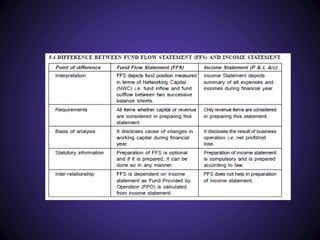
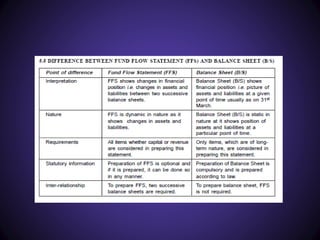
 The balance sheet and income statement are the
traditional basic financial statements of a business
enterprise.
 Balance sheet gives the summary of the firm’s
resources and obligations at a point of time.
 Profit & loss account reflects the results of the
business operations by summarizing revenue and
expenses during a period of time.
 A serious limitation of these statements is that
they do not provide information regarding
changes in the firm’s financial position during
particular period of time.
 They fail to provide the information regarding
causes of changes or the movements of finances
between two-time period or determine the
various causes that lead changes in financial
position of a concern.
 Therefore, an additional statement should be
prepared to show the changes in assets,
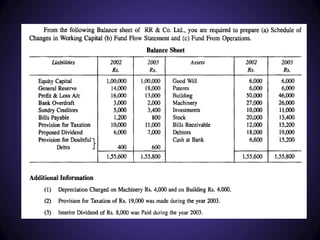
liabilities and owner’s equity between dates of
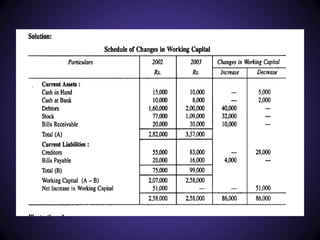
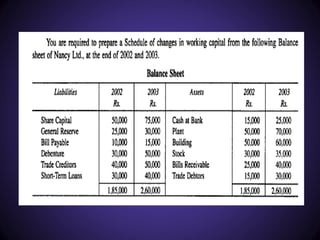
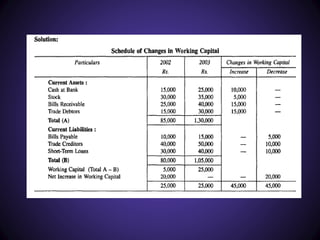
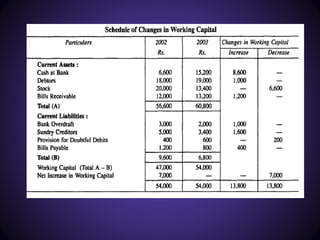
two balance sheets.
 Such a statement referred to as the statement of
changes in financial positions.
 The statement of changes in financial position
overcomes these limitations of basic financial
statements.
 The most commonly used forms of the
statement of changes in financial position are
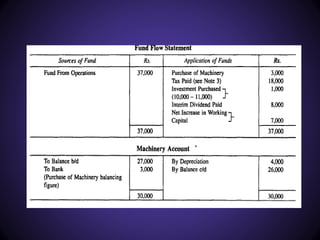
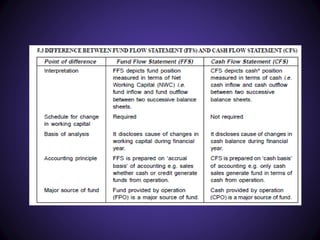
called the Funds Flow Statement and the Cash
Flow Statement
Fund
 Funds mean working capital.
 Two concepts regarding the meaning of the
working capital.
 First, the broad concept according to which
working capital refers to the gross working capital
and represents the amount of funds invested in
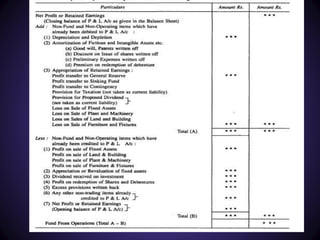
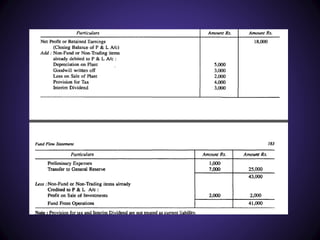
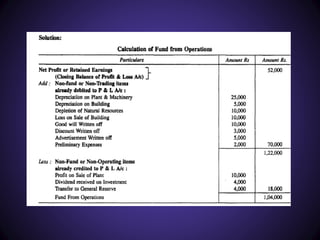
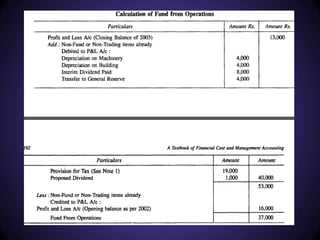
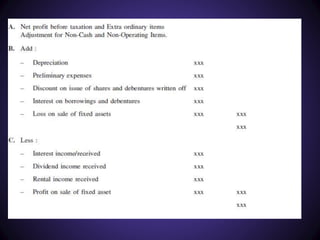
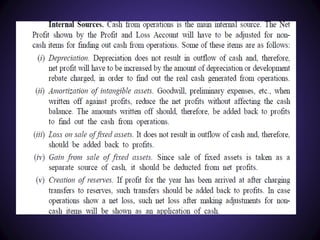
current assets.
 Thus, the gross working capital is the capital
investment in total current assets of the enterprise.
 Current assets are those assets, which in the
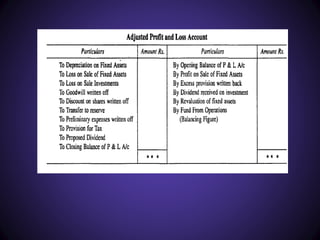
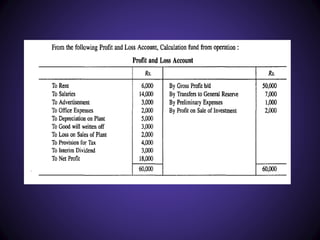
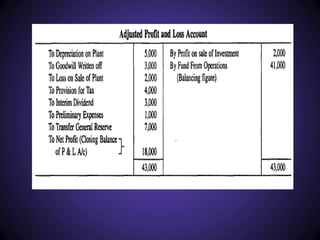
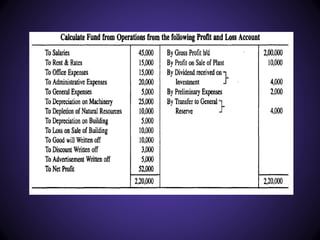
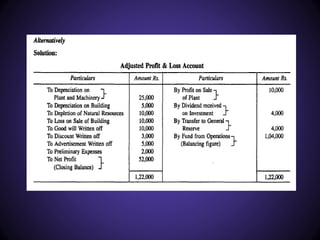
ordinary course of business can be converted onto
 Second, the narrow sense, which termed working
capital as the excess of current asset over current
liabilities or that part of the current asset, which is
financed by the long-term source of finance.
 In case of the Funds Flow Statement the narrow
concept of the working capital is used.
Flow
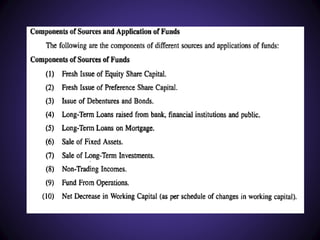
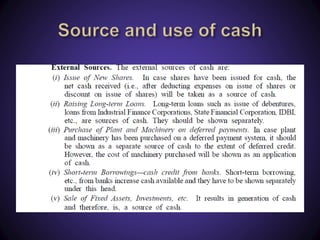
 Flow means movement.
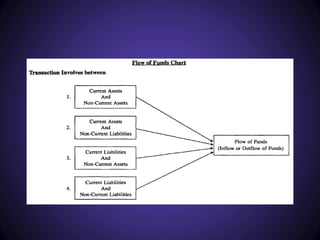
 If we take the flow of funds it means changes in
the position of the funds due to any transaction.
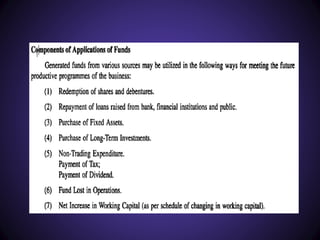
 As a result of the transaction the funds may
increase or decrease.
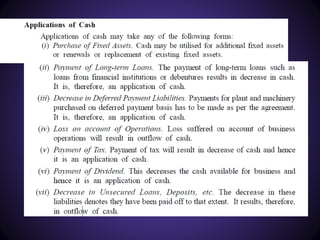
 The increase in funds is called funds inflow and if
funds decrease, it is called funds outflow.
 The one important point to be noted here is
that the flow of funds only occurs when a
transaction affects on the one hand a non
current account and on the other a current
account and vice-versa.
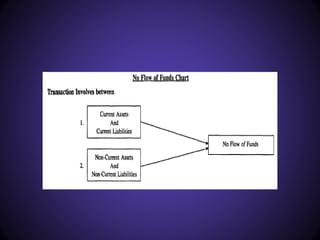
 If a transaction only two current account or
only two non-current accounts then flow of
funds does not take place because here funds
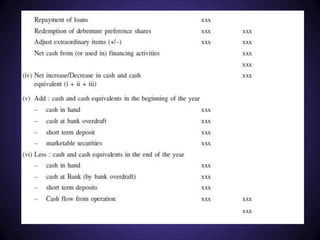
means the difference of the current assets and
current liabilities.
Statement
 Statement means the written description about
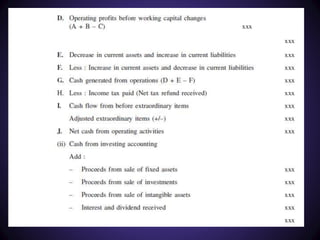
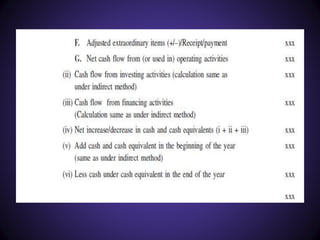
some thing or a detail note, which provide the
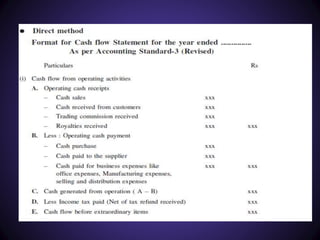
informations.
 The Funds Flow Statement means a summary
of the sources and uses of the working capital.
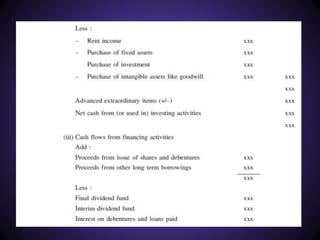
 “A statement of sources and application of funds is
a technical device designed to analyze the changes
in the financial condition of a business enterprise
between two dates.” Foulke
 According to I.C.W.A. “Funds Flow Statement is a
statement either prospective or retrospective,
setting out the sources and applications of the fund
of an enterprise. The purpose of the statement is to
indicate clearly the requirement of funds and how
they are proposed to be raised and the efficient
utilization and application of the same.”
 Funds Flow Statement is a statement, which
indicates various means by which the funds
have been obtained during a certain period and
the ways to which these funds have been used
during that period.
 The main objective is to know the sources and
applications of the funds within a specific time
period.
1. Provide the information regarding changes in
funds position
Provides information regarding the funds, from
where they have procured and where they have
invested meanwhile two specific dates.
2. It helps in the formation of future dividend
policy.
 Sometimes a firm has sufficient profit available for
distribution as dividend but yet it may not be
advisable to distribute dividend for lack of liquid
or cash resources.
 In such cases, funds flow statement helps in the
formation of a realistic dividend policy.
3. It helps in proper allocation of resources
 The resources of a concern are always limited and
it wants to make the best use of these resources.
 A projected funds flow statement constructed for
the future helps in making managerial decisions.
 The firm can plan the deployment of its resources
and allocate them among various applications.
4. It act as future guide
 A projected funds flow statement also acts as a
guide for future to the management.
 The management can come to know the various
problems it is going to face in near future for want
of funds.
 The firm’s future needs of funds can be projected
well in advance and also the timing of these needs.
 The form can arrange to finance these needs more
effectively and avoid future problems.
5. It helps in appraising the use of working capital
 It helps to appraise the performance of a financial
manager in utilization of the working capital and
also suggested the right way to use the working
capital efficiently.
6. It helps to the overall credit worthiness of a
firm
 The financial institutions and banks such as
SFI, IDBI, IFCI etc. all ask for funds flow
statement constructed for a number of years
before granting loans to know the
creditworthiness and paying capacity of the
firm.
 Hence, a firm seeking financial assistance firm
these institutions has no alternative but to
prepare funds flow statements.
7. It helps to know about the utilization of the
sources
 It also provides the information to the
managers and the another interested parties
that the sources they have collected or
provided where they have allocated.
1. Prepared from the final statements: The funds
flow statement is prepared with the help of
final statements. So all the limitations of the
final statements are inherent in it.
2. Only rearrangement: The funds flow statement
is only the rearrangement of the data provided
by the final statements so this is not providing
the actual figure and facts.
3. Working capital oriented: It concentrates on the
concept of the working capital and show the
position of the working capital in the concern
while changes in cash are more important and
relevant for financial management than the
working capital.
4. Periodic in nature: It only reveals the changes in
the working capital position in the concern
between to specific dates. It cannot reveal
continuous changes.
5. Not a substitute: It is not a substitute of an income
statement or a balance sheet, it provide only some
additional information as regards changes in
working capital.
 Funds flow statement can be prepared by
comparing two balance sheets and other
information derived from various accounts as
may be needed.
 While preparing the funds flow statement
mainly two statements are prepared:
1) Schedule of Changes in Working Capital
2) Funds Flow Statement
Schedule of Changes in Working Capital
 Here the narrow concept of the working capital
is used.
 Where working capital means the surplus of
current assets over current liabilities.
 This statement is made to recognize the
changes in the amount of working capital
among the dates of two balance sheets.
 This statement is prepared by deriving the
values of current assets and current liabilities
from the balance sheet
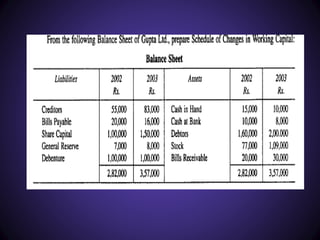
 The schedule of changes in working capital can be
prepared by comparing the balance sheets of two
dates.
 Firstly we have to recognize the current assets and
current liabilities of the concern and then compare
them between two dates if the current assets of
current year are more than the previous year that
is recognized as an increase in working capital or
vice-versa.
 On the other hand if current liabilities of current
year is more than the previous year it will
recognize a decrease in working capital or vice
versa because
Working Capital = Current Assets – Current
Liabilities
Fund Flow Statement
 Funds flow statement is a statement, which
shows the sources and application of the funds
during a particular time period.
 This statement shows that during that period
from where the funds have been procured and
where have been invested.
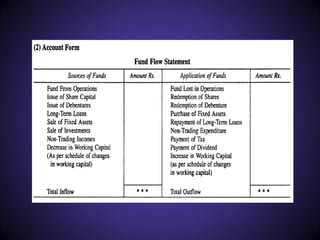
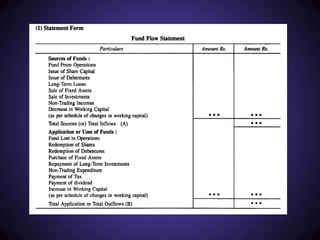
 This statement can be prepared in two forms:
1) Report Form/statement form
2) T Form or Account Form
 Flow of fund means movement of working
capital over a period of time.
 Increase or decrease in working capital reflects
flow of funds.
 When a transaction increases working capital, it
is known as source of funds and when it
decreases working capital it is called use of
funds.
 When a business transaction does not affect
working capital, no flow of funds takes place.
 Fund flow statement is a statement in which all
the transactions which increase or decrease the
working capital is included while those which
do not affect the working capital are excluded.
 These sources can be classified in two
categories.
 Internal Source
 External Source
1.Internal Source:
 Funds from Operations is only single internal
source of funds.
 Funds from operations means the funds
obtained by the general business of the
organization.
 It is equal to the difference of revenue obtained
by the sale of goods and the total cost of
manufacturing them.
 The profit or loss shown by the Profit & Loss
a/c is not always equal to the funds from
operations because in the some non-cash items
are included in the Profit & Loss a/c, which
does not affect the working capital such as
Depreciation and amortization or written off
Preliminary Expenses, Discount on Debentures,
goodwill, Patent Rights, Advertisement
Expenses, Underwriting Commission etc.
 All the expenses, which do not affect the
position of the funds, should be added back in
the profit.
 With the non cash expenses some exceptional
items are also there which are not concerning
with the operations of the business such as
profit or loss arise from the sale of fixed assets
and investment and non business incomes such
as dividend received, interest received, rent
received, refund of income tax and
appreciation in the value of fixed assets etc.
 These items should be deducted from the profit
to calculate the funds from operations.
 There are two methods to prepare the funds
from operations, which are as follows:
A) The First method is to proceed from the figure
of net profit or net loss as arrived at from the
profit and loss account already prepared.
Funds from operations by this method can be
calculated as below.
B) The second method is to prepare the Profit &
Loss account afresh by taking into
consideration only funds and operational
items, which involves funds and are related to
the normal operations of the business.
 The balancing figure in this case will be either
funds from operation or funds lost in
operations depending upon whether income or
credit side of profit and loss a/c exceeds the
expenses or debit side of the profit and loss a/c
or vice-versa.
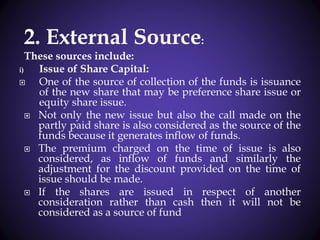
2. External Source:
These sources include:
i) Issue of Share Capital:
 One of the source of collection of the funds is issuance
of the new share that may be preference share issue or
equity share issue.
 Not only the new issue but also the call made on the
partly paid share is also considered as the source of the
funds because it generates inflow of funds.
 The premium charged on the time of issue is also
considered, as inflow of funds and similarly the
adjustment for the discount provided on the time of
issue should be made.
 If the shares are issued in respect of another
consideration rather than cash then it will not be
considered as a source of fund
ii) Issue of Debenture and Raising of Loans:
 Just like the shares issue of debenture and raising
of loans are also a source of funds and the same
adjustment regarding the premium and discount
should be made as in case of the issuance of the
share.
iii) Sale of the Fixed Assets and Long-term
Investments:
 One can increase the funds in the concern by
selling their investment they have made in
different alternatives and in fixed assets just like
plant, machinery, building etc.
 But one thing that should be remembered that if
the assets are exchanged with rather than cash that
will not a source of funds.
iv) Non-Trading Receipts:
 Any non-trading receipts just as rent received,
interest received, dividend received and refund
of tax or any another non-operating income
generates the inflow of cash will be treated as
source of funds.
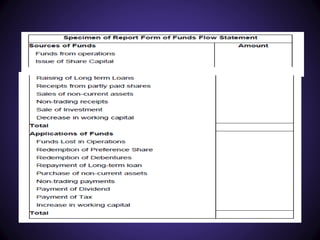
v) Decrease in Working Capital:
 If the working capital decreases in comparison
of previous year in the release of funds from
the working capital so that will be termed as
source of funds.
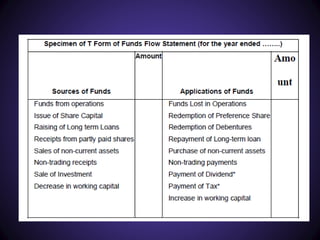
 The other side of the funds flow statement is
application of funds that side shows how the
funds procured from different sources are
allocated or used.
1) Funds lost in Operations:
 Sometimes the result of trading in a certain year is a loss
and some funds are lost during that trading period.
 Such loss of funds means outflow of funds so that item if
treated as an application of funds.
2) Redemption of the Preference Share Capital:
 A company can’t redeem its equity share within its life
time but can redeem their preference share as the result of
redemption of preference share an outflow of funds takes
place.
 So the redemption of the shares is written in the
application side of the funds flow statement.
 One thing should be remembered is that the premium
provided on the redemption will also considered as an
application.
3) Repayment of Loans & Redemption of Debentures:
 As share the repayment of loans and redemption of debenture
also leads a outflow of cash so these items are also treated as
application of the funds.
4) Purchase of any Non-current or Fixed Asset:
 If the businessman purchases any fixed asset or making
investment for the long time period that will also generate a
outflow of funds and treated as an application of funds.
 But if the fixed asset is purchased in exchange of any other
consideration rather than cash that will not treated as
application of funds.
5) Payment of Dividend & Tax:
 Payment of dividend and tax are also applications if funds.
 It is the actual payment of dividend and tax, which should be
taken as an outflow of funds and not the mere declaration of
the dividend or creation of a provision for taxation.
6) Any other Non-trading Payment:
 Any payment or expenses not related to the trading
operations of the business amounts to outflow and is
taken as an application of funds.
 The examples could be drawing in case of sole trader
or partnership firm, loss of cash.
Cash Flow Statement
 Cash means, cash in hand and demand
deposits with the bank.
 Cash equivalent consists of bank overdraft,
cash credit, short term deposits and marketable
securities.
 Cash Flow Statement deals with flow of cash
which includes cash equivalents as well as
cash.
 The statement shows the incoming and
outgoing of cash.
 “Cash-Flow statement may be defined as a
summary of receipts and disbursements of cash for a
particular period of time.”
 Transactions which increase the cash position
of the entity are called as inflows of cash and
those which decrease the cash position as
outflows of cash.
 The statement of cash flow serves a number of
objectives which are as follows :
 Cash flow statement aims at highlighting the cash
generated from operating activities.
 Cash flow statement helps in planning the
repayment of loan schedule and replacement of fixed
assets, etc.
 Cash is the centre of all financial decisions. It is used
as the basis for the projection of future investing and
financing plans of the enterprise.
 Cash flow statement helps to ascertain the liquid
position of the firm in a better manner. Banks and
financial institutions mostly prefer cash flow
statement to analyze liquidity of the borrowing firm.
 Cash flow Statement helps in efficient and effective
management of cash.
 The management generally looks into cash flow
statements to understand the internally generated
cash which is best utilized for payment of dividends.
 The cash flow statement should report cash
flows during the period classified by operating,
investment and financing activities as follows:
 Cash flow from operating activities
 Cash flow from investing activities
 Cash flow from financing activities
Cash flow from operating activities
 Involves cash generated by producing and
delivering goods and providing services.
 Cash inflow includes receipts from customers
for sales of goods and services
 Cash outflow from operating activities include
payments to suppliers for purchase of material
and for services, payment to employees for
services and payment to governments for taxes
and duties.
Example of cash flows from operating activities
are:
 Cash receipts from the sale of goods and
rendering the services.
 Cash receipts from royalties, fees, commission
and other revenue.
 Cash payment to suppliers of goods and
services.
 Cash payment to and on behalf of employees.
 Cash receipts and cash payment of an
insurance enterprise for premium and claims,
annuities and other policy benefits.
Example of cash flows from operating activities are:
a) cash receipts from the sale of goods and the rendering
of services;
b) cash receipts from royalties, fees, commissions, and
other revenue;
c) cash payments to suppliers for goods and services;
d) cash payments to and on behalf of employees;
e) cash receipts and cash payments of an insurance
enterprise for premiums and claims, annuities and
other policy benefits;
f) cash payments or refunds of income taxes unless they
can be specifically identified with financing and
investing activities; and
g) cash receipts and payments relating to future contracts,
forward contracts, option contracts and swap contracts
Cash flow from investing activities
 The cash generated by making and collecting
loans and acquiring and disposing of debts and
equity instruments and fixed assets.
 Cash inflows from investing activities are
receipts from collection of loans, receipts from
sales of shares, receipts from sale of fixed assets
and interest and dividend received from loans
and investments
 Cash outflows from investing activities are
disbursement of loans, payments to acquire share
debts or similar instruments of other enterprise
and payment to acquire fixed assets.
Cash flows from financing activities
 Cash flows from financing activities involve
the proceeding from issuing share or other
similar instrument, debenture, bonds and other
short term or long-term borrowings.
 Cash outflow from financing activities are
payments of dividend, payments to acquire or
redeem shares to other similar instruments of
the enterprise, payment of amount borrowed,
principal payment to creditors who have
extended long-term credit and interest paid.
Cost Control And Cost
Reduction
Cost Control
 Aims at reducing inefficiencies and
wastage and setting up predetermined
cost and achieving them.
 Cost control is exercised through setting
of standards and norms or targets and
comparing actual performance to
ascertain deviations from set targets or
norms or standards and taking
corrective action to ensure that future
performance conforms to the set
standards or norms or targets.
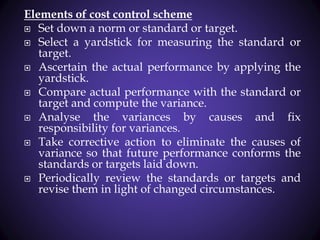
Elements of cost control scheme
 Set down a norm or standard or target.
 Select a yardstick for measuring the standard or
target.
 Ascertain the actual performance by applying the
yardstick.
 Compare actual performance with the standard or
target and compute the variance.
 Analyse the variances by causes and fix
responsibility for variances.
 Take corrective action to eliminate the causes of
variance so that future performance conforms the
standards or targets laid down.
 Periodically review the standards or targets and
revise them in light of changed circumstances.
Steps should be taken in an effective cost
control system
1)Firm should have a definite plan of
organisation. Authority and responsibility of
each executive should be clearly defined.
Targets for performance of work as well as the
cost to be incurred for the purpose should be
laid down for each area of responsibility so that
responsibility may be fixed for the deviation of
actual cost from the predetermined cost.
2) Coast should be collected by each area of
responsibility and reporting of efficiency or
inefficiency displayed by each section should
be prompt. If a considerable time elapses
between happening of events and reporting
,opportunity for taking appropriate action be
lost or some wrong decisions may be taken by
the management in the absence of information.
3)Bring to light the factors leading to increase in cost
rather than to punish people to take remedial
action to improve the peformance in future.
4)Good performance should be handsomely
rewarded so that workers may be motivated
towards better performance.
5)There should be effective budgetary control and
proper setting up of standards. Cooperation of all
persons who are to achieve the budgeted results or
standards should be secured in preparing budgets
or setting up standards to get their willing
involvement in achieving the desired results.
Cost control Techniques
 Material control
 Labour control
 Overhead control
 Budgetary control
 Standard costing
 Control of capital expenditure
Cost Reduction
 Aims in the permanent and real reduction in
the unit of cost of goods manufactured or
services rendered without impairing their
suitability for the use intended.
Characteristics of cost reduction
 Reduction must be real one in the cost of
manufacture or services rendered.
 Real cost reduction comes through greater
productivity.
 Reduction must be a permanent one.
 Reduction must not be at the cost of essential
characteristics ,such as quality of the products
or services rendered.
Areas of cost reduction
1)Product design
 Cost reduction begins with the improvement in
the design of the product.
 An investigation into the possibilities of cost
reduction should be made when introducing
new designs and when making improvements
in the existing design.
2)Factory organisation and production methods
 Efforts should be constantly made to reduce
the costs by the adoption of new methods of
the organisation and new production methods.
3)Factory layout: Study of the factory layout
should be done to find the scope of cost
reduction by elimination of wastage of time,
unnecessary effort and loss of money due to
useless movements and travels.
4)Administration:Office should be reorganised if
there is a scope for improving the efficiency of
persons engaged in the office.
 Use of unnecessary forms should be avoided to
save the cost of stationery and labour cost
involved in compiling them
5)Marketing : Various activities which can be
brought under cost reduction include market
research, advertisement, packing, warehouse,
distribution, after sales service.
6)Finance:Management should eliminate useless
investment.
 For that it must critically examine the amount
of working capital and fixed capital needed
and financial conveniences of reducing them
 Wasteful use of capital is as bad as inadequate
capital.
Tools and techniques of cost reduction
 Budgetary control
 Satndard costing
 Standardisation of products and tools
 Simplification and variety reduction
 Improvement in design
 Material control
 Labour control
 Overhead control
 Production planning and control
 Automation
 Operation research
 Market research
 Planning and control of finance
 Value analysis
 Cost benfit analysis
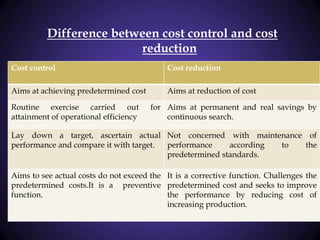
Difference between cost control and cost
reduction
Cost control Cost reduction
Aims at achieving predetermined cost Aims at reduction of cost
Routine exercise carried out for
attainment of operational efficiency
Aims at permanent and real savings by
continuous search.
Lay down a target, ascertain actual
performance and compare it with target.
Not concerned with maintenance of
performance according to the
predetermined standards.
Aims to see actual costs do not exceed the
predetermined costs.It is a preventive
function.
It is a corrective function. Challenges the
predetermined cost and seeks to improve
the performance by reducing cost of
increasing production.
Advantages of cost reduction
 It increases profit.
 Cost reduction will provide more money for
labour welfare scheme and thus improve men
management relation ship.
 Will make goods available to the customers at
cheaper rates.
 Higher profit will provide more revenue to the
government by the way of taxation.
 As a result of reduction in cost export price
may be lowered which may increase total
exports.
Disadvantages of cost reduction
1)Quality may be sacrificed at the cost of reduction in
control.to reduce cost quality may be reduced
gradually and it may not be detected till it has assumed
alarming proportion.Quality may be reduced to such
extent that it may not be accepted in the market and
the business may be lost.
2)In the beginning cost reduction program may not be
liked by employees and danger may be posed to the
program because success of any cost reduction plan
depends upon the willing cooperation and active
participation of the employees..
3)There may be a conflict between individual objective
and organisational objective. It is possible that
activities followed by the head of the department for
the purpose of cost reudction may lead to the increase
in cost of organisation as a whole.
Value Analysis
 Scientific aid to managerial decision making.
 Effective tool for cost reduction.
 Comprises a group of techniques aimed at the
identification of unnecessary costs in a product
or service and efficiently eliminating them
without impairing its quality and efficiency.
 Defined as the systematic analysis of
techniques with a view to exploring channels
of performance improvement so that value
attached to a particular product or service may
be improved.
 Value analysis finds out unnecessary costs.
 By eliminating these costs the cost of product
or service may be reduced and the sales and
the resulting profit proportionately increased.
 In value analysis it is possib;e to improve
performance, increase the value of a product
and thus reduce costs by a continuous process
of planned action.
 Value analysis give importance for searching
out new ideas while cost is confined to already
known facts.
 Value analysis is not a substitution for cost
reduction methods but it is a completely
different procedure for accomplishment of
greater results leading to the elimination of
unnecessary costs and value improvement of a
product or service.
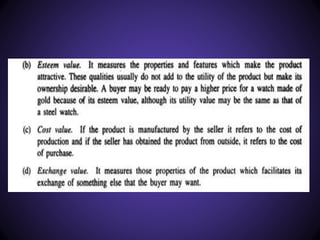
Types of value
 For a designer value means quality of the
product designed and efficiency of the product
produced.
 For a sales man value means price of the
product at which it is sold in the market.
Procedure for value analysis
1) Identification and definition of the problem.
2) Feasibility of the alternative and exploring the
bast method of performing the work at
minimum cost.
3) The investemnt ,if any required for the
alternative.
4) Percentage of the return on new
investment.This return should be equal to or
more than the expected return on investment.
5) Costs resulting indirectly out of a decision to
change to alternative like costs of items
becoming obsolete,cost of training.
6)Benefits from the alternative like reduction in
costs and increased revenue.
7) Recommendation of the final proposal for
implementation after considering the above
points which will increase use value or esteem
value.
Advantages of value analysis
Refer photostat

Module iv funds flow statement

  • 1.
  • 3.
     The balancesheet and income statement are the traditional basic financial statements of a business enterprise.  Balance sheet gives the summary of the firm’s resources and obligations at a point of time.  Profit & loss account reflects the results of the business operations by summarizing revenue and expenses during a period of time.
  • 4.
     A seriouslimitation of these statements is that they do not provide information regarding changes in the firm’s financial position during particular period of time.  They fail to provide the information regarding causes of changes or the movements of finances between two-time period or determine the various causes that lead changes in financial position of a concern.
  • 5.
     Therefore, anadditional statement should be prepared to show the changes in assets, liabilities and owner’s equity between dates of two balance sheets.  Such a statement referred to as the statement of changes in financial positions.  The statement of changes in financial position overcomes these limitations of basic financial statements.  The most commonly used forms of the statement of changes in financial position are called the Funds Flow Statement and the Cash Flow Statement
  • 6.
    Fund  Funds meanworking capital.  Two concepts regarding the meaning of the working capital.  First, the broad concept according to which working capital refers to the gross working capital and represents the amount of funds invested in current assets.  Thus, the gross working capital is the capital investment in total current assets of the enterprise.  Current assets are those assets, which in the ordinary course of business can be converted onto
  • 7.
     Second, thenarrow sense, which termed working capital as the excess of current asset over current liabilities or that part of the current asset, which is financed by the long-term source of finance.  In case of the Funds Flow Statement the narrow concept of the working capital is used. Flow  Flow means movement.  If we take the flow of funds it means changes in the position of the funds due to any transaction.  As a result of the transaction the funds may increase or decrease.  The increase in funds is called funds inflow and if funds decrease, it is called funds outflow.
  • 8.
     The oneimportant point to be noted here is that the flow of funds only occurs when a transaction affects on the one hand a non current account and on the other a current account and vice-versa.  If a transaction only two current account or only two non-current accounts then flow of funds does not take place because here funds means the difference of the current assets and current liabilities.
  • 11.
    Statement  Statement meansthe written description about some thing or a detail note, which provide the informations.  The Funds Flow Statement means a summary of the sources and uses of the working capital.
  • 12.
     “A statementof sources and application of funds is a technical device designed to analyze the changes in the financial condition of a business enterprise between two dates.” Foulke  According to I.C.W.A. “Funds Flow Statement is a statement either prospective or retrospective, setting out the sources and applications of the fund of an enterprise. The purpose of the statement is to indicate clearly the requirement of funds and how they are proposed to be raised and the efficient utilization and application of the same.”
  • 13.
     Funds FlowStatement is a statement, which indicates various means by which the funds have been obtained during a certain period and the ways to which these funds have been used during that period.
  • 14.
     The mainobjective is to know the sources and applications of the funds within a specific time period. 1. Provide the information regarding changes in funds position Provides information regarding the funds, from where they have procured and where they have invested meanwhile two specific dates.
  • 15.
    2. It helpsin the formation of future dividend policy.  Sometimes a firm has sufficient profit available for distribution as dividend but yet it may not be advisable to distribute dividend for lack of liquid or cash resources.  In such cases, funds flow statement helps in the formation of a realistic dividend policy. 3. It helps in proper allocation of resources  The resources of a concern are always limited and it wants to make the best use of these resources.  A projected funds flow statement constructed for the future helps in making managerial decisions.  The firm can plan the deployment of its resources and allocate them among various applications.
  • 16.
    4. It actas future guide  A projected funds flow statement also acts as a guide for future to the management.  The management can come to know the various problems it is going to face in near future for want of funds.  The firm’s future needs of funds can be projected well in advance and also the timing of these needs.  The form can arrange to finance these needs more effectively and avoid future problems. 5. It helps in appraising the use of working capital  It helps to appraise the performance of a financial manager in utilization of the working capital and also suggested the right way to use the working capital efficiently.
  • 17.
    6. It helpsto the overall credit worthiness of a firm  The financial institutions and banks such as SFI, IDBI, IFCI etc. all ask for funds flow statement constructed for a number of years before granting loans to know the creditworthiness and paying capacity of the firm.  Hence, a firm seeking financial assistance firm these institutions has no alternative but to prepare funds flow statements.
  • 18.
    7. It helpsto know about the utilization of the sources  It also provides the information to the managers and the another interested parties that the sources they have collected or provided where they have allocated.
  • 19.
    1. Prepared fromthe final statements: The funds flow statement is prepared with the help of final statements. So all the limitations of the final statements are inherent in it. 2. Only rearrangement: The funds flow statement is only the rearrangement of the data provided by the final statements so this is not providing the actual figure and facts.
  • 20.
    3. Working capitaloriented: It concentrates on the concept of the working capital and show the position of the working capital in the concern while changes in cash are more important and relevant for financial management than the working capital. 4. Periodic in nature: It only reveals the changes in the working capital position in the concern between to specific dates. It cannot reveal continuous changes. 5. Not a substitute: It is not a substitute of an income statement or a balance sheet, it provide only some additional information as regards changes in working capital.
  • 21.
     Funds flowstatement can be prepared by comparing two balance sheets and other information derived from various accounts as may be needed.  While preparing the funds flow statement mainly two statements are prepared: 1) Schedule of Changes in Working Capital 2) Funds Flow Statement
  • 22.
    Schedule of Changesin Working Capital  Here the narrow concept of the working capital is used.  Where working capital means the surplus of current assets over current liabilities.  This statement is made to recognize the changes in the amount of working capital among the dates of two balance sheets.  This statement is prepared by deriving the values of current assets and current liabilities from the balance sheet
  • 23.
     The scheduleof changes in working capital can be prepared by comparing the balance sheets of two dates.  Firstly we have to recognize the current assets and current liabilities of the concern and then compare them between two dates if the current assets of current year are more than the previous year that is recognized as an increase in working capital or vice-versa.  On the other hand if current liabilities of current year is more than the previous year it will recognize a decrease in working capital or vice versa because Working Capital = Current Assets – Current Liabilities
  • 30.
    Fund Flow Statement Funds flow statement is a statement, which shows the sources and application of the funds during a particular time period.  This statement shows that during that period from where the funds have been procured and where have been invested.  This statement can be prepared in two forms: 1) Report Form/statement form 2) T Form or Account Form
  • 31.
     Flow offund means movement of working capital over a period of time.  Increase or decrease in working capital reflects flow of funds.  When a transaction increases working capital, it is known as source of funds and when it decreases working capital it is called use of funds.
  • 32.
     When abusiness transaction does not affect working capital, no flow of funds takes place.  Fund flow statement is a statement in which all the transactions which increase or decrease the working capital is included while those which do not affect the working capital are excluded.
  • 37.
     These sourcescan be classified in two categories.  Internal Source  External Source
  • 38.
    1.Internal Source:  Fundsfrom Operations is only single internal source of funds.  Funds from operations means the funds obtained by the general business of the organization.  It is equal to the difference of revenue obtained by the sale of goods and the total cost of manufacturing them.
  • 39.
     The profitor loss shown by the Profit & Loss a/c is not always equal to the funds from operations because in the some non-cash items are included in the Profit & Loss a/c, which does not affect the working capital such as Depreciation and amortization or written off Preliminary Expenses, Discount on Debentures, goodwill, Patent Rights, Advertisement Expenses, Underwriting Commission etc.  All the expenses, which do not affect the position of the funds, should be added back in the profit.
  • 40.
     With thenon cash expenses some exceptional items are also there which are not concerning with the operations of the business such as profit or loss arise from the sale of fixed assets and investment and non business incomes such as dividend received, interest received, rent received, refund of income tax and appreciation in the value of fixed assets etc.  These items should be deducted from the profit to calculate the funds from operations.  There are two methods to prepare the funds from operations, which are as follows:
  • 41.
    A) The Firstmethod is to proceed from the figure of net profit or net loss as arrived at from the profit and loss account already prepared. Funds from operations by this method can be calculated as below.
  • 43.
    B) The secondmethod is to prepare the Profit & Loss account afresh by taking into consideration only funds and operational items, which involves funds and are related to the normal operations of the business.  The balancing figure in this case will be either funds from operation or funds lost in operations depending upon whether income or credit side of profit and loss a/c exceeds the expenses or debit side of the profit and loss a/c or vice-versa.
  • 51.
    2. External Source: Thesesources include: i) Issue of Share Capital:  One of the source of collection of the funds is issuance of the new share that may be preference share issue or equity share issue.  Not only the new issue but also the call made on the partly paid share is also considered as the source of the funds because it generates inflow of funds.  The premium charged on the time of issue is also considered, as inflow of funds and similarly the adjustment for the discount provided on the time of issue should be made.  If the shares are issued in respect of another consideration rather than cash then it will not be considered as a source of fund
  • 52.
    ii) Issue ofDebenture and Raising of Loans:  Just like the shares issue of debenture and raising of loans are also a source of funds and the same adjustment regarding the premium and discount should be made as in case of the issuance of the share. iii) Sale of the Fixed Assets and Long-term Investments:  One can increase the funds in the concern by selling their investment they have made in different alternatives and in fixed assets just like plant, machinery, building etc.  But one thing that should be remembered that if the assets are exchanged with rather than cash that will not a source of funds.
  • 53.
    iv) Non-Trading Receipts: Any non-trading receipts just as rent received, interest received, dividend received and refund of tax or any another non-operating income generates the inflow of cash will be treated as source of funds. v) Decrease in Working Capital:  If the working capital decreases in comparison of previous year in the release of funds from the working capital so that will be termed as source of funds.
  • 54.
     The otherside of the funds flow statement is application of funds that side shows how the funds procured from different sources are allocated or used.
  • 55.
    1) Funds lostin Operations:  Sometimes the result of trading in a certain year is a loss and some funds are lost during that trading period.  Such loss of funds means outflow of funds so that item if treated as an application of funds. 2) Redemption of the Preference Share Capital:  A company can’t redeem its equity share within its life time but can redeem their preference share as the result of redemption of preference share an outflow of funds takes place.  So the redemption of the shares is written in the application side of the funds flow statement.  One thing should be remembered is that the premium provided on the redemption will also considered as an application.
  • 56.
    3) Repayment ofLoans & Redemption of Debentures:  As share the repayment of loans and redemption of debenture also leads a outflow of cash so these items are also treated as application of the funds. 4) Purchase of any Non-current or Fixed Asset:  If the businessman purchases any fixed asset or making investment for the long time period that will also generate a outflow of funds and treated as an application of funds.  But if the fixed asset is purchased in exchange of any other consideration rather than cash that will not treated as application of funds. 5) Payment of Dividend & Tax:  Payment of dividend and tax are also applications if funds.  It is the actual payment of dividend and tax, which should be taken as an outflow of funds and not the mere declaration of the dividend or creation of a provision for taxation.
  • 57.
    6) Any otherNon-trading Payment:  Any payment or expenses not related to the trading operations of the business amounts to outflow and is taken as an application of funds.  The examples could be drawing in case of sole trader or partnership firm, loss of cash.
  • 65.
  • 66.
     Cash means,cash in hand and demand deposits with the bank.  Cash equivalent consists of bank overdraft, cash credit, short term deposits and marketable securities.  Cash Flow Statement deals with flow of cash which includes cash equivalents as well as cash.  The statement shows the incoming and outgoing of cash.
  • 67.
     “Cash-Flow statementmay be defined as a summary of receipts and disbursements of cash for a particular period of time.”  Transactions which increase the cash position of the entity are called as inflows of cash and those which decrease the cash position as outflows of cash.
  • 68.
     The statementof cash flow serves a number of objectives which are as follows :  Cash flow statement aims at highlighting the cash generated from operating activities.  Cash flow statement helps in planning the repayment of loan schedule and replacement of fixed assets, etc.  Cash is the centre of all financial decisions. It is used as the basis for the projection of future investing and financing plans of the enterprise.
  • 69.
     Cash flowstatement helps to ascertain the liquid position of the firm in a better manner. Banks and financial institutions mostly prefer cash flow statement to analyze liquidity of the borrowing firm.  Cash flow Statement helps in efficient and effective management of cash.  The management generally looks into cash flow statements to understand the internally generated cash which is best utilized for payment of dividends.
  • 70.
     The cashflow statement should report cash flows during the period classified by operating, investment and financing activities as follows:  Cash flow from operating activities  Cash flow from investing activities  Cash flow from financing activities
  • 71.
    Cash flow fromoperating activities  Involves cash generated by producing and delivering goods and providing services.  Cash inflow includes receipts from customers for sales of goods and services  Cash outflow from operating activities include payments to suppliers for purchase of material and for services, payment to employees for services and payment to governments for taxes and duties.
  • 72.
    Example of cashflows from operating activities are:  Cash receipts from the sale of goods and rendering the services.  Cash receipts from royalties, fees, commission and other revenue.  Cash payment to suppliers of goods and services.  Cash payment to and on behalf of employees.  Cash receipts and cash payment of an insurance enterprise for premium and claims, annuities and other policy benefits.
  • 73.
    Example of cashflows from operating activities are: a) cash receipts from the sale of goods and the rendering of services; b) cash receipts from royalties, fees, commissions, and other revenue; c) cash payments to suppliers for goods and services; d) cash payments to and on behalf of employees; e) cash receipts and cash payments of an insurance enterprise for premiums and claims, annuities and other policy benefits; f) cash payments or refunds of income taxes unless they can be specifically identified with financing and investing activities; and g) cash receipts and payments relating to future contracts, forward contracts, option contracts and swap contracts
  • 74.
    Cash flow frominvesting activities  The cash generated by making and collecting loans and acquiring and disposing of debts and equity instruments and fixed assets.  Cash inflows from investing activities are receipts from collection of loans, receipts from sales of shares, receipts from sale of fixed assets and interest and dividend received from loans and investments
  • 75.
     Cash outflowsfrom investing activities are disbursement of loans, payments to acquire share debts or similar instruments of other enterprise and payment to acquire fixed assets.
  • 76.
    Cash flows fromfinancing activities  Cash flows from financing activities involve the proceeding from issuing share or other similar instrument, debenture, bonds and other short term or long-term borrowings.  Cash outflow from financing activities are payments of dividend, payments to acquire or redeem shares to other similar instruments of the enterprise, payment of amount borrowed, principal payment to creditors who have extended long-term credit and interest paid.
  • 90.
    Cost Control AndCost Reduction
  • 91.
    Cost Control  Aimsat reducing inefficiencies and wastage and setting up predetermined cost and achieving them.  Cost control is exercised through setting of standards and norms or targets and comparing actual performance to ascertain deviations from set targets or norms or standards and taking corrective action to ensure that future performance conforms to the set standards or norms or targets.
  • 92.
    Elements of costcontrol scheme  Set down a norm or standard or target.  Select a yardstick for measuring the standard or target.  Ascertain the actual performance by applying the yardstick.  Compare actual performance with the standard or target and compute the variance.  Analyse the variances by causes and fix responsibility for variances.  Take corrective action to eliminate the causes of variance so that future performance conforms the standards or targets laid down.  Periodically review the standards or targets and revise them in light of changed circumstances.
  • 93.
    Steps should betaken in an effective cost control system 1)Firm should have a definite plan of organisation. Authority and responsibility of each executive should be clearly defined. Targets for performance of work as well as the cost to be incurred for the purpose should be laid down for each area of responsibility so that responsibility may be fixed for the deviation of actual cost from the predetermined cost.
  • 94.
    2) Coast shouldbe collected by each area of responsibility and reporting of efficiency or inefficiency displayed by each section should be prompt. If a considerable time elapses between happening of events and reporting ,opportunity for taking appropriate action be lost or some wrong decisions may be taken by the management in the absence of information.
  • 95.
    3)Bring to lightthe factors leading to increase in cost rather than to punish people to take remedial action to improve the peformance in future. 4)Good performance should be handsomely rewarded so that workers may be motivated towards better performance. 5)There should be effective budgetary control and proper setting up of standards. Cooperation of all persons who are to achieve the budgeted results or standards should be secured in preparing budgets or setting up standards to get their willing involvement in achieving the desired results.
  • 96.
    Cost control Techniques Material control  Labour control  Overhead control  Budgetary control  Standard costing  Control of capital expenditure
  • 97.
    Cost Reduction  Aimsin the permanent and real reduction in the unit of cost of goods manufactured or services rendered without impairing their suitability for the use intended.
  • 98.
    Characteristics of costreduction  Reduction must be real one in the cost of manufacture or services rendered.  Real cost reduction comes through greater productivity.  Reduction must be a permanent one.  Reduction must not be at the cost of essential characteristics ,such as quality of the products or services rendered.
  • 99.
    Areas of costreduction 1)Product design  Cost reduction begins with the improvement in the design of the product.  An investigation into the possibilities of cost reduction should be made when introducing new designs and when making improvements in the existing design. 2)Factory organisation and production methods  Efforts should be constantly made to reduce the costs by the adoption of new methods of the organisation and new production methods.
  • 100.
    3)Factory layout: Studyof the factory layout should be done to find the scope of cost reduction by elimination of wastage of time, unnecessary effort and loss of money due to useless movements and travels. 4)Administration:Office should be reorganised if there is a scope for improving the efficiency of persons engaged in the office.  Use of unnecessary forms should be avoided to save the cost of stationery and labour cost involved in compiling them
  • 101.
    5)Marketing : Variousactivities which can be brought under cost reduction include market research, advertisement, packing, warehouse, distribution, after sales service. 6)Finance:Management should eliminate useless investment.  For that it must critically examine the amount of working capital and fixed capital needed and financial conveniences of reducing them  Wasteful use of capital is as bad as inadequate capital.
  • 102.
    Tools and techniquesof cost reduction  Budgetary control  Satndard costing  Standardisation of products and tools  Simplification and variety reduction  Improvement in design  Material control  Labour control  Overhead control  Production planning and control  Automation  Operation research  Market research  Planning and control of finance  Value analysis  Cost benfit analysis
  • 103.
    Difference between costcontrol and cost reduction Cost control Cost reduction Aims at achieving predetermined cost Aims at reduction of cost Routine exercise carried out for attainment of operational efficiency Aims at permanent and real savings by continuous search. Lay down a target, ascertain actual performance and compare it with target. Not concerned with maintenance of performance according to the predetermined standards. Aims to see actual costs do not exceed the predetermined costs.It is a preventive function. It is a corrective function. Challenges the predetermined cost and seeks to improve the performance by reducing cost of increasing production.
  • 104.
    Advantages of costreduction  It increases profit.  Cost reduction will provide more money for labour welfare scheme and thus improve men management relation ship.  Will make goods available to the customers at cheaper rates.  Higher profit will provide more revenue to the government by the way of taxation.  As a result of reduction in cost export price may be lowered which may increase total exports.
  • 105.
    Disadvantages of costreduction 1)Quality may be sacrificed at the cost of reduction in control.to reduce cost quality may be reduced gradually and it may not be detected till it has assumed alarming proportion.Quality may be reduced to such extent that it may not be accepted in the market and the business may be lost. 2)In the beginning cost reduction program may not be liked by employees and danger may be posed to the program because success of any cost reduction plan depends upon the willing cooperation and active participation of the employees.. 3)There may be a conflict between individual objective and organisational objective. It is possible that activities followed by the head of the department for the purpose of cost reudction may lead to the increase in cost of organisation as a whole.
  • 106.
    Value Analysis  Scientificaid to managerial decision making.  Effective tool for cost reduction.  Comprises a group of techniques aimed at the identification of unnecessary costs in a product or service and efficiently eliminating them without impairing its quality and efficiency.  Defined as the systematic analysis of techniques with a view to exploring channels of performance improvement so that value attached to a particular product or service may be improved.
  • 107.
     Value analysisfinds out unnecessary costs.  By eliminating these costs the cost of product or service may be reduced and the sales and the resulting profit proportionately increased.  In value analysis it is possib;e to improve performance, increase the value of a product and thus reduce costs by a continuous process of planned action.  Value analysis give importance for searching out new ideas while cost is confined to already known facts.
  • 108.
     Value analysisis not a substitution for cost reduction methods but it is a completely different procedure for accomplishment of greater results leading to the elimination of unnecessary costs and value improvement of a product or service.
  • 109.
    Types of value For a designer value means quality of the product designed and efficiency of the product produced.  For a sales man value means price of the product at which it is sold in the market.
  • 111.
    Procedure for valueanalysis 1) Identification and definition of the problem. 2) Feasibility of the alternative and exploring the bast method of performing the work at minimum cost. 3) The investemnt ,if any required for the alternative. 4) Percentage of the return on new investment.This return should be equal to or more than the expected return on investment. 5) Costs resulting indirectly out of a decision to change to alternative like costs of items becoming obsolete,cost of training.
  • 112.
    6)Benefits from thealternative like reduction in costs and increased revenue. 7) Recommendation of the final proposal for implementation after considering the above points which will increase use value or esteem value.
  • 113.
    Advantages of valueanalysis Refer photostat

Editor's Notes

  • #4 Income statement –presents the income and expenses during the financial period concerned.Tells the result of business operations(Profit/loss)
  • #26 * Proposed dividend and Provision for taxation may be considered as current liabilities or long-term liabilities. If they are considered as current liabilities then these will be shown in Schedule of changing in working capital.
  • #52 The balancing amount of adjusted profit and loss account is described as fund from operations.
  • #68 Funds held in an account from which deposited funds can be withdrawn at any time without any advance notice to the depository institution. Demand deposits can be "demanded" by an account holder at any time. Many checking and savings accounts today are demand deposits and are accessible by the account holder through a variety of banking options, including teller, ATM and online banking. In contrast, a term deposit is a type of account which cannot be accessed for a predetermined period (typically the loan's term). An extension of credit from a lending institution when an account reaches zero. An overdraft allows the individual to continue withdrawing money even if the account has no funds in it A short term deposit is an amount of money deposited in a bank or financial institution for no longer than a year. Marketable securities are securities or debts that are to be sold or redeemed within a year.
  • #71 liquidity position of a firm is the amount of liquid assets ,that is, cash ,bank balance and those assets which can be converted into cash as and when required by the firm which is owned by the firm currently