CHAPTER – IV
FUNDS FLOW SATEMENT
 Flow of Fund means the inward and outward
movement of a fund of an enterprise.
 For the purpose, Fund refers to Working
Capital and flow means movement or
changes.
 Therefore, Flow of Fund means movement of
or changes in the Working Capital (i.e.,
current) items.
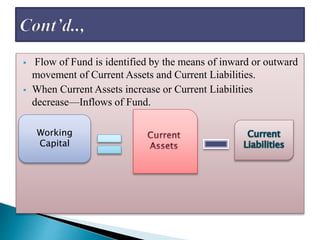
 Flow of Fund is identified by the means of inward or outward
movement of Current Assets and Current Liabilities.
 When Current Assets increase or Current Liabilities
decrease—Inflows of Fund.
Working
Capital
 The Funds flow statement contain all the details of
the financial resources which have became
available during an accounting period.
 This statement discloses the amounts raised from
various sources of finance during a period.
 It explains that how finance has been used in the
business.
 It is a very useful tool in analysis of financial
statements which analyses the changes taking
place between two balance sheet dates.
 Fund Flow Statement acts as an important tool for
financial analysis and shows the brief reasons for change
in the Working Capital between two Balance Sheet
dates.
 Fund Flow Statement explains how the financial
position has changed from the beginning of an
accounting period to the end of that period.
 It acts as an important instrument for allocation of
resources of a concern.
 It can be used in planning a sound dividend policy.
 It is useful in forecasting the flow of funds and in
projecting the working capital requirements.
Fund Flow Statement is not a basic Financial Statement, but is a
supplementary statement. It does not disclose any new fact which is not
reflected in the Income Statement and the Balance Sheet.
It provides a partial financial information to the management.
It cannot present the continuous changes in the financial position.
It does not indicate the structural change of an asset or a liability.
It is prepared on the basis of historical data.
It exhibits the changes in the Fund position, but does not indicate the
changes in the cash position, which is most important for every business
concern.
The changes which occurred in the current
accounts as a result flow of fund are reflected in
a statement known as ‘schedule of changes in
working capital’ .
The similar changes in non current accounts are
shown in ‘Fund Flow Statement’.
Therefore, following two statements under this
techniques .
1. Statement or Schedule of Changes in
Working Capital.
2. Statement of Sources and Uses of Funds or
Funds Flow Statement.
A funds flow statement depicts change in working capital.
It will, therefore, be better for the
students to prepare first a
Schedule of Changes in Working
Capital before preparing a funds
flow statement.
The primary purpose of the statement is to explain the net
change in Working Capital, as arrived in Funds Flow Statement.
It can be prepared by comparing the
current assets and the current
liabilities of two periods.
Item
(A) Current Assets
Cash at bank
Cash in hand
Stock in trade
Debtors
Bills receivable
Advance payment
Short term investment
Prepaid expense
Accrued income
Total (A)
(B) Current Liabilities
(1) Short term loans
(2) Bank overdraft
(3) Creditors
(4) Bills payable
(5) Outstanding expenses
(6) Unclaim dividend
Total (B)
Net Working Capital (A-B)
Incraese / Decrease in Working Capital
Total
Previous Year Current Year Effect on
Incraese Rs.
Working captial
Decrease Rs.
Statement or Schedule of Changes in Working Capital.
A decrease in current liabilities, increases working capital
An increase in current liabilities, decreases working capital
A decrease in current assets, decreases working capital
An increase in current assets, increases working capital
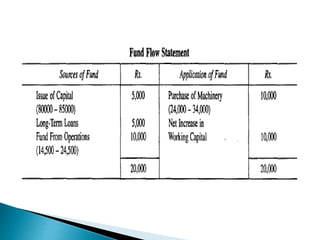
 In order to prepare a Funds Flow Statement, it is
necessary to find out the “sources” and “applications” of
funds.
 While preparing a funds flow statement, current assets
and current liabilities are to be ignored.
 Consider the changes in Fixed Assets and Fixed
Liabilities.
Sources of Funds Amount Application of Funds Amount
Issue of share capital ……. Redemption of pref. share ……..
Issue of debenture ……. Redemption of debenture ……..
Raising of long term loan ……. Payment of long term loan ……..
Sales of fixed assets ……. Purchase of fixed assets ……..
Interest received ……. Interest paid ……..
Dividend received ……. Dividend paid .…….
Refund of Taxes ……. Payment of Taxes ……..
Decrease in working capital ……. Increase in working capital ……..
Fund from operation …….
TOTAL …….. TOTAL ……..
Particular Amount
Depreciation
Loss on sale of fixed assets
Under writing commissions
Discount on issue of shares &
debentures
Preliminary expense written off
Deferred revenue expenses
Goodwill written off
Patent or trademark
Provision for taxes
(If treated non current)
Particular Amount
Profit or gain on sale of
fixed asset
Dividend received
Interest received of
investment
Profit on revaluation
of asset
Fund from operation
Balance Sheet of M/s ______
Liabilities
as on 31stMarch
Assets
as on 31stMarch
2006 2007 2006 2007
Capital
Profit/Loss
Appropriation
Bank Loan
Bills Payable
Sundry Creditors
Reserve for
Taxation
18,50,000
14,78,000
12,00,000
4,00,000
14,00,000
2,00,000
21,00,000
17,64,000
9,00,0000
6,80,000
12,20,000
1,80,000
Goodwill (at Cost)
Land and Buildings
Plant and
Machinery
Furniture and
Fittings
Stock/Inventories
Sundry Debtors
Bills Receivable
Bank
Cash
6,00,000
18,50,000
4,74,000
1,94,000
8,26,000
12,00,000
8,00,000
5,00,000
84,000
6,00,000
22,00,000
5,24,000
1,94,000
7,24,000
12,80,000
7,21,000
4,83,000
1,18,000
TOTAL 65,28,000 68,44,000 TOTAL 65,28,000 68,44,000
Balance Sheet of M/s ______
Liabilities
as on 31stMarch
Assets
as on 31stMarch
2006 2007 2006 2007
Capital
Profit/Loss Appropriation
Bank Loan
Bills Payable
Sundry Creditors
Reserve for Taxation
18,50,000
14,78,000
12,00,000
4,00,000
14,00,000
2,00,000
21,00,000
17,64,000
9,00,0000
6,80,000
12,20,000
1,80,000
Goodwill (at Cost)
Land and Buildings
Plant and Machinery
Furniture and Fittings
Stock/Inventories
Sundry Debtors
Bills Receivable
Bank
Cash
6,00,000
18,50,000
4,74,000
1,94,000
8,26,000
12,00,000
8,00,000
5,00,000
84,000
6,00,000
22,00,000
5,24,000
1,94,000
7,24,000
12,80,000
7,21,000
4,83,000
1,18,000
TOTAL 65,28,000 68,44,000 TOTAL 65,28,000 68,44,000
Current Items
Non-Current Items
Schedule/Statement of Changes in Working Capital for the period from 31/03/06 to 31/03/07
Particulars/Account
Balance as on 31st March Working Capital Change
2006 2007 Increase Decrease
a) CURRENT ASSETS
1) Stock/Inventories
2) Sundry Debtors
3) Bills Receivable
4) Bank
5) Cash
826,000
1,200,000
800,000
500,000
84,000
724,000
1,280,000
721,000
483,000
118,000
80,000
34,000
102,000
79,000
17,000
TOTAL 3,410,000 3,326,000 114,000 198,000
b) CURRENT LIABILITIES
1) Bills Payable
2) Sundry Creditors
3) Provision for Taxation
400,000
1,400,000
200,000
680,000
1,220,000
180,000
180,000
20,000
280,000
TOTAL 2,000,000 2,080,000 200,000 280,000
Working Capital [(a) - (b)] 1,410,000 1,246,000
TOTAL 314,000 478,000
Net Change in Working Capital 164,000
 There is a decrease in working capital to the extent of
164,000.
 The net change can also be obtained from the working
capital figures relating to the two balance sheet dates.
Change in Working Capital =
 Working Capital as on 31/03/07 - Working Capital as on
31/03/06
= 1,246,000 – 1,400,000
= - 164,000
 Negative value indicates a decrease in working capital.
 When there is no additional data apart from the
balance sheets and we are sure that there are no
other transactions that have affected the non-
current accounts.
 Therefore, we may derive the inflow/outflow by
comparing the opening and closing figures.
Statement of changes in Non-Current Accounts
Account
Balance as on 31st Dec Change
Type Result
2006 2007 Amount Direction
Capital
Profit/Loss
Appropriation
Bank Loan
Land and Building
Plant and Machinery
18,50,000
14,78,000
12,00,000
18,50,000
4,74,000
21,00,000
17,64,000
9,00,000
22,00,000
5,24,000
2,50,000
2,86,000
3,00,000
3,50,000
50,000
Increase
Increase
Decrease
Increase
Increase
Liability
Liability
Liability
Assets
Assets
Inflow
Inflow
outflow
outflow
outflow
Statement of Sources and Applications of Funds for the period from 31/03/06 to
31/03/07
Sources/Inflows of Funds Amount
Applications/Outflows
of Funds
Amount
Capital
Funds from Operations
[P/L Appropriation a/c]
2,50,000
2,86,000
Land and Buildings
Plant and Machinery
Bank Loan
3,50,000
50,000
3,00,000
5,36,000 7,00,000
Change in Fund (Working
Capital)
1,64,000
Since the Applications/outflows are more than the Sources/Inflows of Funds there is a Net
decrease in Fund (Working Capital) = 700,000 – 536,000 = 164,000
Balance Sheet of M/s ___
Liabilities
As on 31st December
Assets
As on 31st December
2004 2005 2004 2005
Share Capital
Profit and Loss
Appropriation account
Long Term Loan
Sundry Creditors
Bills Payable
10,000
5,000
4,000
8,000
5,000
15,000
8,000
6,000
12,000
3,000
Cash
Debtors
Stock
Machinery
Land
5,000
10,000
10,000
3,000
4,000
8,000
15,000
12,000
5,000
4,000
32,000 44,000 32,000 44,000
By
Dr.Suresh Vadde
M.Com;MFA;MBA;M.Phil;Ph.D
Associate Professor
Dept. of Management
Samara University, Ethiopia.

Funds flow statement

  • 1.
    CHAPTER – IV FUNDSFLOW SATEMENT
  • 2.
     Flow ofFund means the inward and outward movement of a fund of an enterprise.  For the purpose, Fund refers to Working Capital and flow means movement or changes.  Therefore, Flow of Fund means movement of or changes in the Working Capital (i.e., current) items.
  • 3.
     Flow ofFund is identified by the means of inward or outward movement of Current Assets and Current Liabilities.  When Current Assets increase or Current Liabilities decrease—Inflows of Fund. Working Capital
  • 4.
     The Fundsflow statement contain all the details of the financial resources which have became available during an accounting period.  This statement discloses the amounts raised from various sources of finance during a period.  It explains that how finance has been used in the business.  It is a very useful tool in analysis of financial statements which analyses the changes taking place between two balance sheet dates.
  • 5.
     Fund FlowStatement acts as an important tool for financial analysis and shows the brief reasons for change in the Working Capital between two Balance Sheet dates.  Fund Flow Statement explains how the financial position has changed from the beginning of an accounting period to the end of that period.  It acts as an important instrument for allocation of resources of a concern.  It can be used in planning a sound dividend policy.  It is useful in forecasting the flow of funds and in projecting the working capital requirements.
  • 6.
    Fund Flow Statementis not a basic Financial Statement, but is a supplementary statement. It does not disclose any new fact which is not reflected in the Income Statement and the Balance Sheet. It provides a partial financial information to the management. It cannot present the continuous changes in the financial position. It does not indicate the structural change of an asset or a liability. It is prepared on the basis of historical data. It exhibits the changes in the Fund position, but does not indicate the changes in the cash position, which is most important for every business concern.
  • 7.
    The changes whichoccurred in the current accounts as a result flow of fund are reflected in a statement known as ‘schedule of changes in working capital’ . The similar changes in non current accounts are shown in ‘Fund Flow Statement’. Therefore, following two statements under this techniques . 1. Statement or Schedule of Changes in Working Capital. 2. Statement of Sources and Uses of Funds or Funds Flow Statement.
  • 8.
    A funds flowstatement depicts change in working capital. It will, therefore, be better for the students to prepare first a Schedule of Changes in Working Capital before preparing a funds flow statement. The primary purpose of the statement is to explain the net change in Working Capital, as arrived in Funds Flow Statement. It can be prepared by comparing the current assets and the current liabilities of two periods.
  • 9.
    Item (A) Current Assets Cashat bank Cash in hand Stock in trade Debtors Bills receivable Advance payment Short term investment Prepaid expense Accrued income Total (A) (B) Current Liabilities (1) Short term loans (2) Bank overdraft (3) Creditors (4) Bills payable (5) Outstanding expenses (6) Unclaim dividend Total (B) Net Working Capital (A-B) Incraese / Decrease in Working Capital Total Previous Year Current Year Effect on Incraese Rs. Working captial Decrease Rs. Statement or Schedule of Changes in Working Capital.
  • 10.
    A decrease incurrent liabilities, increases working capital An increase in current liabilities, decreases working capital A decrease in current assets, decreases working capital An increase in current assets, increases working capital
  • 11.
     In orderto prepare a Funds Flow Statement, it is necessary to find out the “sources” and “applications” of funds.  While preparing a funds flow statement, current assets and current liabilities are to be ignored.  Consider the changes in Fixed Assets and Fixed Liabilities.
  • 12.
    Sources of FundsAmount Application of Funds Amount Issue of share capital ……. Redemption of pref. share …….. Issue of debenture ……. Redemption of debenture …….. Raising of long term loan ……. Payment of long term loan …….. Sales of fixed assets ……. Purchase of fixed assets …….. Interest received ……. Interest paid …….. Dividend received ……. Dividend paid .……. Refund of Taxes ……. Payment of Taxes …….. Decrease in working capital ……. Increase in working capital …….. Fund from operation ……. TOTAL …….. TOTAL ……..
  • 13.
    Particular Amount Depreciation Loss onsale of fixed assets Under writing commissions Discount on issue of shares & debentures Preliminary expense written off Deferred revenue expenses Goodwill written off Patent or trademark Provision for taxes (If treated non current) Particular Amount Profit or gain on sale of fixed asset Dividend received Interest received of investment Profit on revaluation of asset Fund from operation
  • 14.
    Balance Sheet ofM/s ______ Liabilities as on 31stMarch Assets as on 31stMarch 2006 2007 2006 2007 Capital Profit/Loss Appropriation Bank Loan Bills Payable Sundry Creditors Reserve for Taxation 18,50,000 14,78,000 12,00,000 4,00,000 14,00,000 2,00,000 21,00,000 17,64,000 9,00,0000 6,80,000 12,20,000 1,80,000 Goodwill (at Cost) Land and Buildings Plant and Machinery Furniture and Fittings Stock/Inventories Sundry Debtors Bills Receivable Bank Cash 6,00,000 18,50,000 4,74,000 1,94,000 8,26,000 12,00,000 8,00,000 5,00,000 84,000 6,00,000 22,00,000 5,24,000 1,94,000 7,24,000 12,80,000 7,21,000 4,83,000 1,18,000 TOTAL 65,28,000 68,44,000 TOTAL 65,28,000 68,44,000
  • 15.
    Balance Sheet ofM/s ______ Liabilities as on 31stMarch Assets as on 31stMarch 2006 2007 2006 2007 Capital Profit/Loss Appropriation Bank Loan Bills Payable Sundry Creditors Reserve for Taxation 18,50,000 14,78,000 12,00,000 4,00,000 14,00,000 2,00,000 21,00,000 17,64,000 9,00,0000 6,80,000 12,20,000 1,80,000 Goodwill (at Cost) Land and Buildings Plant and Machinery Furniture and Fittings Stock/Inventories Sundry Debtors Bills Receivable Bank Cash 6,00,000 18,50,000 4,74,000 1,94,000 8,26,000 12,00,000 8,00,000 5,00,000 84,000 6,00,000 22,00,000 5,24,000 1,94,000 7,24,000 12,80,000 7,21,000 4,83,000 1,18,000 TOTAL 65,28,000 68,44,000 TOTAL 65,28,000 68,44,000 Current Items Non-Current Items
  • 16.
    Schedule/Statement of Changesin Working Capital for the period from 31/03/06 to 31/03/07 Particulars/Account Balance as on 31st March Working Capital Change 2006 2007 Increase Decrease a) CURRENT ASSETS 1) Stock/Inventories 2) Sundry Debtors 3) Bills Receivable 4) Bank 5) Cash 826,000 1,200,000 800,000 500,000 84,000 724,000 1,280,000 721,000 483,000 118,000 80,000 34,000 102,000 79,000 17,000 TOTAL 3,410,000 3,326,000 114,000 198,000 b) CURRENT LIABILITIES 1) Bills Payable 2) Sundry Creditors 3) Provision for Taxation 400,000 1,400,000 200,000 680,000 1,220,000 180,000 180,000 20,000 280,000 TOTAL 2,000,000 2,080,000 200,000 280,000 Working Capital [(a) - (b)] 1,410,000 1,246,000 TOTAL 314,000 478,000 Net Change in Working Capital 164,000
  • 17.
     There isa decrease in working capital to the extent of 164,000.  The net change can also be obtained from the working capital figures relating to the two balance sheet dates. Change in Working Capital =  Working Capital as on 31/03/07 - Working Capital as on 31/03/06 = 1,246,000 – 1,400,000 = - 164,000  Negative value indicates a decrease in working capital.
  • 18.
     When thereis no additional data apart from the balance sheets and we are sure that there are no other transactions that have affected the non- current accounts.  Therefore, we may derive the inflow/outflow by comparing the opening and closing figures.
  • 19.
    Statement of changesin Non-Current Accounts Account Balance as on 31st Dec Change Type Result 2006 2007 Amount Direction Capital Profit/Loss Appropriation Bank Loan Land and Building Plant and Machinery 18,50,000 14,78,000 12,00,000 18,50,000 4,74,000 21,00,000 17,64,000 9,00,000 22,00,000 5,24,000 2,50,000 2,86,000 3,00,000 3,50,000 50,000 Increase Increase Decrease Increase Increase Liability Liability Liability Assets Assets Inflow Inflow outflow outflow outflow
  • 20.
    Statement of Sourcesand Applications of Funds for the period from 31/03/06 to 31/03/07 Sources/Inflows of Funds Amount Applications/Outflows of Funds Amount Capital Funds from Operations [P/L Appropriation a/c] 2,50,000 2,86,000 Land and Buildings Plant and Machinery Bank Loan 3,50,000 50,000 3,00,000 5,36,000 7,00,000 Change in Fund (Working Capital) 1,64,000 Since the Applications/outflows are more than the Sources/Inflows of Funds there is a Net decrease in Fund (Working Capital) = 700,000 – 536,000 = 164,000
  • 24.
    Balance Sheet ofM/s ___ Liabilities As on 31st December Assets As on 31st December 2004 2005 2004 2005 Share Capital Profit and Loss Appropriation account Long Term Loan Sundry Creditors Bills Payable 10,000 5,000 4,000 8,000 5,000 15,000 8,000 6,000 12,000 3,000 Cash Debtors Stock Machinery Land 5,000 10,000 10,000 3,000 4,000 8,000 15,000 12,000 5,000 4,000 32,000 44,000 32,000 44,000
  • 25.