Fund Flow Statement
Meaningof Fund flow statement, Uses of
fund flow statement, Limitations of funds
flow statement, Preparation of Fund flow
statement
2.
Fund Flow Analysis
•According to Foulke, “A Statement of sources
and application of funds is a technical device
designed to analyze the changes in the
financial condition of a business enterprise
between two dates”.
3.
Main Objectives ofFund Flow Analysis
• To show how the resources have been obtained and used
• To indicate the results of current financial management
• To throw light upon the most important changes that have
taken place during a specific period
• To show how the general expansion of the business has been
financed
• To indicate the relationship between profits from operations,
distribution of dividend and raising of new capital or term
loans
• To have an assessment of the working capital position of the
concern
4.
Meaning of Fundsand concept of Flow of
funds
• Funds – Refers to all financial resources
• Flow means change in funds
Managerial uses of funds flow statement:
– Analysis of financial operations
– Evaluation of the firm’s financing
– Answers to indicate questions
• How the loans were repaid?
• How much funds were generated from operations?
• How were the funds used?
• How was the increase in working capital financed?
5.
Managerial Uses ofFund Flow Statements
• Allocation of scare resources
• Helps in working capital management
• Acts as a guide to future
• Helps financial institutions
6.
Explain how fundsfrom operations is
calculated ?
• Profit of a period is an important source of
funds
• The Profit and Loss account reveals the net
profit or loss of a business
• The net profit is arrived at after taking into
account all items of income and expenditure
(both operating and non-operating, both fund
items and non fund items).
7.
Basis of DifferenceFund flow statement/Analysis Cash Flow Statement/Analysis
Objective
Its objective is to help in
providing information relating
to firm's ability to meet its long
term liabilities
Its objective is to provide the firm's
ability to meet its short term
liabilities
Dependence
Funds flow statement can be
prepared if cash flow statement
is there
Cash flow statement is prepared
only when schedule of changes in
working capital along with funds
flow statement is there. Thus it is
dependent
Opening balance There is no such balance
There is always cash opeining
balance, or it is prepared with the
opening balance of cash in hand
Nature of Statement
It deals with the cahges in
working capital
It deals with the changes in cash
position only
Difference of sides
Difference of both sides of
funds flow statement is either
the increase or decrease in
working capital
Difference of both the sides of cash
flow statement is the closing
balance of cash
8.
Additional Statement
Whenever fundsflow
statement is prepared an
additional statement in the
name of schedule showing
changes in working capital
is also prepared
No additional statement is
prepared when cash flow
statement is prepared
Planning
Fund flow is helpful in long
term planning
Cash flow is useful in short
term planning
Period
It is prepared for longer
period
It is prepared for shorter period
Components
Statement of changes in
working capital and
statement of source and
applications/uses of funds
It involves operating activities,
investing activities and
financing activities
Disclose
Movement of Funds inside
and outside the company
Movement of Cash inside and
outside the company
Helpful in
Payments for long term
finance
In Declaring dividends etc.,
9.
Calculation of fundsfrom operations
Format for Funds from Operations
Net Profit Earned during the year xxx
Add: Non-Fund and Non-operating items which are already debited to P&L a/c.,
Depreciation on fixed assets xxx
Goodwill written off xxx
Discount on issue of shares, written off xxx
Preliminary expenses written off xxx
Patents written off xxx
Transfer to reserves xxx
Loss on sales of fixed assets xxx
Less: Non-fund or Non-Operating items which are already credited to P&L a/c.,
Profit on sale of fixed assets xxx
Profit on revaluation of assets xxx
Rent received xxx
Dividend received xxx
Refund of income tax xxx
Funds from operations XXXX
10.
Procedure for thepreparation of funds flow
statement
• Step 1: Schedule of Changes in Working
Capital
• Step 2 : Opening of Accounts for Non-
Current items
• Step 3 : Preparation of Adjusted Profit
and Loss Account
• Step 4 : Preparation of Funds flow
Statement
11.
Schedule of changesin Working Capital
Items As on As on Change
Increase Decrease
Current Assets
Cash Balance
Bank Balance
Marketable Securities
Accounts Receivable
Stock in Trade
Pre paid Expenses
Book Debts
Current Liabilities:
Bank Overdraft
Outstanding Expenses
Provision for Tax
Account Payable
Total
Net Increase/Decrease in Working Capital
12.
Preparation of theSchedule of changes in Working Capital
While preparing this statement, there are some rules
which may be applied. They are : -
1. Increase in a Current Asset results in increase (+)
in “Working Capital”
2. Decrease in a Current Asset results in decrease (-)
in “Working Capital”
3. Increase in a Current Liability results in decrease
(-) in “Working Capital”
4. Decrease in a Current Liability results in increase
(+) in “Working Capital”
13.
Tips to performFund Flow Ledger
• While creating Ledger a/c.,
– Rule for Opening and closing Balance –
Liability -> Credit side b/d.,
– Rule for Opening and Closing Balance –
Asset -> Debit Side b/d.,
14.
Problem 1
From thefollowing balance sheet of Mr. Sridhar. Prepare a funds flow statement
Particulars 30th June 1999 30th June 2000
Cash 5000 2,300
Debtors 17,500 19,200
Stock 12,500 11,000
Land 10,000 15,000
Building 25,000 27,500
Machinery 40,000 43,000
Total Assets 110000 118000
Creditors 18,000 20,500
Bank Loan 15,000 19,500
Capital 77,000 78,000
Total Liabilities 110,000 118,000
Drawings of Mr. Sridhar during the year was Rs. 20,000 and
depreciation charges on machinery was Rs. 4,000
15.
Schedule of changesin Working Capital
Items As on As on Change
30th
June
1999
30th
June
2000 Increase Decrease
Current Assets
Cash Balance 5,000 2,300 2,700
Stock in Trade 12,500 11,000 1,500
Debtors 17,500 19,200 1,700
Current Liabilities:
Creditors 18,000 20,500 2,500
Working Capital (CA-CL) 17,000 12,000 1,700 6,700
Decrease in Working Capital 5,000 5,000
Total 17,000 17,000 6,700 6,700
16.
Working Ledger
Machinery Account
Dr.Cr.
Particulars Rs. Particulars Rs.
To Balance b/d., 40,000
By Dep. adjusted
P&L a/c. 4,000
To Cash (Purchase)
(Balancing Figure) 7,000 By Balance c/d 43,000
47,000 47,000
17.
Working Ledger
Capital Account
Dr.Cr.
Particulars Rs. Particulars Rs.
To Drawings 20,000 By Balance b/d., 77,000
To Balance C/d., 78,000
By Adjusted P&L
Account (?) 21,000
98,000 98,000
18.
Working Ledger
Adjusted Profitand Loss Account
Dr. Cr.
Particulars Rs. Particulars Rs.
To Machinery 4,000
By Funds from
Operations 25,000
To Net Profit 21,000
25,000 25,000
19.
Statement of Sourcesand Application of Funds
Fund Flow Statement
Sources Rs. Application Rs.
Bank Loan 4,500 Purchase of Land 5,000
Funds from Operations 25,000
Purchase of
Building 2,500
Decrease in Working
Capital 5,000
Purchase of
Machinery 7,000
Drawings 20,000
34,500 34,500
20.
From the followingare the summarized balance sheets of XYZ ltd., as on 31st December 1998 and 1999
Balance Sheet – Problem 2
Liabilities
31st Dec.
1998
31st Dec.
1999 Assets
31st Dec.
1998
31st Dec.
1999
Rs. Rs. Rs. Rs.
Capital
7% Redeemable Preference Shares - 10,000 Fixed Assets 41,000 40,000
Equity Shares 40,000 40,000 Less: Depreciation 11,000 15,000
40,000 50,000 30,000 25,000
General Reserve 2,000 2,000 Current Assets:
Profit and Loss Account 1,000 1,200 Debtors 20,000 24,000
Debentures 6,000 7,000 Stock 30,000 35,000
Current Liabilities Prepaid Expenses 300 500
Creditors 12,000 11,000 Cash 1,200 3,500
Provision for Tax 3,000 4,200
Proposed Dividend 5,000 5,800
Bank O/D 12,500 6,800
81,500 88,000 81,500 88,000
(i) Prepare a Statement showing changes in the working capital
(ii) Prepare a statement of Sources and Application of Funds
21.
Schedule of changesin Working Capital
Particulars 1998 1999 Increase Decrease
Current Assets
Cash Balance 1,200 3,500 2,300 -
Stock 30,000 35,000 5,000 -
Prepaid Expenses 300 500 200 -
Debtors 20,000 24,000 4,000 -
51,500 63,000
Current Liabilities:
Creditors 12,000 11,000 1,000 -
Provision for tax 3,000 4,200 - 1,200
Proposed Dividend 5,000 5,800 - 8,00
Bank Overdraft 12,500 6,800 5,700 -
32,500 27,800
Working Capital (CA-CL) 19,000 35,200 18,200 2,000
Increase in Working Capital 16,200 - - 16,200
Total 35,200 35,200 18,200 18,200
22.
Working Ledger
Fixed AssetsAccount
Dr. Cr.
Particulars Rs. Particulars Rs.
To Balance b/d., 41,000 By Cash (Sale) (?) 1,000
By Balance c/d 40,000
41,000 41,000
23.
Working Ledger
Provision forDepreciation Account
Dr. Cr.
Particulars Rs. Particulars Rs.
By Balance b/d. 11,000
To Balance c/d., 15,000
By Adjusted P&L a/c
(Balancing Figure) 4,000
15,000 15,000
24.
Working Ledger
Adjusted Profitand Loss Account
Dr. Cr.
Particulars Rs. Particulars Rs.
To Provision for
Depreciation 4,000 By Balance b/d. 1,000
To Balance c/d., 1,200
By Funds from
Operations (?) 4,200
5,200 5,200
25.
Statement of Sourcesand Application of Funds
Fund Flow Statement
Sources Rs. Application Rs.
Issue of 7% Redeemable
Preference Shares 10,000 Increase in W.C. 16,200
Funds from Operations 4,200
Issue of Debentures 1,000
Sale of Fixed Assets 1,000
16,200 16,200
26.
From the followingare the summarized balance sheets of XYZ ltd., as on 31st December 1998 and 1999
Balance Sheet – Problem 3
Liabilities
31st Dec.
1998
31st Dec.
1999 Assets
31st Dec.
1998
31st Dec.
1999
Rs. Rs. Rs. Rs.
Share Capital 1,00,000 1,00,000 Goodwill 12,000 12,000
General Reserve 14,000 18,000 Building 40,000 36,000
Profit and Loss Account 16,000 13,000 Plant 37,000 36,000
Sundry Creditors 8,000 5,400 Investment 10,000 11,000
Bills Payable 1,200 8,00 Stock 30,000 23,400
Provision of Taxation 16,000 18,000 Bills Receivable 2,000 3,200
Provision for doubtful debts 400 600 Debtors 18,000 19,000
Cash 6,600 15,200
1,55,600 1,55,800 1,55,600 1,55,800
The Following additional information has also been given:
1. Depreciation charged on plant was Rs. 4,000 and on building Rs. 4,000
2. Provision for taxation of Rs. 19,000 was made during the year 1999
3. Interim Dividend of Rs. 8,000 was paid during 1999
Prepare fund flow statement
27.
Step 1: Scheduleof changes in Working Capital
Particulars 1998 1999 Increase Decrease
Current Assets
Stock 30,000 23,400 6,600
Bills Receivable 2,000 3,200 1,200
Debtors 18,000 19,000 1,000 -
Cash 6,600 15,200 8,600 -
56,600 60,800
Current Liabilities:
Sundry Creditors 8,000 5,400 2,600 -
Bills Payable 1,200 800 400 -
Provision for doubtful debts 400 600 - 200
9,600 6,800
Working Capital 47,000 54,000 13,800 6,800
Increase in Working Capital 7,000 7,000
54,000 54,000 13,800 13,800
28.
Step 2: WorkingLedger
Building
Dr. Cr.
Particulars Rs. Particulars Rs.
To Balance b/d., 40,000 By Balance c/d., 36,000
By Adjusted P&L
A/c., (Dep.) 4,000
40,000 40,000
29.
Step 2: WorkingLedger
Plant Account
Dr. Cr.
Particulars Rs. Particulars Rs.
To Balance b/d., 37,000
By Adjusted P&L
A/c., (Dep.) 4,000
To Cash (Purchase) (?) 3,000 By Balance c/d 36,000
40,000 40,000
30.
Step 2: WorkingLedger
General Reserve Account
Dr. Cr.
Particulars Rs. Particulars Rs.
To Balance c/d., 18,000 By Balance b/d., 14,000
By Adjusted P&L
Account 4,000
18,000 18,000
31.
Step 2: WorkingLedger
Provision for Taxation Account
Dr. Cr.
Particulars Rs. Particulars Rs.
To Balance C/d., 18,000 By Balance b/d., 16,000
To Cash (?) (Tax Paid) 17,000
By Adjusted P&L
Account (Current
Year Provision) 19,000
18,000 18,000
32.
Step 3: WorkingLedger
Adjusted Profit and Loss Account
Dr. Cr.
Particulars Rs. Particulars Rs.
To Building
(Depreciation) 4,000 By Balance b/d 16,000
To Plant
(Depreciation) 4,000 By Funds from Operations (?) 36,000
To General Reserve 4,000
To Provision for
Taxation 19,000
To Interim Dividend 8,000
To Balance C/d., 13,000
52,000 52,000
33.
Statement of Sourcesand Application of Funds
Fund Flow Statement
Sources Rs. Application Rs.
Funds from Operations 36,000 Purchase of Plant 3,000
Purchase of
Investment 1,000
Tax Paid 17,000
Interim Dividend 8,000
Increase in WC 7,000
36,000 36,000
34.
From the followingare the summarized balance sheets of XYZ ltd., as on 31st December 1999 and 2000
Balance Sheet – Problem 4
Liabilities 1999 2000 Assets 1999 2000
Rs. Rs. Rs. Rs.
Equity Share capital 3,00,000 4,00,000 Goodwill 1,15,000 90,000
Preference Shares 1,50,000 70,000
Land and
Building 2,00,000 1,70,000
General Reserve 40,000 70,000 Plant 80,000 2,00,000
Profit & Loss a/c., 30,000 48,000 Debtors 1,60,000 2,00,000
Proposed Dividend 42,000 50,000 Stock 77,000 1,09,000
Creditors 55,000 83,000 Bills Receivable 20,000 30,000
Bills Payable 20,000 16,000 Cash in Hand 15,000 10,000
Provision for Taxation 40,000 50,000 Cash at Bank 10,000 8,000
6,77,000 8,17,000 6,77,000 8,17,000
1. Depreciation of Rs. 10,000 and Rs. 20,000 have been charged on plant and land
buildings respectively in 2000
2. A Dividend of Rs. 20,000 has been paid in 2000
3. Income tax of Rs. 35,000 has been paid during 2000
35.
Step 1: Scheduleof changes in Working Capital
Particulars 1999 2000 Increase Decrease
Current Assets
Debtors 1,60,000 2,00,000 40,000
Bills Receivable 20,000 30,000 10,000
Stock 77,000 1,09,000 32,000
Cash 15,000 10,000 5,000
Cash at Bank 10,000 8,000 2,000
Total Current Assets 2,82,000 3,57,000
Current Liabilities:
Sundry Creditors 55,000 83,000 28,000
Bills Payable 20,000 16,000 4,000
Total Current Liabilities 75,000 99,000 24,000
Working Capital = CA – CL 207,000 2,58,000
Increase in Working Capital 51,000
Application side Fund Flow
Statement
36.
Step 2: WorkingLedger
Provision for Taxation Account
Dr. Cr.
Particulars Rs. Particulars Rs.
To Balance C/d., 50,000 By Balance b/d., 40,000
To Cash (Tax Paid) 35,000 By Adjusted P&L 45,000
18,000 18,000
37.
Step 2: WorkingLedger
Land and Building Account
Dr. Cr.
Particulars Rs. Particulars Rs.
To Balance b/d., 2,00,000 By Balance c/d., 1,70,000
By Depreciation a/c. 20,000
By Cash (Sales) 10,000
2,00,000 2,00,000
38.
Step 2: WorkingLedger
Plant Account
Dr. Cr.
Particulars Rs. Particulars Rs.
To Balance b/d., 80,000 By Balance c/d., 2,00,000
To cash (Purchase) 1,30,000 By Depreciation a/c. 10,000
2,10,000 2,10,000
39.
Step 3: WorkingLedger
Adjusted Profit and Loss Account
Dr. Cr.
Particulars Rs. Particulars Rs.
To General Reserve 30,000 By Balance c/d., 30,000
To Goodwill Written off 25,000
By Fund from Operations If
Credit Side (Source) 2,18,000
To Depreciation on plant 10,000
To Depreciation on
building 20,000
To dividend paid 20,000
To Balance c/d., 48,000
To Income Tax provided 45,000
To Proposed Dividend 50,000
2,48,000 2,48,000
40.
Statement of Sourcesand Application of Funds
Fund Flow Statement
Sources Rs. Application Rs.
Issue of Equity Shares 1,00,000
Redemption of
redeemable 50,000
Sale of Land and Buildings 10,000 Dividend paid 20,000
Fund from Operations 2,18,000 Income tax paid 35,000
Purchase of plant 1,30,000
Proposed Dividend paid 42,000
Increase in WC 51,000
3,28,000 3,28,000
41.
From the followingare the summarized balance sheets of XYZ ltd., as on 31st December 1999 and 2000
Balance Sheet – Problem 5
Liabilities 2012 2013 Assets 2012 2013
Equity Share capital 4,00,000 5,00,000 Fixed Assets 5,00,000 7,00,000
General Reserve 1,00,000 1,50,000 Investments 2,00,000 1,80,000
P&L a/c., 1,00,000 1,50,000 Stock 1,50,000 1,00,000
10% Debentures 2,00,000 2,00,000 Debtors 1,20,000 2,00,000
Depreciation – Provision 1,50,000 2,00,000 Cash 25,000 95,000
Provision of Taxation 40,000 50,000
Underwriting
Commission 10,000 5,000
Creditors 15,000 30,000
10,50,00012,80,000 10,05,00012,80,000
The following transactions took place during the year 2013
1. Dividends paid Rs. 40,000
2. Income Tax Paid Rs. 50,000
3. There was a profit on sale of investment Rs. 10,000
4. A Machinery (Cost Rs. 50,000, on which accumulated depreciation Rs. 40,000) was
sold for Rs. 20,000
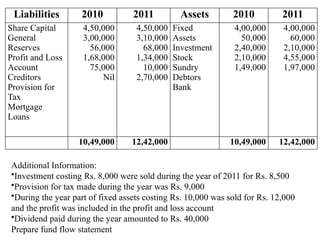
43.
Liabilities 2010 2011Assets 2010 2011
Share Capital
General
Reserves
Profit and Loss
Account
Creditors
Provision for
Tax
Mortgage
Loans
4,50,000
3,00,000
56,000
1,68,000
75,000
Nil
4,50,000
3,10,000
68,000
1,34,000
10,000
2,70,000
Fixed
Assets
Investment
Stock
Sundry
Debtors
Bank
4,00,000
50,000
2,40,000
2,10,000
1,49,000
4,00,000
60,000
2,10,000
4,55,000
1,97,000
10,49,000 12,42,000 10,49,000 12,42,000
Additional Information:
•Investment costing Rs. 8,000 were sold during the year of 2011 for Rs. 8,500
•Provision for tax made during the year was Rs. 9,000
•During the year part of fixed assets costing Rs. 10,000 was sold for Rs. 12,000
and the profit was included in the profit and loss account
•Dividend paid during the year amounted to Rs. 40,000
Prepare fund flow statement
44.
Cash Flow Analysis– AS 3
• Cash flow includes cash inflows and outflows
receipts and cash payments – during a period
• Definition of Cash flow Statement:
– Cash flows are inflows and outflows of cash and
cash equivalents
– Cash equivalents are short term, high liquid
investments that are readily convertible into
known amounts of cash
45.
Benefits of Cashflow Analysis
• Historical analysis as guide to forecasting
• Effective cash management
• Formulation of financial policies
• Preparation of cash budgets
• Short term financial decisions
• Liquidity position
• Revaluation of assets
46.
Objectives of Cashflow Statement
• A basis to assess the ability of the enterprise to
generate cash and cash equivalents
• The needs of the enterprise to utilise those cash
flows.
• An evaluation of the ability of an enterprise to
generate cash and cash equivalents.
• The timing and certainty of their generation of cash
for working capital Management means of a cash
• Flow statement which classifies cash flows during
the period from operating, investing and financing
activities.
47.
Benefits of Cashflow Information
• It provides information that enables users to evaluate the
changes in net assets of an enterprise
• It provide information on financial structure (including its
liquidity and solvency)
• Cash and cash equivalent ability to affect the amount of
operations and financial activities.
• Timing of cash flows in
• Its order to adapt to changing circumstances and
opportunities in business environment
• Enables users to develop models to assess and compare the
present value of the future cash flows of different enterprises.
48.
Benefits of Cashflow Information
• It also enhances the comparability of the reporting of
operating performance by different enterprises because it
eliminates the effects of using different accounting
treatments for the same transactions and events.
• Historical cash flow information is often used as an
indicator of the amount, timing and certainty of future
cash flows.
• It is also useful in checking the accuracy of past
assessments of future cash flows and in examining the
relationship between profitability and net cash flow and
the impact of changing prices.
49.
Utility of Cashflow Analysis
• Helps in Efficient cash management
• Helps in Internal Financial Management
• Disclose the movements of cash
• Disclose success or failure of cash Planning
50.
Definitions
1.Cash comprises cashon hand and demand
deposits with banks.
2.Cash equivalents are short term, highly liquid
investments that are readily convertible into
known amounts of cash and which are subject
to an insignificant risk of changes in value.
3. Cash flows are inflows and outflows of cash
and cash equivalents.
51.
Operating activities arethe principal revenue-
producing activities of the enterprise and
other activities that are not investing or
financing activities.
Investing activities are the acquisition and
disposal of long-term assets and other
investments not included in cash equivalents.
Financing activities are activities that result in
changes in the size and composition of the
owners’ capital (including preference share
capital in the case of a company) and
borrowings of the enterprise
52.
Cash flows fromoperating activities
Cash flows from operating activities are primarily derived
from the principal revenue-producing activities of the
enterprise. Therefore, they generally result from the
transactions and other events that enter into the
determination of net profit or loss. Examples of cash flows
from operating activities are:
(a)Cash receipts from the sale of goods and the rendering of
services;
(b) Cash receipts from royalties, fees, commissions and other
revenue;
(c) Cash payments to suppliers for goods and services;
(d) Cash payments to and on behalf of employees;
53.
Cash flows fromoperating activities
(e) Cash receipts and cash payments of an insurance
enterprise for premiums and claims, annuities and
other policy benefits;
(f) Cash payments or refunds of income taxes unless
they can be specifically identified with financing and
investing activities; and
(g) Cash receipts and payments relating to futures
contracts, forward contracts, option contracts and
swap contracts when the contracts are held for
dealing or trading purposes.
54.
Cash flow fromInvesting Activities
• The separate disclosure of cash flows arising from investing activities is important
because the cash flows represent the extent to which expenditures have been made
for resources intended to generate future income and cash flows. Examples of cash
flows arising from investing activities are:
(a) Cash payments to acquire fixed assets (including intangibles). These payments
include those relating to capitalized research and development costs and self-
constructed fixed assets;
(b) Cash receipts from disposal of fixed assets (including intangibles);
(c) Cash payments to acquire shares, warrants or debt instruments of other enterprises
and interests in joint ventures (other than payments for those instruments
considered to be cash equivalents and those held for dealing or trading purposes);
(d) Cash receipts from disposal of shares, warrants or debt instruments of other
enterprises and interests in joint ventures (other than receipts from those
instruments considered to be cash equivalents and those held for dealing or trading
purposes);
55.
Cash flow fromInvesting Activities
(e) Cash advances and loans made to third parties (other than advances
and loans made by a financial enterprise);
(f) Cash receipts from the repayment of advances and loans made to
third parties (other than advances and loans of a financial enterprise);
(g) Cash payments for futures contracts, forward contracts, option
contracts and swap contracts except when the contracts are held for
dealing or trading purposes, or the payments are classified as
financing activities; and
(h) Cash receipts from futures contracts, forward contracts, option
contracts and swap contracts except when the contracts are held or
dealing or trading purposes, or the receipts are classified as financing
activities.
56.
• The separatedisclosure of cash flows arising from
financing activities is important because it is useful
in predicting claims on future cash flows by
providers of funds (both capital and borrowings) to
the enterprise. Examples of cash flows arising from
financing activities are:
(a) cash proceeds from issuing shares or other similar
instruments;
(b) cash proceeds from issuing debentures, loans,
notes, bonds, and other short or long-term
borrowings; and
(c) cash repayments of amounts borrowed.
57.
Cash Flow Statement(AS-03)
I Cash Flows from Operating Activities Amount Amount Amount
Net profit earned during the year XXX
Add:
Depreciation XXX
Loss on sale of machinery XXX
Preliminary expenes written off XXX
Goodwill written off XXX
Patents and copy write written off XXX
Increase in provision for doubtful debts XXX
XXX
Less:
Profit on sale of investment XXX
XXX
Operating profit before working capital changes XXX
Net cash flows from operating Activities (A) XXX
58.
Adjustment of WorkingCapital
Add:
Increase in Current Liabilities XXX
Decrease in Current Assets XXX
XXX
Less:
Increase in Current Assets XXX
Decrease in Current Liabilities XXX
XXX
Cash Generated from operating Activities XXX
Less:
Income tax paid XXX
59.
II Cash Flowsfrom Investing Activities XXX
Add:
Sale of Investments XXX
Sale of Machine XXX
Interest on Investment Received XXX
XXX
Less:
Purchase of machinery XXX
Interest on Loan Paid XXX
XXX XXX
60.
Net Cash flowsfrom Financing Activities (B)
III Cash flows from Financing Activities
Add: (All Items Cash Inflows)
Issue of Shares XXX
Issue of Debentures XXX
Loan Borrowed XXX
XXX XXX
Less:
Redemption of Shares and debenture XXX
Loan repaid XXX
Dividend paid XXX
Interim Dividend paid XXX
Drawings XXX
XXX XXX
Net Cash flows from Financing Activities ( C )
Net Increase or Decrease in cash and cash
equivalents XXX
Opening Balance Cash and Cash Equivalents XXX
Cash and cash equivalents at end of the year XXX
61.
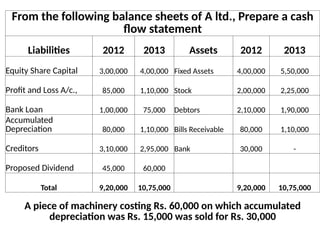
From the followingbalance sheets of A ltd., Prepare a cash
flow statement
Liabilities 2012 2013 Assets 2012 2013
Equity Share Capital 3,00,000 4,00,000 Fixed Assets 4,00,000 5,50,000
Profit and Loss A/c., 85,000 1,10,000 Stock 2,00,000 2,25,000
Bank Loan 1,00,000 75,000 Debtors 2,10,000 1,90,000
Accumulated
Depreciation 80,000 1,10,000 Bills Receivable 80,000 1,10,000
Creditors 3,10,000 2,95,000 Bank 30,000 -
Proposed Dividend 45,000 60,000
Total 9,20,000 10,75,000 9,20,000 10,75,000
A piece of machinery costing Rs. 60,000 on which accumulated
depreciation was Rs. 15,000 was sold for Rs. 30,000
62.
Cash Flow Statement(AS-3)
Cash Flows from Operating Activities
Net profit as per P&L A/c. (1,10,000 - 85,000) 25,000
Add:
Depreciation (135000-80,000) = 55000+15000 = 70,000 70,000
Proposed Dividend (Current Year) 60,000
Loss from Sale of Machinery 15,000
Operating Profit before Working Capital Changes 1,70,000
Add:
Debtors 20,000
Less:
Increase in Stock -25,000
Increase in Bills Receivable -30,000
Decrease in creditors -15,000 -50,000
Net Cash Flows from Operating Activities (A) 1,20,000
63.
Cash flow forInvesting Activities (B)
Add:
Sale of Machinery 30,000
Less:
Purchase of Machinery -210000
Net Cash Flow from Investing
Activities (B) -180000
64.
Cash flow forFinancing Activities
Add:
Increase in equity share capital 100000
Less:
Repayment of Loan -25000
Dividend Paid -45000
Net cash flows from Financing Activities ( C ) 30000
A+B+C -30000
Cash and Cash equivalents at the beginning of the
year 30000
Cash and Cash equivalents at the end of the year 0
65.
From the followingbalance sheets of A ltd., Prepare a cash flow statement
Liabilities 31.3.12 31.3.13 Assets 31.3.12 31.3.13
Equity Share Capital 3,00,000 3,50,000 Fixed Assets 5,10,000 6,20,000
15% Preference Share Capital 2,00,000 1,00,000 Investments 30,000 80,000
15% Debenture 1,00,000 2,00,000 Current Assets 2,00,000 3,05,000
Reserves and Surplus 1,10,000 2,70,000 Cash in Hand 40,000 70,000
Current Liabilities 80,000 1,60,000
Discount on
Issue of
Debenture 10,000 5,000
Additional Information: A Machine with a book value of Rs.40,000 was sold for Rs. 25,000
15% preference shares were redeemed at a premium of 15% on 31.3.12 for Rs 1,00,000
Dividend on equity shares at 15% was paid for the year 2012 during 2013
Depreciation charged during 2013 was Rs. 60,000
66.
Prepare a CashFlow Statement as per AS-3 (Revised)
Cash Flow Statement (AS - 3)
Particulars Rs. Rs.
Cash Flow from Operating Activities
Excess of Reserves and Surplus (270000-110000) 1,60,000
Add:
Depreciation 60,000
Loss on sale of Machince 15,000
Premium on Redemption of Preference shares 15,000
Dividends Paid 45,000
Discount on Debentures 5,000
Operating Profit Before Working Capital Changes 3,00,000
Add: Increase in CL (160000-80000) 80,000
Less: Increase in CA (3,05,000 - 2,00,000) (1,05,000) -25000
Net Cash from Operating Activities (A) 2,75,000
67.
Cash Flow fromInvesting Activities
Add:
Sale of Machine 25,000
Less:
Purchase of Machine -210000
Purchase of Investment -50000
Net Cash flows from Investing Activities (B) -235000
68.
Cash Flow fromfinancing activities
Add:
Issue of shares 50000
Issue of Debentures 100000
Less:
Redemption of preference shares at premium -115000
Dividend paid (3,00,000*15%) -45000
Net Cash flows from financing Activities ( C ) -10000
Net Increase in cash and cash equivalents
(A+B+C) 30000
Cash and Cash equivalent at the beginning 40000
Cash and cash equivalent at the end 70,000
69.
Working Ledger
Machinery Account
Dr.Cr.
Particulars Rs. Particulars Rs.
To Balance b/d., 5,10,000 By Cash (Sale) 25,000
To Cash (Purchase) 2,10,000 By P&L a/c., (Loss on Sale) 15,000
By Depreciation 60,000
By Balance c/d., 6,20,000
7,20,000 7,20,000
70.
From the followingbalance sheets of A ltd., Prepare a cash flow statement
Liabilities 31.3.12 31.3.13 Assets 31.3.12 31.3.13
Equity Share Capital 30,000 40,000 Goodwill 11,500 9,000
15% Redeemable preference
share capital 15,000 10,000 Land and Building 20,000 17,000
General Reserve 4,000 7,000 Plant 8,000 20,000
Profit and Loss A/C., 3,000 4,800 Debtors 16,000 20,000
Proposed Dividend 4,200 5,000 Stock 7,700 10,900
Creditors 5,500 8,300 Bills Receivable 2,000 3,000
Bills Payable 2,000 1,600 Cash in Hand 1,500 1,000
Provision for Tax 4,000 5,000 Cash at Bank 1,000 800
Total 67,700 81,700 67,700 81,700
Depreciation of Rs. 1,000 and Rs. 2,000 have been charged on plant & building and plant
An Interim Dividend of Rs. 2000 has been paid during 2013
Income Tax Rs. 3,500 has been during the year 2013
71.
Prepare a CashFlow Statement as per AS-3 (Revised)
Cash Flow Statement (AS - 3)
Particulars Rs. Rs.
Cash Flow from Operating Activities
Excess of Profit (4800-3000) 1,800
Add:
General Reserve 3000
Proposed Dividend 5000
Interim Dividend 2000
Provision for Tax 1000
Tax paid 3500
Goodwill Written off 2500
Depreciation 3000
Operating Profit Before Working Capital Changes 21,800
72.
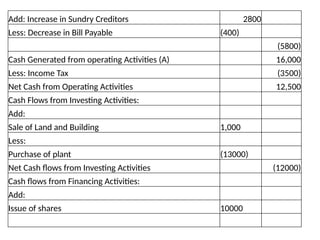
Add: Increase inSundry Creditors 2800
Less: Decrease in Bill Payable (400)
(5800)
Cash Generated from operating Activities (A) 16,000
Less: Income Tax (3500)
Net Cash from Operating Activities 12,500
Cash Flows from Investing Activities:
Add:
Sale of Land and Building 1,000
Less:
Purchase of plant (13000)
Net Cash flows from Investing Activities (12000)
Cash flows from Financing Activities:
Add:
Issue of shares 10000
73.
Less:
Redemption of preferenceshares (5000)
Interim Dividend Paid (2000)
Dividend Paid (4200)
Net Cash flows from Financing Activities (1200)
Net Decrease in Cash and Cash Equivalents (A+B+C) (700)
Cash and Cash Equivalents at the beginning of the year 2500
Cash and Cash Equivalents at end of the year 1800
74.
Working Ledger
Plant Account
Dr.Cr.
Particulars Rs. Particulars Rs.
To Balance b/d., 8,000 By Depreciation 1,000
To Cash (Purchase) (?) 13,000 By Balance c/d., 20,000
21,000 21,000
75.
Working Ledger
Land andBuilding Account
Dr. Cr.
Particulars Rs. Particulars Rs.
To Balance b/d., 20,000 By Depreciation 2000
By Cash (Sale) (?) 1,000
By Balance C/d., 17,000
20000 20000
76.
Working Ledger
Provision forTax Account
Dr. Cr.
Particulars Rs. Particulars Rs.
To Cash Tax Paid 3,500 By Balance b/d., 4,000
To Balance c/d., 5,000
By P&L A/c., (Balancing
Figure) 4,500
8,500 8,500