
DR. RICHA SINGHAL
ASSOCIATE PROFESSOR
DEPT. OF EAFM
S.S.JAIN SUBODH PG COLLEGE
FUNDS FLOW
STATEMENT
Funds : Cash and cash equivalents.
Working Capital:
Gross concept- Total Current Assets
Net concept- Excess of current assets over current
liabilities.
Current Assets: Assets which are reasonably expected to be
realized in cash or sold or consumed during the normal
operating cycle of the business ex. Cash, accounts
receivable, inventory, advances recoverable, prepaid
expenses etc.
Current Liabilities: All obligations that will require within
the coming year or operating cycle, whichever is longer,
(i) the use of existing current assets or (ii) the creation
of other current liabilities ex. accounts payable,
outstanding
2
Cont…
..
expenses, bank overdrafts, short term loans, advance
payments received, current maturities of long-term loans
etc.
Non Current Assets: All Assets other than current assets ex.
goodwill, land, building, machinery, furniture, debit
balance in P & L account etc.
Non Current Liabilities: All liabilities other than current
liabilities ex. share capital, long term loans, debentures,
share premium, credit balance in P & L account.
3
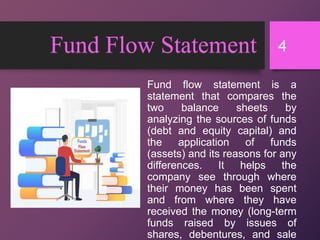
Fund Flow Statement
Fund flow statement is a
statement that compares the
two balance sheets by
analyzing the sources of funds
(debt and equity capital) and
the application of funds
(assets) and its reasons for any
differences. It helps the
company see through where
their money has been spent
and from where they have
received the money (long-term
funds raised by issues of
shares, debentures, and sale
4
Importance of
Fund Flow Statement 5
Importance
of fund
Flow
Analysis
Analysis
of
Financial
Position
Scientific method of preparation of
Fund Flow Statement
6
Statement of change in working
capital
Fund From Operations
Statement of sources and
uses of funds
Preparation of
Funds Flow Statement
The statement or schedule of changes in working
capital discloses the changes in individual items of
current assets and current liabilities between two dates
and their effect on working capital.
This schedule is prepared with the
help of current assets and current liabilities appearing in
the balance sheet. Additional information pertaining to
these current assets and liabilities should outright be
ignored unless these are not incorporated into books of
accounts.
7
From April 1, 2014 ‘Provision for Taxation’ and Proposed Dividend’ are
included in sub-head ‘other current liabilities’ .
CONT…
Rules:
i. Increase in current assets results in
increase in working capital and vice versa
ii. Increase in current liabilities results in
decrease in current liabilities and vice
versa
Results:
i. Increase in Working Capital= Uses of funds
ii. Decrease in Working Capital= Sources of
funds
8
Schedule of changes in
Working Capital
Item Previous Current Change
Year Year
--- --- Increase Decrease
Current Assets:
Cash
Bank Balance
Accounts receivable
Stock in trade
Prepaid expenses
Current Liabilities:
Bank Overdraft
Outstanding Expenses
Accounts payable
Provision for Tax
Proposed Dividend
Net Increase/ Decrease in working capital
9
FUND FROM OPERATIONS
Net income from operations is calculated after reducing COGS
and other expenses from the sales price of goods sold. But this
amount does not represent the operational profit for the funds
flow statement. Profit and loss may include those items which
do not affect working capital, therefore for calculation of
funds from operations for fund flow statement some
adjustments have to be made in net profit shown by profit and
loss account.
Two methods:
i. By Preparing Profit and Loss Adjustment a/c
ii. By Preparing Statement
Results:
i. Loss from operations = Uses of funds
ii. Profits in Working Capital= Sources of funds
10
Adjusted Profit and Loss A/c
• To Depreciation on Fixed Assets
• To Loss on sale of Fixed Assets
• To Transfer to Reserve
• To Goodwill/Patent W/O
• To Preliminary Exp. W/O
• To Premium on Redemption of
shares. Debentures
• To Interim Dividend
• To loss from operations
(balancing figure)
• To Balance C/D
• By Balance B/D
• By Profit on sale of Fixed
Assets
• By Dividend received
• By Interest Received
• By Transfer from Reserve
• By Profit from operations
(balancing figure)
11
Statement of Fund from Operations
Closing Balance of Surplus A/c XXX
Add: Non Fund Expenses XXX
XXX
Less: Non Fund Incomes XXX
XXX
Less: Opening Balance of Surplus A/c XXX
Fund from Operations XXX
12
FUNDS FLOW STATEMENT
Funds Flow Statement: While preparing this
statement, current assets and liabilities are to be
ignored. Attention is to be given to changes in
fixed assets and fixed liabilities:
• The objective of funds flow statement is to analyse
the causes for net increase or decrease in the
working capital as shown by the schedule of
working capital changes.
• It is prepared in Report Form.
13
Cont ….
A. Sources of funds:
Issue of shares
Issue of debentures
Long term borrowings
Sale of fixed Assets
Profit from operations
Decrease in Working Capital
B. Application of funds:
Redemption of redeemable preference shares
Redemption of debentures
Repayment of other long term loans
Purchase of fixed Assets
Loss from operations
Increase in Working Capital
14
Treatment of At cost and WDV
If the ‘provision for depreciation balance’ is given in the
balance sheet, then the assets will be treated ‘at
cost’, but if the same is given outside the balance
sheet i.e. in the additional information, then the
assets will be treated at the ‘written down value’
(WDV) and In this case Assert Account will be
brought At cost by adding Depreciation Opening in
Assets Opening and Accumulated Depreciation (acc.
dep.) is used while creating Account At cost and in
that case Provision for Depreciation Whereas annual
depreciation (annual depreciation) is used while
preparing the account on the written down value
(WDV).
15
Funds Flow Vs. Income Statement
 To ascertain the funds generated
from operations. It reveals the
sources of funds and their
applications.
 Prepared with the help of
balance sheets of two
consecutive years.
 Takes into a/c not only funds
available from trading
operations but also funds
available from other sources like
issue of share.
 To ascertain the profit/ loss by
the company out of business
operations at the end of
particular year.
 Prepared on the basis of
nominal accounts of particular
accounting period.
 Uses only income and
expenditure transactions
relating to trading operations of
particular period.
16
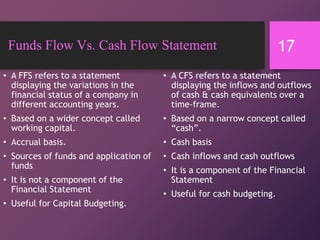
Funds Flow Vs. Cash Flow Statement
• A FFS refers to a statement
displaying the variations in the
financial status of a company in
different accounting years.
• Based on a wider concept called
working capital.
• Accrual basis.
• Sources of funds and application of
funds
• It is not a component of the
Financial Statement
• Useful for Capital Budgeting.
• A CFS refers to a statement
displaying the inflows and outflows
of cash & cash equivalents over a
time-frame.
• Based on a narrow concept called
“cash”.
• Cash basis
• Cash inflows and cash outflows
• It is a component of the Financial
Statement
• Useful for cash budgeting.
17
SUMMARY
In this chapter you have studied :
 The meaning of Funds Flow Statement
 Importance of Funds Flow Statement
 Preparation of Funds Flow Statement
 Funds Flow Vs. Income Statement
 Funds Flow Vs. Cash Flow Statement
18
THANKS
19

FUND FLOW STATEMENT

  • 1.
    DR. RICHA SINGHAL ASSOCIATEPROFESSOR DEPT. OF EAFM S.S.JAIN SUBODH PG COLLEGE FUNDS FLOW STATEMENT
  • 2.
    Funds : Cashand cash equivalents. Working Capital: Gross concept- Total Current Assets Net concept- Excess of current assets over current liabilities. Current Assets: Assets which are reasonably expected to be realized in cash or sold or consumed during the normal operating cycle of the business ex. Cash, accounts receivable, inventory, advances recoverable, prepaid expenses etc. Current Liabilities: All obligations that will require within the coming year or operating cycle, whichever is longer, (i) the use of existing current assets or (ii) the creation of other current liabilities ex. accounts payable, outstanding 2
  • 3.
    Cont… .. expenses, bank overdrafts,short term loans, advance payments received, current maturities of long-term loans etc. Non Current Assets: All Assets other than current assets ex. goodwill, land, building, machinery, furniture, debit balance in P & L account etc. Non Current Liabilities: All liabilities other than current liabilities ex. share capital, long term loans, debentures, share premium, credit balance in P & L account. 3
  • 4.
    Fund Flow Statement Fundflow statement is a statement that compares the two balance sheets by analyzing the sources of funds (debt and equity capital) and the application of funds (assets) and its reasons for any differences. It helps the company see through where their money has been spent and from where they have received the money (long-term funds raised by issues of shares, debentures, and sale 4
  • 5.
    Importance of Fund FlowStatement 5 Importance of fund Flow Analysis Analysis of Financial Position
  • 6.
    Scientific method ofpreparation of Fund Flow Statement 6 Statement of change in working capital Fund From Operations Statement of sources and uses of funds
  • 7.
    Preparation of Funds FlowStatement The statement or schedule of changes in working capital discloses the changes in individual items of current assets and current liabilities between two dates and their effect on working capital. This schedule is prepared with the help of current assets and current liabilities appearing in the balance sheet. Additional information pertaining to these current assets and liabilities should outright be ignored unless these are not incorporated into books of accounts. 7 From April 1, 2014 ‘Provision for Taxation’ and Proposed Dividend’ are included in sub-head ‘other current liabilities’ .
  • 8.
    CONT… Rules: i. Increase incurrent assets results in increase in working capital and vice versa ii. Increase in current liabilities results in decrease in current liabilities and vice versa Results: i. Increase in Working Capital= Uses of funds ii. Decrease in Working Capital= Sources of funds 8
  • 9.
    Schedule of changesin Working Capital Item Previous Current Change Year Year --- --- Increase Decrease Current Assets: Cash Bank Balance Accounts receivable Stock in trade Prepaid expenses Current Liabilities: Bank Overdraft Outstanding Expenses Accounts payable Provision for Tax Proposed Dividend Net Increase/ Decrease in working capital 9
  • 10.
    FUND FROM OPERATIONS Netincome from operations is calculated after reducing COGS and other expenses from the sales price of goods sold. But this amount does not represent the operational profit for the funds flow statement. Profit and loss may include those items which do not affect working capital, therefore for calculation of funds from operations for fund flow statement some adjustments have to be made in net profit shown by profit and loss account. Two methods: i. By Preparing Profit and Loss Adjustment a/c ii. By Preparing Statement Results: i. Loss from operations = Uses of funds ii. Profits in Working Capital= Sources of funds 10
  • 11.
    Adjusted Profit andLoss A/c • To Depreciation on Fixed Assets • To Loss on sale of Fixed Assets • To Transfer to Reserve • To Goodwill/Patent W/O • To Preliminary Exp. W/O • To Premium on Redemption of shares. Debentures • To Interim Dividend • To loss from operations (balancing figure) • To Balance C/D • By Balance B/D • By Profit on sale of Fixed Assets • By Dividend received • By Interest Received • By Transfer from Reserve • By Profit from operations (balancing figure) 11
  • 12.
    Statement of Fundfrom Operations Closing Balance of Surplus A/c XXX Add: Non Fund Expenses XXX XXX Less: Non Fund Incomes XXX XXX Less: Opening Balance of Surplus A/c XXX Fund from Operations XXX 12
  • 13.
    FUNDS FLOW STATEMENT FundsFlow Statement: While preparing this statement, current assets and liabilities are to be ignored. Attention is to be given to changes in fixed assets and fixed liabilities: • The objective of funds flow statement is to analyse the causes for net increase or decrease in the working capital as shown by the schedule of working capital changes. • It is prepared in Report Form. 13
  • 14.
    Cont …. A. Sourcesof funds: Issue of shares Issue of debentures Long term borrowings Sale of fixed Assets Profit from operations Decrease in Working Capital B. Application of funds: Redemption of redeemable preference shares Redemption of debentures Repayment of other long term loans Purchase of fixed Assets Loss from operations Increase in Working Capital 14
  • 15.
    Treatment of Atcost and WDV If the ‘provision for depreciation balance’ is given in the balance sheet, then the assets will be treated ‘at cost’, but if the same is given outside the balance sheet i.e. in the additional information, then the assets will be treated at the ‘written down value’ (WDV) and In this case Assert Account will be brought At cost by adding Depreciation Opening in Assets Opening and Accumulated Depreciation (acc. dep.) is used while creating Account At cost and in that case Provision for Depreciation Whereas annual depreciation (annual depreciation) is used while preparing the account on the written down value (WDV). 15
  • 16.
    Funds Flow Vs.Income Statement  To ascertain the funds generated from operations. It reveals the sources of funds and their applications.  Prepared with the help of balance sheets of two consecutive years.  Takes into a/c not only funds available from trading operations but also funds available from other sources like issue of share.  To ascertain the profit/ loss by the company out of business operations at the end of particular year.  Prepared on the basis of nominal accounts of particular accounting period.  Uses only income and expenditure transactions relating to trading operations of particular period. 16
  • 17.
    Funds Flow Vs.Cash Flow Statement • A FFS refers to a statement displaying the variations in the financial status of a company in different accounting years. • Based on a wider concept called working capital. • Accrual basis. • Sources of funds and application of funds • It is not a component of the Financial Statement • Useful for Capital Budgeting. • A CFS refers to a statement displaying the inflows and outflows of cash & cash equivalents over a time-frame. • Based on a narrow concept called “cash”. • Cash basis • Cash inflows and cash outflows • It is a component of the Financial Statement • Useful for cash budgeting. 17
  • 18.
    SUMMARY In this chapteryou have studied :  The meaning of Funds Flow Statement  Importance of Funds Flow Statement  Preparation of Funds Flow Statement  Funds Flow Vs. Income Statement  Funds Flow Vs. Cash Flow Statement 18
  • 19.