

P A R A G J . T A R W A D I , I S H W A R V . B H O G E
1 . p t a r w a d i @ y a h o o . c o m ,
2 . b h o g e i 0 0 7 @ g m a i l . c o m
Free space optical
communication
Presented by :-
Contents:-
1. Introduction
2. Communication
network
3. Free-Space path
loss
4.Why to use free
space optical
communication
5. Challenges in
technology
implementation
6.Application
7. Conclusion
Introduction
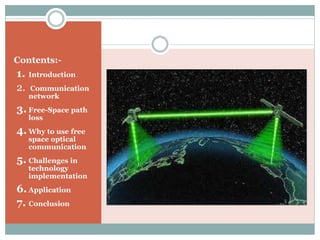
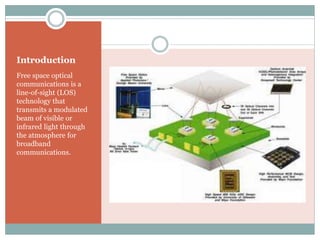
Free space optical
communications is a
line-of-sight (LOS)
technology that
transmits a modulated
beam of visible or
infrared light through
the atmosphere for
broadband
communications.
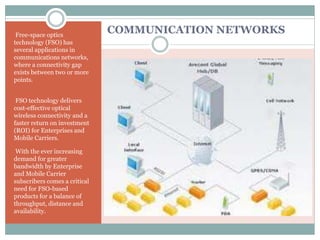
COMMUNICATION NETWORKSFree-space optics
technology (FSO) has
several applications in
communications networks,
where a connectivity gap
exists between two or more
points.
FSO technology delivers
cost-effective optical
wireless connectivity and a
faster return on investment
(ROI) for Enterprises and
Mobile Carriers.
With the ever increasing
demand for greater
bandwidth by Enterprise
and Mobile Carrier
subscribers comes a critical
need for FSO-based
products for a balance of
throughput, distance and
availability.
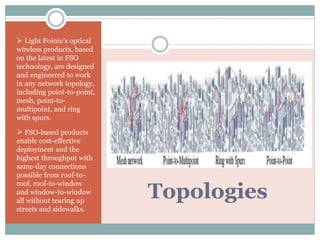
Topologies
 Light Pointe’s optical
wireless products, based
on the latest in FSO
technology, are designed
and engineered to work
in any network topology,
including point-to-point,
mesh, point-to-
multipoint, and ring
with spurs.
 FSO-based products
enable cost-effective
deployment and the
highest throughput with
same-day connections
possible from roof-to-
roof, roof-to-window
and window-to-window
all without tearing up
streets and sidewalks.
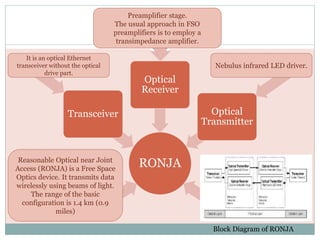
RONJA
Transceiver
Optical
Receiver
Optical
Transmitter
Block Diagram of RONJA
Nebulus infrared LED driver.
It is an optical Ethernet
transceiver without the optical
drive part.
Preamplifier stage.
The usual approach in FSO
preamplifiers is to employ a
transimpedance amplifier.
Reasonable Optical near Joint
Access (RONJA) is a Free Space
Optics device. It transmits data
wirelessly using beams of light.
The range of the basic
configuration is 1.4 km (0.9
miles)
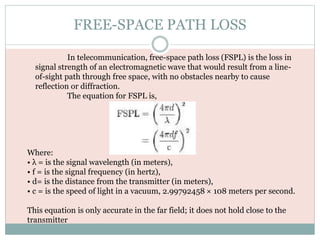
FREE-SPACE PATH LOSS
Where:
• λ = is the signal wavelength (in meters),
• f = is the signal frequency (in hertz),
• d= is the distance from the transmitter (in meters),
• c = is the speed of light in a vacuum, 2.99792458 × 10⁸ meters per second.
This equation is only accurate in the far field; it does not hold close to the
transmitter
In telecommunication, free-space path loss (FSPL) is the loss in
signal strength of an electromagnetic wave that would result from a line-
of-sight path through free space, with no obstacles nearby to cause
reflection or diffraction.
The equation for FSPL is,
Advantages
• Ease of deployment
• License-free operation
• High bit rates
• Low bit error rates
• Immunity to
electromagnetic
interference
• Full duplex operation
• Protocol transparency
Disadvantages
• Beam dispersion
• Atmospheric absorption
• Rain
• Fog (10...~100 dB/km
attenuation)
• Snow
• Pointing stability in wind
• Pollution / smog
• If the sun goes exactly
behind the transmitter, it
can swamp the signal.
WHY TO USE FREE SPACE
OPTICAL COMMUNICATION
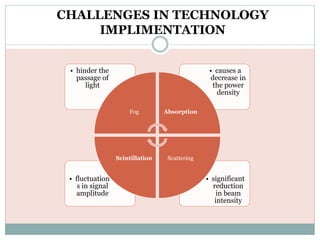
• significant
reduction
in beam
intensity
• fluctuation
s in signal
amplitude
• causes a
decrease in
the power
density
• hinder the
passage of
light
Fog Absorption
ScatteringScintillation
CHALLENGES IN TECHNOLOGY
IMPLIMENTATION
APPLICATIONS
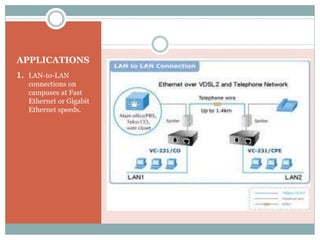
1. LAN-to-LAN
connections on
campuses at Fast
Ethernet or Gigabit
Ethernet speeds.
APPLICATIONS
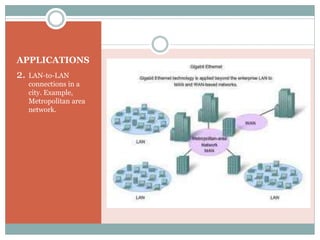
2. LAN-to-LAN
connections in a
city. Example,
Metropolitan area
network.
APPLICATIONS
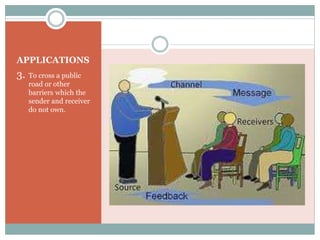
3. To cross a public
road or other
barriers which the
sender and receiver
do not own.
APPLICATIONS
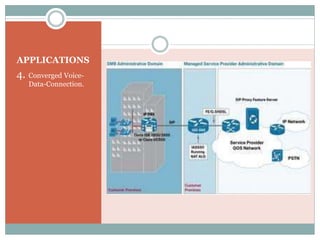
4. Converged Voice-
Data-Connection.
APPLICATIONS
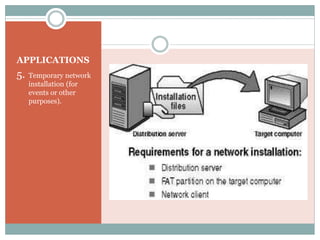
5. Temporary network
installation (for
events or other
purposes).
APPLICATIONS
6. Reestablish high-
speed connection
quickly (disaster
recovery).
CONCLUSION:
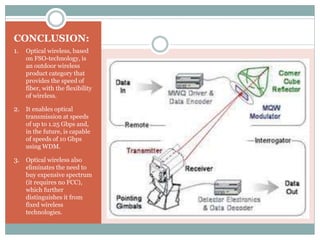
1. Optical wireless, based
on FSO-technology, is
an outdoor wireless
product category that
provides the speed of
fiber, with the flexibility
of wireless.
2. It enables optical
transmission at speeds
of up to 1.25 Gbps and,
in the future, is capable
of speeds of 10 Gbps
using WDM.
3. Optical wireless also
eliminates the need to
buy expensive spectrum
(it requires no FCC),
which further
distinguishes it from
fixed wireless
technologies.
FURTHER QUERIES?????
THANK YOU

Free space optical communication

  • 1.
    P A RA G J . T A R W A D I , I S H W A R V . B H O G E 1 . p t a r w a d i @ y a h o o . c o m , 2 . b h o g e i 0 0 7 @ g m a i l . c o m Free space optical communication Presented by :-
  • 2.
    Contents:- 1. Introduction 2. Communication network 3.Free-Space path loss 4.Why to use free space optical communication 5. Challenges in technology implementation 6.Application 7. Conclusion
  • 3.
    Introduction Free space optical communicationsis a line-of-sight (LOS) technology that transmits a modulated beam of visible or infrared light through the atmosphere for broadband communications.
  • 4.
    COMMUNICATION NETWORKSFree-space optics technology(FSO) has several applications in communications networks, where a connectivity gap exists between two or more points. FSO technology delivers cost-effective optical wireless connectivity and a faster return on investment (ROI) for Enterprises and Mobile Carriers. With the ever increasing demand for greater bandwidth by Enterprise and Mobile Carrier subscribers comes a critical need for FSO-based products for a balance of throughput, distance and availability.
  • 5.
    Topologies  Light Pointe’soptical wireless products, based on the latest in FSO technology, are designed and engineered to work in any network topology, including point-to-point, mesh, point-to- multipoint, and ring with spurs.  FSO-based products enable cost-effective deployment and the highest throughput with same-day connections possible from roof-to- roof, roof-to-window and window-to-window all without tearing up streets and sidewalks.
  • 6.
    RONJA Transceiver Optical Receiver Optical Transmitter Block Diagram ofRONJA Nebulus infrared LED driver. It is an optical Ethernet transceiver without the optical drive part. Preamplifier stage. The usual approach in FSO preamplifiers is to employ a transimpedance amplifier. Reasonable Optical near Joint Access (RONJA) is a Free Space Optics device. It transmits data wirelessly using beams of light. The range of the basic configuration is 1.4 km (0.9 miles)
  • 7.
    FREE-SPACE PATH LOSS Where: •λ = is the signal wavelength (in meters), • f = is the signal frequency (in hertz), • d= is the distance from the transmitter (in meters), • c = is the speed of light in a vacuum, 2.99792458 × 10⁸ meters per second. This equation is only accurate in the far field; it does not hold close to the transmitter In telecommunication, free-space path loss (FSPL) is the loss in signal strength of an electromagnetic wave that would result from a line- of-sight path through free space, with no obstacles nearby to cause reflection or diffraction. The equation for FSPL is,
  • 8.
    Advantages • Ease ofdeployment • License-free operation • High bit rates • Low bit error rates • Immunity to electromagnetic interference • Full duplex operation • Protocol transparency Disadvantages • Beam dispersion • Atmospheric absorption • Rain • Fog (10...~100 dB/km attenuation) • Snow • Pointing stability in wind • Pollution / smog • If the sun goes exactly behind the transmitter, it can swamp the signal. WHY TO USE FREE SPACE OPTICAL COMMUNICATION
  • 9.
    • significant reduction in beam intensity •fluctuation s in signal amplitude • causes a decrease in the power density • hinder the passage of light Fog Absorption ScatteringScintillation CHALLENGES IN TECHNOLOGY IMPLIMENTATION
  • 10.
    APPLICATIONS 1. LAN-to-LAN connections on campusesat Fast Ethernet or Gigabit Ethernet speeds.
  • 11.
    APPLICATIONS 2. LAN-to-LAN connections ina city. Example, Metropolitan area network.
  • 12.
    APPLICATIONS 3. To crossa public road or other barriers which the sender and receiver do not own.
  • 13.
  • 14.
    APPLICATIONS 5. Temporary network installation(for events or other purposes).
  • 15.
    APPLICATIONS 6. Reestablish high- speedconnection quickly (disaster recovery).
  • 16.
    CONCLUSION: 1. Optical wireless,based on FSO-technology, is an outdoor wireless product category that provides the speed of fiber, with the flexibility of wireless. 2. It enables optical transmission at speeds of up to 1.25 Gbps and, in the future, is capable of speeds of 10 Gbps using WDM. 3. Optical wireless also eliminates the need to buy expensive spectrum (it requires no FCC), which further distinguishes it from fixed wireless technologies.
  • 17.