Unijunction Transistor (UJT)
• UJT is a breakover-type switching device
• Useful in industrial circuits: timers,
oscillators, waveform generators, gate
control circuits for SCRs and triacs
• Is a special transistor that has two bases and
one emitter
• Has two states: completely on or completely
off
• Part of thyristor family which include SCR,
triac, and diac
P
Unijunction Transistor (UJT)
Lightly-doped
Heavily-doped
• UJT consists of a bar of N-type silicon
material (lightly-doped) and a small amount
of diffused P-type material (heavily-doped)
• An emitter terminal E is connected to the P
material to form the PN junction
• Two paths for current flow: B2 to B1; E to
B1
• Normally current does not flow in either
path until Emitter voltage is about 10 volts
higher than B1 voltage
Unijunction Transistor (UJT)
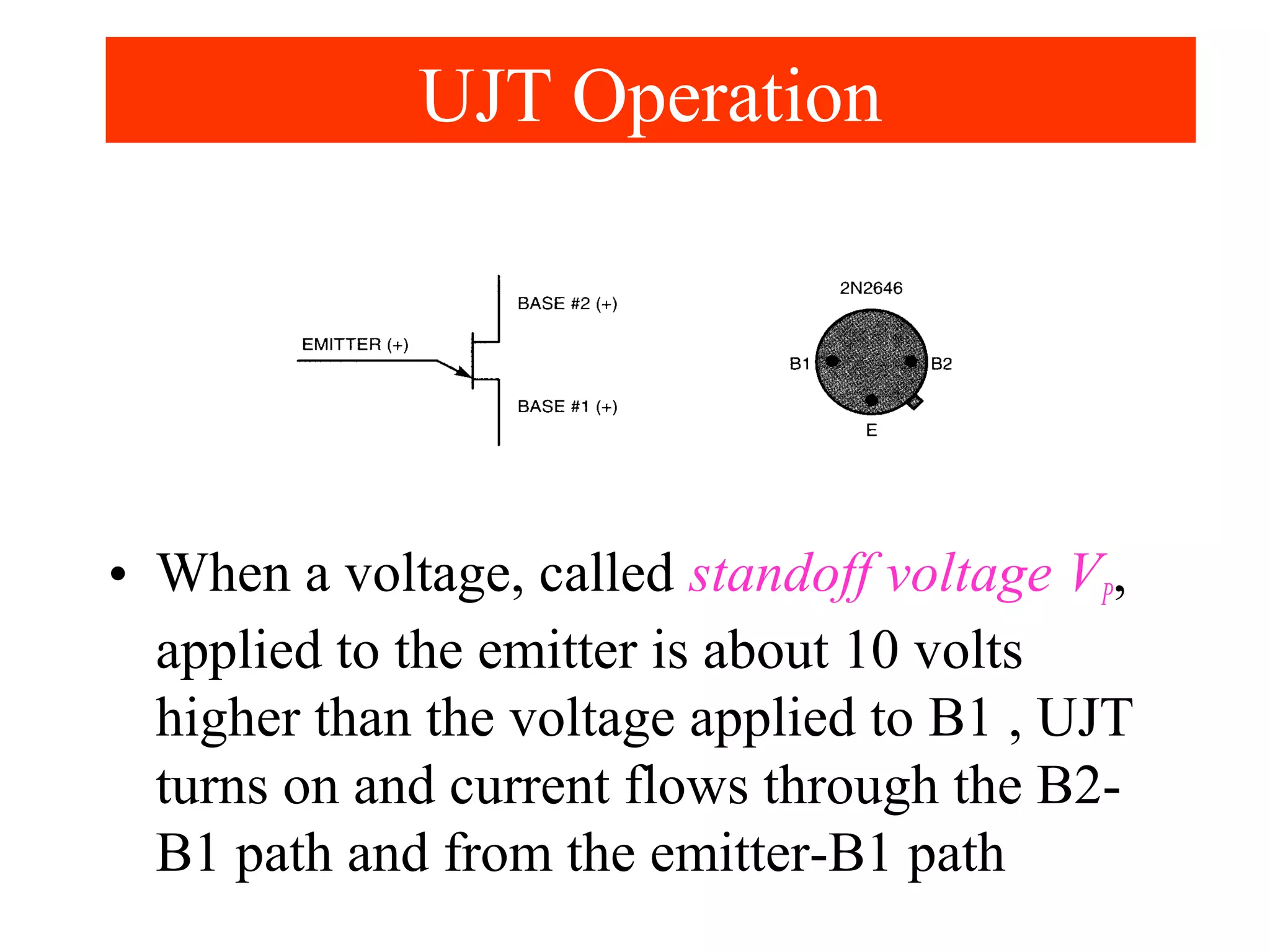
• When a voltage, called standoff voltage VP,
applied to the emitter is about 10 volts
higher than the voltage applied to B1 , UJT
turns on and current flows through the B2-
B1 path and from the emitter-B1 path
UJT Operation
• Current will continue to flow through the
UJT until the voltage applied to the emitter
drops to a point that is about 3 volts higher
than the voltage applied to B1
Common UJT circuit Pulse produced by capacitor discharge
UJT Operation
• When emitter voltage drops to this point,
the UJT will turn off and will remain off
until the voltage applied to the emitter again
reaches a level about 10 volts higher than
the voltage applied to B1
UJT Operation
• Since the N-type silicon bar is lightly-
doped, it has a high resistance and can be
represented by two resistors:
UJT CHARACTERISTICS
B2
B1
E
RB2
RB1
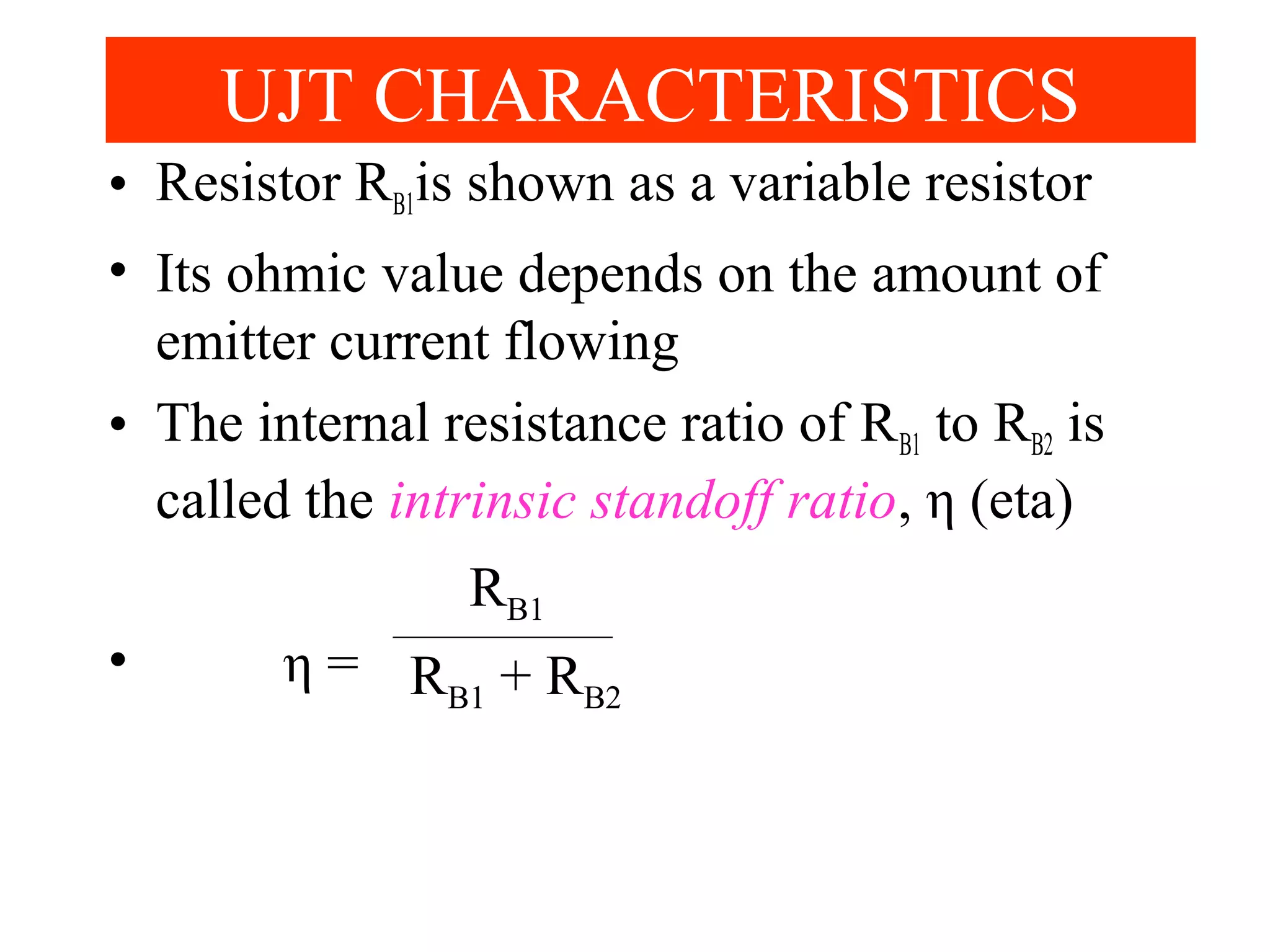
• Resistor RB1is shown as a variable resistor
• Its ohmic value depends on the amount of
emitter current flowing
• The internal resistance ratio of RB1 to RB2 is
called the intrinsic standoff ratio, η (eta)
• η =
UJT CHARACTERISTICS
RB1
RB1 + RB2
• The amount of emitter voltage required to
switch the UJT on is called the standoff
voltage, VP
• It is found be multiplying the applied
voltage VBB, by η
• VP = ηVBB + VF
• VF is the P-N junction forward-voltage drop
UJT CHARACTERISTICS
• When VP is reached, the UJT latches in the
conducting state and current flows between
E and B1
• The UJT is a latching device that will
remain in the conducting state as long as the
emitter current remains above a minimum
value called the holding current
• RB1 varies as a function of the emitter current
• As emitter current increases, RB1 decreases
UJT CHARACTERISTICS
• VP is the peak voltage, VV is the valley
voltage
UJT CHARACTERISTICS
UJT CHARCTERISTIC CURVE
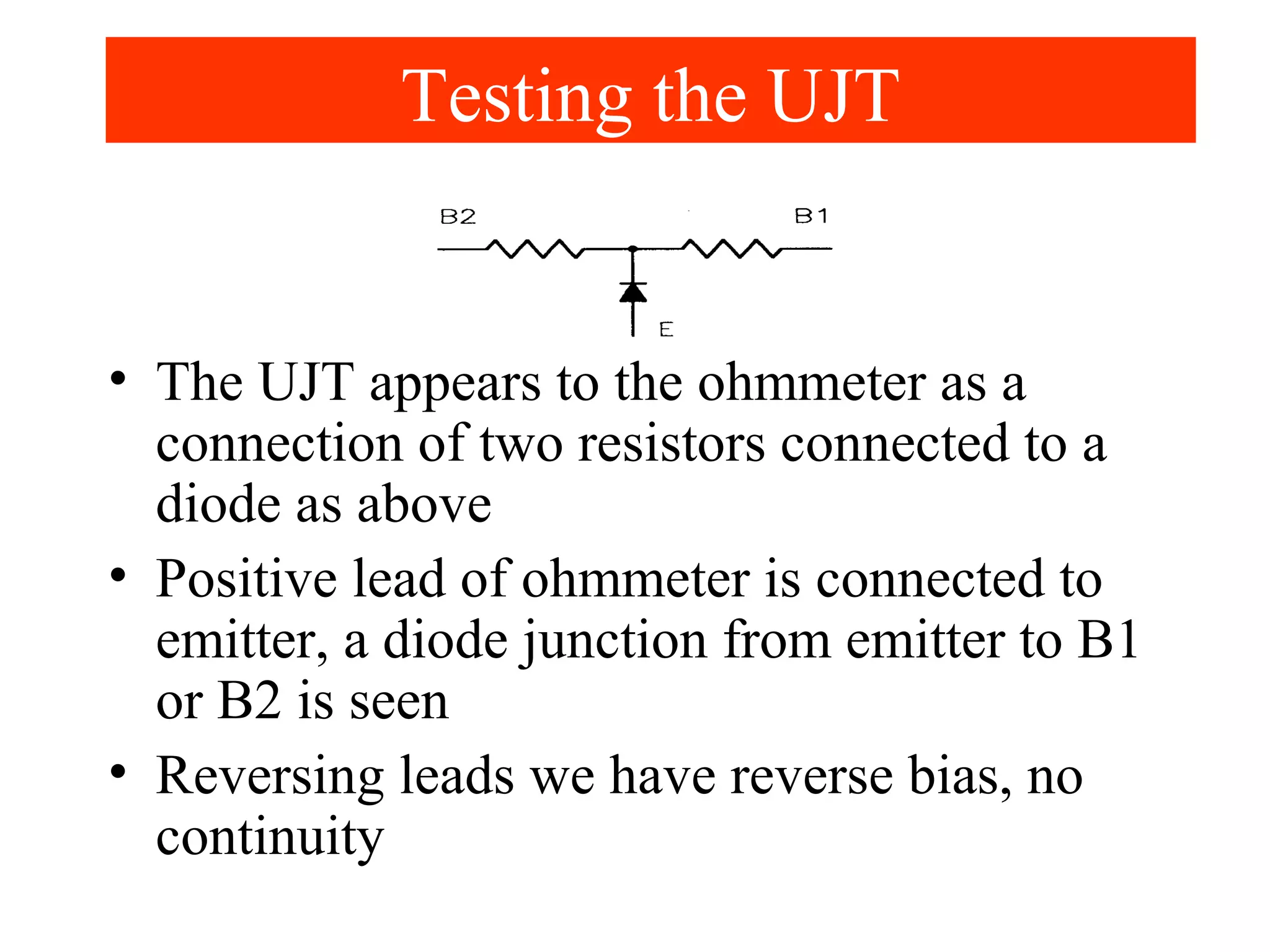
• The UJT appears to the ohmmeter as a
connection of two resistors connected to a
diode as above
• Positive lead of ohmmeter is connected to
emitter, a diode junction from emitter to B1
or B2 is seen
• Reversing leads we have reverse bias, no
continuity
Testing the UJT
Some Packages and Terminal Identification

Unijunction transistor (ujt)

  • 1.
    Unijunction Transistor (UJT) •UJT is a breakover-type switching device • Useful in industrial circuits: timers, oscillators, waveform generators, gate control circuits for SCRs and triacs
  • 2.
    • Is aspecial transistor that has two bases and one emitter • Has two states: completely on or completely off • Part of thyristor family which include SCR, triac, and diac P Unijunction Transistor (UJT) Lightly-doped Heavily-doped
  • 3.
    • UJT consistsof a bar of N-type silicon material (lightly-doped) and a small amount of diffused P-type material (heavily-doped) • An emitter terminal E is connected to the P material to form the PN junction • Two paths for current flow: B2 to B1; E to B1 • Normally current does not flow in either path until Emitter voltage is about 10 volts higher than B1 voltage Unijunction Transistor (UJT)
  • 4.
    • When avoltage, called standoff voltage VP, applied to the emitter is about 10 volts higher than the voltage applied to B1 , UJT turns on and current flows through the B2- B1 path and from the emitter-B1 path UJT Operation
  • 5.
    • Current willcontinue to flow through the UJT until the voltage applied to the emitter drops to a point that is about 3 volts higher than the voltage applied to B1 Common UJT circuit Pulse produced by capacitor discharge UJT Operation
  • 6.
    • When emittervoltage drops to this point, the UJT will turn off and will remain off until the voltage applied to the emitter again reaches a level about 10 volts higher than the voltage applied to B1 UJT Operation
  • 7.
    • Since theN-type silicon bar is lightly- doped, it has a high resistance and can be represented by two resistors: UJT CHARACTERISTICS B2 B1 E RB2 RB1
  • 8.
    • Resistor RB1isshown as a variable resistor • Its ohmic value depends on the amount of emitter current flowing • The internal resistance ratio of RB1 to RB2 is called the intrinsic standoff ratio, η (eta) • η = UJT CHARACTERISTICS RB1 RB1 + RB2
  • 9.
    • The amountof emitter voltage required to switch the UJT on is called the standoff voltage, VP • It is found be multiplying the applied voltage VBB, by η • VP = ηVBB + VF • VF is the P-N junction forward-voltage drop UJT CHARACTERISTICS
  • 10.
    • When VPis reached, the UJT latches in the conducting state and current flows between E and B1 • The UJT is a latching device that will remain in the conducting state as long as the emitter current remains above a minimum value called the holding current • RB1 varies as a function of the emitter current • As emitter current increases, RB1 decreases UJT CHARACTERISTICS
  • 11.
    • VP isthe peak voltage, VV is the valley voltage UJT CHARACTERISTICS UJT CHARCTERISTIC CURVE
  • 12.
    • The UJTappears to the ohmmeter as a connection of two resistors connected to a diode as above • Positive lead of ohmmeter is connected to emitter, a diode junction from emitter to B1 or B2 is seen • Reversing leads we have reverse bias, no continuity Testing the UJT
  • 13.
    Some Packages andTerminal Identification