
Abstract— FSO is a communication system where free space
acts as medium between transceivers and they should be in LOS
for successful transmission of optical signal. Medium can be air,
outer space, or vacuum. This system can be used for
communication purpose in hours andin lessereconomy. There are
many advantages of FSO like high bandwidth and no spectrum
license. The transmission in FSO is dependent on the medium
because the presence of foreign elements like rain, fog, and haze,
physical obstruction, scattering, and atmospheric turbulence are
some of these factors. Different studies on weatherconditions and
techniques employed to mitigate their effect are discussed in this
paper.
I. INTRODUCTION
FSO (free space optics) is an optical communication
technology in which data is transmitted by propagation of light
in free space allowing optical connectivity. There is no
requirement of the optical fiber cable. Working of FSO is
similar to OFC (optical fiber cable) networks but the only
difference is that the optical beams are sent through free air
instead of OFC cores that is glass fiber. Free-space optics
(FSO) communication offers potentially wide bandwidth and
high data rate, which makes this typeof communication system
highly attractive in meeting the increasing demand for
broadband traffic, which is mostly driven by Internet access
and high-definition television broadcasting service. In current
optical communications, the fiber optics technology with a
capacity beyond 1 Tb/s is ubiquitously used,which is
achieved using the wavelength division multiplexing (WDM)
technology.FSO is totally similar to the fiber optics
communication systembut with more improvement from the
point of flexibility of being fiber free and high speed. An FSO
systemis a line-of-sight communication system ; thus,no
laying of fiber optic cables is needed,no expensive rooftop
installations are required, and no security upgrades are
necessary. . Currently, the FSO systemcan transmit large
capacity of data at a date rate of 1.25 Gb/s . Although the FSO
systemhas all these advantages,it suffers from degradation
from atmospheric occurrences such as absorption,scattering,
and nonselective scattering due to large-sized raindrops . The
nonselective scattering is considered as the main drawback of
the FSO in tropical countries such as in southeast Asian
countries .
The link performance of an FSO communication system
with a single-beam transceiver is less efficient during
heavy rain. To enhance the link performance, using more
than one beam at the transmitter and receiver could be a
possible option . The technique of combining more than one
beam in a multibeam FSO systemreduces the effect of
turbulent atmosphere, such as scintillation and loss of power
in the detector due to heavy rain . The performance of an
FSO systemthat uses the multiple-beam technique has been
studied in terms of geometrical losses,received power, and
link margin, regardless of the atmospheric losses .Most
of the recurrent physicalobstructions such as birds,insects,
scintillation, rain, and snoware excluded in the use of the
multibeam FSO system, and the systemprovides a fail-safe
operation . In coastalareas, low visibility due to fog can
also be a problem; therefore, a solution to this problem is
to use a multiple-beam systemto maintain higher link
availability. In the present study,up to four beams at the same
wavelength have been employed in a multiple-beam FSO
systembecause this technique is prominent, as suggested
by . The performance of a multibeam FSO system, especially
using four beams, has been known to be far greater
than that of the one-beam, two-beam, and three-beam FSO
systems in clear weather without any atmospheric attenuation.
Consequently,performance improvement in using several
beams greater than four is negligible . The concept
of the multibeam FSO systemis the replacement of the
single-beam transceiverby multiple-beam transceivers.
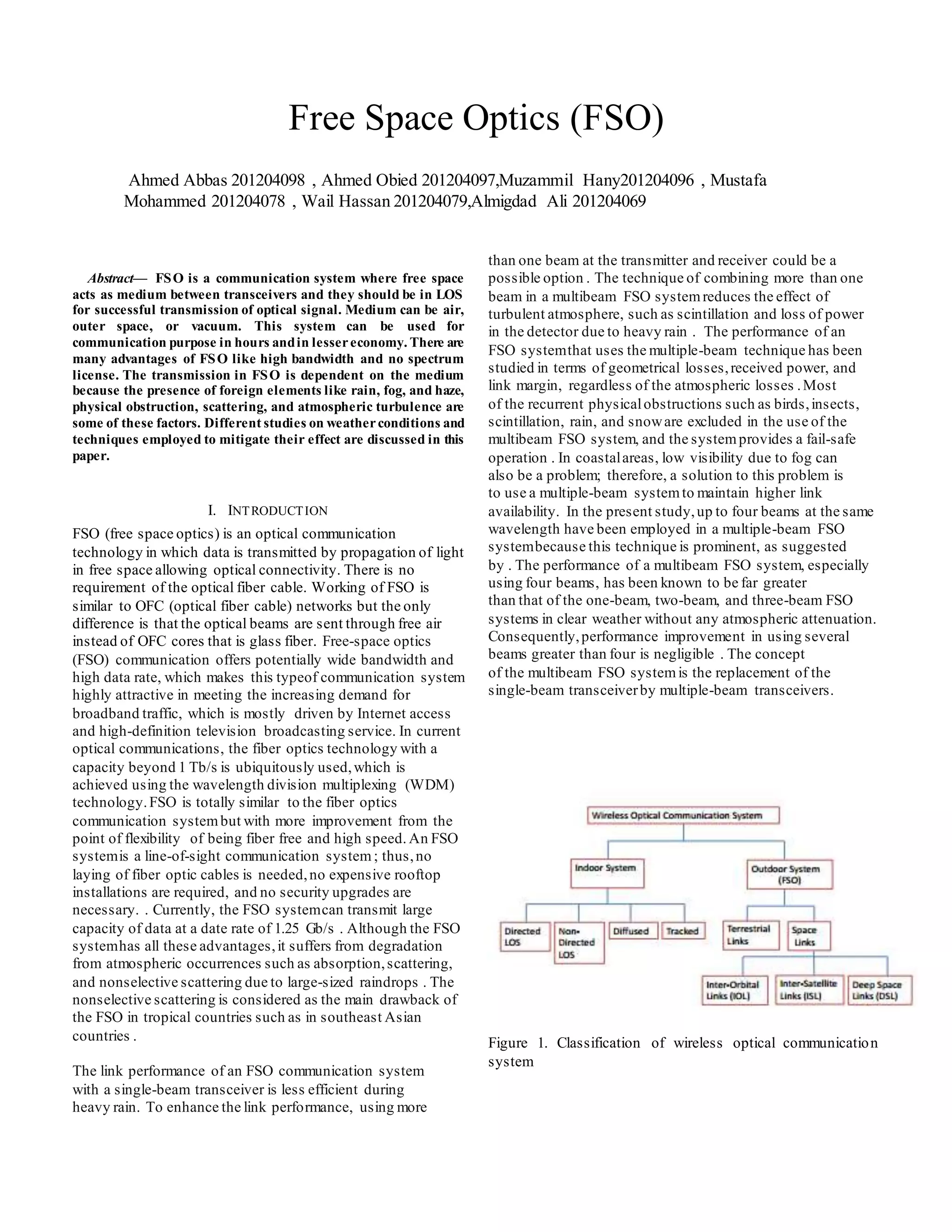
Figure 1. Classification of wireless optical communication
system
Free Space Optics (FSO)
Ahmed Abbas 201204098 , Ahmed Obied 201204097,Muzammil Hany201204096 , Mustafa
Mohammed 201204078 , Wail Hassan 201204079,Almigdad Ali 201204069
An effective FSO system should have the following
characteristics :
(a)FSO systems should have the ability to operate at higher
power levels for longer distance.
(b)For high speed FSO systems, high speed modulation is
important.
(c)An overall system design should have small footprint and
low power consumption because of its maintenance.
(d)FSO system should have the ability to operate over wide
temperature range and the performance degradation would be
less for outdoor systems.
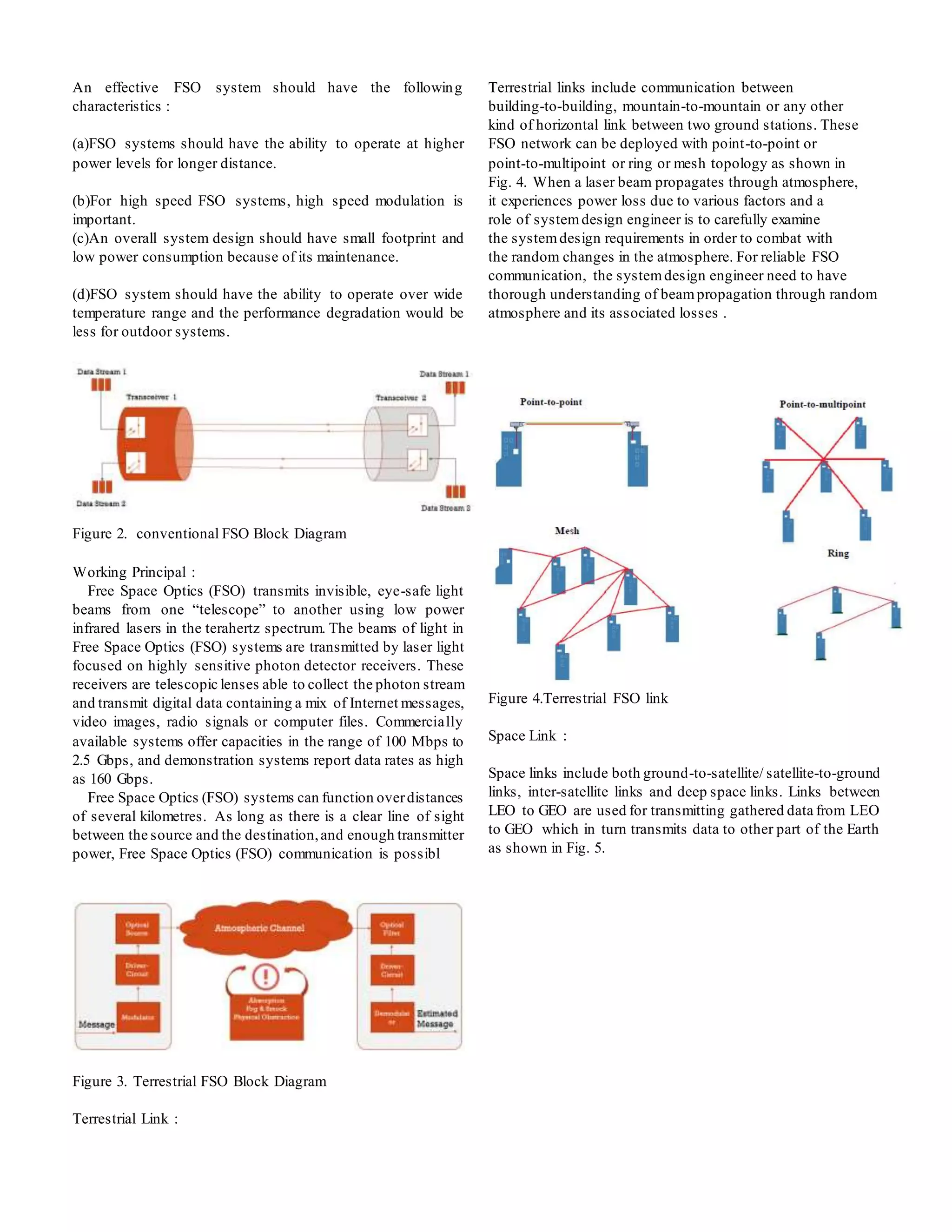
Figure 2. conventional FSO Block Diagram
Working Principal :
Free Space Optics (FSO) transmits invisible, eye-safe light
beams from one “telescope” to another using low power
infrared lasers in the terahertz spectrum. The beams of light in
Free Space Optics (FSO) systems are transmitted by laser light
focused on highly sensitive photon detector receivers. These
receivers are telescopic lenses able to collect the photon stream
and transmit digital data containing a mix of Internet messages,
video images, radio signals or computer files. Commercially
available systems offer capacities in the range of 100 Mbps to
2.5 Gbps, and demonstration systems report data rates as high
as 160 Gbps.
Free Space Optics (FSO) systems can function overdistances
of several kilometres. As long as there is a clear line of sight
between the source and the destination,and enough transmitter
power, Free Space Optics (FSO) communication is possibl
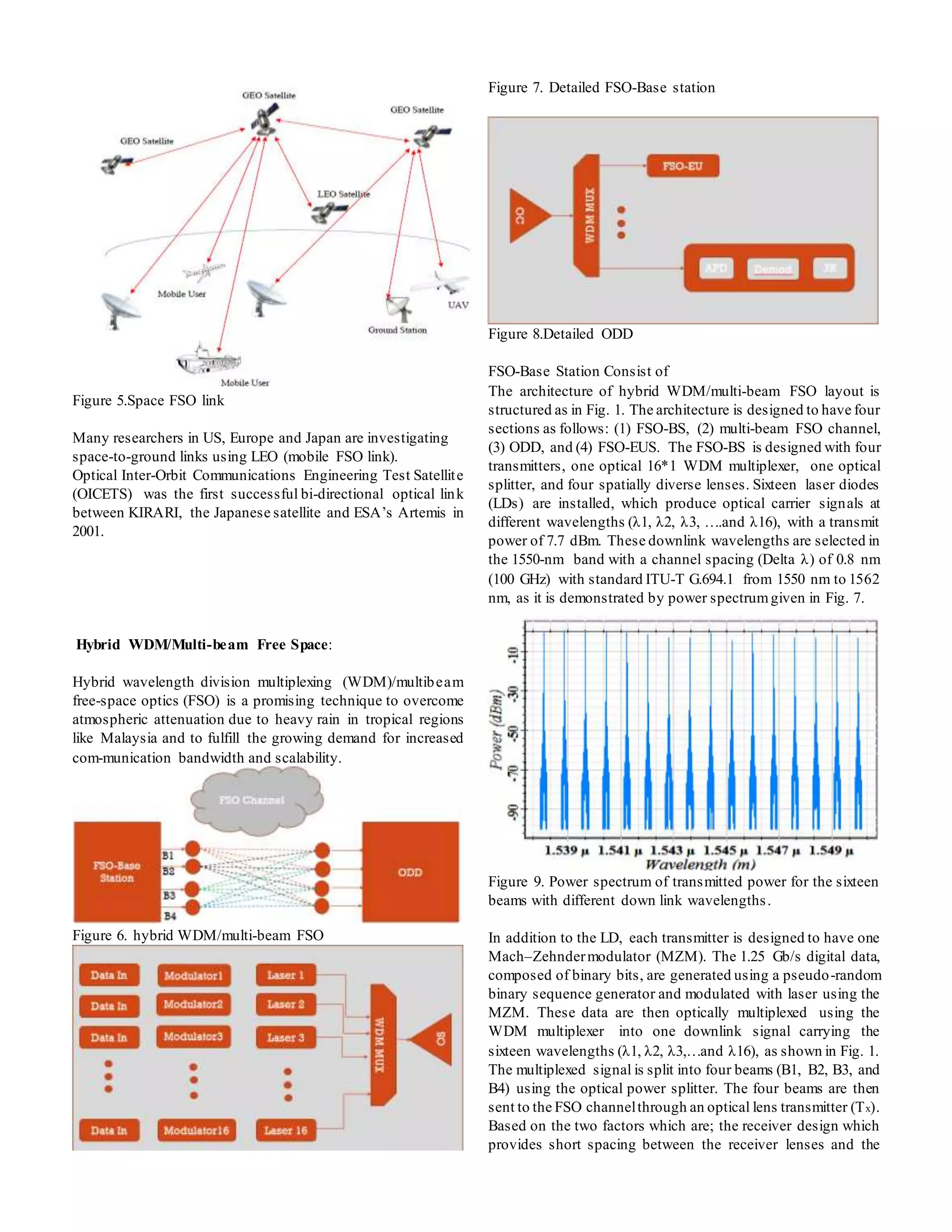
Figure 3. Terrestrial FSO Block Diagram
Terrestrial Link :
Terrestrial links include communication between
building-to-building, mountain-to-mountain or any other
kind of horizontal link between two ground stations. These
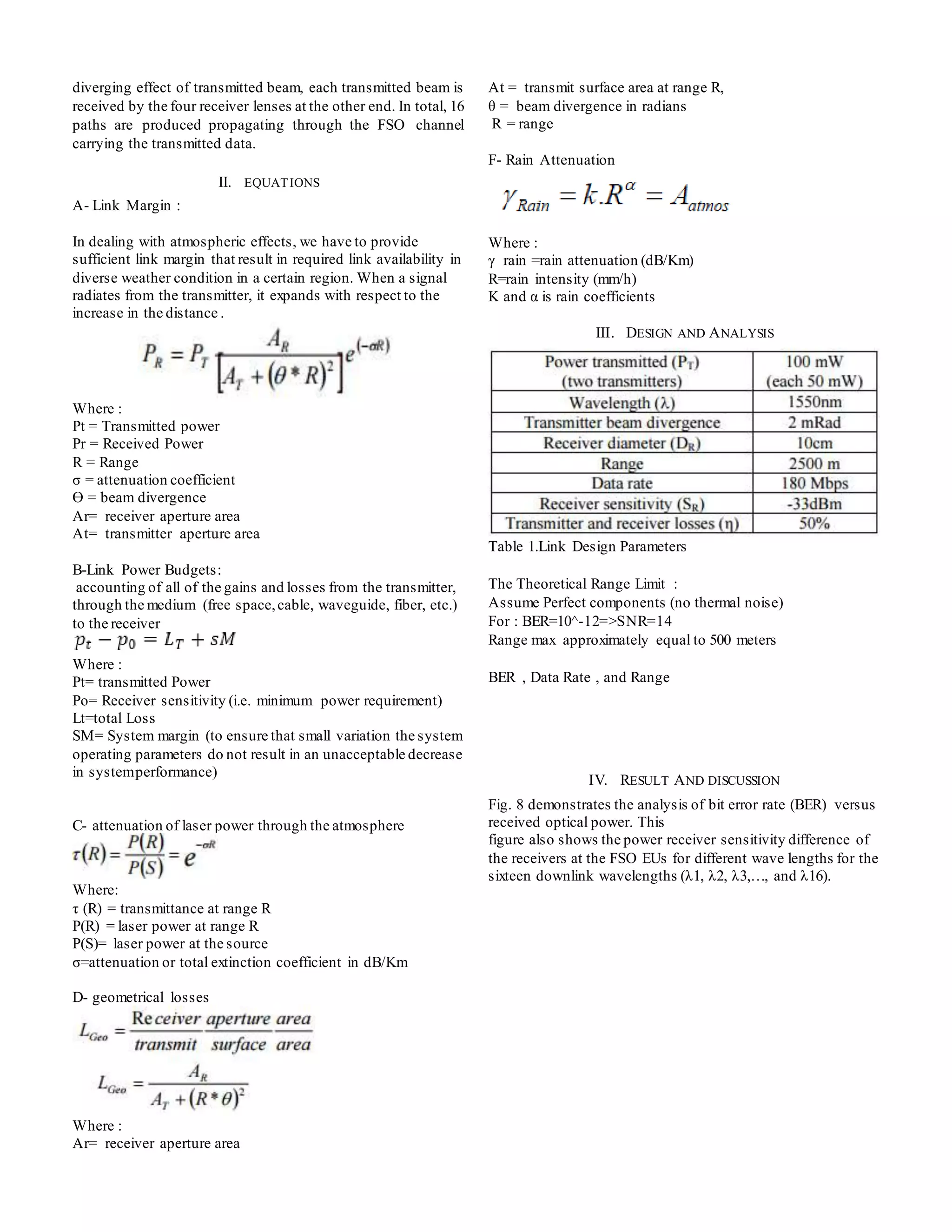
FSO network can be deployed with point-to-point or
point-to-multipoint or ring or mesh topology as shown in
Fig. 4. When a laser beam propagates through atmosphere,
it experiences power loss due to various factors and a
role of systemdesign engineer is to carefully examine
the systemdesign requirements in order to combat with
the random changes in the atmosphere. For reliable FSO
communication, the systemdesign engineer need to have
thorough understanding of beampropagation through random
atmosphere and its associated losses .
Figure 4.Terrestrial FSO link
Space Link :
Space links include both ground-to-satellite/ satellite-to-ground
links, inter-satellite links and deep space links. Links between
LEO to GEO are used for transmitting gathered data from LEO
to GEO which in turn transmits data to other part of the Earth
as shown in Fig. 5.
Figure 5.Space FSO link
Many researchers in US, Europe and Japan are investigating
space-to-ground links using LEO (mobile FSO link).
Optical Inter-Orbit Communications Engineering Test Satellite
(OICETS) was the first successful bi-directional optical link
between KIRARI, the Japanese satellite and ESA’s Artemis in
2001.
Hybrid WDM/Multi-beam Free Space:
Hybrid wavelength division multiplexing (WDM)/multibeam
free-space optics (FSO) is a promising technique to overcome
atmospheric attenuation due to heavy rain in tropical regions
like Malaysia and to fulfill the growing demand for increased
com-munication bandwidth and scalability.
Figure 6. hybrid WDM/multi-beam FSO
Figure 7. Detailed FSO-Base station
Figure 8.Detailed ODD
FSO-Base Station Consist of
The architecture of hybrid WDM/multi-beam FSO layout is
structured as in Fig. 1. The architecture is designed to have four
sections as follows: (1) FSO-BS, (2) multi-beam FSO channel,
(3) ODD, and (4) FSO-EUS. The FSO-BS is designed with four
transmitters, one optical 16*1 WDM multiplexer, one optical
splitter, and four spatially diverse lenses. Sixteen laser diodes
(LDs) are installed, which produce optical carrier signals at
different wavelengths (λ1, λ2, λ3, ….and λ16), with a transmit
power of 7.7 dBm. These downlink wavelengths are selected in
the 1550-nm band with a channel spacing (Delta λ) of 0.8 nm
(100 GHz) with standard ITU-T G.694.1 from 1550 nm to 1562
nm, as it is demonstrated by power spectrumgiven in Fig. 7.
Figure 9. Power spectrum of transmitted power for the sixteen
beams with different down link wavelengths.
In addition to the LD, each transmitter is designed to have one
Mach–Zehndermodulator (MZM). The 1.25 Gb/s digital data,
composed of binary bits, are generated using a pseudo-random
binary sequence generator and modulated with laser using the
MZM. These data are then optically multiplexed using the
WDM multiplexer into one downlink signal carrying the
sixteen wavelengths (λ1, λ2, λ3,…and λ16), as shown in Fig. 1.
The multiplexed signal is split into four beams (B1, B2, B3, and
B4) using the optical power splitter. The four beams are then
sent to the FSO channelthrough an optical lens transmitter (Tx).
Based on the two factors which are; the receiver design which
provides short spacing between the receiver lenses and the
diverging effect of transmitted beam, each transmitted beam is
received by the four receiver lenses at the other end. In total, 16
paths are produced propagating through the FSO channel
carrying the transmitted data.
II. EQUATIONS
A- Link Margin :
In dealing with atmospheric effects, we have to provide
sufficient link margin that result in required link availability in
diverse weather condition in a certain region. When a signal
radiates from the transmitter, it expands with respect to the
increase in the distance .
Where :
Pt = Transmitted power
Pr = Received Power
R = Range
σ = attenuation coefficient
ϴ = beam divergence
Ar= receiver aperture area
At= transmitter aperture area
B-Link Power Budgets:
accounting of all of the gains and losses from the transmitter,
through the medium (free space,cable, waveguide, fiber, etc.)
to the receiver
Where :
Pt= transmitted Power
Po= Receiver sensitivity (i.e. minimum power requirement)
Lt=total Loss
SM= System margin (to ensure that small variation the system
operating parameters do not result in an unacceptable decrease
in systemperformance)
C- attenuation of laser power through the atmosphere
Where:
τ (R) = transmittance at range R
P(R) = laser power at range R
P(S)= laser power at the source
σ=attenuation or total extinction coefficient in dB/Km
D- geometrical losses
Where :
Ar= receiver aperture area
At = transmit surface area at range R,
θ = beam divergence in radians
R = range
F- Rain Attenuation
Where :
γ rain =rain attenuation (dB/Km)
R=rain intensity (mm/h)
K and α is rain coefficients
III. DESIGN AND ANALYSIS
Table 1.Link Design Parameters
The Theoretical Range Limit :
Assume Perfect components (no thermal noise)
For : BER=10^-12=>SNR=14
Range max approximately equal to 500 meters
BER , Data Rate , and Range
IV. RESULT AND DISCUSSION
Fig. 8 demonstrates the analysis of bit error rate (BER) versus
received optical power. This
figure also shows the power receiver sensitivity difference of
the receivers at the FSO EUs for different wave lengths for the
sixteen downlink wavelengths (λ1, λ2, λ3,…, and λ16).
Figure 10. BER performance of the received optical power at
the FSO EUs.
The power receiver sensitivity difference of the receiver for
different wave lengths at required BER of 10-9 is clearly a
small value, which is roughly less than 1 dB.
Fig. 9 shows the maximum distance achieved by the network.
It clearly demonstrated that the maximum distance achieved by
the network is 1085 m at a BER of 10−9. The increase in the
distance beyond the stated optimum distance causes channel
overlapping and degradation of the systemperformance.
Figure 11. Optimum link distance achieved by the proposed
network .
Figure 12. Attenuation Vs Different Rain Rate
V. CONCLUSION
The paper presents overall systemperformance of FSO in
Conventional and Hybrid ,terrestrial and space links under
diverse as well as adverse weather conditions The FSO system
performance can be judged by looking at its link margin.
Higher the link margin, more the systemwill tolerate the
losses.Following are the different techniques used to optimize
the systemperformance underadverse weather conditions.
• By selecting smaller hops (short distance FSO nodes).
• Use hybrid system(FSO switches to RF and vice versa).
REFERENCES
[1] Willebrand, H. andGhuman,B.S., 2002. Free space optics: enablingoptical
connectivity in today's networks. SAMS publishing.
[2] Killinger, D., 2002. Free space optics for laser
communication through the air. Optics and Photonics
News, 13(10), pp.36-42.
[3] Willebrand, H. and Ghuman, B.S., 2002. Free space
optics: enabling optical connectivity in today's networks.
SAMS publishing.
[4] Al-Gailani, S.A., Mohammad, A.B. and Shaddad, R.Q.,
Scalable Hybrid WDM/Multi-beam Free Space Optical
Network in Tropical Weather.
[5] Al-Gailani, S.A., Mohammad, A.B., Shaddad, R.Q.,
Sheikh, U.U. and Elmagzoub, M.A., 2015. Hybrid
WDM/multibeam free-space optics for multigigabit access
network. Photonic Network Communications, 29(2),
pp.138-145.

Free Space Optical communication - FSO IEEE paper

  • 1.
     Abstract— FSO isa communication system where free space acts as medium between transceivers and they should be in LOS for successful transmission of optical signal. Medium can be air, outer space, or vacuum. This system can be used for communication purpose in hours andin lessereconomy. There are many advantages of FSO like high bandwidth and no spectrum license. The transmission in FSO is dependent on the medium because the presence of foreign elements like rain, fog, and haze, physical obstruction, scattering, and atmospheric turbulence are some of these factors. Different studies on weatherconditions and techniques employed to mitigate their effect are discussed in this paper. I. INTRODUCTION FSO (free space optics) is an optical communication technology in which data is transmitted by propagation of light in free space allowing optical connectivity. There is no requirement of the optical fiber cable. Working of FSO is similar to OFC (optical fiber cable) networks but the only difference is that the optical beams are sent through free air instead of OFC cores that is glass fiber. Free-space optics (FSO) communication offers potentially wide bandwidth and high data rate, which makes this typeof communication system highly attractive in meeting the increasing demand for broadband traffic, which is mostly driven by Internet access and high-definition television broadcasting service. In current optical communications, the fiber optics technology with a capacity beyond 1 Tb/s is ubiquitously used,which is achieved using the wavelength division multiplexing (WDM) technology.FSO is totally similar to the fiber optics communication systembut with more improvement from the point of flexibility of being fiber free and high speed. An FSO systemis a line-of-sight communication system ; thus,no laying of fiber optic cables is needed,no expensive rooftop installations are required, and no security upgrades are necessary. . Currently, the FSO systemcan transmit large capacity of data at a date rate of 1.25 Gb/s . Although the FSO systemhas all these advantages,it suffers from degradation from atmospheric occurrences such as absorption,scattering, and nonselective scattering due to large-sized raindrops . The nonselective scattering is considered as the main drawback of the FSO in tropical countries such as in southeast Asian countries . The link performance of an FSO communication system with a single-beam transceiver is less efficient during heavy rain. To enhance the link performance, using more than one beam at the transmitter and receiver could be a possible option . The technique of combining more than one beam in a multibeam FSO systemreduces the effect of turbulent atmosphere, such as scintillation and loss of power in the detector due to heavy rain . The performance of an FSO systemthat uses the multiple-beam technique has been studied in terms of geometrical losses,received power, and link margin, regardless of the atmospheric losses .Most of the recurrent physicalobstructions such as birds,insects, scintillation, rain, and snoware excluded in the use of the multibeam FSO system, and the systemprovides a fail-safe operation . In coastalareas, low visibility due to fog can also be a problem; therefore, a solution to this problem is to use a multiple-beam systemto maintain higher link availability. In the present study,up to four beams at the same wavelength have been employed in a multiple-beam FSO systembecause this technique is prominent, as suggested by . The performance of a multibeam FSO system, especially using four beams, has been known to be far greater than that of the one-beam, two-beam, and three-beam FSO systems in clear weather without any atmospheric attenuation. Consequently,performance improvement in using several beams greater than four is negligible . The concept of the multibeam FSO systemis the replacement of the single-beam transceiverby multiple-beam transceivers. Figure 1. Classification of wireless optical communication system Free Space Optics (FSO) Ahmed Abbas 201204098 , Ahmed Obied 201204097,Muzammil Hany201204096 , Mustafa Mohammed 201204078 , Wail Hassan 201204079,Almigdad Ali 201204069
  • 2.
    An effective FSOsystem should have the following characteristics : (a)FSO systems should have the ability to operate at higher power levels for longer distance. (b)For high speed FSO systems, high speed modulation is important. (c)An overall system design should have small footprint and low power consumption because of its maintenance. (d)FSO system should have the ability to operate over wide temperature range and the performance degradation would be less for outdoor systems. Figure 2. conventional FSO Block Diagram Working Principal : Free Space Optics (FSO) transmits invisible, eye-safe light beams from one “telescope” to another using low power infrared lasers in the terahertz spectrum. The beams of light in Free Space Optics (FSO) systems are transmitted by laser light focused on highly sensitive photon detector receivers. These receivers are telescopic lenses able to collect the photon stream and transmit digital data containing a mix of Internet messages, video images, radio signals or computer files. Commercially available systems offer capacities in the range of 100 Mbps to 2.5 Gbps, and demonstration systems report data rates as high as 160 Gbps. Free Space Optics (FSO) systems can function overdistances of several kilometres. As long as there is a clear line of sight between the source and the destination,and enough transmitter power, Free Space Optics (FSO) communication is possibl Figure 3. Terrestrial FSO Block Diagram Terrestrial Link : Terrestrial links include communication between building-to-building, mountain-to-mountain or any other kind of horizontal link between two ground stations. These FSO network can be deployed with point-to-point or point-to-multipoint or ring or mesh topology as shown in Fig. 4. When a laser beam propagates through atmosphere, it experiences power loss due to various factors and a role of systemdesign engineer is to carefully examine the systemdesign requirements in order to combat with the random changes in the atmosphere. For reliable FSO communication, the systemdesign engineer need to have thorough understanding of beampropagation through random atmosphere and its associated losses . Figure 4.Terrestrial FSO link Space Link : Space links include both ground-to-satellite/ satellite-to-ground links, inter-satellite links and deep space links. Links between LEO to GEO are used for transmitting gathered data from LEO to GEO which in turn transmits data to other part of the Earth as shown in Fig. 5.
  • 3.
    Figure 5.Space FSOlink Many researchers in US, Europe and Japan are investigating space-to-ground links using LEO (mobile FSO link). Optical Inter-Orbit Communications Engineering Test Satellite (OICETS) was the first successful bi-directional optical link between KIRARI, the Japanese satellite and ESA’s Artemis in 2001. Hybrid WDM/Multi-beam Free Space: Hybrid wavelength division multiplexing (WDM)/multibeam free-space optics (FSO) is a promising technique to overcome atmospheric attenuation due to heavy rain in tropical regions like Malaysia and to fulfill the growing demand for increased com-munication bandwidth and scalability. Figure 6. hybrid WDM/multi-beam FSO Figure 7. Detailed FSO-Base station Figure 8.Detailed ODD FSO-Base Station Consist of The architecture of hybrid WDM/multi-beam FSO layout is structured as in Fig. 1. The architecture is designed to have four sections as follows: (1) FSO-BS, (2) multi-beam FSO channel, (3) ODD, and (4) FSO-EUS. The FSO-BS is designed with four transmitters, one optical 16*1 WDM multiplexer, one optical splitter, and four spatially diverse lenses. Sixteen laser diodes (LDs) are installed, which produce optical carrier signals at different wavelengths (λ1, λ2, λ3, ….and λ16), with a transmit power of 7.7 dBm. These downlink wavelengths are selected in the 1550-nm band with a channel spacing (Delta λ) of 0.8 nm (100 GHz) with standard ITU-T G.694.1 from 1550 nm to 1562 nm, as it is demonstrated by power spectrumgiven in Fig. 7. Figure 9. Power spectrum of transmitted power for the sixteen beams with different down link wavelengths. In addition to the LD, each transmitter is designed to have one Mach–Zehndermodulator (MZM). The 1.25 Gb/s digital data, composed of binary bits, are generated using a pseudo-random binary sequence generator and modulated with laser using the MZM. These data are then optically multiplexed using the WDM multiplexer into one downlink signal carrying the sixteen wavelengths (λ1, λ2, λ3,…and λ16), as shown in Fig. 1. The multiplexed signal is split into four beams (B1, B2, B3, and B4) using the optical power splitter. The four beams are then sent to the FSO channelthrough an optical lens transmitter (Tx). Based on the two factors which are; the receiver design which provides short spacing between the receiver lenses and the
  • 4.
    diverging effect oftransmitted beam, each transmitted beam is received by the four receiver lenses at the other end. In total, 16 paths are produced propagating through the FSO channel carrying the transmitted data. II. EQUATIONS A- Link Margin : In dealing with atmospheric effects, we have to provide sufficient link margin that result in required link availability in diverse weather condition in a certain region. When a signal radiates from the transmitter, it expands with respect to the increase in the distance . Where : Pt = Transmitted power Pr = Received Power R = Range σ = attenuation coefficient ϴ = beam divergence Ar= receiver aperture area At= transmitter aperture area B-Link Power Budgets: accounting of all of the gains and losses from the transmitter, through the medium (free space,cable, waveguide, fiber, etc.) to the receiver Where : Pt= transmitted Power Po= Receiver sensitivity (i.e. minimum power requirement) Lt=total Loss SM= System margin (to ensure that small variation the system operating parameters do not result in an unacceptable decrease in systemperformance) C- attenuation of laser power through the atmosphere Where: τ (R) = transmittance at range R P(R) = laser power at range R P(S)= laser power at the source σ=attenuation or total extinction coefficient in dB/Km D- geometrical losses Where : Ar= receiver aperture area At = transmit surface area at range R, θ = beam divergence in radians R = range F- Rain Attenuation Where : γ rain =rain attenuation (dB/Km) R=rain intensity (mm/h) K and α is rain coefficients III. DESIGN AND ANALYSIS Table 1.Link Design Parameters The Theoretical Range Limit : Assume Perfect components (no thermal noise) For : BER=10^-12=>SNR=14 Range max approximately equal to 500 meters BER , Data Rate , and Range IV. RESULT AND DISCUSSION Fig. 8 demonstrates the analysis of bit error rate (BER) versus received optical power. This figure also shows the power receiver sensitivity difference of the receivers at the FSO EUs for different wave lengths for the sixteen downlink wavelengths (λ1, λ2, λ3,…, and λ16).
  • 5.
    Figure 10. BERperformance of the received optical power at the FSO EUs. The power receiver sensitivity difference of the receiver for different wave lengths at required BER of 10-9 is clearly a small value, which is roughly less than 1 dB. Fig. 9 shows the maximum distance achieved by the network. It clearly demonstrated that the maximum distance achieved by the network is 1085 m at a BER of 10−9. The increase in the distance beyond the stated optimum distance causes channel overlapping and degradation of the systemperformance. Figure 11. Optimum link distance achieved by the proposed network . Figure 12. Attenuation Vs Different Rain Rate V. CONCLUSION The paper presents overall systemperformance of FSO in Conventional and Hybrid ,terrestrial and space links under diverse as well as adverse weather conditions The FSO system performance can be judged by looking at its link margin. Higher the link margin, more the systemwill tolerate the losses.Following are the different techniques used to optimize the systemperformance underadverse weather conditions. • By selecting smaller hops (short distance FSO nodes). • Use hybrid system(FSO switches to RF and vice versa). REFERENCES [1] Willebrand, H. andGhuman,B.S., 2002. Free space optics: enablingoptical connectivity in today's networks. SAMS publishing. [2] Killinger, D., 2002. Free space optics for laser communication through the air. Optics and Photonics News, 13(10), pp.36-42. [3] Willebrand, H. and Ghuman, B.S., 2002. Free space optics: enabling optical connectivity in today's networks. SAMS publishing. [4] Al-Gailani, S.A., Mohammad, A.B. and Shaddad, R.Q., Scalable Hybrid WDM/Multi-beam Free Space Optical Network in Tropical Weather. [5] Al-Gailani, S.A., Mohammad, A.B., Shaddad, R.Q., Sheikh, U.U. and Elmagzoub, M.A., 2015. Hybrid WDM/multibeam free-space optics for multigigabit access network. Photonic Network Communications, 29(2), pp.138-145.