CONTENTS
• Introduction
• Principle of operation
• Working
• Literature Survey
• Block diagram
• Applications
• Advantages
• References
INTRODUCTION
• Free-space optical communication (FSO) is an optical
communication technology that uses light propagating in free
space wirelessly transmit data for telecommunications.
• FSO communication is one of the key area in wireless
Communications. Due to its low noise ratio makes its one of the
well suited communication medium for exchange of information.
• FSO communications systems work similarly to fiber optic links,
except the beam is transmitted through free space.
FSO
 Line-of-sight technology.
 Uses LASERS and Photo detectors.
 Optical connections between two points—without the fiber.
 Provide full duplex capability.
HISTORY OF FREE SPACE OPTICS
• In the late nineteenth century, Alexander Graham Bell’s "photo-phone”.
• Late 1950‘s~early 1960's, several scientists theorized and developed laser.
• In the mid-1960's NASA initiated experiments to utilize the laser as a
means of communication between the Goddard Space Flight Center and the
Gemini-7 orbiting space capsule.
• In the early 1980's United States and its military research.
• Germany, France and Japan made significant advancements in free space
optics for satellite communications.
CIRCUIT SCHEMATICS
WORKING OF FSO COMMUNICATION SYSTEM
 FSO communication System comprises of mainly 2 sections
- Transmitter section (optical transceiver with a laser)
- Receiver section(Photo detector)
 Transmitter section is used to transmit the data and sound signals, which comprised
by microphone, modulator analog and laser diode to generate medium for
transmission of signals.
 Transmitter converts the signal into laser beam and transmit it in an straight line.
 The receiver section is used to receive the laser beam, using solar Panel , which is
incorporated with the data or sound signals from the transmitter to extract the data
signals from the received laser beam and is given as a input to the speaker.
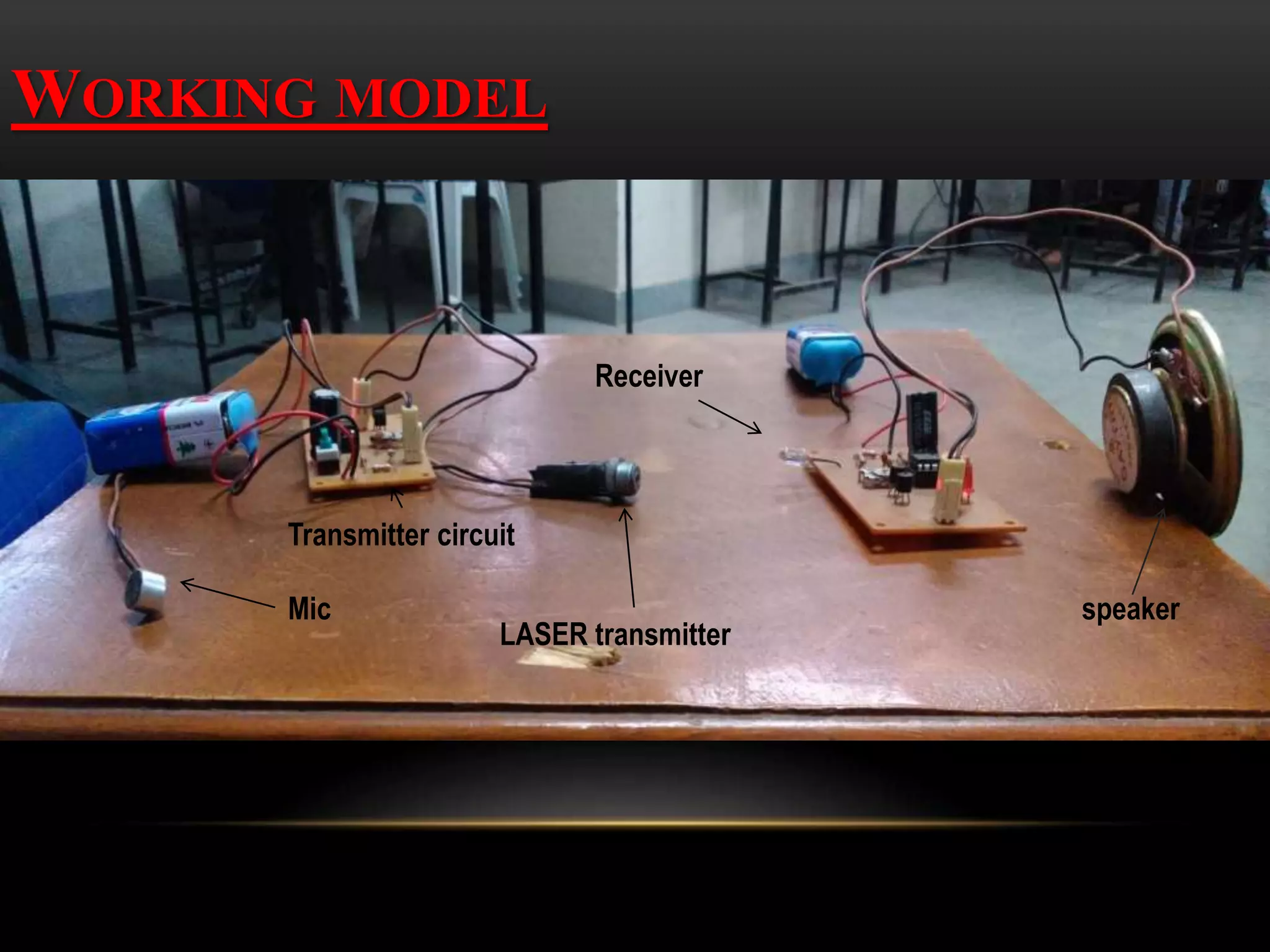
WORKING MODEL
Mic speaker
Transmitter circuit
LASER transmitter
Receiver
LITERATURE SURVEY
• The Aim of this project is to design a communication system through Laser.
• A laser diode at the transmitting end act as a transducer to convert the audio signal into
laser form and transmitted, at the receiving end a laser transistor convert the laser data
into digital form.
• Here the motive of using Laser is that while the transmitter and receiver must require
lineof-sight conditions, they have the benefit of eliminating the need for broadcast rights
and buried cables.
• Laser communications systems can be easily deployed since they are inexpensive,
small, low power and do not require any radio interference studies.
PROBLEM IDENTIFICATION
• Signal attenuation in long distance transmission
• Distortion due to interference
• Half Duplex communication is achieved.
OBJECTIVE
• Our aim is to achieve following results
• Minimal Signal attenuation in long distance transmission
• Less Distortion due to interference.
• Full Duplex communication .
TOOLS USED
• MULTI SIM
• CRO
• Multimeter
• Battery eliminator
• Soldering iron
• Printed circuit boards
WHY NOT FIBER OPTICS?
• Not always possible to lay fiber lines
• Satellites
• Combat zones
• Physically / Economically not practical
• Emergencies
WHY NOT RF?
 Bandwidth
 for Laser Communication (LC) is 100 times greater than for RF.
 Power
 in LC is directed at target, so much less transmission power
required. Also the power loss is less.
 Size / Weight
 LC antenna is much smaller than RF.
 Security
 Due to low divergence of laser beam, LC is more secure than RF.
CONCLUSION
• If the laser is properly aimed at the phototransistor as discussed
in the mechanics section, the bit stream is received perfectly.
ADVANTAGES OF FSO SYSTEMS
• No licensing required.
• Very low installation cost.
• No sunk costs.
• No capital overhangs.
• Highly secure transmission possible.
APPLICATIONS
•Straight communication with satellite from
the earth.
•Tactical Line Of Sight Optical Network
(TLSON) uses high frequency laser to
transmit data.
•One to many communication.
REFERENCES
• Harvard Broadband Communictions Laboratory.
• W. J. Perez H., J. Velasco Medina, D. Ravotto, E. Sanchez, M. SonzaReordaThe
IEEE Workshop on Design and Diagnostics of Electronic Circuits and Systems, 2008.
• International Conference on data warehousing and knowledge discovery,2003.
• http//www.semiconductors.philips.com
• A. Acampora, “Last Mile by Laser,” Scientific American, July 2002.
• Vikrant, Anjesh Kumar& R.S. Jha, “Comparison of Underwater Laser Communication
System with Underwater Acoustic Sensor Network” , International Journal of
Scientific & Engineering Research, Vol. 3, Issue 10, October-2012.
Thank you very much!

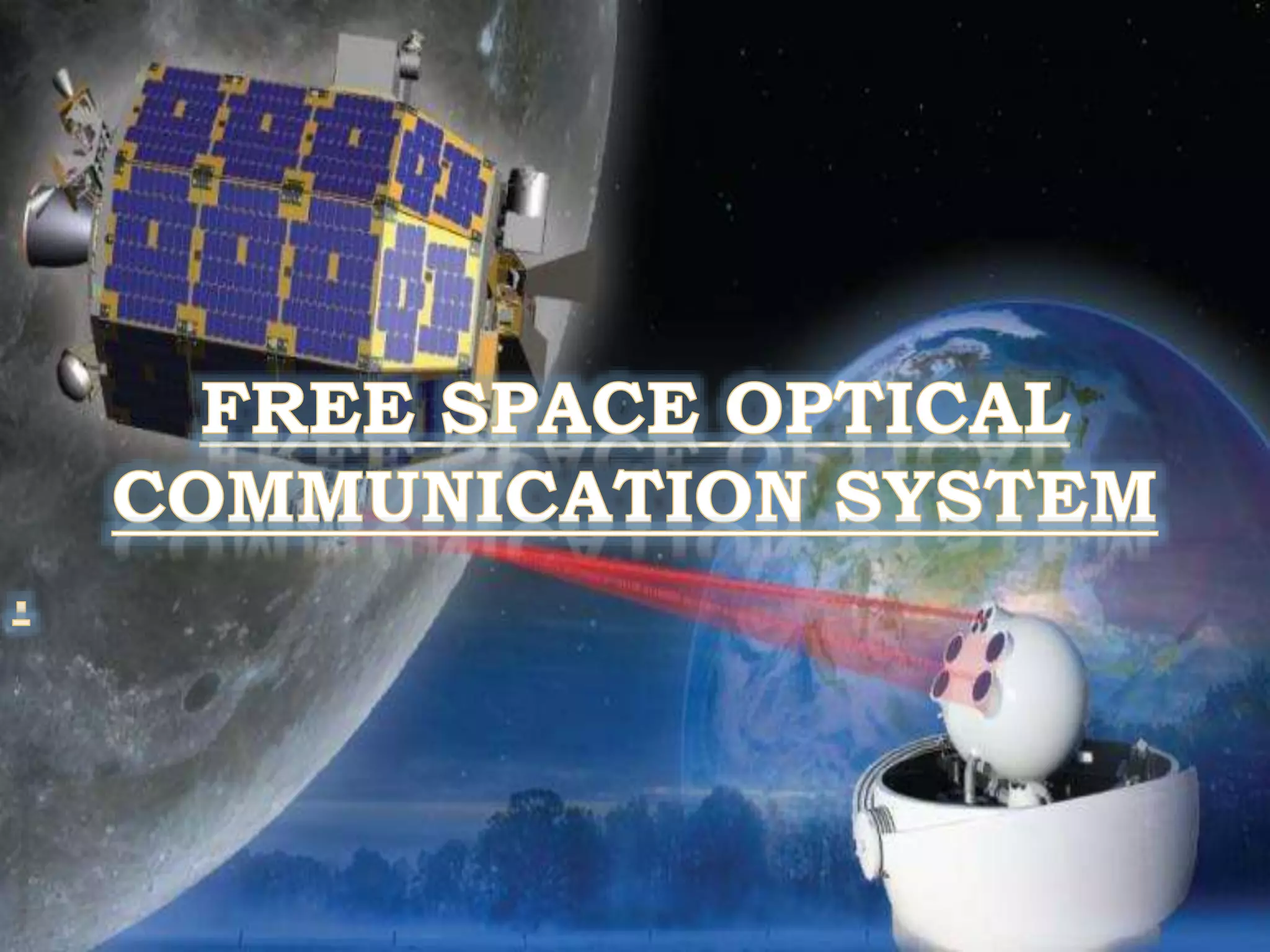
Free space optical communication system

  • 2.
    CONTENTS • Introduction • Principleof operation • Working • Literature Survey • Block diagram • Applications • Advantages • References
  • 3.
    INTRODUCTION • Free-space opticalcommunication (FSO) is an optical communication technology that uses light propagating in free space wirelessly transmit data for telecommunications. • FSO communication is one of the key area in wireless Communications. Due to its low noise ratio makes its one of the well suited communication medium for exchange of information. • FSO communications systems work similarly to fiber optic links, except the beam is transmitted through free space.
  • 4.
    FSO  Line-of-sight technology. Uses LASERS and Photo detectors.  Optical connections between two points—without the fiber.  Provide full duplex capability.
  • 5.
    HISTORY OF FREESPACE OPTICS • In the late nineteenth century, Alexander Graham Bell’s "photo-phone”. • Late 1950‘s~early 1960's, several scientists theorized and developed laser. • In the mid-1960's NASA initiated experiments to utilize the laser as a means of communication between the Goddard Space Flight Center and the Gemini-7 orbiting space capsule. • In the early 1980's United States and its military research. • Germany, France and Japan made significant advancements in free space optics for satellite communications.
  • 6.
  • 7.
    WORKING OF FSOCOMMUNICATION SYSTEM  FSO communication System comprises of mainly 2 sections - Transmitter section (optical transceiver with a laser) - Receiver section(Photo detector)  Transmitter section is used to transmit the data and sound signals, which comprised by microphone, modulator analog and laser diode to generate medium for transmission of signals.  Transmitter converts the signal into laser beam and transmit it in an straight line.  The receiver section is used to receive the laser beam, using solar Panel , which is incorporated with the data or sound signals from the transmitter to extract the data signals from the received laser beam and is given as a input to the speaker.
  • 8.
    WORKING MODEL Mic speaker Transmittercircuit LASER transmitter Receiver
  • 9.
    LITERATURE SURVEY • TheAim of this project is to design a communication system through Laser. • A laser diode at the transmitting end act as a transducer to convert the audio signal into laser form and transmitted, at the receiving end a laser transistor convert the laser data into digital form. • Here the motive of using Laser is that while the transmitter and receiver must require lineof-sight conditions, they have the benefit of eliminating the need for broadcast rights and buried cables. • Laser communications systems can be easily deployed since they are inexpensive, small, low power and do not require any radio interference studies.
  • 10.
    PROBLEM IDENTIFICATION • Signalattenuation in long distance transmission • Distortion due to interference • Half Duplex communication is achieved.
  • 11.
    OBJECTIVE • Our aimis to achieve following results • Minimal Signal attenuation in long distance transmission • Less Distortion due to interference. • Full Duplex communication .
  • 12.
    TOOLS USED • MULTISIM • CRO • Multimeter • Battery eliminator • Soldering iron • Printed circuit boards
  • 13.
    WHY NOT FIBEROPTICS? • Not always possible to lay fiber lines • Satellites • Combat zones • Physically / Economically not practical • Emergencies
  • 14.
    WHY NOT RF? Bandwidth  for Laser Communication (LC) is 100 times greater than for RF.  Power  in LC is directed at target, so much less transmission power required. Also the power loss is less.  Size / Weight  LC antenna is much smaller than RF.  Security  Due to low divergence of laser beam, LC is more secure than RF.
  • 15.
    CONCLUSION • If thelaser is properly aimed at the phototransistor as discussed in the mechanics section, the bit stream is received perfectly.
  • 16.
    ADVANTAGES OF FSOSYSTEMS • No licensing required. • Very low installation cost. • No sunk costs. • No capital overhangs. • Highly secure transmission possible.
  • 17.
    APPLICATIONS •Straight communication withsatellite from the earth. •Tactical Line Of Sight Optical Network (TLSON) uses high frequency laser to transmit data. •One to many communication.
  • 18.
    REFERENCES • Harvard BroadbandCommunictions Laboratory. • W. J. Perez H., J. Velasco Medina, D. Ravotto, E. Sanchez, M. SonzaReordaThe IEEE Workshop on Design and Diagnostics of Electronic Circuits and Systems, 2008. • International Conference on data warehousing and knowledge discovery,2003. • http//www.semiconductors.philips.com • A. Acampora, “Last Mile by Laser,” Scientific American, July 2002. • Vikrant, Anjesh Kumar& R.S. Jha, “Comparison of Underwater Laser Communication System with Underwater Acoustic Sensor Network” , International Journal of Scientific & Engineering Research, Vol. 3, Issue 10, October-2012.
  • 19.