Free Space Optical Communication
             (FSO)
 Supervised by:
      Prof. Magdy Ibrahim
 Prepared by:
      Ahmed Ashraf Abdel-Haseb
      Ahmed-Houssam Mahmoud
      Ahmed Magdy El-Sayed
      Amr Atef Hussein
      Mohamed Khaled Abo-Seif
Free Space Optical Communication
             (FSO)
 Supervised by:
      Prof. Magdy Ibrahim
 Prepared by:
      Ahmed Ashraf Abdel-Haseb
      Ahmed-Houssam Mahmoud
      Ahmed Magdy El-Sayed
      Amr Atef Hussein
      Mohamed Khaled Abo-Seif
Outlines
• Introduction [1]
• Free Space Optical Link Design [2]
• Applications [3]
• FSO vs. Fiber vs. Microwave Links
Outlines
• Introduction [1]
• Free Space Optical Link Design [2]
• Applications [3]
• FSO vs. Fiber vs. Microwave Links
Introduction
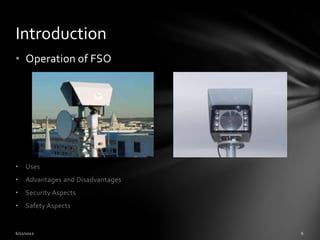
• Operation of FSO
• Uses
• Advantages and Disadvantages
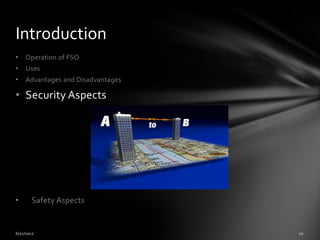
• Security Aspects
• Safety Aspects
Introduction
• Operation of FSO


•   Uses
•   Advantages and Disadvantages
•   Security Aspects
•   Safety Aspects
Introduction
•    Operation of FSO

• Uses
    • To cross a public road or other barriers which the sender and
      receiver do not own.

    • For communications between spacecraft.

    • Speedy service delivery of high-bandwidth access to optical
      fiber networks.


•    Advantages and Disadvantages
•    Security Aspects
•    Safety Aspects
Introduction
•   Operation of FSO
•   Uses

• Advantages and Disadvantages
     Advantages
     •   License-free operation.
     •   High bit rates.
     •   Low bit error rates.
     •   Immunity to electromagnetic interference.
     •   Security.
     •   Easiness and speed of installation.
•   Security Aspects
•   Safety Aspects
Introduction
•   Operation of FSO
•   Uses

• Advantages and Disadvantages
     Disadvantages
     •   Beam dispersion.
     •   Atmospheric absorption.
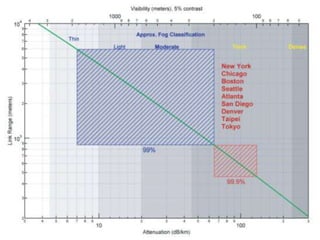
     •   Rain, Snow, Fog (10..~100 dB/km attenuation).
     •   Background light.
•   Security Aspects
•   Safety Aspects
Introduction
•   Operation of FSO
•   Uses
•   Advantages and Disadvantages

• Security Aspects


•    Safety Aspects
Introduction
•       Operation of FSO
•       Applications
•       Advantages and Disadvantages

•       Security Aspects

•        Safety Aspects
    •      Eye Damage
Outlines
• Introduction [1]
• Free Space Optical Link Design [2]
• Applications [3]
• FSO vs. Fiber vs. Microwave Links
Free Space Optical Link Design
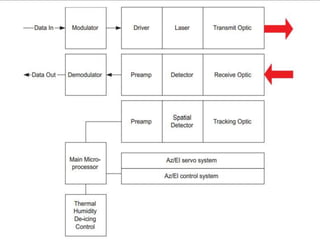
• FSO Subsystems
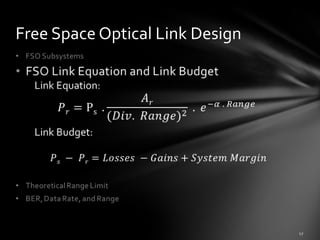
• FSO Link Equation and Link Budget
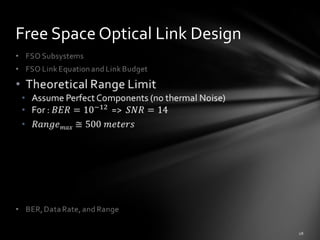
• Theoretical Range Limit
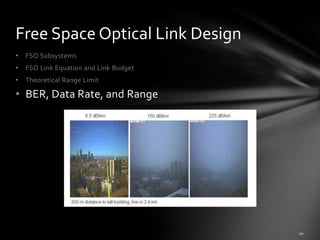
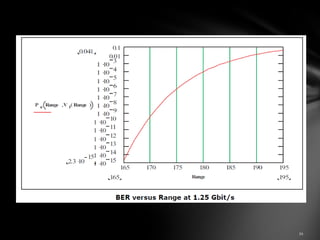
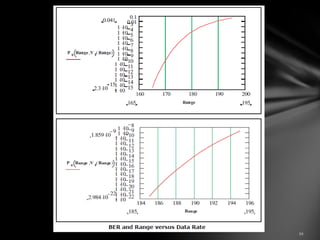
• BER, Data Rate, and Range
Free Space Optical Link Design
• FSO Subsystems
 1. Transmitter
 2. Receiver
 3. Tracking System


• FSO Link Equation and Link Budget
• Theoretical Range Limit
• BER, Data Rate, and Range
Free Space Optical Link Design
• FSO Subsystems
 1. Transmitter
 2. Receiver
 3. Tracking System
    • Requirements:
        Tracking Frequency, Resolution, Speed, … etc.

• FSO Link Equation and Link Budget
• Theoretical Range Limit
• BER, Data Rate, and Range
Free Space Optical Link Design
•   FSO Subsystems
•   FSO Link Equation and Link Budget
•   Theoretical Range Limit

• BER, Data Rate, and Range


.
Outlines
• Introduction [1]
• Free Space Optical Link Design [2]
• Applications [3]
• FSO vs. Fiber vs. Microwave Links
Applications
Free Space Optical Networks
• Point to Point FSO Systems
• Mesh FSO Systems
FSO on HAPs (Future Application)
Applications
Free Space Optical Networks
• Point to Point FSO Systems


•   Mesh FSO Systems
FSO on HAPs (Future Application)
Applications
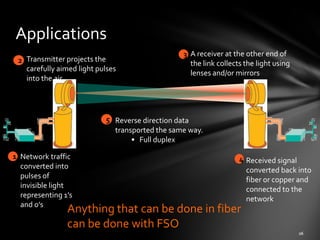
                                                3 A receiver at the other end of
 2 Transmitter projects the                       the link collects the light using
   carefully aimed light pulses
                                                  lenses and/or mirrors
   into the air


                           5 Reverse direction data
                             transported the same way.
                                  • Full duplex

1 Network traffic                                                 4 Received signal
  converted into                                                    converted back into
  pulses of                                                         fiber or copper and
  invisible light                                                   connected to the
  representing 1’s                                                  network
  and 0’s
                Anything that can be done in fiber
                can be done with FSO
Applications
Free Space Optical Networks
• Point to Point FSO Systems
    Disadvantages
    • Cannot connect more than 2 points

    • The points cannot have arbitrary distance between them

    • Has the poorest network and traffic protection


•   Mesh FSO Systems
FSO on HAPs (Future Application)
Applications
Free Space Optical Networks
• Ring FSO Systems

• Mesh FSO Systems


FSO on HAPs (Future Application)
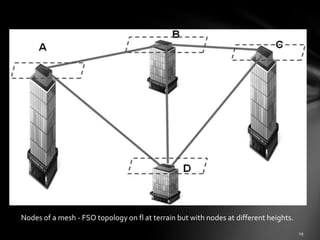
Nodes of a mesh - FSO topology on fl at terrain but with nodes at different heights.
Applications
Free Space Optical Networks
• Ring FSO Systems

• Mesh FSO Systems
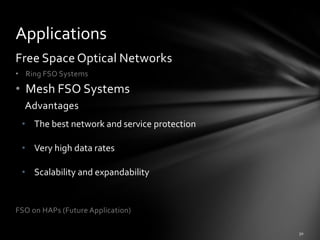
  Advantages
 • The best network and service protection

 • Very high data rates

 • Scalability and expandability


FSO on HAPs (Future Application)
Applications
Free Space Optical Networks
• Ring FSO Systems

• Mesh FSO Systems
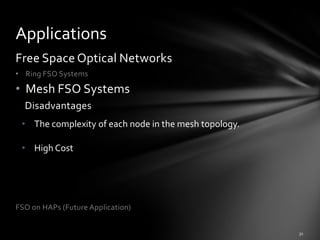
  Disadvantages
 • The complexity of each node in the mesh topology.

 • High Cost


FSO on HAPs (Future Application)
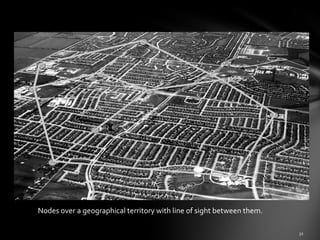
Nodes over a geographical territory with line of sight between them.
Applications
Free Space Optical Networks
•   Ring FSO Systems
•   Mesh FSO Systems

FSO on HAPs (Future Application)
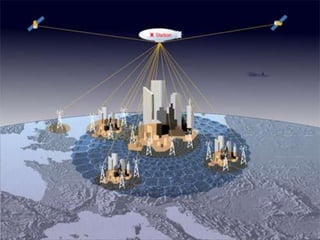
• Use on high altitude platforms (HAPs), (20 – 30 Km).
• Estimated Range: more than 600km.


•   .
Applications
Free Space Optical Networks
•    Ring FSO Systems
•    Mesh FSO Systems

FSO on HAPs (Future Application)
    Advantages:
         • Stratospheric Conditions.
          • Low attenuation, no cloud interference, low tempreture…etc.
         • Cost Effective (Compared to Satellites)
         • FSO Advantages
          • High Data rate, Low Power Consumption …etc.

•    .
Outlines
• Introduction [1]
• Free Space Optical Link Design [2]
• Applications [3]
• FSO vs. Fiber vs. Microwave Links
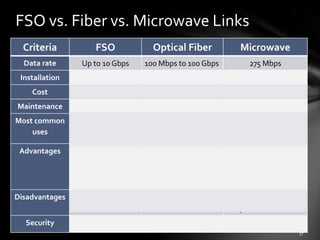
FSO vs. Fiber vs. Microwave Links
  Criteria           FSO              Optical Fiber            Microwave
  Data rate       Up to 10 Gbps     100 Mbps to 100 Gbps          275 Mbps
 Installation         Easy                Difficult               Moderate
    Cost           Moderate                 High                  Moderate
Maintenance           low                   High                     low
Most common     Between buildings      Point-to point          Point-to-point
    uses
                 Short distance        Long distance           Short distance
 Advantages           Price               Security                 speed
                  performance        capacity and speed
                   No license         Immunity to EMI
Disadvantages Can be intercepted      Difficult to splice    Can be intercepted
                                        determinate         Requires radio license
  Security         Moderate               Excellent                 Poor
References
[1] S.V. Kartalopoulos , “ Disaster Avoidance in the Manhattan
   Fiber Distributed Data Interface Network , ” Globecom ’
   93, Houston, TX, December 2, 1993 .
[2] Scott Bloom, “The Physics of Free Space Optics”, AirFiber, Inc.
[3] “Free-Space Optical Communications on
    HAPs”, www.hapcos.org , accessed on : 13-May-2012
Thanks

Free space optical communication

  • 1.
    Free Space OpticalCommunication (FSO) Supervised by: Prof. Magdy Ibrahim Prepared by: Ahmed Ashraf Abdel-Haseb Ahmed-Houssam Mahmoud Ahmed Magdy El-Sayed Amr Atef Hussein Mohamed Khaled Abo-Seif
  • 2.
    Free Space OpticalCommunication (FSO) Supervised by: Prof. Magdy Ibrahim Prepared by: Ahmed Ashraf Abdel-Haseb Ahmed-Houssam Mahmoud Ahmed Magdy El-Sayed Amr Atef Hussein Mohamed Khaled Abo-Seif
  • 3.
    Outlines • Introduction [1] •Free Space Optical Link Design [2] • Applications [3] • FSO vs. Fiber vs. Microwave Links
  • 4.
    Outlines • Introduction [1] •Free Space Optical Link Design [2] • Applications [3] • FSO vs. Fiber vs. Microwave Links
  • 5.
    Introduction • Operation ofFSO • Uses • Advantages and Disadvantages • Security Aspects • Safety Aspects
  • 6.
    Introduction • Operation ofFSO • Uses • Advantages and Disadvantages • Security Aspects • Safety Aspects
  • 7.
    Introduction • Operation of FSO • Uses • To cross a public road or other barriers which the sender and receiver do not own. • For communications between spacecraft. • Speedy service delivery of high-bandwidth access to optical fiber networks. • Advantages and Disadvantages • Security Aspects • Safety Aspects
  • 8.
    Introduction • Operation of FSO • Uses • Advantages and Disadvantages  Advantages • License-free operation. • High bit rates. • Low bit error rates. • Immunity to electromagnetic interference. • Security. • Easiness and speed of installation. • Security Aspects • Safety Aspects
  • 9.
    Introduction • Operation of FSO • Uses • Advantages and Disadvantages  Disadvantages • Beam dispersion. • Atmospheric absorption. • Rain, Snow, Fog (10..~100 dB/km attenuation). • Background light. • Security Aspects • Safety Aspects
  • 10.
    Introduction • Operation of FSO • Uses • Advantages and Disadvantages • Security Aspects • Safety Aspects
  • 11.
    Introduction • Operation of FSO • Applications • Advantages and Disadvantages • Security Aspects • Safety Aspects • Eye Damage
  • 12.
    Outlines • Introduction [1] •Free Space Optical Link Design [2] • Applications [3] • FSO vs. Fiber vs. Microwave Links
  • 13.
    Free Space OpticalLink Design • FSO Subsystems • FSO Link Equation and Link Budget • Theoretical Range Limit • BER, Data Rate, and Range
  • 14.
    Free Space OpticalLink Design • FSO Subsystems 1. Transmitter 2. Receiver 3. Tracking System • FSO Link Equation and Link Budget • Theoretical Range Limit • BER, Data Rate, and Range
  • 16.
    Free Space OpticalLink Design • FSO Subsystems 1. Transmitter 2. Receiver 3. Tracking System • Requirements: Tracking Frequency, Resolution, Speed, … etc. • FSO Link Equation and Link Budget • Theoretical Range Limit • BER, Data Rate, and Range
  • 17.
    Free Space OpticalLink Design
  • 18.
    Free Space OpticalLink Design
  • 20.
    Free Space OpticalLink Design • FSO Subsystems • FSO Link Equation and Link Budget • Theoretical Range Limit • BER, Data Rate, and Range .
  • 23.
    Outlines • Introduction [1] •Free Space Optical Link Design [2] • Applications [3] • FSO vs. Fiber vs. Microwave Links
  • 24.
    Applications Free Space OpticalNetworks • Point to Point FSO Systems • Mesh FSO Systems FSO on HAPs (Future Application)
  • 25.
    Applications Free Space OpticalNetworks • Point to Point FSO Systems • Mesh FSO Systems FSO on HAPs (Future Application)
  • 26.
    Applications 3 A receiver at the other end of 2 Transmitter projects the the link collects the light using carefully aimed light pulses lenses and/or mirrors into the air 5 Reverse direction data transported the same way. • Full duplex 1 Network traffic 4 Received signal converted into converted back into pulses of fiber or copper and invisible light connected to the representing 1’s network and 0’s Anything that can be done in fiber can be done with FSO
  • 27.
    Applications Free Space OpticalNetworks • Point to Point FSO Systems Disadvantages • Cannot connect more than 2 points • The points cannot have arbitrary distance between them • Has the poorest network and traffic protection • Mesh FSO Systems FSO on HAPs (Future Application)
  • 28.
    Applications Free Space OpticalNetworks • Ring FSO Systems • Mesh FSO Systems FSO on HAPs (Future Application)
  • 29.
    Nodes of amesh - FSO topology on fl at terrain but with nodes at different heights.
  • 30.
    Applications Free Space OpticalNetworks • Ring FSO Systems • Mesh FSO Systems Advantages • The best network and service protection • Very high data rates • Scalability and expandability FSO on HAPs (Future Application)
  • 31.
    Applications Free Space OpticalNetworks • Ring FSO Systems • Mesh FSO Systems Disadvantages • The complexity of each node in the mesh topology. • High Cost FSO on HAPs (Future Application)
  • 32.
    Nodes over ageographical territory with line of sight between them.
  • 33.
    Applications Free Space OpticalNetworks • Ring FSO Systems • Mesh FSO Systems FSO on HAPs (Future Application) • Use on high altitude platforms (HAPs), (20 – 30 Km). • Estimated Range: more than 600km. • .
  • 35.
    Applications Free Space OpticalNetworks • Ring FSO Systems • Mesh FSO Systems FSO on HAPs (Future Application) Advantages: • Stratospheric Conditions. • Low attenuation, no cloud interference, low tempreture…etc. • Cost Effective (Compared to Satellites) • FSO Advantages • High Data rate, Low Power Consumption …etc. • .
  • 36.
    Outlines • Introduction [1] •Free Space Optical Link Design [2] • Applications [3] • FSO vs. Fiber vs. Microwave Links
  • 37.
    FSO vs. Fibervs. Microwave Links Criteria FSO Optical Fiber Microwave Data rate Up to 10 Gbps 100 Mbps to 100 Gbps 275 Mbps Installation Easy Difficult Moderate Cost Moderate High Moderate Maintenance low High low Most common Between buildings Point-to point Point-to-point uses Short distance Long distance Short distance Advantages Price Security speed performance capacity and speed No license Immunity to EMI Disadvantages Can be intercepted Difficult to splice Can be intercepted determinate Requires radio license Security Moderate Excellent Poor
  • 38.
    References [1] S.V. Kartalopoulos, “ Disaster Avoidance in the Manhattan Fiber Distributed Data Interface Network , ” Globecom ’ 93, Houston, TX, December 2, 1993 . [2] Scott Bloom, “The Physics of Free Space Optics”, AirFiber, Inc. [3] “Free-Space Optical Communications on HAPs”, www.hapcos.org , accessed on : 13-May-2012
  • 39.