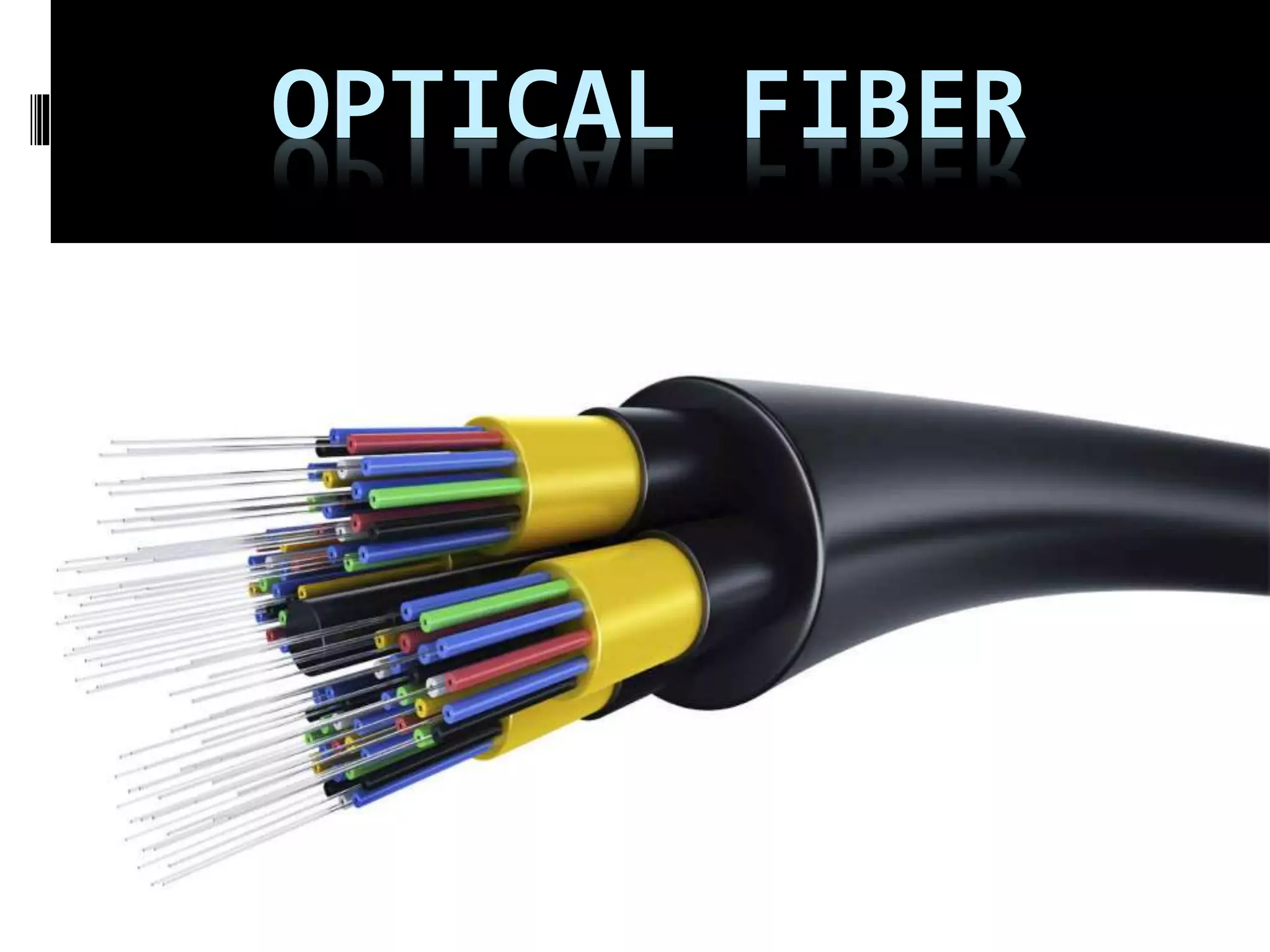


OPTICAL FIBER
What are the Optical Fiber?
Optical fiber refers to the medium and
the technology associated with the
transmission of information as light
impulses along a glass or plastic wire
or fiber.
Refraction of Optical Fiber
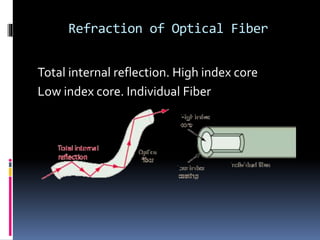
Total internal reflection. High index core
Low index core. Individual Fiber
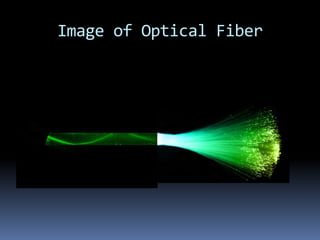
Image of Optical Fiber
Character statics of Optical Fiber
The relatively smaller cross section of Optic-
Fiber cables allows room for substantial
growth of the capacity in existing conduits.
Optic-Fiber characteristics can be classified
as linear and nonlinear. Nonlinear
characteristics are influenced by parameters,
such as bit rates, channel spacing, and power
levels.
Different Types of Optical Fiber
MainlyThreeTypes of Optical Fiber:
(a) Multimode (b) Single Mode (c) Photonics
 Multimode
1. Step Index
 Plastic and liquid
 Silica high purity
 Silica Doped
 Fluoride
 Incoherent and imaging bundles
 Tapered fibers
2. Gradient Index
 Single Mode
 Photonics
1. Silica cavity
2. Hollow cavity
Advantage of Optical Fiber
 Bandwidth: Optic-Fiber cables have a much greater bandwidth
than metal cables.The amount of information that can be
transmitted per unit time of fiber over other transmission media
is its most significant advantage.
 Low Power Loss: This allows for longer transmission
distances. In comparison to copper; in a network, the longest
recommended copper distance is 100m while with fiber, it is
2000m.
 Interference: Fiber optic cables are immune to electromagnetic
interference. It can also be run in electrically noisy environments
without concern as electrical noise will not affect fiber.
 Weight: Fiber optic cables are much thinner and lighter than
metal wires. Lighter weight makes fiber easier to install.
 Safety: Since the fiber is a dielectric, it does not present a spark
hazard.
Disadvantages of Optical Fiber
 Cost: Cables are expensive to install but last
longer than copper cables.
 Transmission: transmission on optical fiber
requires repeating at distance intervals.
 Fragile: Fibers can be broken or have
transmission loses when wrapped around
curves of only a few centimeters radius.
 Protection: Optical fibers require more
protection around the cable compared to
copper.
Application of Optical Fiber
Applications: Networking, Gigabit,
Ethernet, Harsh Environment, Military,
Aerospace & Avionics, Unmanned
Aerial,Vehicles, Data Storage
Equipment, Simulation, Broadcast, and
more...
Have You Any Questions
Any Question
Thanks To All
ThanksTo All

Optical fiber

  • 1.
  • 2.
    What are theOptical Fiber? Optical fiber refers to the medium and the technology associated with the transmission of information as light impulses along a glass or plastic wire or fiber.
  • 3.
    Refraction of OpticalFiber Total internal reflection. High index core Low index core. Individual Fiber
  • 4.
  • 5.
    Character statics ofOptical Fiber The relatively smaller cross section of Optic- Fiber cables allows room for substantial growth of the capacity in existing conduits. Optic-Fiber characteristics can be classified as linear and nonlinear. Nonlinear characteristics are influenced by parameters, such as bit rates, channel spacing, and power levels.
  • 6.
    Different Types ofOptical Fiber MainlyThreeTypes of Optical Fiber: (a) Multimode (b) Single Mode (c) Photonics  Multimode 1. Step Index  Plastic and liquid  Silica high purity  Silica Doped  Fluoride  Incoherent and imaging bundles  Tapered fibers 2. Gradient Index  Single Mode  Photonics 1. Silica cavity 2. Hollow cavity
  • 7.
    Advantage of OpticalFiber  Bandwidth: Optic-Fiber cables have a much greater bandwidth than metal cables.The amount of information that can be transmitted per unit time of fiber over other transmission media is its most significant advantage.  Low Power Loss: This allows for longer transmission distances. In comparison to copper; in a network, the longest recommended copper distance is 100m while with fiber, it is 2000m.  Interference: Fiber optic cables are immune to electromagnetic interference. It can also be run in electrically noisy environments without concern as electrical noise will not affect fiber.  Weight: Fiber optic cables are much thinner and lighter than metal wires. Lighter weight makes fiber easier to install.  Safety: Since the fiber is a dielectric, it does not present a spark hazard.
  • 8.
    Disadvantages of OpticalFiber  Cost: Cables are expensive to install but last longer than copper cables.  Transmission: transmission on optical fiber requires repeating at distance intervals.  Fragile: Fibers can be broken or have transmission loses when wrapped around curves of only a few centimeters radius.  Protection: Optical fibers require more protection around the cable compared to copper.
  • 9.
    Application of OpticalFiber Applications: Networking, Gigabit, Ethernet, Harsh Environment, Military, Aerospace & Avionics, Unmanned Aerial,Vehicles, Data Storage Equipment, Simulation, Broadcast, and more...
  • 10.
    Have You AnyQuestions Any Question
  • 11.