1
Abstract
Free space optics ( FSO ) is a line-of-sight technology that
currently enables optical transmission up to 2.5 Gbps of data, voice,
and video communications through the air , allowing optical
connectivity without deploying fiber optic cables or securing
spectrum licenses. FSO system can carry full duplex data at giga
bits per second rates over Metropolitan distances of a few city
blocks of few kms. FSO, also known as optical wireless, overcomes
this last-mile access bottleneck by sending high –bitrate signals
through the air using laser transmission .
Free Space Optics (FSO) or Optical Wireless, refers to the
transmission of modulated visible or infrared (IR) beams through the
air to obtain optical communications. Like fiber, Free Space Optics
(FSO) uses lasers to transmit data, but instead of enclosing the data
stream in a glass fiber, it is transmitted through the air. It is a secure,
cost-effective alternative to other wireless connectivity options. This
form of delivering communication has a lot of compelling
advantages.
Data rates comparable to fiber transmission can be carried with very
low error rates, while the extremely narrow laser beam widths ensure
that it is possible to co-locate multiple tranceivers without risk of
mutual interference in a given location. FSO has roles to play as
primary access madium and backup technology. Though this
technology sprang into being, its applications are wide and many. It
indeed is the technology of the future...
(2)
ACKNOWLEDGEMENT
It is very common to see that a person quest for knowledge never
ends. Theory and Practical are essential and complimentary to each
other. I am indebted and thankful to various person who have helped me
in the preparation of seminar. I am highly obliged to Mr. Amitabh Maurya
for his guidance and support throughout the semester and for his help
in the seminar report and presentation. He guided me in every problem
I came across while preparing the seminar. He was instrumental in helping
me expand my horizon and learn more.I would like to thank punit sir for his
supervision on my work and I would nat seem to possible without his
guidance . I would like to thank other faculty members of Computer
Science and Engineering Department and all the staff who directly or
indirectly offered their help and Co-operated to make my effort successful.
Thank You.
Sangam kumar mehta
1222910055
(3)
List of Figures
S .NO. Figure Description Page No.
1 Fig 2.1 : First photophone 9
2 Fig 2.2 : HeNe laser tube 9
3 Fig 2.3 : Lightphone 10
4 Fig 3.1 :Fso internal structure 12
5 Fig 4.1 : FSO block diagram 13
6 Fig 4.2 : Energy level 13
7 Fig 4.3 : ckt. Diagarm of detector 14
8 Fig 4.4 : incident laser beam 16
9 Fig 4.5 : transmission VS. wave-length 18
(4)
List of abbreviations
Term Meaning
FSO Free space optics
ROI Return on investment
CAD Computer aided design
GBPS Gigabits per second
WDM Wavelength division multiplexing
RF Radio frequency
TDM Time division multiplexing
MBPS Megabits per second
PPT Push to talk
MAN Metro area network
LAN Local area network
WAN Wide area network
(5)
Contents:
Chapters page no.
ABSTRACT ...…………………………………………………..1
ACKNOWLEDGEMENT ..……………………………………..2
LIST OF FIGURES ……………………………………………..3
LIST OF ABBREVIATION ……………………………………4
Chapter 1: introduction ………………………………………...7
Chapter 2: History of free space optics ……………………….. 8
Chapter 3: How free optics work ………………………………11
Chapter 4: Method of operation …………………..………….. 12
4.1 : Laser ……………………………………………...……...12
4.2 : Photon detector receiver …………………………...…….13
4.2.1 : Detector technology ………………………......…....14
4.2.2 : Receiver design technology ………………..……...15
4.2.3 : Scattering …………………………………..……....16
4.2.4 : Optical transmission ………………………..………16
Chapter 5: FSO communication network …………..……...….18
5.1 : Enterprise …………………………………..……...…….18
5.2 : mobile carrier backhul ……………………..…...……….18
5.3 : mobile carrier base station “hosteling ……...……………19
Chapter 6 :Terrestrial laser communications challengs...…....20
6.1 : Fog …………………………………………………..….20
6.2 : physical obstruction …..…………………..………...….20
6.3 : Pointing stability …………………...………………...…20
(6)
6.4 : Scintillation ….……………………………………...….21
Chapter 7 : Wireless at the speed of light …..…….…….....….22
Chapter 8 : Broadband bandwidth alternative .…….…...……23
Chapter 9: FSO security ……………………...……..…..………24
Chapter 10: How FSO can help you ? ………………..………..25
Chapter 11: The market why FSO ………..……….….………..26
Chapter 12: Advantage of FSO ………….…………….………27
Chapter 13: FSO application ……………..…………….………30
Chapter 14: Conclusion ………………......…………….………31
REFERNCE:
1. INTRODUCTION
(7)
Free-space optical communication (FSO) systems (in space and
inside the atmosphere) have developed in response to a growing need
for high-speed and tap-proof communication systems. Links
involving satellites, deep-space probes, ground stations, unmanned
aerial vehicles (UAVs), high altitude platforms (HAPs), aircraft, and
other nomadic communication partners are of practical interest.
Moreover, all links can be used in both military and civilian contexts.
FSO is the next frontier for net-centric connectivity, as bandwidth,
spectrum and security issues favor its adoption as an adjunct to radio
frequency (RF) communications.
While fixed FSO links between buildings have long been established
and today form a separate commercial product segment in local and
metropolitan area networks. the mobile and long-range applications
of this technology are aggravated by extreme requirements for
pointing and tracking accuracy because of the small optical beam
divergences involved.
2. HISTORY OF FREE SPACE OPTICS
(8)
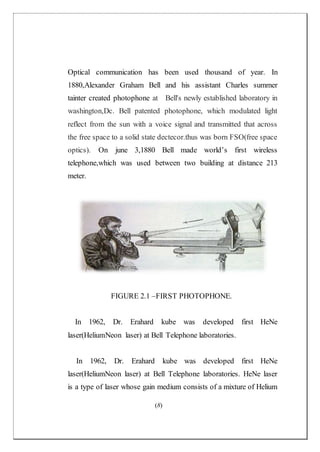
Optical communication has been used thousand of year. In
1880,Alexander Graham Bell and his assistant Charles summer
tainter created photophone at Bell's newly established laboratory in
washington,Dc. Bell patented photophone, which modulated light
reflect from the sun with a voice signal and transmitted that across
the free space to a solid state dectecor.thus was born FSO(free space
optics). On june 3,1880 Bell made world’s first wireless
telephone,which was used between two building at distance 213
meter.
FIGURE 2.1 –FIRST PHOTOPHONE.
In 1962, Dr. Erahard kube was developed first HeNe
laser(HeliumNeon laser) at Bell Telephone laboratories.
In 1962, Dr. Erahard kube was developed first HeNe
laser(HeliumNeon laser) at Bell Telephone laboratories. HeNe laser
is a type of laser whose gain medium consists of a mixture of Helium
(9)
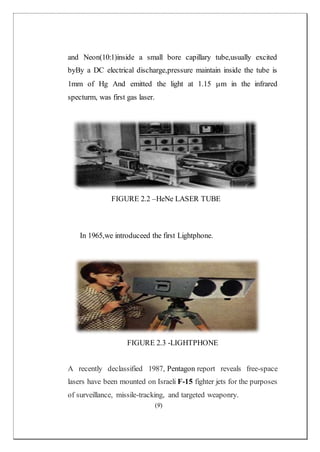
and Neon(10:1)inside a small bore capillary tube,usually excited
byBy a DC electrical discharge,pressure maintain inside the tube is
1mm of Hg And emitted the light at 1.15 m in the infrared
specturm, was first gas laser.
FIGURE 2.2 –HeNe LASER TUBE
In 1965,we introduceed the first Lightphone.
FIGURE 2.3 -LIGHTPHONE
A recently declassified 1987, Pentagon report reveals free-space
lasers have been mounted on Israeli F-15 fighter jets for the purposes
of surveillance, missile-tracking, and targeted weaponry.
(10)
2. HOW FREE SPACE OPTICS WORK.
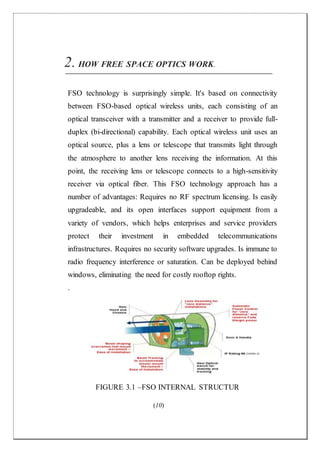
FSO technology is surprisingly simple. It's based on connectivity
between FSO-based optical wireless units, each consisting of an
optical transceiver with a transmitter and a receiver to provide full-
duplex (bi-directional) capability. Each optical wireless unit uses an
optical source, plus a lens or telescope that transmits light through
the atmosphere to another lens receiving the information. At this
point, the receiving lens or telescope connects to a high-sensitivity
receiver via optical fiber. This FSO technology approach has a
number of advantages: Requires no RF spectrum licensing. Is easily
upgradeable, and its open interfaces support equipment from a
variety of vendors, which helps enterprises and service providers
protect their investment in embedded telecommunications
infrastructures. Requires no security software upgrades. Is immune to
radio frequency interference or saturation. Can be deployed behind
windows, eliminating the need for costly rooftop rights.
.
FIGURE 3.1 –FSO INTERNAL STRUCTUR
(11)
4.METHOD OF OPERATION .
FSO systems operate very much like a fiber optic connection using a
cable. Themain difference being the attenuation in a cable is known
and controllable, whereasin a FSO link that uses the atmosphere as
the media, the exact attenuation of the link can vary by the second
and is unknowable. To make this type of system work a device
known as a laser diode , photon detector reciver, digital data.
FIGURE 4.1 – FSO BLOCK DIAGRAM
4.1 LASAER
Laser is the most significant inventions of the 20th century. The
word laser is actually an acronym for Light Amplification by
Stimulated Emission of Radiation. Another acronym, this time for
Microwave Amplification by Stimulated Emission of Radiation. A
laser is very similar to a laser except the photons generated by a laser
(12)
are of a longer wavelength outside the visible and/ or infrared
spectrum.
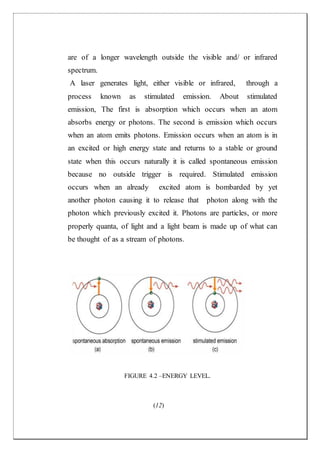
A laser generates light, either visible or infrared, through a
process known as stimulated emission. About stimulated
emission, The first is absorption which occurs when an atom
absorbs energy or photons. The second is emission which occurs
when an atom emits photons. Emission occurs when an atom is in
an excited or high energy state and returns to a stable or ground
state when this occurs naturally it is called spontaneous emission
because no outside trigger is required. Stimulated emission
occurs when an already excited atom is bombarded by yet
another photon causing it to release that photon along with the
photon which previously excited it. Photons are particles, or more
properly quanta, of light and a light beam is made up of what can
be thought of as a stream of photons.
FIGURE 4.2 –ENERGY LEVEL.
(13)
4.2 PHOTON DETECTOR RECEIVER:-
Object that emit light,heat,or other electromagnetic energy are
actually producing photons and therefore can potentially be
measured using an optical reciver. Any temperature greater than the
absolute zero emits photons . photon are massless partical with the
intriguing characteristic that they also exhibits wave like properties.
The of photon is inversialy proportional to to the energy it contains.
Optical remote sensing involves detecting object based on their
characteristic electromagnetic radiation emission or reflection.
Photon detector receiver is explained by following technologies
4.2.1 DETECTOR TECHNONLOGY
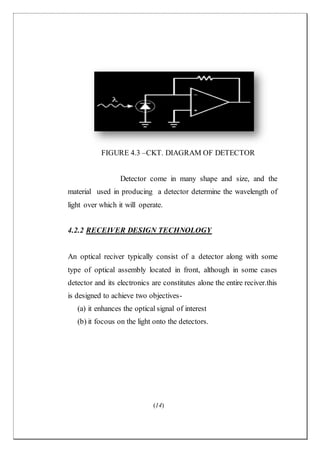
An optical detector is a device that produce a electric signal when
photons are incident on its active rate. The electric signal is
proportional to the intensity of the incident light since the electrical
signals produce by detector are typically very small, they are
amplified electronically to bring them into a meauserable range.
(14)
FIGURE 4.3 –CKT. DIAGRAM OF DETECTOR
Detector come in many shape and size, and the
material used in producing a detector determine the wavelength of
light over which it will operate.
4.2.2 RECEIVER DESIGN TECHNOLOGY
An optical reciver typically consist of a detector along with some
type of optical assembly located in front, although in some cases
detector and its electronics are constitutes alone the entire reciver.this
is designed to achieve two objectives-
(a) it enhances the optical signal of interest
(b) it focous on the light onto the detectors.
(15)
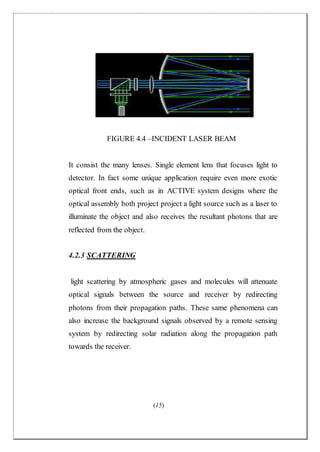
FIGURE 4.4 –INCIDENT LASER BEAM
It consist the many lenses. Single element lens that focuses light to
detector. In fact some unique application require even more exotic
optical front ends, such as in ACTIVE system designs where the
optical assembly both project project a light source such as a laser to
illuminate the object and also receives the resultant photons that are
reflected from the object.
4.2.3 SCATTERING
light scattering by atmospheric gases and molecules will attenuate
optical signals between the source and receiver by redirecting
photons from their propagation paths. These same phenomena can
also increase the background signals observed by a remote sensing
system by redirecting solar radiation along the propagation path
towards the receiver.
(16)
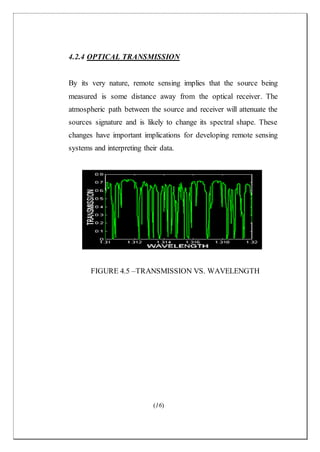
4.2.4 OPTICAL TRANSMISSION
By its very nature, remote sensing implies that the source being
measured is some distance away from the optical receiver. The
atmospheric path between the source and receiver will attenuate the
sources signature and is likely to change its spectral shape. These
changes have important implications for developing remote sensing
systems and interpreting their data.
FIGURE 4.5 –TRANSMISSION VS. WAVELENGTH
(17)
5.FREE SAPCE TECHNOLOGY COMMUNICATION
NETWORK
Free-space optics technology (FSO) has several applications in
communications networks, where a connectivity gap exists between
two or more points. FSO technology delivers cost-effective optical
wireless connectivity and a faster return on investment (ROI) for
Enterprises and Mobile Carriers. With the ever-increasing demand
for greater bandwidth by Enterprise and Mobile Carrier subscribers
comes a critical need for FSO-based products for a balance of
throughput, distance and availability. Due to some for private
network uses, FSO product have grown
5.1 Enterprise
Because of the scalability and flexibility of FSO technology, optical
wireless products can be deployed in many enterprise applications
including building-to-building connectivity, disaster recovery,
network redundancy and temporary connectivity for applications
such as data, voice and data, video services, medical imaging, CAD
and engineering services, and fixed-line carrier bypass.
5.2 Mobile carrier backhul
(18)
In a hierarchical telecommunication network the backhaul portion
of the network comprises the intermediate links between the core
network or backbone network and the small subnetworks at the
"edge" of the entire hierarchical network.
5.3 Mobile Carrier Base Station “Hoteling”
Next-generation mobile network operators are looking for ways help
reduce cost, simplify networks and share resources. Base Station
Hoteling as a network architecture enables wireless carrier networks
to aggregate their headend gear in a central location, allowing for
more cost effective deployment and sharing of resources for reduce
operational costs. ZeneFi network to present on base station
“hotelling”. ZenFi’s purpose-built fronthaul and backhaul network to
distributed base stations is a key component in the movement
towards Centralized-RAN (C-RAN) as carriers look towards on-
demand resource allocation, virtualized software, definable and
tunable architecture, and lower cost general purpose hardware.
(19)
6.TERRESTRIAL LASER COMMUNICATIONS
CHALLENGS
6.1 FOG
Fog substantially attenuates visible radiation, and it has a similar
affect on the near-infrared wavelengths that are employed in laser
communications. Similar to the case of rain attenuation with RF
wireless, fog attenuation is not a “show-stopper” for optical wireless,
because the optical link can be engineered such that, for a large
fraction of the time, an acceptable power will be received even in the
presence of heavy fog.
6.2 PHYSICAL OBSTRUCTIONS
Laser communications systems that employ multiple, spatially
diverse transmitters and large receive optics will eliminate
interference concerns from objects such as birds.
6.3 POINTING STABILLITY
Pointing stability in commercial laser communications systems is
achieved by one of two methods. The simpler, less costly method is
to widen the beam divergence so that if either end of the link moves
the receiver will still be within the beam. The second method is to
employ a beam tracking system. While more costly, such systems
(20)
allow for a tighter beam to be transmitted allowing for higher
security and longer distance transmissions.
6.4 SCINTILLATION
Performance of many laser communications systems is adversely
affected by scintillation on bright sunny days. Through a large
aperture receiver, widely spaced transmitters, finely tuned receive
filtering, and automatic gain control, downtime due to scintillation
can be avoided.
(21)
7.FSO :WIRELESS AT THE SPEED OF LIGHT
Optical wireless, based on FSO-technology, is an outdoor wireless
product category that provides the speed of fiber, with the flexibility
of wireless. It enables optical transmission at speeds of up to 1.25
Gbps and, in the future, is capable of speeds of 10 Gbps using
WDM.This is not possible with any fixed wireless or RF technology.
Optical wireless also eliminates the need to buy expensive spectrum
(it requires no municipal license approvals worldwide), which
further distinguishes it from fixed wireless technologies. Moreover,
FSO technology’s narrow beam transmission is typically two meters
versus 20 meters and more for traditional, even newer radio-based
technologies such as millimeter-wave radio. Optical wireless
products' similarities with conventional wired optical solutions
enable the seamless integration of access networks with optical core
networks and helps to realize the vision of an all-optical network.
(22)
8.BROADBAND BANDWIDTH ALTERNATIVE.
Access technologies in general use today include telco-provisioned
copper wire, wireless Internet access, broadband RF/microwave,
coaxial cable and direct optical fiber connections (fiber to the
building; fiber to the home). Telco/PTT telephone networks are still
trapped in the old Time Division Multiplex (TDM) based network
infrastructure that rations bandwidth to the customer in increments of
1.5 Mbps (T-1) or 2.024 Mbps (E-1). DSL penetration rates have
been throttled by slow deployment and the pricing strategies of the
PTTs. Cable modem access has had more success in residential
markets, but suffers from security and capacity problems, and is
generally conditional on the user subscribing to a package of cable
TV channels. Wireless Internet access is still slow, and the tiny
screen renders it of little appeal for web browsing.
Broadband RF/microwave systems have severe limitations and are
losing favor. The radio spectrum is a scarce and expensive licensed
commodity, sold or leased to the highest bidder, or on a first-come
first-served basis, and all too often, simply unavailable due to
congestion. As building owners have realized the value of their roof
space, the price of roof rights has risen sharply. Furthermore, radio
equipment is not inexpensive, the maximum data rates achievable
with RF systems are low compared to optical fiber, and
communications channels are insecure and subject to interference
from and to other systems (a major constraint on the use of radio
systems).
(23)
9. FREE SPACE OPTICS (FSO) SECURITY
Security issues of free-space optical (FSO) communications are
discussed. Based on a subcarrier intensity-modulated air-to-
ground FSO system model, we first analyze the coherence time of
the air-to-ground FSO link and show that under practical
assumptions, scintillation reciprocity holds in the FSO
communication system. A private secret-key-based cryptosystem
with key management is introduced to enhance FSO security, and
a key agreement approach is proposed based on statistics of the
random atmospheric-turbulence-induced fading channel
measurements. The secret key rate of the key agreement scheme
is investigated for the gamma-gamma turbulence model. Practical
key agreement protocols based on bidirectional channel
identification are designed for different FSO communication
scenarios. Our numerical results reveal that the key rate is not
sensitive to the strength of the atmospheric turbulence; the per-
symbol signal-to-noise ratio and the training sequence length are
the dominating factors.
(24)
10.HOW FREE SPACE OPTICS (FSO) CAN HELP YOU
FSO’s freedom from licensing and regulation translates into ease,
speed and low cost of deployment. Since Free Space Optics (FSO)
transceivers can transmit and receive through windows, it is possible
to mount Free Space Optics (FSO) systems inside buildings,
reducing the need to compete for roof space, simplifying wiring and
cabling, and permitting Free Space Optics (FSO) equipment to
operate in a very favorable environment. The only essential
requirement for Free Space Optics (FSO) or optical wireless
transmission is line of sight between the two ends of the link.
For Metro Area Network (MAN) providers the last mile or even feet
can be the most daunting. Free Space Optics (FSO) networks can
close this gap and allow new customers access to high-speed MAN’s.
Providers also can take advantage of the reduced risk of installing an
Free Space Optics (FSO) network which can later be redeployed.
(25)
11.THE MARKET. WHY FREE SPACE OPTICS(FSO)
The global telecommunications network has seen massive expansion
over the last few years. First came the tremendous growth of the
optical fiber long-haul, wide-area network (WAN), followed by a
more recent emphasis on metropolitan area networks (MANs).
Meanwhile, local area networks (LANs) and gigabit ethernet ports
are being deployed with a comparable growth rate. In order for this
tremendous network capacity to be exploited, and for the users to be
able to utilize the broad array of new services becoming available,
network designers must provide a flexible and cost-effective means
for the users to access the telecommunications network. Presently,
however, most local loop network connections are limited to 1.5
Mbps (a T1 line). As a consequence, there is a strong need for a
high-bandwidth bridge (the “last mile” or “first mile”) between the
LANs and the MANs or WANs.
Free Space Optics (FSO) systems represent one of
the most promising approaches for addressing the emerging
broadband access market and its “last mile” bottleneck. Free Space
Optics (FSO) systems offer many features, principal among them
being low start-up and operational costs, rapid deployment, and high
fiber-like bandwidths due to the optical nature of the technology.
(26)
12.ADVANTAGE OF FREE SPACE OPTICS(FSO)
I. Ultrahigh wireless banswidth:-these system provides a full
Gigabit Ethernet interface link while accepting fiber
input/output pairs. The LaserFire system is not limited to a
particular bandwidth, and provides Gigabit Ethernet in
standard installations with variability depending on the
application.
II. Cut the cost of wasted time:- Lots of time and money can be
lost during the laying of fiber, days or even weeks of valuable
time spent digging and burying pounds of fiber optic cables
with heavy duty equipment, all while having to consider
difficult obstacles. With LaserFire, a 5 km line of
communication can be up and running in just one or two
hours.
III. Long distance realy:- Other FSO systems are generally
incapable of opperating over around 1 kilometer, and the one's
that have higher distances are still in the mid Mbps's. One
LaserFire link is currently able to opperate over 5 km with
Gbps speeds and if longer distances are needed, the system
iseasily relayed from one transciever to another for long
distance and non-line-of-sight applications. With future
development the posibilities are endless.
IV. Push button acquisition:- Other free space optics terminals
have to be carefully aligned with telescopes to establish a link
and require frequent servicing for beam realignment. Due to a
(27)
patented automatic Tracking, Acquisition, and Pointing
technique, the LaserFire system requires less than 15 minutes
for initial acquisition and instantaneously for repeated
acquisition.
V. Uninterupted wireless communication:- The LaserFire
system is ideal for building-to-building, tower-to-tower, or
stable vehicle-to-vehicle communications where high capacity
fiber optic cable is not advisable. As said before, this system is
very quick and easy to deploy and withdraw. The data
transmission is not affected by, nor does it interfere with RF
transmissions and can be deployed in RF-denied
environments.
VI. Automatic tracking for reliable linking:- Other FSO
solutions are stationary links between two rigidly mounted
terminals. Any change in position, whether from the building
swaying, seasonal, or temperature induced expansion and
contraction, will cause the link to lose alignment and will
eventually lose the connection entirely. The proprietary beam
steering technique at the heart of the LaserFire communication
systemcontinually realigning itself and operates within a 30°
diameter to maintain an optimal link between the units.
VII. Low total cost of ownership:- these system is sold, it can be
deployed and redeployed as the customer deems fit. The
customer owns the hardware and can move it, resell it, or even
rent it to others as the need arises. It can be moved around,
resold, rented to others, etc. The LaserFire system is compact
(28)
and only consumes approximately 50 Watts of power for a low
total cost of ownership.
VIII. Secure wireless communication:- Competing FSO solutions
use a large beam size to account for small shifts in the building
to maintain their links. This large beam size introduces a
security risk because anyone that has a similar terminal can
intercept the beam in such a way that the original link is still
connected. The LaserFire FSO system uses a small, highly
collimated beam that is approximately the size of the terminal,
along with a graphical user interface (GUI) to assure and
assess connection between terminals. If any part of the beam is
intercepted, the LaserFire system registers the loss in power
and automatically discontinues the beam. Additional security
is provided due to the fact that the LaserFire terminals use
infrared lasers and it is impossible to know where the beam is
at all times.
IX. Multi-protocol compatiable:- The only requirement for the
LaserFire system is an optical source. Any network hardware
that has a fiber output, regardless of protocol, can be used with
the LaserFire system. Further, Space Photonics also provides
an intellegent gatewayto invisibly between protocols for
reliable data transmission.
X. Environmentally friendly:- Using FSO free space optics
allows for quick point to point information transfer without the
need for tearing up dirt or trees while burying fiber optics.
FSO also uses less power than your standard home appliance.
(29)
13.FREE SPACE OPTICS (FSO) APPLICATION
 Metro network extensions:- FSO is used to extend existing
metropolitan area fiberings to connect new networks from
outside.
 Last mile access:- FSO can be used in high-speed links to
connect end users with ISPs.
 Enterprise connectivity:- The ease in which FSO can be
installed makes them a solution for interconnecting LAN
segments, housed in buildings separated by public streets.
 Fiber backup:- FSO may be deployed in redundant links to
backup fiber in place of a second fiber link.
 Backhaul:- Used to carry cellular telephone traffic from
antenna towers back to facilities into the public switched
telephone networks.
(30)
14. CONCLUSION
FSO enables optical transmission of voice video and data through air
at very high rates. It has key roles to play as primary access medium
and backup technology. Driven by the need for high speed local loop
connectivity and the cost and the difficulties of deploying fiber, the
interest in FSO has certainly picked up dramatically among service
providers world- wide . Instead of fiber coaxial systems, fiber laser
systems may turn out to be the best way to deliver high data rates to
your home. FSO continues to accelerate the vision of all optical
networks cost effectively, reliably and quickly with freedom and
flexibility of deployment.
(31)
REFERENCES
1. http://en.wikipedia.org/wiki/Freespace_optical_comm
unication.
2. http://www.laseroptronics.com/index.cfm
3. https://www.scribd.com/doc/56143270/Free-space-
optics-A-technical-seminar-report
4. http://www.lightpointe.com/freespaceoptics.html
5. http://laseritc.ru/files/files/MRV-WP-
FSOAtmosProp.pdf
6. http://web.archive.org/web/20070613000248/http://w
ww.hqisec.army.mil/isec/publications/Analysis_of_Fre
e_Space_Optics_as_a_Transmission_Technology_Mar
05.pdf
(32)
(33)

FIBER SPACE OPTICS

  • 1.
    1 Abstract Free space optics( FSO ) is a line-of-sight technology that currently enables optical transmission up to 2.5 Gbps of data, voice, and video communications through the air , allowing optical connectivity without deploying fiber optic cables or securing spectrum licenses. FSO system can carry full duplex data at giga bits per second rates over Metropolitan distances of a few city blocks of few kms. FSO, also known as optical wireless, overcomes this last-mile access bottleneck by sending high –bitrate signals through the air using laser transmission . Free Space Optics (FSO) or Optical Wireless, refers to the transmission of modulated visible or infrared (IR) beams through the air to obtain optical communications. Like fiber, Free Space Optics (FSO) uses lasers to transmit data, but instead of enclosing the data stream in a glass fiber, it is transmitted through the air. It is a secure, cost-effective alternative to other wireless connectivity options. This form of delivering communication has a lot of compelling advantages. Data rates comparable to fiber transmission can be carried with very low error rates, while the extremely narrow laser beam widths ensure that it is possible to co-locate multiple tranceivers without risk of mutual interference in a given location. FSO has roles to play as primary access madium and backup technology. Though this technology sprang into being, its applications are wide and many. It indeed is the technology of the future...
  • 2.
    (2) ACKNOWLEDGEMENT It is verycommon to see that a person quest for knowledge never ends. Theory and Practical are essential and complimentary to each other. I am indebted and thankful to various person who have helped me in the preparation of seminar. I am highly obliged to Mr. Amitabh Maurya for his guidance and support throughout the semester and for his help in the seminar report and presentation. He guided me in every problem I came across while preparing the seminar. He was instrumental in helping me expand my horizon and learn more.I would like to thank punit sir for his supervision on my work and I would nat seem to possible without his guidance . I would like to thank other faculty members of Computer Science and Engineering Department and all the staff who directly or indirectly offered their help and Co-operated to make my effort successful. Thank You. Sangam kumar mehta 1222910055
  • 3.
    (3) List of Figures S.NO. Figure Description Page No. 1 Fig 2.1 : First photophone 9 2 Fig 2.2 : HeNe laser tube 9 3 Fig 2.3 : Lightphone 10 4 Fig 3.1 :Fso internal structure 12 5 Fig 4.1 : FSO block diagram 13 6 Fig 4.2 : Energy level 13 7 Fig 4.3 : ckt. Diagarm of detector 14 8 Fig 4.4 : incident laser beam 16 9 Fig 4.5 : transmission VS. wave-length 18
  • 4.
    (4) List of abbreviations TermMeaning FSO Free space optics ROI Return on investment CAD Computer aided design GBPS Gigabits per second WDM Wavelength division multiplexing RF Radio frequency TDM Time division multiplexing MBPS Megabits per second PPT Push to talk MAN Metro area network LAN Local area network WAN Wide area network
  • 5.
    (5) Contents: Chapters page no. ABSTRACT...…………………………………………………..1 ACKNOWLEDGEMENT ..……………………………………..2 LIST OF FIGURES ……………………………………………..3 LIST OF ABBREVIATION ……………………………………4 Chapter 1: introduction ………………………………………...7 Chapter 2: History of free space optics ……………………….. 8 Chapter 3: How free optics work ………………………………11 Chapter 4: Method of operation …………………..………….. 12 4.1 : Laser ……………………………………………...……...12 4.2 : Photon detector receiver …………………………...…….13 4.2.1 : Detector technology ………………………......…....14 4.2.2 : Receiver design technology ………………..……...15 4.2.3 : Scattering …………………………………..……....16 4.2.4 : Optical transmission ………………………..………16 Chapter 5: FSO communication network …………..……...….18 5.1 : Enterprise …………………………………..……...…….18 5.2 : mobile carrier backhul ……………………..…...……….18 5.3 : mobile carrier base station “hosteling ……...……………19 Chapter 6 :Terrestrial laser communications challengs...…....20 6.1 : Fog …………………………………………………..….20 6.2 : physical obstruction …..…………………..………...….20 6.3 : Pointing stability …………………...………………...…20
  • 6.
    (6) 6.4 : Scintillation….……………………………………...….21 Chapter 7 : Wireless at the speed of light …..…….…….....….22 Chapter 8 : Broadband bandwidth alternative .…….…...……23 Chapter 9: FSO security ……………………...……..…..………24 Chapter 10: How FSO can help you ? ………………..………..25 Chapter 11: The market why FSO ………..……….….………..26 Chapter 12: Advantage of FSO ………….…………….………27 Chapter 13: FSO application ……………..…………….………30 Chapter 14: Conclusion ………………......…………….………31 REFERNCE: 1. INTRODUCTION
  • 7.
    (7) Free-space optical communication(FSO) systems (in space and inside the atmosphere) have developed in response to a growing need for high-speed and tap-proof communication systems. Links involving satellites, deep-space probes, ground stations, unmanned aerial vehicles (UAVs), high altitude platforms (HAPs), aircraft, and other nomadic communication partners are of practical interest. Moreover, all links can be used in both military and civilian contexts. FSO is the next frontier for net-centric connectivity, as bandwidth, spectrum and security issues favor its adoption as an adjunct to radio frequency (RF) communications. While fixed FSO links between buildings have long been established and today form a separate commercial product segment in local and metropolitan area networks. the mobile and long-range applications of this technology are aggravated by extreme requirements for pointing and tracking accuracy because of the small optical beam divergences involved. 2. HISTORY OF FREE SPACE OPTICS
  • 8.
    (8) Optical communication hasbeen used thousand of year. In 1880,Alexander Graham Bell and his assistant Charles summer tainter created photophone at Bell's newly established laboratory in washington,Dc. Bell patented photophone, which modulated light reflect from the sun with a voice signal and transmitted that across the free space to a solid state dectecor.thus was born FSO(free space optics). On june 3,1880 Bell made world’s first wireless telephone,which was used between two building at distance 213 meter. FIGURE 2.1 –FIRST PHOTOPHONE. In 1962, Dr. Erahard kube was developed first HeNe laser(HeliumNeon laser) at Bell Telephone laboratories. In 1962, Dr. Erahard kube was developed first HeNe laser(HeliumNeon laser) at Bell Telephone laboratories. HeNe laser is a type of laser whose gain medium consists of a mixture of Helium
  • 9.
    (9) and Neon(10:1)inside asmall bore capillary tube,usually excited byBy a DC electrical discharge,pressure maintain inside the tube is 1mm of Hg And emitted the light at 1.15 m in the infrared specturm, was first gas laser. FIGURE 2.2 –HeNe LASER TUBE In 1965,we introduceed the first Lightphone. FIGURE 2.3 -LIGHTPHONE A recently declassified 1987, Pentagon report reveals free-space lasers have been mounted on Israeli F-15 fighter jets for the purposes of surveillance, missile-tracking, and targeted weaponry.
  • 10.
    (10) 2. HOW FREESPACE OPTICS WORK. FSO technology is surprisingly simple. It's based on connectivity between FSO-based optical wireless units, each consisting of an optical transceiver with a transmitter and a receiver to provide full- duplex (bi-directional) capability. Each optical wireless unit uses an optical source, plus a lens or telescope that transmits light through the atmosphere to another lens receiving the information. At this point, the receiving lens or telescope connects to a high-sensitivity receiver via optical fiber. This FSO technology approach has a number of advantages: Requires no RF spectrum licensing. Is easily upgradeable, and its open interfaces support equipment from a variety of vendors, which helps enterprises and service providers protect their investment in embedded telecommunications infrastructures. Requires no security software upgrades. Is immune to radio frequency interference or saturation. Can be deployed behind windows, eliminating the need for costly rooftop rights. . FIGURE 3.1 –FSO INTERNAL STRUCTUR
  • 11.
    (11) 4.METHOD OF OPERATION. FSO systems operate very much like a fiber optic connection using a cable. Themain difference being the attenuation in a cable is known and controllable, whereasin a FSO link that uses the atmosphere as the media, the exact attenuation of the link can vary by the second and is unknowable. To make this type of system work a device known as a laser diode , photon detector reciver, digital data. FIGURE 4.1 – FSO BLOCK DIAGRAM 4.1 LASAER Laser is the most significant inventions of the 20th century. The word laser is actually an acronym for Light Amplification by Stimulated Emission of Radiation. Another acronym, this time for Microwave Amplification by Stimulated Emission of Radiation. A laser is very similar to a laser except the photons generated by a laser
  • 12.
    (12) are of alonger wavelength outside the visible and/ or infrared spectrum. A laser generates light, either visible or infrared, through a process known as stimulated emission. About stimulated emission, The first is absorption which occurs when an atom absorbs energy or photons. The second is emission which occurs when an atom emits photons. Emission occurs when an atom is in an excited or high energy state and returns to a stable or ground state when this occurs naturally it is called spontaneous emission because no outside trigger is required. Stimulated emission occurs when an already excited atom is bombarded by yet another photon causing it to release that photon along with the photon which previously excited it. Photons are particles, or more properly quanta, of light and a light beam is made up of what can be thought of as a stream of photons. FIGURE 4.2 –ENERGY LEVEL.
  • 13.
    (13) 4.2 PHOTON DETECTORRECEIVER:- Object that emit light,heat,or other electromagnetic energy are actually producing photons and therefore can potentially be measured using an optical reciver. Any temperature greater than the absolute zero emits photons . photon are massless partical with the intriguing characteristic that they also exhibits wave like properties. The of photon is inversialy proportional to to the energy it contains. Optical remote sensing involves detecting object based on their characteristic electromagnetic radiation emission or reflection. Photon detector receiver is explained by following technologies 4.2.1 DETECTOR TECHNONLOGY An optical detector is a device that produce a electric signal when photons are incident on its active rate. The electric signal is proportional to the intensity of the incident light since the electrical signals produce by detector are typically very small, they are amplified electronically to bring them into a meauserable range.
  • 14.
    (14) FIGURE 4.3 –CKT.DIAGRAM OF DETECTOR Detector come in many shape and size, and the material used in producing a detector determine the wavelength of light over which it will operate. 4.2.2 RECEIVER DESIGN TECHNOLOGY An optical reciver typically consist of a detector along with some type of optical assembly located in front, although in some cases detector and its electronics are constitutes alone the entire reciver.this is designed to achieve two objectives- (a) it enhances the optical signal of interest (b) it focous on the light onto the detectors.
  • 15.
    (15) FIGURE 4.4 –INCIDENTLASER BEAM It consist the many lenses. Single element lens that focuses light to detector. In fact some unique application require even more exotic optical front ends, such as in ACTIVE system designs where the optical assembly both project project a light source such as a laser to illuminate the object and also receives the resultant photons that are reflected from the object. 4.2.3 SCATTERING light scattering by atmospheric gases and molecules will attenuate optical signals between the source and receiver by redirecting photons from their propagation paths. These same phenomena can also increase the background signals observed by a remote sensing system by redirecting solar radiation along the propagation path towards the receiver.
  • 16.
    (16) 4.2.4 OPTICAL TRANSMISSION Byits very nature, remote sensing implies that the source being measured is some distance away from the optical receiver. The atmospheric path between the source and receiver will attenuate the sources signature and is likely to change its spectral shape. These changes have important implications for developing remote sensing systems and interpreting their data. FIGURE 4.5 –TRANSMISSION VS. WAVELENGTH
  • 17.
    (17) 5.FREE SAPCE TECHNOLOGYCOMMUNICATION NETWORK Free-space optics technology (FSO) has several applications in communications networks, where a connectivity gap exists between two or more points. FSO technology delivers cost-effective optical wireless connectivity and a faster return on investment (ROI) for Enterprises and Mobile Carriers. With the ever-increasing demand for greater bandwidth by Enterprise and Mobile Carrier subscribers comes a critical need for FSO-based products for a balance of throughput, distance and availability. Due to some for private network uses, FSO product have grown 5.1 Enterprise Because of the scalability and flexibility of FSO technology, optical wireless products can be deployed in many enterprise applications including building-to-building connectivity, disaster recovery, network redundancy and temporary connectivity for applications such as data, voice and data, video services, medical imaging, CAD and engineering services, and fixed-line carrier bypass. 5.2 Mobile carrier backhul
  • 18.
    (18) In a hierarchicaltelecommunication network the backhaul portion of the network comprises the intermediate links between the core network or backbone network and the small subnetworks at the "edge" of the entire hierarchical network. 5.3 Mobile Carrier Base Station “Hoteling” Next-generation mobile network operators are looking for ways help reduce cost, simplify networks and share resources. Base Station Hoteling as a network architecture enables wireless carrier networks to aggregate their headend gear in a central location, allowing for more cost effective deployment and sharing of resources for reduce operational costs. ZeneFi network to present on base station “hotelling”. ZenFi’s purpose-built fronthaul and backhaul network to distributed base stations is a key component in the movement towards Centralized-RAN (C-RAN) as carriers look towards on- demand resource allocation, virtualized software, definable and tunable architecture, and lower cost general purpose hardware.
  • 19.
    (19) 6.TERRESTRIAL LASER COMMUNICATIONS CHALLENGS 6.1FOG Fog substantially attenuates visible radiation, and it has a similar affect on the near-infrared wavelengths that are employed in laser communications. Similar to the case of rain attenuation with RF wireless, fog attenuation is not a “show-stopper” for optical wireless, because the optical link can be engineered such that, for a large fraction of the time, an acceptable power will be received even in the presence of heavy fog. 6.2 PHYSICAL OBSTRUCTIONS Laser communications systems that employ multiple, spatially diverse transmitters and large receive optics will eliminate interference concerns from objects such as birds. 6.3 POINTING STABILLITY Pointing stability in commercial laser communications systems is achieved by one of two methods. The simpler, less costly method is to widen the beam divergence so that if either end of the link moves the receiver will still be within the beam. The second method is to employ a beam tracking system. While more costly, such systems
  • 20.
    (20) allow for atighter beam to be transmitted allowing for higher security and longer distance transmissions. 6.4 SCINTILLATION Performance of many laser communications systems is adversely affected by scintillation on bright sunny days. Through a large aperture receiver, widely spaced transmitters, finely tuned receive filtering, and automatic gain control, downtime due to scintillation can be avoided.
  • 21.
    (21) 7.FSO :WIRELESS ATTHE SPEED OF LIGHT Optical wireless, based on FSO-technology, is an outdoor wireless product category that provides the speed of fiber, with the flexibility of wireless. It enables optical transmission at speeds of up to 1.25 Gbps and, in the future, is capable of speeds of 10 Gbps using WDM.This is not possible with any fixed wireless or RF technology. Optical wireless also eliminates the need to buy expensive spectrum (it requires no municipal license approvals worldwide), which further distinguishes it from fixed wireless technologies. Moreover, FSO technology’s narrow beam transmission is typically two meters versus 20 meters and more for traditional, even newer radio-based technologies such as millimeter-wave radio. Optical wireless products' similarities with conventional wired optical solutions enable the seamless integration of access networks with optical core networks and helps to realize the vision of an all-optical network.
  • 22.
    (22) 8.BROADBAND BANDWIDTH ALTERNATIVE. Accesstechnologies in general use today include telco-provisioned copper wire, wireless Internet access, broadband RF/microwave, coaxial cable and direct optical fiber connections (fiber to the building; fiber to the home). Telco/PTT telephone networks are still trapped in the old Time Division Multiplex (TDM) based network infrastructure that rations bandwidth to the customer in increments of 1.5 Mbps (T-1) or 2.024 Mbps (E-1). DSL penetration rates have been throttled by slow deployment and the pricing strategies of the PTTs. Cable modem access has had more success in residential markets, but suffers from security and capacity problems, and is generally conditional on the user subscribing to a package of cable TV channels. Wireless Internet access is still slow, and the tiny screen renders it of little appeal for web browsing. Broadband RF/microwave systems have severe limitations and are losing favor. The radio spectrum is a scarce and expensive licensed commodity, sold or leased to the highest bidder, or on a first-come first-served basis, and all too often, simply unavailable due to congestion. As building owners have realized the value of their roof space, the price of roof rights has risen sharply. Furthermore, radio equipment is not inexpensive, the maximum data rates achievable with RF systems are low compared to optical fiber, and communications channels are insecure and subject to interference from and to other systems (a major constraint on the use of radio systems).
  • 23.
    (23) 9. FREE SPACEOPTICS (FSO) SECURITY Security issues of free-space optical (FSO) communications are discussed. Based on a subcarrier intensity-modulated air-to- ground FSO system model, we first analyze the coherence time of the air-to-ground FSO link and show that under practical assumptions, scintillation reciprocity holds in the FSO communication system. A private secret-key-based cryptosystem with key management is introduced to enhance FSO security, and a key agreement approach is proposed based on statistics of the random atmospheric-turbulence-induced fading channel measurements. The secret key rate of the key agreement scheme is investigated for the gamma-gamma turbulence model. Practical key agreement protocols based on bidirectional channel identification are designed for different FSO communication scenarios. Our numerical results reveal that the key rate is not sensitive to the strength of the atmospheric turbulence; the per- symbol signal-to-noise ratio and the training sequence length are the dominating factors.
  • 24.
    (24) 10.HOW FREE SPACEOPTICS (FSO) CAN HELP YOU FSO’s freedom from licensing and regulation translates into ease, speed and low cost of deployment. Since Free Space Optics (FSO) transceivers can transmit and receive through windows, it is possible to mount Free Space Optics (FSO) systems inside buildings, reducing the need to compete for roof space, simplifying wiring and cabling, and permitting Free Space Optics (FSO) equipment to operate in a very favorable environment. The only essential requirement for Free Space Optics (FSO) or optical wireless transmission is line of sight between the two ends of the link. For Metro Area Network (MAN) providers the last mile or even feet can be the most daunting. Free Space Optics (FSO) networks can close this gap and allow new customers access to high-speed MAN’s. Providers also can take advantage of the reduced risk of installing an Free Space Optics (FSO) network which can later be redeployed.
  • 25.
    (25) 11.THE MARKET. WHYFREE SPACE OPTICS(FSO) The global telecommunications network has seen massive expansion over the last few years. First came the tremendous growth of the optical fiber long-haul, wide-area network (WAN), followed by a more recent emphasis on metropolitan area networks (MANs). Meanwhile, local area networks (LANs) and gigabit ethernet ports are being deployed with a comparable growth rate. In order for this tremendous network capacity to be exploited, and for the users to be able to utilize the broad array of new services becoming available, network designers must provide a flexible and cost-effective means for the users to access the telecommunications network. Presently, however, most local loop network connections are limited to 1.5 Mbps (a T1 line). As a consequence, there is a strong need for a high-bandwidth bridge (the “last mile” or “first mile”) between the LANs and the MANs or WANs. Free Space Optics (FSO) systems represent one of the most promising approaches for addressing the emerging broadband access market and its “last mile” bottleneck. Free Space Optics (FSO) systems offer many features, principal among them being low start-up and operational costs, rapid deployment, and high fiber-like bandwidths due to the optical nature of the technology.
  • 26.
    (26) 12.ADVANTAGE OF FREESPACE OPTICS(FSO) I. Ultrahigh wireless banswidth:-these system provides a full Gigabit Ethernet interface link while accepting fiber input/output pairs. The LaserFire system is not limited to a particular bandwidth, and provides Gigabit Ethernet in standard installations with variability depending on the application. II. Cut the cost of wasted time:- Lots of time and money can be lost during the laying of fiber, days or even weeks of valuable time spent digging and burying pounds of fiber optic cables with heavy duty equipment, all while having to consider difficult obstacles. With LaserFire, a 5 km line of communication can be up and running in just one or two hours. III. Long distance realy:- Other FSO systems are generally incapable of opperating over around 1 kilometer, and the one's that have higher distances are still in the mid Mbps's. One LaserFire link is currently able to opperate over 5 km with Gbps speeds and if longer distances are needed, the system iseasily relayed from one transciever to another for long distance and non-line-of-sight applications. With future development the posibilities are endless. IV. Push button acquisition:- Other free space optics terminals have to be carefully aligned with telescopes to establish a link and require frequent servicing for beam realignment. Due to a
  • 27.
    (27) patented automatic Tracking,Acquisition, and Pointing technique, the LaserFire system requires less than 15 minutes for initial acquisition and instantaneously for repeated acquisition. V. Uninterupted wireless communication:- The LaserFire system is ideal for building-to-building, tower-to-tower, or stable vehicle-to-vehicle communications where high capacity fiber optic cable is not advisable. As said before, this system is very quick and easy to deploy and withdraw. The data transmission is not affected by, nor does it interfere with RF transmissions and can be deployed in RF-denied environments. VI. Automatic tracking for reliable linking:- Other FSO solutions are stationary links between two rigidly mounted terminals. Any change in position, whether from the building swaying, seasonal, or temperature induced expansion and contraction, will cause the link to lose alignment and will eventually lose the connection entirely. The proprietary beam steering technique at the heart of the LaserFire communication systemcontinually realigning itself and operates within a 30° diameter to maintain an optimal link between the units. VII. Low total cost of ownership:- these system is sold, it can be deployed and redeployed as the customer deems fit. The customer owns the hardware and can move it, resell it, or even rent it to others as the need arises. It can be moved around, resold, rented to others, etc. The LaserFire system is compact
  • 28.
    (28) and only consumesapproximately 50 Watts of power for a low total cost of ownership. VIII. Secure wireless communication:- Competing FSO solutions use a large beam size to account for small shifts in the building to maintain their links. This large beam size introduces a security risk because anyone that has a similar terminal can intercept the beam in such a way that the original link is still connected. The LaserFire FSO system uses a small, highly collimated beam that is approximately the size of the terminal, along with a graphical user interface (GUI) to assure and assess connection between terminals. If any part of the beam is intercepted, the LaserFire system registers the loss in power and automatically discontinues the beam. Additional security is provided due to the fact that the LaserFire terminals use infrared lasers and it is impossible to know where the beam is at all times. IX. Multi-protocol compatiable:- The only requirement for the LaserFire system is an optical source. Any network hardware that has a fiber output, regardless of protocol, can be used with the LaserFire system. Further, Space Photonics also provides an intellegent gatewayto invisibly between protocols for reliable data transmission. X. Environmentally friendly:- Using FSO free space optics allows for quick point to point information transfer without the need for tearing up dirt or trees while burying fiber optics. FSO also uses less power than your standard home appliance.
  • 29.
    (29) 13.FREE SPACE OPTICS(FSO) APPLICATION  Metro network extensions:- FSO is used to extend existing metropolitan area fiberings to connect new networks from outside.  Last mile access:- FSO can be used in high-speed links to connect end users with ISPs.  Enterprise connectivity:- The ease in which FSO can be installed makes them a solution for interconnecting LAN segments, housed in buildings separated by public streets.  Fiber backup:- FSO may be deployed in redundant links to backup fiber in place of a second fiber link.  Backhaul:- Used to carry cellular telephone traffic from antenna towers back to facilities into the public switched telephone networks.
  • 30.
    (30) 14. CONCLUSION FSO enablesoptical transmission of voice video and data through air at very high rates. It has key roles to play as primary access medium and backup technology. Driven by the need for high speed local loop connectivity and the cost and the difficulties of deploying fiber, the interest in FSO has certainly picked up dramatically among service providers world- wide . Instead of fiber coaxial systems, fiber laser systems may turn out to be the best way to deliver high data rates to your home. FSO continues to accelerate the vision of all optical networks cost effectively, reliably and quickly with freedom and flexibility of deployment.
  • 31.
    (31) REFERENCES 1. http://en.wikipedia.org/wiki/Freespace_optical_comm unication. 2. http://www.laseroptronics.com/index.cfm 3.https://www.scribd.com/doc/56143270/Free-space- optics-A-technical-seminar-report 4. http://www.lightpointe.com/freespaceoptics.html 5. http://laseritc.ru/files/files/MRV-WP- FSOAtmosProp.pdf 6. http://web.archive.org/web/20070613000248/http://w ww.hqisec.army.mil/isec/publications/Analysis_of_Fre e_Space_Optics_as_a_Transmission_Technology_Mar 05.pdf
  • 32.
  • 33.