
PRESENTATION
ON
“ FREESPACEOPTICALCOMMUNICATION”
Submittedby:
VIKASH KUMAR
REG NO-17304025
DEPARTMENTOFELECTRONICS ENGINEERING
Outline
 Introduction
 History
 Working
 Advantages
 Disadvantages
 Applications
 Security
 Conclusion
 References
Introduction
 FSO is a line-of-sight (LOS) technology that transmits a
modulated beam of visible or infrared light through the
atmosphere forbroadband communications.
 FSO technology delivers cost-effective optical wireless
connectivity, power efficient, and a faster return on
investment (ROI) for Enterprises and Mobile Carriers.
 Of high usage where physical connections are impractical
due to high costs and other considerations.
History
 In 1880, AlexanderGraham Bellinvented the ‘photo-phone’
 The invention of lasers In the 1960s, revolutionized free space
optics.
 Germany, France and Japan made significant advancements
in free space optics for satellite communications.
 Military organizationsespecially were interested and forced
some developments.
Why FSO??
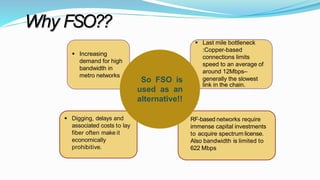
 Increasing
demand for high
bandwidth in
metro networks
 Last mile bottleneck
:Copper-based
connections limits
speed to an average of
around 12Mbps–
generally the slowest
link in the chain.
 Digging, delays and
associated costs to lay
fiber often make it
economically
prohibitive.
 RF-based networks require
immense capital investments
to acquire spectrum license.
Also bandwidth is limited to
622 Mbps
So FSO is
used as an
alternative!!
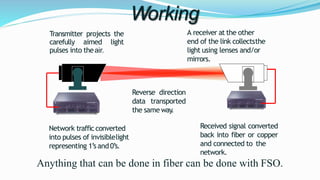
Working
Network traffic converted
into pulses of invisiblelight
representing 1’s and0’s.
Transmitter projects the
carefully aimed light
pulses into theair.
Reverse direction
data transported
the same way.
A receiver at the other
end of the link collectsthe
light using lenses and/or
mirrors.
Received signal converted
back into fiber or copper
and connected to the
network.
Anything that can be done in fiber can be done with FSO.
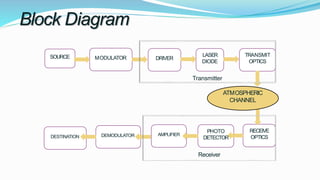
Block Diagram
SOURCE
DESTINATION DEMODULATOR AMPLIFIER
PHOTO RECEIVE
OPTICS
TRANSMIT
OPTICS
DRIVER
LASER
MODULATOR
ATMOSPHERIC
CHANNEL
DETECTOR
Receiver
DIODE
Transmitter
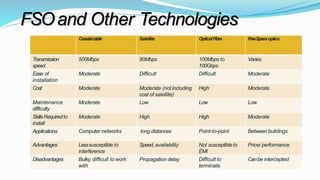
FSOand Other Technologies
Coaxialcable Satellite OpticalFibre FreeSpaceoptics
Transmission
speed
500Mbps 90Mbps 100Mbps to
100Gbps
Varies
Ease of
installation
Moderate Difficult Difficult Moderate
Cost Moderate Moderate (not including
cost of satellite)
High Moderate
Maintenance
difficulty
Moderate Low Low Low
SkillsRequiredto
install
Moderate High High Moderate
Applications Computer networks long distances Point-to-point Between buildings
Advantages Lesssusceptible to
interference
Speed, availability Not susceptibleto
EMI
Price/ performance
Disadvantages Bulky, difficult to work
with
Propagation delay Difficult to
terminate
Canbe intercepted
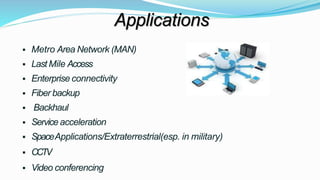
Applications
 Metro Area Network (MAN)
 Last Mile Access
 Enterprise connectivity
 Fiber backup
 Backhaul
 Service acceleration
 SpaceApplications/Extraterrestrial(esp. in military)
 CCTV
 Video conferencing
Advantages
 Installation cost is very low as compared to layingFiber
 Highly secure transmission possible
 Unregulated Spectrum
 Low Power Consumption
 Easeofinstallation
 License-free long-range operation
 Immunity to electromagneticinterference
 Speed: high bit rates and low biterror rates
Disadvantages
 High Launch Power represents eye hazard.
 Physical obstruction
 Atmospheric barriers
 SNRcan vary significantly with the distance and the ambient noise
 Low Power Sourcerequires high sensitive receivers.
 If the sun goes exactly behind the transmitter, it can swamp the
signal.
SECURITY
FSO laser beams cannot be detected with spectrum analyzers or
RF meters.
FSO laser transmissions are optical and travel along a line of sight
path that cannot be intercepted easily.
The laser beams generated by FSO systems are narrow and
invisible, making them harder to find and even harder to intercept
and crack.
Data can be transmitted over an encrypted connection adding to the
degree of security available in FSO network transmissions.
Conclusion
 For future short-range applications, optical wireless communications
present a viable and promising supplemental technology to radio
wireless systemsand optical fiber.
 It provides a low cost, rapidly deployable method of gaining access to
fiber-quality connections and provides the lowest cost transmission
capacity in the broadband industry saving substantial up-front capital
investments.
 Can be installed for as little as one-tenth of the cost of laying fiber cable,
and about half as much as comparable microwave/RF wireless systems
thus eliminating the need to buy expensive spectrum, which further
distinguishes it from fixedwireless technologies.
References
[1] www.opticsinfobase.orgoefulltext.cfmuri=oe-19-26-B56&id=224428
[2] www.pi-usa.us/products/images/300x250_images/S-334-Red-Beams.jpg
[3] www.pi-usa.us/products/images/300x250_images/S-334-Red-Beams.jpg
[4] image.slidesharecdn.com/introductiontofsotechnology-1216024918992120-
8/95/introduction-to-fso-technology-3-728.jpg?cb=1360750423
[5] image.slidesharecdn.com/freespaceoptics-140721105157- phpapp02/95/free-
space-optics-communication-9-638.jpg?cb=1405957976
[6] www.optica.ru/EN/lant3a.jpg.
[7] http://cictr.ee.psu.edu/research/pcs/index_files/image010.jpg
Free space optical communication

Free space optical communication

  • 1.
  • 2.
    Outline  Introduction  History Working  Advantages  Disadvantages  Applications  Security  Conclusion  References
  • 3.
    Introduction  FSO isa line-of-sight (LOS) technology that transmits a modulated beam of visible or infrared light through the atmosphere forbroadband communications.  FSO technology delivers cost-effective optical wireless connectivity, power efficient, and a faster return on investment (ROI) for Enterprises and Mobile Carriers.  Of high usage where physical connections are impractical due to high costs and other considerations.
  • 4.
    History  In 1880,AlexanderGraham Bellinvented the ‘photo-phone’  The invention of lasers In the 1960s, revolutionized free space optics.  Germany, France and Japan made significant advancements in free space optics for satellite communications.  Military organizationsespecially were interested and forced some developments.
  • 5.
    Why FSO??  Increasing demandfor high bandwidth in metro networks  Last mile bottleneck :Copper-based connections limits speed to an average of around 12Mbps– generally the slowest link in the chain.  Digging, delays and associated costs to lay fiber often make it economically prohibitive.  RF-based networks require immense capital investments to acquire spectrum license. Also bandwidth is limited to 622 Mbps So FSO is used as an alternative!!
  • 6.
    Working Network traffic converted intopulses of invisiblelight representing 1’s and0’s. Transmitter projects the carefully aimed light pulses into theair. Reverse direction data transported the same way. A receiver at the other end of the link collectsthe light using lenses and/or mirrors. Received signal converted back into fiber or copper and connected to the network. Anything that can be done in fiber can be done with FSO.
  • 7.
    Block Diagram SOURCE DESTINATION DEMODULATORAMPLIFIER PHOTO RECEIVE OPTICS TRANSMIT OPTICS DRIVER LASER MODULATOR ATMOSPHERIC CHANNEL DETECTOR Receiver DIODE Transmitter
  • 8.
    FSOand Other Technologies CoaxialcableSatellite OpticalFibre FreeSpaceoptics Transmission speed 500Mbps 90Mbps 100Mbps to 100Gbps Varies Ease of installation Moderate Difficult Difficult Moderate Cost Moderate Moderate (not including cost of satellite) High Moderate Maintenance difficulty Moderate Low Low Low SkillsRequiredto install Moderate High High Moderate Applications Computer networks long distances Point-to-point Between buildings Advantages Lesssusceptible to interference Speed, availability Not susceptibleto EMI Price/ performance Disadvantages Bulky, difficult to work with Propagation delay Difficult to terminate Canbe intercepted
  • 9.
    Applications  Metro AreaNetwork (MAN)  Last Mile Access  Enterprise connectivity  Fiber backup  Backhaul  Service acceleration  SpaceApplications/Extraterrestrial(esp. in military)  CCTV  Video conferencing
  • 10.
    Advantages  Installation costis very low as compared to layingFiber  Highly secure transmission possible  Unregulated Spectrum  Low Power Consumption  Easeofinstallation  License-free long-range operation  Immunity to electromagneticinterference  Speed: high bit rates and low biterror rates
  • 11.
    Disadvantages  High LaunchPower represents eye hazard.  Physical obstruction  Atmospheric barriers  SNRcan vary significantly with the distance and the ambient noise  Low Power Sourcerequires high sensitive receivers.  If the sun goes exactly behind the transmitter, it can swamp the signal.
  • 12.
    SECURITY FSO laser beamscannot be detected with spectrum analyzers or RF meters. FSO laser transmissions are optical and travel along a line of sight path that cannot be intercepted easily. The laser beams generated by FSO systems are narrow and invisible, making them harder to find and even harder to intercept and crack. Data can be transmitted over an encrypted connection adding to the degree of security available in FSO network transmissions.
  • 13.
    Conclusion  For futureshort-range applications, optical wireless communications present a viable and promising supplemental technology to radio wireless systemsand optical fiber.  It provides a low cost, rapidly deployable method of gaining access to fiber-quality connections and provides the lowest cost transmission capacity in the broadband industry saving substantial up-front capital investments.  Can be installed for as little as one-tenth of the cost of laying fiber cable, and about half as much as comparable microwave/RF wireless systems thus eliminating the need to buy expensive spectrum, which further distinguishes it from fixedwireless technologies.
  • 14.
    References [1] www.opticsinfobase.orgoefulltext.cfmuri=oe-19-26-B56&id=224428 [2] www.pi-usa.us/products/images/300x250_images/S-334-Red-Beams.jpg [3]www.pi-usa.us/products/images/300x250_images/S-334-Red-Beams.jpg [4] image.slidesharecdn.com/introductiontofsotechnology-1216024918992120- 8/95/introduction-to-fso-technology-3-728.jpg?cb=1360750423 [5] image.slidesharecdn.com/freespaceoptics-140721105157- phpapp02/95/free- space-optics-communication-9-638.jpg?cb=1405957976 [6] www.optica.ru/EN/lant3a.jpg. [7] http://cictr.ee.psu.edu/research/pcs/index_files/image010.jpg