Implementation of
Soft-core Processor
on FPGA
GROUP 8:
NIKHIL SHAH
NIRMIT PATEL
SARTHAK GANDHI
DEEPAKKUMAR PRAJAPATI
Project Guide:
Rahul V Mehta
Abstract
• Hard-core processor are fixed and cannot be changed while soft-core processors Can be easily
modified and tuned to specific requirements, more features, custom instructions, etc.
• In soft-core processor Multiple cores can be used.
• We can add a soft-core processor to a FPGA-based system after it's already designed. However,
adding a hard-core processor requires either a different FPGA, or an additional chip on the board.
• All the major FPGA vendors have soft-core processors in their product offerings and there are
also a number of companies and organizations developing soft-core processors and can be
implemented in any FPGA design.
• Thus, due to following advantages of Soft-core processor over other types of processors we
have decided to work on Soft-core processor.
Implementation of Soft-Core Processor on FPGA
Phase I (Language Survey)
• Study of Basic VHDL Programming Language.
• Learn the basics of Xilinx and implement simple programs to
understand the working of each stage.
• Study of Soft-core Processor – PicoBlaze.
• The KCPSM3 Assembler.
• Study the methods of Handshaking to implement multi-core processor
and decide one of them.
Implementation of Soft-Core Processor on FPGA
Phase II
• Implement the selected method of Handshaking on FPGA Board
Spartan 3E.
• Make an application of the soft-core processor. For eg. Graphical LCD,
Stepper Motor or Sensor Interfacing.
Implementation of Soft-Core Processor on FPGA
Why VHDL?
• Is an IEEE and ANSI standard .
• Three basic different description styles: structural, dataflow, and
behavioral.
• The language supports hierarchy.
• Wide range of abstraction levels.
• Easier large scale design modeling.
• Test benches can be written.
• Precise simulation semantics are defined.
• Capability of defining new data types.
Implementation of Soft-Core Processor on FPGA
PicoBlaze
• The most popular and widely-used cores (of Xilinx Incorporated) are
the MicroBlaze and PicoBlaze soft-core processors.
• The PicoBlaze microcontroller is a compact, capable, and cost-
effective fully embedded 8-bit RISC microcontroller core optimized
for the Xilinx FPGA families.
• The KCPSM3 version used in this project occupies just 96 FPGA slices
in a Spartan-3 Generation FPGA (which is only 12.5% of an XC3S50
device).
• The PicoBlaze microcontroller performs a respectable 44 to 100
million instructions per second (MIPS) depending on the target FPGA
family and speed grade.
Implementation of Soft-Core Processor on FPGA
PicoBlaze
Key Features
• Supports Virtex-7, Kintex-7, Spartan-3E and older Xilinx FPGA families
• 16 byte-wide general-purpose data registers
• 1K instructions of programmable on-chip program store
• Byte-wide Arithmetic Logic Unit (ALU) with CARRY and ZERO indicator
flags
• 256 input and 256 output ports & up to 240MHz performance
• Highly integrated for implementing non-time critical state machine
• Predictable fast interrupt response
Implementation of Soft-Core Processor on FPGA
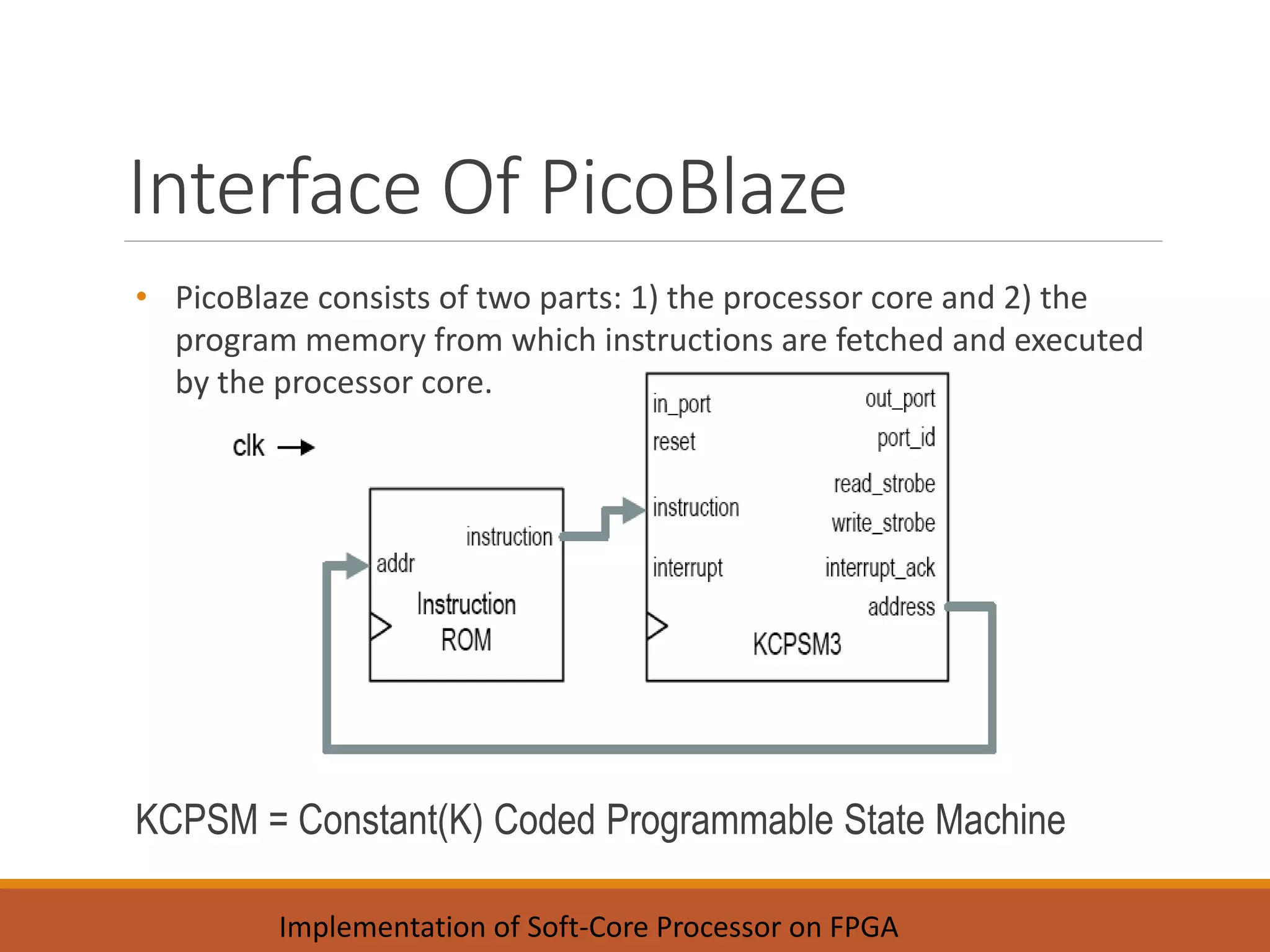
Interface Of PicoBlaze
KCPSM = Constant(K) Coded Programmable State Machine
• PicoBlaze consists of two parts: 1) the processor core and 2) the
program memory from which instructions are fetched and executed
by the processor core.
Implementation of Soft-Core Processor on FPGA
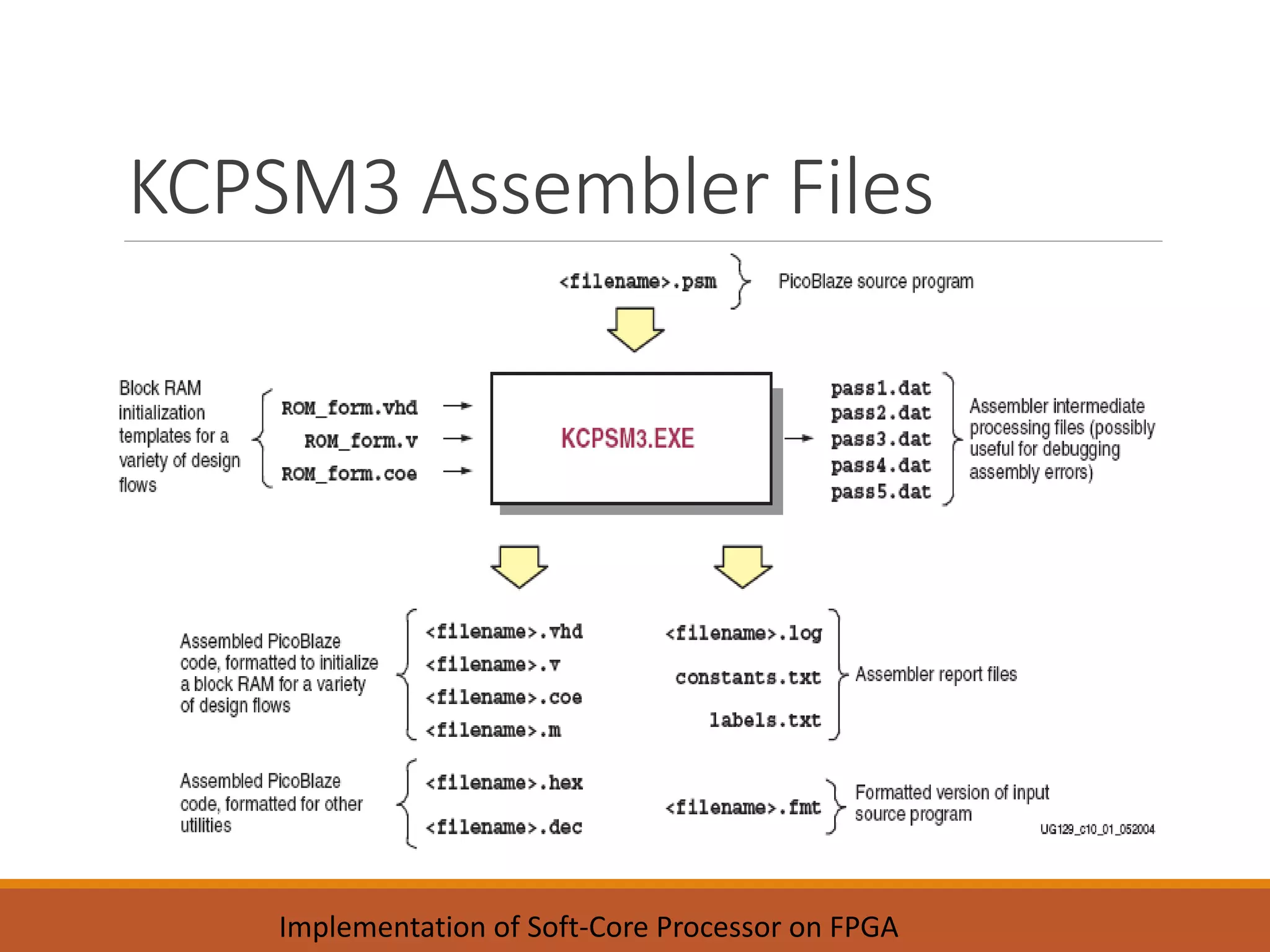
KCPSM3 Assembler Files
Implementation of Soft-Core Processor on FPGA
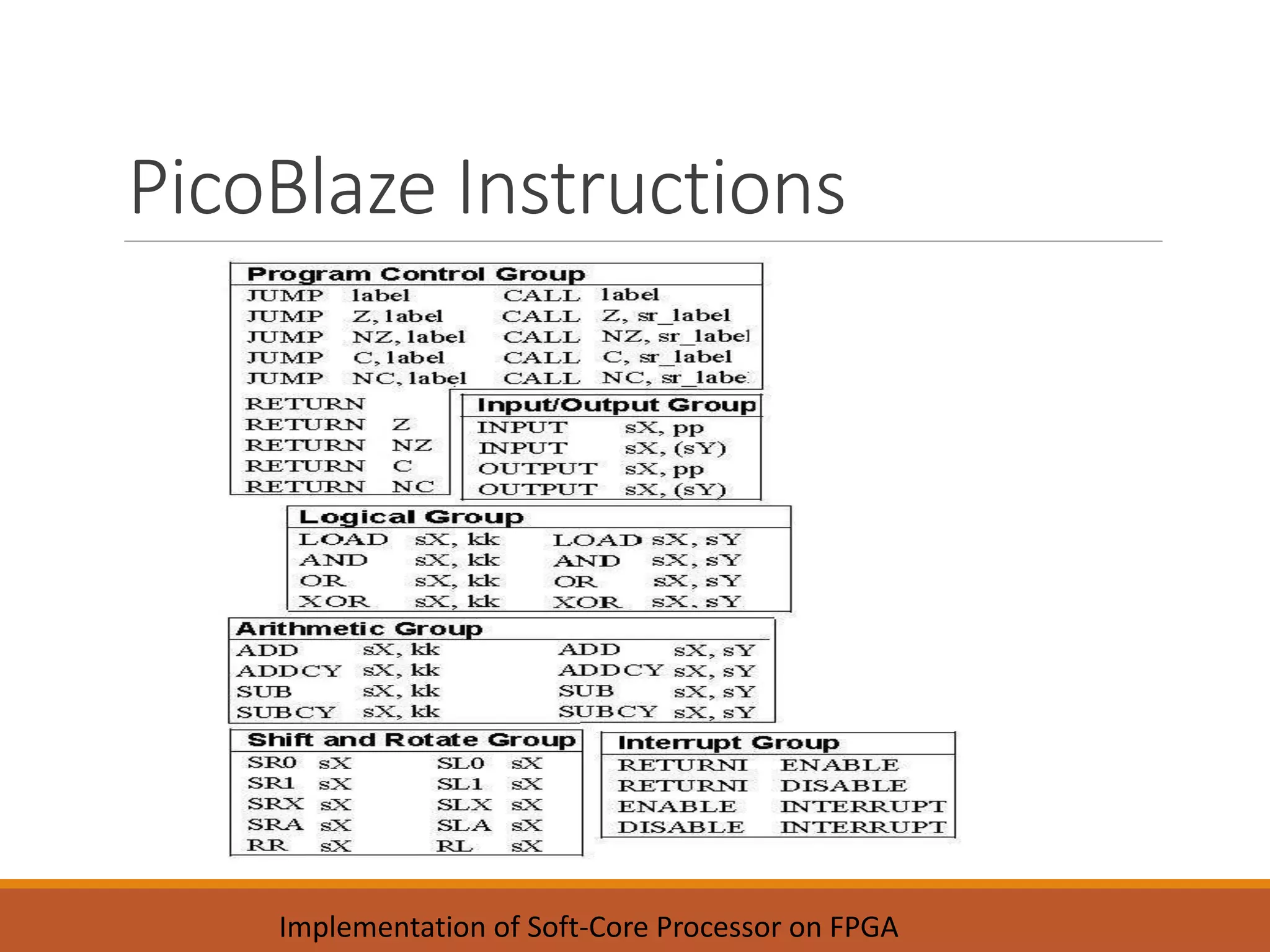
PicoBlaze Instructions
Implementation of Soft-Core Processor on FPGA
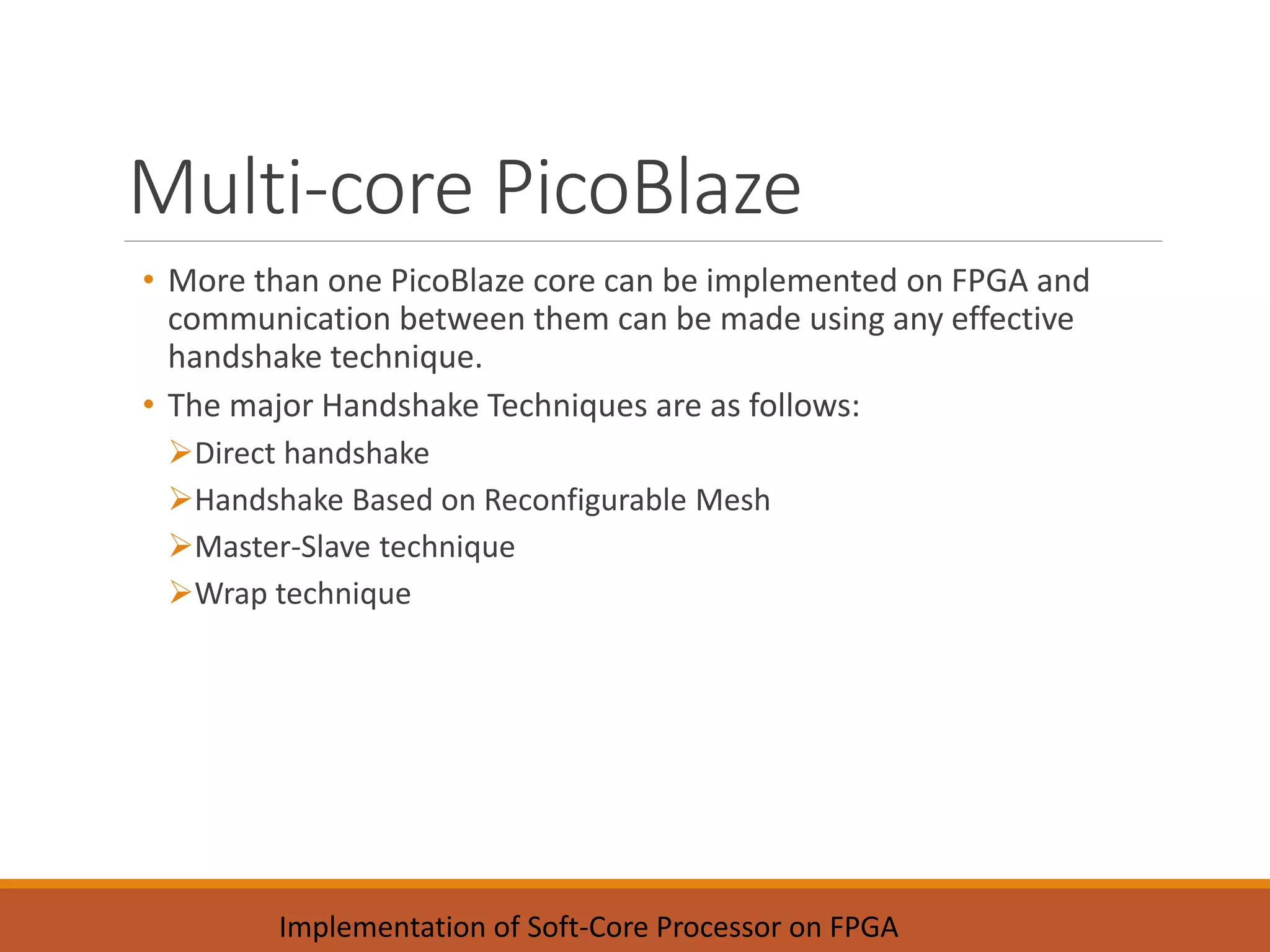
Multi-core PicoBlaze
• More than one PicoBlaze core can be implemented on FPGA and
communication between them can be made using any effective
handshake technique.
• The major Handshake Techniques are as follows:
Direct handshake
Handshake Based on Reconfigurable Mesh
Master-Slave technique
Wrap technique
Implementation of Soft-Core Processor on FPGA
References
• Download PicoBlaze reference designs and additional files.
http://www.xilinx.com/ipcenter/processor_central/picoblaze
• Xilinx System Generator User Guide: “Designing PicoBlaze Microcontroller Applications”
http://www.xilinx.com/support/sw_manuals/sysgen_ug.pdf
•Mehta Rahul V. “Implementation of PicoBlaze on Xilinx's Spartan 3E FPGA”, International
Journal of Computer and Electronics engineering Volume 4 Number 2(July-Dec 2012).
•J. Bhaskar “A VHDL Primer”.
•Volnei A. Pedroni “Circuit Design with VHDL”, Massachusetts Institute of Technology, 2004.
•Heiner Giefers and Marco Platzner “A Many-core Implementation Based On The
Reconfigurable Mesh Model ”, University of Paderborn.
Thanks for your attention.
Queries OR Suggestions

Implementation of Soft-core Processor on FPGA

  • 1.
    Implementation of Soft-core Processor onFPGA GROUP 8: NIKHIL SHAH NIRMIT PATEL SARTHAK GANDHI DEEPAKKUMAR PRAJAPATI Project Guide: Rahul V Mehta
  • 2.
    Abstract • Hard-core processorare fixed and cannot be changed while soft-core processors Can be easily modified and tuned to specific requirements, more features, custom instructions, etc. • In soft-core processor Multiple cores can be used. • We can add a soft-core processor to a FPGA-based system after it's already designed. However, adding a hard-core processor requires either a different FPGA, or an additional chip on the board. • All the major FPGA vendors have soft-core processors in their product offerings and there are also a number of companies and organizations developing soft-core processors and can be implemented in any FPGA design. • Thus, due to following advantages of Soft-core processor over other types of processors we have decided to work on Soft-core processor. Implementation of Soft-Core Processor on FPGA
  • 3.
    Phase I (LanguageSurvey) • Study of Basic VHDL Programming Language. • Learn the basics of Xilinx and implement simple programs to understand the working of each stage. • Study of Soft-core Processor – PicoBlaze. • The KCPSM3 Assembler. • Study the methods of Handshaking to implement multi-core processor and decide one of them. Implementation of Soft-Core Processor on FPGA
  • 4.
    Phase II • Implementthe selected method of Handshaking on FPGA Board Spartan 3E. • Make an application of the soft-core processor. For eg. Graphical LCD, Stepper Motor or Sensor Interfacing. Implementation of Soft-Core Processor on FPGA
  • 5.
    Why VHDL? • Isan IEEE and ANSI standard . • Three basic different description styles: structural, dataflow, and behavioral. • The language supports hierarchy. • Wide range of abstraction levels. • Easier large scale design modeling. • Test benches can be written. • Precise simulation semantics are defined. • Capability of defining new data types. Implementation of Soft-Core Processor on FPGA
  • 6.
    PicoBlaze • The mostpopular and widely-used cores (of Xilinx Incorporated) are the MicroBlaze and PicoBlaze soft-core processors. • The PicoBlaze microcontroller is a compact, capable, and cost- effective fully embedded 8-bit RISC microcontroller core optimized for the Xilinx FPGA families. • The KCPSM3 version used in this project occupies just 96 FPGA slices in a Spartan-3 Generation FPGA (which is only 12.5% of an XC3S50 device). • The PicoBlaze microcontroller performs a respectable 44 to 100 million instructions per second (MIPS) depending on the target FPGA family and speed grade. Implementation of Soft-Core Processor on FPGA
  • 7.
    PicoBlaze Key Features • SupportsVirtex-7, Kintex-7, Spartan-3E and older Xilinx FPGA families • 16 byte-wide general-purpose data registers • 1K instructions of programmable on-chip program store • Byte-wide Arithmetic Logic Unit (ALU) with CARRY and ZERO indicator flags • 256 input and 256 output ports & up to 240MHz performance • Highly integrated for implementing non-time critical state machine • Predictable fast interrupt response Implementation of Soft-Core Processor on FPGA
  • 8.
    Interface Of PicoBlaze KCPSM= Constant(K) Coded Programmable State Machine • PicoBlaze consists of two parts: 1) the processor core and 2) the program memory from which instructions are fetched and executed by the processor core. Implementation of Soft-Core Processor on FPGA
  • 9.
    KCPSM3 Assembler Files Implementationof Soft-Core Processor on FPGA
  • 10.
    PicoBlaze Instructions Implementation ofSoft-Core Processor on FPGA
  • 11.
    Multi-core PicoBlaze • Morethan one PicoBlaze core can be implemented on FPGA and communication between them can be made using any effective handshake technique. • The major Handshake Techniques are as follows: Direct handshake Handshake Based on Reconfigurable Mesh Master-Slave technique Wrap technique Implementation of Soft-Core Processor on FPGA
  • 12.
    References • Download PicoBlazereference designs and additional files. http://www.xilinx.com/ipcenter/processor_central/picoblaze • Xilinx System Generator User Guide: “Designing PicoBlaze Microcontroller Applications” http://www.xilinx.com/support/sw_manuals/sysgen_ug.pdf •Mehta Rahul V. “Implementation of PicoBlaze on Xilinx's Spartan 3E FPGA”, International Journal of Computer and Electronics engineering Volume 4 Number 2(July-Dec 2012). •J. Bhaskar “A VHDL Primer”. •Volnei A. Pedroni “Circuit Design with VHDL”, Massachusetts Institute of Technology, 2004. •Heiner Giefers and Marco Platzner “A Many-core Implementation Based On The Reconfigurable Mesh Model ”, University of Paderborn. Thanks for your attention.
  • 13.