Day 1 Lecture 3
Deep Networks
Elisa Sayrol
[course site]
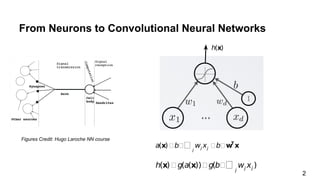
From Neurons to Convolutional Neural Networks
Figures Credit: Hugo Laroche NN course
2
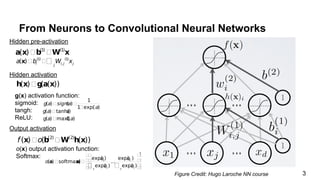
From Neurons to Convolutional Neural Networks
Figure Credit: Hugo Laroche NN course
Hidden pre-activation
Hidden activation
Output activation
g(x) activation function:
sigmoid:
tangh:
ReLU:
o(x) output activation function:
Softmax:
3
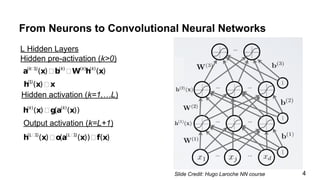
From Neurons to Convolutional Neural Networks
L Hidden Layers
Hidden pre-activation (k>0)
Hidden activation (k=1,…L)
Output activation (k=L+1)
Slide Credit: Hugo Laroche NN course 4
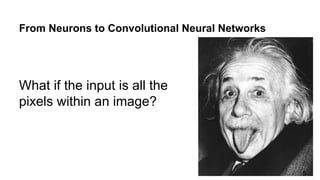
From Neurons to Convolutional Neural Networks
What if the input is all the
pixels within an image?
5
From Neurons to Convolutional Neural Networks
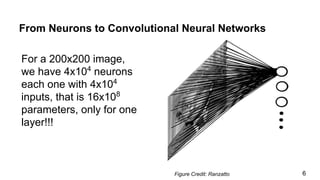
For a 200x200 image,
we have 4x10⁴
neurons
each one with 4x10⁴
inputs, that is 16x108
parameters, only for one
layer!!!
Figure Credit: Ranzatto 6
From Neurons to Convolutional Neural Networks
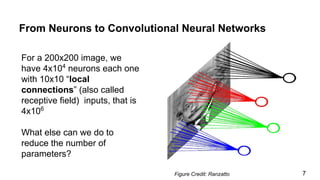
For a 200x200 image, we
have 4x10⁴
neurons each one
with 10x10 “local
connections” (also called
receptive field) inputs, that is
4x10⁶
What else can we do to
reduce the number of
parameters?
Figure Credit: Ranzatto 7
From Neurons to Convolutional Neural Networks
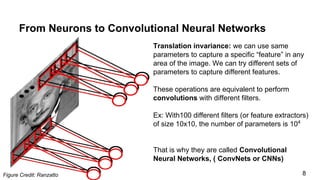
Translation invariance: we can use same
parameters to capture a specific “feature” in any
area of the image. We can try different sets of
parameters to capture different features.
These operations are equivalent to perform
convolutions with different filters.
Ex: With100 different filters (or feature extractors)
of size 10x10, the number of parameters is 104
That is why they are called Convolutional
Neural Networks, ( ConvNets or CNNs)
Figure Credit: Ranzatto 8
From Neurons to Convolutional Neural Networks
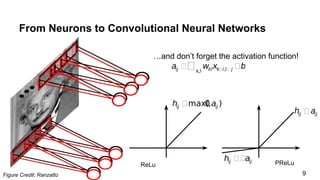
…and don’t forget the activation function!
Figure Credit: Ranzatto
ReLu PReLu
9
From Neurons to Convolutional Neural Networks
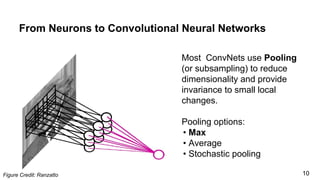
Most ConvNets use Pooling
(or subsampling) to reduce
dimensionality and provide
invariance to small local
changes.
Pooling options:
• Max
• Average
• Stochastic pooling
Figure Credit: Ranzatto 10
From Neurons to Convolutional Neural Networks
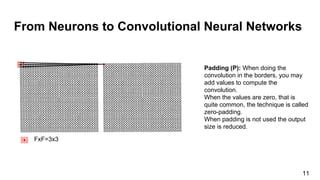
Padding (P): When doing the
convolution in the borders, you may
add values to compute the
convolution.
When the values are zero, that is
quite common, the technique is called
zero-padding.
When padding is not used the output
size is reduced.
FxF=3x3
11
From Neurons to Convolutional Neural Networks
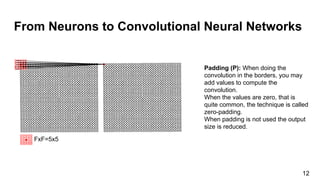
Padding (P): When doing the
convolution in the borders, you may
add values to compute the
convolution.
When the values are zero, that is
quite common, the technique is called
zero-padding.
When padding is not used the output
size is reduced.
FxF=5x5
12
From Neurons to Convolutional Neural Networks
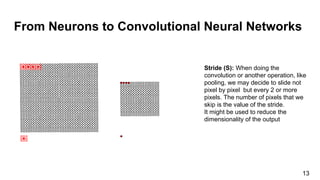
Stride (S): When doing the
convolution or another operation, like
pooling, we may decide to slide not
pixel by pixel but every 2 or more
pixels. The number of pixels that we
skip is the value of the stride.
It might be used to reduce the
dimensionality of the output
13
From Neurons to Convolutional Neural Networks
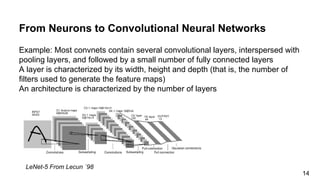
Example: Most convnets contain several convolutional layers, interspersed with
pooling layers, and followed by a small number of fully connected layers
A layer is characterized by its width, height and depth (that is, the number of
filters used to generate the feature maps)
An architecture is characterized by the number of layers
LeNet-5 From Lecun ´98
14

Deep Learning for Computer Vision: Deep Networks (UPC 2016)

  • 1.
    Day 1 Lecture3 Deep Networks Elisa Sayrol [course site]
  • 2.
    From Neurons toConvolutional Neural Networks Figures Credit: Hugo Laroche NN course 2
  • 3.
    From Neurons toConvolutional Neural Networks Figure Credit: Hugo Laroche NN course Hidden pre-activation Hidden activation Output activation g(x) activation function: sigmoid: tangh: ReLU: o(x) output activation function: Softmax: 3
  • 4.
    From Neurons toConvolutional Neural Networks L Hidden Layers Hidden pre-activation (k>0) Hidden activation (k=1,…L) Output activation (k=L+1) Slide Credit: Hugo Laroche NN course 4
  • 5.
    From Neurons toConvolutional Neural Networks What if the input is all the pixels within an image? 5
  • 6.
    From Neurons toConvolutional Neural Networks For a 200x200 image, we have 4x10⁴ neurons each one with 4x10⁴ inputs, that is 16x108 parameters, only for one layer!!! Figure Credit: Ranzatto 6
  • 7.
    From Neurons toConvolutional Neural Networks For a 200x200 image, we have 4x10⁴ neurons each one with 10x10 “local connections” (also called receptive field) inputs, that is 4x10⁶ What else can we do to reduce the number of parameters? Figure Credit: Ranzatto 7
  • 8.
    From Neurons toConvolutional Neural Networks Translation invariance: we can use same parameters to capture a specific “feature” in any area of the image. We can try different sets of parameters to capture different features. These operations are equivalent to perform convolutions with different filters. Ex: With100 different filters (or feature extractors) of size 10x10, the number of parameters is 104 That is why they are called Convolutional Neural Networks, ( ConvNets or CNNs) Figure Credit: Ranzatto 8
  • 9.
    From Neurons toConvolutional Neural Networks …and don’t forget the activation function! Figure Credit: Ranzatto ReLu PReLu 9
  • 10.
    From Neurons toConvolutional Neural Networks Most ConvNets use Pooling (or subsampling) to reduce dimensionality and provide invariance to small local changes. Pooling options: • Max • Average • Stochastic pooling Figure Credit: Ranzatto 10
  • 11.
    From Neurons toConvolutional Neural Networks Padding (P): When doing the convolution in the borders, you may add values to compute the convolution. When the values are zero, that is quite common, the technique is called zero-padding. When padding is not used the output size is reduced. FxF=3x3 11
  • 12.
    From Neurons toConvolutional Neural Networks Padding (P): When doing the convolution in the borders, you may add values to compute the convolution. When the values are zero, that is quite common, the technique is called zero-padding. When padding is not used the output size is reduced. FxF=5x5 12
  • 13.
    From Neurons toConvolutional Neural Networks Stride (S): When doing the convolution or another operation, like pooling, we may decide to slide not pixel by pixel but every 2 or more pixels. The number of pixels that we skip is the value of the stride. It might be used to reduce the dimensionality of the output 13
  • 14.
    From Neurons toConvolutional Neural Networks Example: Most convnets contain several convolutional layers, interspersed with pooling layers, and followed by a small number of fully connected layers A layer is characterized by its width, height and depth (that is, the number of filters used to generate the feature maps) An architecture is characterized by the number of layers LeNet-5 From Lecun ´98 14