Processor IP Cores in FPGA
Presented By
Mr.Nishant S. Nerpagar
Smart Logic Technologies, Pune
smartlogitech@gmail.com
nishantnerpagar123@gmail.com
Prerequisites
 Digital logic Design
 VHDL
 Basic idea about FPGA
What is FPGA
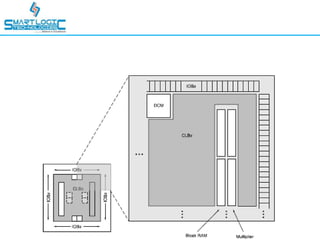
 Configurable Logic Blocks (CLBs) contain flexible
Look-Up Tables (LUTs) that implement logic plus storage elements used as
flip-flops or latches. CLBs perform a wide variety of logical functions as well as
store data.
 • Input/Output Blocks (IOBs) control the flow of data
between the I/O pins and the internal logic of the device. Each IOB supports
directional data flow plus 3-state operation. Supports a variety of signal
standards, including four high-performance differential standards. Double Data-
Rate (DDR) registers are included.
 • Block RAM provides data storage in the form of
18-Kbit dual-port blocks.
 Digital Clock Manager (DCM) Blocks provide
self-calibrating, fully digital solutions for distributing, delaying ,
multiplying, dividing, and phase-shifting clock signals.
I/O Capabilities
• 3.3V low-voltage TTL (LVTTL)
• Low-voltage CMOS (LVCMOS) at 3.3V, 2.5V, 1.8V,
1.5V, or 1.2V
• 3V PCI at 33 MHz, and in some devices, 66 MHz
• HSTL I and III at 1.8V, commonly used in memory
applications
• SSTL I at 1.8V and 2.5V, commonly used for memory
applications
Spartan-3E FPGAs support the following differential standards:
• LVDS
• Bus LVDS
• mini-LVDS
• RSDS
• Differential HSTL (1.8V, Types I and III)
• Differential SSTL (2.5V and 1.8V, Type I)
• 2.5V LVPECL inputs
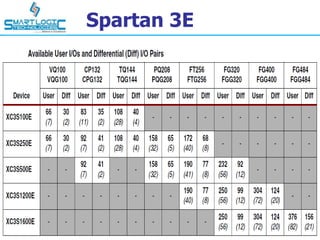
Spartan 3E
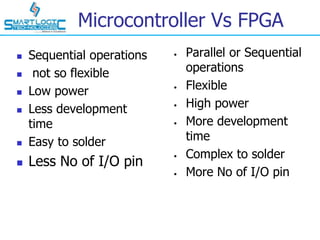
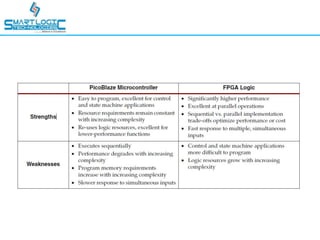
Microcontroller Vs FPGA
 Sequential operations
 not so flexible
 Low power
 Less development
time
 Easy to solder
 Less No of I/O pin
• Parallel or Sequential
operations
• Flexible
• High power
• More development
time
• Complex to solder
• More No of I/O pin
Intellectual properties
Soft IP
Hard IP
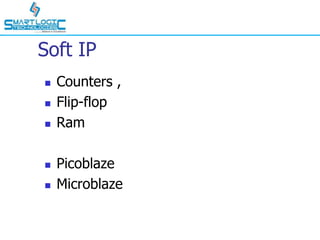
Soft IP
 Counters ,
 Flip-flop
 Ram
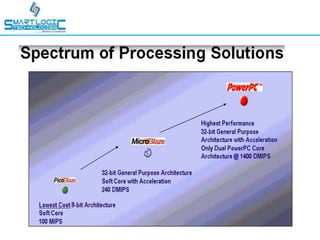
 Picoblaze
 Microblaze
Hard IP
 Dcm
 Multipliers
 Blockram
 Power -pc
 Have a fun with all
Intellectual properties in
Xilinx ISE
 Can we use assembly
language for FPGA ?
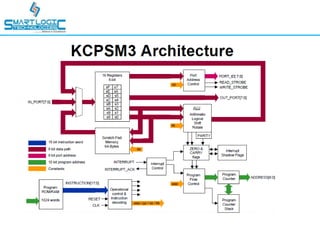
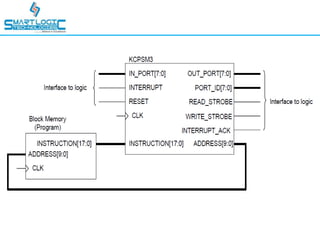
Key Feature Set
• 16 byte-wide general-purpose data registers
• 1K instructions of programmable on-chip program
store, automatically
loaded during FPGA configuration
• Byte-wide Arithmetic Logic Unit (ALU) with CARRY
and ZERO
indicator flags
• 64-byte internal scratchpad RAM
• 256 input and 256 output ports for easy expansion
and enhancement
• Automatic 31-location CALL/RETURN stack
• Predictable performance, always two clock cycles per
instruction,
up to 200 MHz or 100 MIPS in a Virtex-4™ FPGA and 88 MHz
or 44 MIPS in a Spartan-3 FPGA
• Fast interrupt response; worst-case 5 clock cycles
• Assembler, instruction-set simulator support
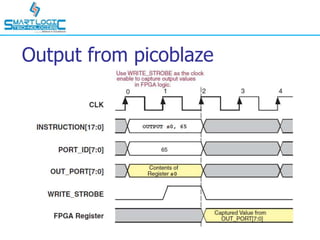
Output from picoblaze
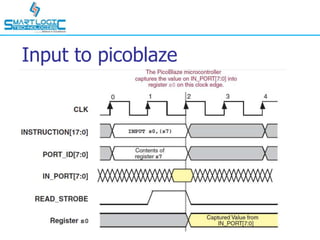
Input to picoblaze
 Have a fun with all
picoblaze
 Can we use C language
for FPGA ?
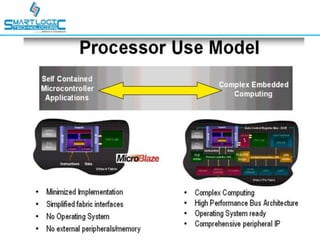
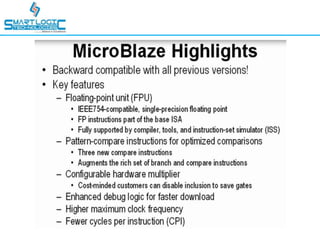
Microblaze Overview
 Microblaze is a soft core embedded in the bit
stream and is not available until the FPGA has
been configured.
 Software-only; updates for Microblaze are
possible without regenerating the bit stream.
 Is one of the Fastest soft processor
 Virtex- 5 (- 2), 400 MHz
 Virtex- II (- 5), 125 MHz
 Is supported in the following Devices,
 Virtex, VirtexE, VirtexII, Spartan- II, Spartan3
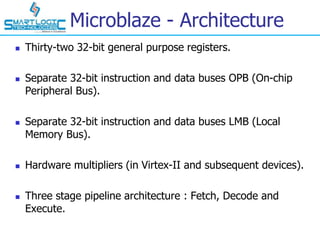
Microblaze - Architecture
 Thirty-two 32-bit general purpose registers.
 Separate 32-bit instruction and data buses OPB (On-chip
Peripheral Bus).
 Separate 32-bit instruction and data buses LMB (Local
Memory Bus).
 Hardware multipliers (in Virtex-II and subsequent devices).
 Three stage pipeline architecture : Fetch, Decode and
Execute.
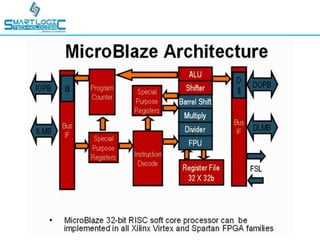
MicroBlaze - Architecure
 The Microblaze core is organized as a Harvard architecture
with separate bus interface units for data accesses and
instruction accesses.
 Each bus interface unit is further split into a Local Memory
Bus (LMB) and IBM’s On-chip Peripheral Bus (OPB).
 The LMB provides single-cycle access to on-chip dual port
block RAM.
 The OPB interface provides a connection to both on and
off chip peripherals and memory.
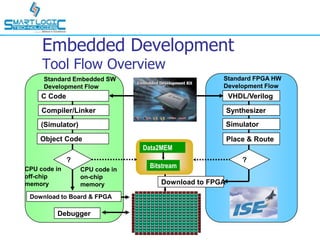
Embedded Development
Tool Flow Overview
Data2MEM
Bitstream
Compiler/Linker
(Simulator)
C Code
Debugger
Standard Embedded SW
Development Flow
CPU code in
on-chip
memory
?
CPU code in
off-chip
memory
Download to Board & FPGA
Object Code
Standard FPGA HW
Development Flow
Synthesizer
Place & Route
Simulator
VHDL/Verilog
?
Download to FPGA
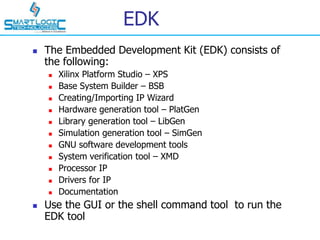
EDK
 The Embedded Development Kit (EDK) consists of
the following:
 Xilinx Platform Studio – XPS
 Base System Builder – BSB
 Creating/Importing IP Wizard
 Hardware generation tool – PlatGen
 Library generation tool – LibGen
 Simulation generation tool – SimGen
 GNU software development tools
 System verification tool – XMD
 Processor IP
 Drivers for IP
 Documentation
 Use the GUI or the shell command tool to run the
EDK tool
Microblaze : Area Statistics
 Area consumed by Microblaze. For a simple 8-
bit counter written in “C” with the counter
contents being displayed on LEDs,
the details of the FPGA resources consumed
are as follows: -
 Device Used SPARTAN II (XC2S100 TQ144 -
5)
 Number of BLOCKRAMs 4 out of 10 40%
 Number of SLICEs 769 out of 1200
64%
 737 SLICES FOR MICROBLAZE
 32 SLICES FOR One GPIO
 Total 769 SLICES of FPGA
MicroBlaze - Benefits
The Complete Solution
 Pre-verified and optimized
soft processor Core.
 IBM CoreConnectTM bus
Peripherals compatible with
embedded PowerPCTM in
Xilinx next generation
Platform.
 Microblaze applications can
range from software based
simple state machines to
complex controllers for
internet appliances or other
embedded applications.
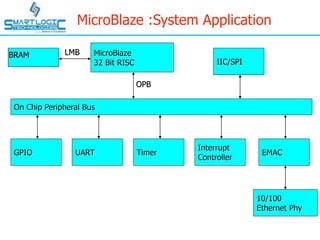
MicroBlaze
32 Bit RISC
On Chip Peripheral Bus
BRAM
GPIO
LMB
UART Timer
Interrupt
Controller
OPB
EMAC
10/100
Ethernet Phy
IIC/SPI
MicroBlaze :System Application
MicroBlaze - System Diagram
Off-Chip
Memory
0-4GB
Off-Chip
Memory
0-4GB
Machine Status Reg
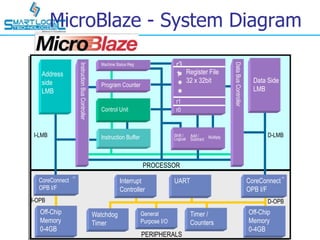
Program Counter
DataBusController
Register File
32 x 32bit
r0
r1
r3
1Address
side
LMB
CoreConnect
OPB I/F
CoreConnect
OPB I/F
TM TM
Data Side
LMB
UART
Timer /
Counters
Interrupt
Controller
General
Purpose I/O
Watchdog
Timer
Instruction Buffer
InstructionBusController
Control Unit
Multi
ply
Multi
ply
Add /
Subtract
Shift /
Logical Multiply
PROCESSOR
PERIPHERALS
I-LMB
I-OPB D-OPB
D-LMB
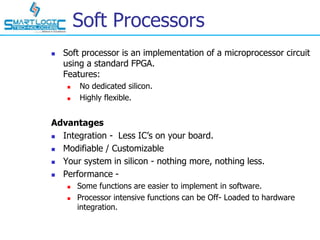
Soft Processors
 Soft processor is an implementation of a microprocessor circuit
using a standard FPGA.
Features:
 No dedicated silicon.
 Highly flexible.
Advantages
 Integration - Less IC’s on your board.
 Modifiable / Customizable
 Your system in silicon - nothing more, nothing less.
 Performance -
 Some functions are easier to implement in software.
 Processor intensive functions can be Off- Loaded to hardware
integration.
Advantages - continued
 Soft processor cores can be ‘owned’ by the
customer and used across many projects –
never going obsolete!
 No IP / License issues
 Peripherals can be added to make up the
required functions
 No wastage of peripherals or logic gates!
 Code and peripheral ‘banks’ can be built up
and used across many projects over time.
 Have a fun with all
Microblaze
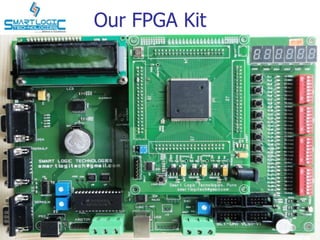
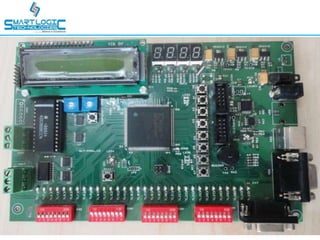
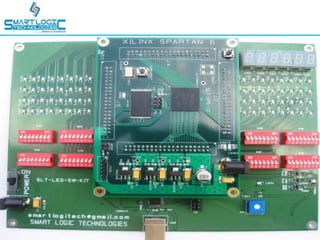
Our FPGA Kit
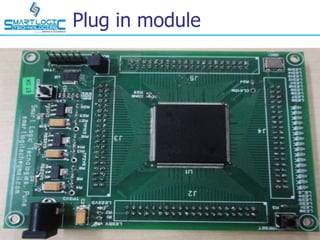
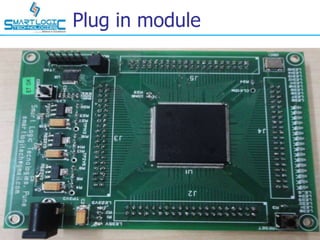
Plug in module
Plug in module
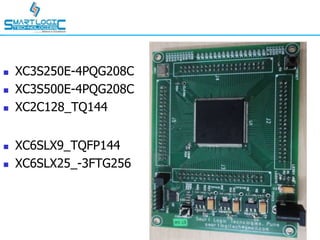
 XC3S250E-4PQG208C
 XC3S500E-4PQG208C
 XC2C128_TQ144
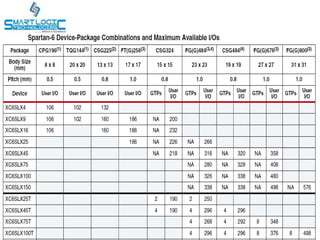
 XC6SLX9_TQFP144
 XC6SLX25_-3FTG256
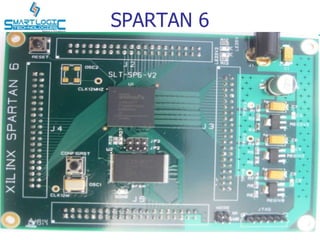
SPARTAN 6
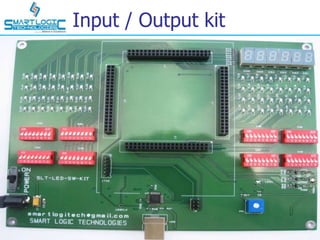
Input / Output kit
 nishantnerpagar123@gmail.com
 9420839857
Thanks……….!
 nishantnerpagar123@gmail.com
 9420839857

Smart logic

  • 1.
    Processor IP Coresin FPGA Presented By Mr.Nishant S. Nerpagar Smart Logic Technologies, Pune smartlogitech@gmail.com nishantnerpagar123@gmail.com
  • 2.
    Prerequisites  Digital logicDesign  VHDL  Basic idea about FPGA
  • 3.
    What is FPGA Configurable Logic Blocks (CLBs) contain flexible Look-Up Tables (LUTs) that implement logic plus storage elements used as flip-flops or latches. CLBs perform a wide variety of logical functions as well as store data.  • Input/Output Blocks (IOBs) control the flow of data between the I/O pins and the internal logic of the device. Each IOB supports directional data flow plus 3-state operation. Supports a variety of signal standards, including four high-performance differential standards. Double Data- Rate (DDR) registers are included.  • Block RAM provides data storage in the form of 18-Kbit dual-port blocks.  Digital Clock Manager (DCM) Blocks provide self-calibrating, fully digital solutions for distributing, delaying , multiplying, dividing, and phase-shifting clock signals.
  • 5.
    I/O Capabilities • 3.3Vlow-voltage TTL (LVTTL) • Low-voltage CMOS (LVCMOS) at 3.3V, 2.5V, 1.8V, 1.5V, or 1.2V • 3V PCI at 33 MHz, and in some devices, 66 MHz • HSTL I and III at 1.8V, commonly used in memory applications • SSTL I at 1.8V and 2.5V, commonly used for memory applications Spartan-3E FPGAs support the following differential standards: • LVDS • Bus LVDS • mini-LVDS • RSDS • Differential HSTL (1.8V, Types I and III) • Differential SSTL (2.5V and 1.8V, Type I) • 2.5V LVPECL inputs
  • 7.
  • 9.
    Microcontroller Vs FPGA Sequential operations  not so flexible  Low power  Less development time  Easy to solder  Less No of I/O pin • Parallel or Sequential operations • Flexible • High power • More development time • Complex to solder • More No of I/O pin
  • 10.
  • 11.
    Soft IP  Counters,  Flip-flop  Ram  Picoblaze  Microblaze
  • 12.
    Hard IP  Dcm Multipliers  Blockram  Power -pc
  • 13.
     Have afun with all Intellectual properties in Xilinx ISE
  • 14.
     Can weuse assembly language for FPGA ?
  • 16.
    Key Feature Set •16 byte-wide general-purpose data registers • 1K instructions of programmable on-chip program store, automatically loaded during FPGA configuration • Byte-wide Arithmetic Logic Unit (ALU) with CARRY and ZERO indicator flags • 64-byte internal scratchpad RAM • 256 input and 256 output ports for easy expansion and enhancement • Automatic 31-location CALL/RETURN stack • Predictable performance, always two clock cycles per instruction, up to 200 MHz or 100 MIPS in a Virtex-4™ FPGA and 88 MHz or 44 MIPS in a Spartan-3 FPGA • Fast interrupt response; worst-case 5 clock cycles • Assembler, instruction-set simulator support
  • 18.
  • 19.
  • 21.
     Have afun with all picoblaze
  • 22.
     Can weuse C language for FPGA ?
  • 24.
    Microblaze Overview  Microblazeis a soft core embedded in the bit stream and is not available until the FPGA has been configured.  Software-only; updates for Microblaze are possible without regenerating the bit stream.  Is one of the Fastest soft processor  Virtex- 5 (- 2), 400 MHz  Virtex- II (- 5), 125 MHz  Is supported in the following Devices,  Virtex, VirtexE, VirtexII, Spartan- II, Spartan3
  • 28.
    Microblaze - Architecture Thirty-two 32-bit general purpose registers.  Separate 32-bit instruction and data buses OPB (On-chip Peripheral Bus).  Separate 32-bit instruction and data buses LMB (Local Memory Bus).  Hardware multipliers (in Virtex-II and subsequent devices).  Three stage pipeline architecture : Fetch, Decode and Execute.
  • 29.
    MicroBlaze - Architecure The Microblaze core is organized as a Harvard architecture with separate bus interface units for data accesses and instruction accesses.  Each bus interface unit is further split into a Local Memory Bus (LMB) and IBM’s On-chip Peripheral Bus (OPB).  The LMB provides single-cycle access to on-chip dual port block RAM.  The OPB interface provides a connection to both on and off chip peripherals and memory.
  • 31.
    Embedded Development Tool FlowOverview Data2MEM Bitstream Compiler/Linker (Simulator) C Code Debugger Standard Embedded SW Development Flow CPU code in on-chip memory ? CPU code in off-chip memory Download to Board & FPGA Object Code Standard FPGA HW Development Flow Synthesizer Place & Route Simulator VHDL/Verilog ? Download to FPGA
  • 32.
    EDK  The EmbeddedDevelopment Kit (EDK) consists of the following:  Xilinx Platform Studio – XPS  Base System Builder – BSB  Creating/Importing IP Wizard  Hardware generation tool – PlatGen  Library generation tool – LibGen  Simulation generation tool – SimGen  GNU software development tools  System verification tool – XMD  Processor IP  Drivers for IP  Documentation  Use the GUI or the shell command tool to run the EDK tool
  • 33.
    Microblaze : AreaStatistics  Area consumed by Microblaze. For a simple 8- bit counter written in “C” with the counter contents being displayed on LEDs, the details of the FPGA resources consumed are as follows: -  Device Used SPARTAN II (XC2S100 TQ144 - 5)  Number of BLOCKRAMs 4 out of 10 40%  Number of SLICEs 769 out of 1200 64%  737 SLICES FOR MICROBLAZE  32 SLICES FOR One GPIO  Total 769 SLICES of FPGA
  • 34.
    MicroBlaze - Benefits TheComplete Solution  Pre-verified and optimized soft processor Core.  IBM CoreConnectTM bus Peripherals compatible with embedded PowerPCTM in Xilinx next generation Platform.  Microblaze applications can range from software based simple state machines to complex controllers for internet appliances or other embedded applications.
  • 35.
    MicroBlaze 32 Bit RISC OnChip Peripheral Bus BRAM GPIO LMB UART Timer Interrupt Controller OPB EMAC 10/100 Ethernet Phy IIC/SPI MicroBlaze :System Application
  • 36.
    MicroBlaze - SystemDiagram Off-Chip Memory 0-4GB Off-Chip Memory 0-4GB Machine Status Reg Program Counter DataBusController Register File 32 x 32bit r0 r1 r3 1Address side LMB CoreConnect OPB I/F CoreConnect OPB I/F TM TM Data Side LMB UART Timer / Counters Interrupt Controller General Purpose I/O Watchdog Timer Instruction Buffer InstructionBusController Control Unit Multi ply Multi ply Add / Subtract Shift / Logical Multiply PROCESSOR PERIPHERALS I-LMB I-OPB D-OPB D-LMB
  • 37.
    Soft Processors  Softprocessor is an implementation of a microprocessor circuit using a standard FPGA. Features:  No dedicated silicon.  Highly flexible. Advantages  Integration - Less IC’s on your board.  Modifiable / Customizable  Your system in silicon - nothing more, nothing less.  Performance -  Some functions are easier to implement in software.  Processor intensive functions can be Off- Loaded to hardware integration.
  • 38.
    Advantages - continued Soft processor cores can be ‘owned’ by the customer and used across many projects – never going obsolete!  No IP / License issues  Peripherals can be added to make up the required functions  No wastage of peripherals or logic gates!  Code and peripheral ‘banks’ can be built up and used across many projects over time.
  • 39.
     Have afun with all Microblaze
  • 40.
  • 41.
  • 43.
  • 44.
     XC3S250E-4PQG208C  XC3S500E-4PQG208C XC2C128_TQ144  XC6SLX9_TQFP144  XC6SLX25_-3FTG256
  • 45.
  • 46.
  • 48.
  • 49.