Introduction to FPGA acceleration
Marco Barbone
m.barbone19@imperial.ac.uk
Introduction to FPGA acceleration
14/04/2021
About me
2
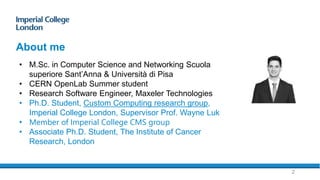
• M.Sc. in Computer Science and Networking Scuola
superiore Sant’Anna & Università di Pisa
• CERN OpenLab Summer student
• Research Software Engineer, Maxeler Technologies
• Ph.D. Student, Custom Computing research group,
Imperial College London, Supervisor Prof. Wayne Luk
• Member of Imperial College CMS group
• Associate Ph.D. Student, The Institute of Cancer
Research, London
What is an FPGA?
3
https://www.xilinx.com/content/dam/xilinx/imgs/kits/u200-hero-p.jpg https://www.intel.com/content/dam/altera-www/global/en_US/support/boards-
kits/stratix10/mx_fpga/stratix10mxboardtop.jpg/_jcr_content/renditions/cq5dam.web.1920.1080.jpeg https://en.wikipedia.org/wiki/Field-programmable_gate_array
A field-programmable gate array (FPGA)
is an integrated circuit designed to be
configured by a customer or a designer
after manufacturing – hence the term "field-
programmable".
Microsoft’s Project Brainwave
“Microsoft’s Project Brainwave is a deep learning platform for real-time AI
inference in the cloud and on the edge. A soft Neural Processing Unit (NPU),
based on a high-performance field-programmable gate array (FPGA),
accelerates deep neural network (DNN) inferencing, with applications in
computer vision and natural language processing. Project Brainwave is
transforming computing by augmenting CPUs with an interconnected and
configurable compute layer composed of programmable silicon.”
4
https://www.microsoft.com/en-us/research/project/project-brainwave/
https://www.microsoft.com/en-us/research/blog/microsoft-unveils-project-brainwave/
Amazon EC2 F1 instances use FPGAs to enable delivery of custom
hardware accelerations. F1 instances are easy to program and come with
everything you need to develop, simulate, debug, and compile your hardware
acceleration code, including an FPGA Developer AMI and supporting
hardware level development on the cloud. Using F1 instances to deploy
hardware accelerations can be useful in many applications to solve
complex science, engineering, and business problems that require high
bandwidth, enhanced networking, and very high compute
capabilities. Examples of target applications that can benefit from F1
instance acceleration are genomics, search/analytics, image and video
processing, network security, electronic design automation (EDA),
image and file compression and big data analytics.
Amazon EC2 F1
https://aws.amazon.com/ec2/instance-types/f1/ 5
The DRAGEN Platform enables labs of all sizes and disciplines to do more
with their genomic data. The DRAGEN Platform uses highly
reconfigurable field-programmable gate array technology (FPGA) to
provide hardware-accelerated implementations of genomic analysis
algorithms, such as BCL conversion, mapping, alignment, sorting,
duplicate marking, and haplotype variant calling.
DNA Sequencing: DRAGEN Platform
6
https://www.illumina.com/products/by-type/informatics-products/dragen-bio-it-platform.html
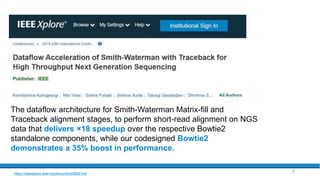
The dataflow architecture for Smith-Waterman Matrix-fill and
Traceback alignment stages, to perform short-read alignment on NGS
data that delivers ×18 speedup over the respective Bowtie2
standalone components, while our codesigned Bowtie2
demonstrates a 35% boost in performance.
Genomics DNA sequencing
7
https://ieeexplore.ieee.org/document/8892144
8
Circuits
Electrons
Microarchitecture
Program
Machine Language
Interpreter
Circuits
Electrons
Microarchitecture
Program
Machine Language
Circuits
Electrons
Program
Microarchitecture
Interpreted program Compiled program FPGA implementation
Performance
Fixed
Programmable
FPGAs fill the gap between software and hardware
Field Programmable Gate Array
• FPGA is a reconfigurable substrate
– Reconfigurable functions, interconnection of functions, input/output
• FPGAs fill the gap between software and hardware
– higher throughput than software
– lower latency than software
– more flexibility than hardware
9
Onur Mutlu, Digital Design and Computer Architecture, Spring 2020
Not always true!
Latency
FPGAs achieve lower latency than software:
– latency in the order of microseconds
– latency constant and predictable
CPUs are not suitable as thread overhead is ≈ 10 microseconds
GPUs are even worse since PCIe bus sys-call requires milliseconds
Examples:
– Ultra low latency trading
– CERN trigger system
10
https://www.velvetech.com/blog/fpga-in-high-frequency-trading/
https://indico.cern.ch/event/557251/contributions/2245644/attachments/1310074/2143323/thea_trg_intro_isotdaq2017.pdf
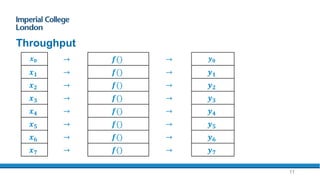
Throughput
11
𝒙𝟎 → 𝒇() → 𝒚𝟎
𝒙𝟏 → 𝒇() → 𝒚𝟏
𝒙𝟐 → 𝒇() → 𝒚𝟐
𝒙𝟑 → 𝒇() → 𝒚𝟑
𝒙𝟒 → 𝒇() → 𝒚𝟒
𝒙𝟓 → 𝒇() → 𝒚𝟓
𝒙𝟔 → 𝒇() → 𝒚𝟔
𝒙𝟕 → 𝒇() → 𝒚𝟕
Throughput
12
Maxeler MaxCompiler
𝒇()𝒇()
𝒇()𝒇()
𝒇()𝒇()
𝒇()𝒇()
𝒇()𝒇()
𝒇()𝒇()
𝒇()𝒇()
𝒇()𝒇()
𝒇()𝒇()
FPGA Accelerator Card
13
https://eu.mouser.com/
Price $8,707.34
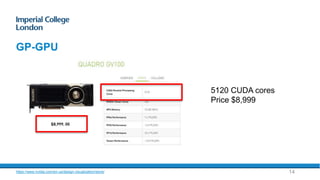
GP-GPU
14
https://www.nvidia.com/en-us/design-visualization/store/
5120 CUDA cores
Price $8,999
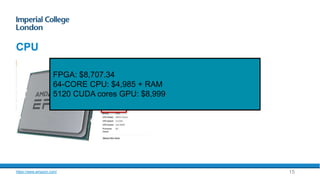
CPU
15
https://www.amazon.com/
64 cores
Price $4,985 + RAM
FPGA: $8,707.34
64-CORE CPU: $4,985 + RAM
5120 CUDA cores GPU: $8,999
• FPGA have higher throughput than CPUs (and GPUs) if the workload:
– Has many branch mispredictions
– Has many cache faults
• CPU: Intel(R) Core(TM) i7-8700 CPU @ 3.20GHz
• L1 latency = 2 cycles
• L2 latency = 15 cycles
• L3 latency = 32 cycles
16
https://github.com/DiamonDinoia/cpp-learning/blob/master/cache-latency/cache_test.c
1. void main_loop() {
2. while (true) {
3. for (x=0; x<ROW; x++) {
4. for(y=0;y<COL;y++){
5. switch (cell_to_char(PLANET[x][y])) {
6. case 'S':
7. if(UPDATE[x][y]==0 && shark_rule2(pw, x, y, k, l)==ALIVE) {
8. shark_rule1 (pw ,x , y, k, l);
9. }
10. break;
11. case 'F':
12. if(UPDATE[x][y]==0){
13. fish_rule4(pw, x, y, k, l);
14. fish_rule3(pw, x, y, k, l);
15. }
16. break;
17. }
18. }
19. }
20. }
21.}
17
https://github.com/DiamonDinoia/wator/
Simulator example
1. int shark_rule2 (wator_t* pw, int x, int y, int *k, int* l){
2. int i=0;
3. long rand=random();
4. motion move[4];
5. if (DEATH[x][y]==pw->sd) {
6. DEATH[x][y]=0;
7. PLANET[x][y]=char_to_cell('W');
8. BIRTH[x][y]=0;
9. return DEAD;
10. }
11. if(DEATH[x][y]<pw->sd){
12. DEATH[x][y]++;
13. }
14. if (BIRTH[x][y]<pw->sb){
15. BIRTH[x][y]++;
16. return ALIVE;
17. }
18. if (BIRTH[x][y]==pw->sb) {
19. BIRTH[x][y]=0;
20. inizialize_motion(pw, x, y, move);
21. i=partialsort(move, 'W');
22. if(!i){
23. return ALIVE;
24. }
25. new_coordinate(x, y, k, l, rand%i, move);
26. return ALIVE;
27. }
28. return ERROR;
29.}
18
Total of 9 branches in 50 lines of code
Metrics
$ perf record -e branch,branch-misses `./wator
[ perf record: Woken up 108 times to write data ]
[ perf record: Captured and wrote 28.441 MB perf.data (620737 samples) ]
$ perf report -n --symbols=main_loop
$
19
20
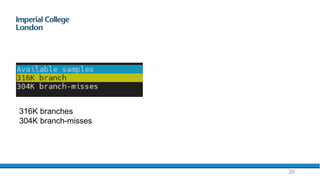
316K branches
304K branch-misses
Workload Examples
FPGA GPU
Sparse Matrix Dense Matrix
Sparse Graph Dense Graphs
Graph Neural Network Convolutional Neural Network
Decision tree
(Monte-Carlo) Simulation
Genomics computation
21
https://ieeexplore.ieee.org/document/8685122
22
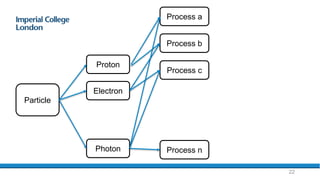
Particle
Proton
Electron
Photon
Process a
Process b
Process c
Process n
FPGA Programming
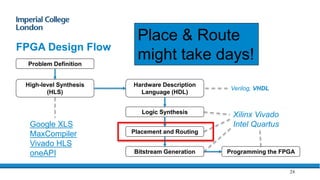
FPGA Design Flow
24
Problem Definition
Hardware Description
Language (HDL)
Verilog, VHDL
Bitstream Generation
Logic Synthesis
Placement and Routing
Programming the FPGA
Xilinx Vivado
Intel Quartus
High-level Synthesis
(HLS)
Google XLS
MaxCompiler
Vivado HLS
oneAPI
Place & Route
might take days!
25
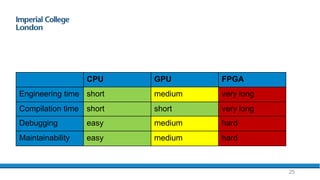
CPU GPU FPGA
Engineering time short medium very long
Compilation time short short very long
Debugging easy medium hard
Maintainability easy medium hard
• Avoid running Place and Route
– Simulate VHDL, Verilog using ModelSim
• ModelSim is slow!
– It is possible to execute very small testbenches in a
reasonable amount of time
26
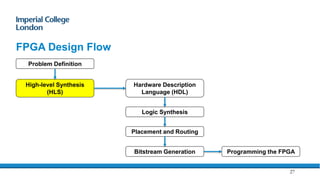
FPGA Design Flow
27
Problem Definition
Hardware Description
Language (HDL)
Bitstream Generation
Logic Synthesis
Placement and Routing
Programming the FPGA
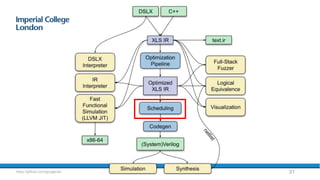
High-level Synthesis
(HLS)
28
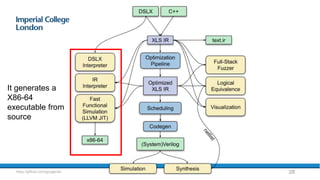
https://github.com/google/xls
It generates a
X86-64
executable from
source
High-level Synthesis (HLS)
• Using HLS toolchains makes unit testing possible in a reasonable amount of
time
• It is easy to interface with a reference software implementation to compare
the results
• It makes FPGA programming much less cumbersome
29
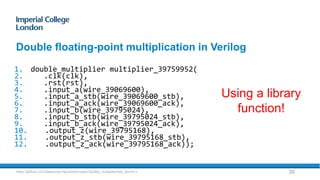
1. double_multiplier multiplier_39759952(
2. .clk(clk),
3. .rst(rst),
4. .input_a(wire_39069600),
5. .input_a_stb(wire_39069600_stb),
6. .input_a_ack(wire_39069600_ack),
7. .input_b(wire_39795024),
8. .input_b_stb(wire_39795024_stb),
9. .input_b_ack(wire_39795024_ack),
10. .output_z(wire_39795168),
11. .output_z_stb(wire_39795168_stb),
12. .output_z_ack(wire_39795168_ack));
30
https://github.com/dawsonjon/fpu/blob/master/double_multiplier/test_bench.v
Double floating-point multiplication in Verilog
Using a library
function!
31
https://github.com/google/xls
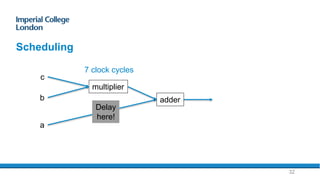
Scheduling
32
multiplier
a
b
c
adder
7 clock cycles
Delay
here!
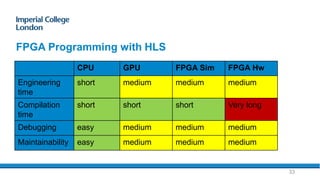
FPGA Programming with HLS
33
CPU GPU FPGA Sim FPGA Hw
Engineering
time
short medium medium medium
Compilation
time
short short short Very long
Debugging easy medium medium medium
Maintainability easy medium medium medium
HLS
• Advantages:
– simplify programming
– reduces engineering time
– Allows “rapid prototyping”
• Disadvantages:
– Nowadays HLS still achieves less performance than hand-written
optimized Verilog/VHDL
34
Performance
• HLS still requires significant engineering effort depending on the size of the
problem
• Hardware builds still take significant amount of time
• What if the FPGA does not perform as hoped?
• Reengineer the problem and start from scratch?
• Optimize the code a build several times?
35
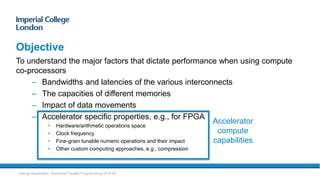
Performance Modelling
To understand the major factors that dictate performance when using compute
co-processors
– Bandwidths and latencies of the various interconnects
– The capacities of different memories
– Impact of data movements
– Accelerator specific properties, e.g., for FPGA
• Hardware/arithmetic operations space
• Clock frequency
• Fine-grain tunable numeric operations and their impact
• Other custom computing approaches, e.g., compression
Accelerator
compute
capabilities
Objective
Georgi Gaydadjiev, Advanced Parallel Programming 2019-20
FPGA Performance
• FPGA Performance is predictable
• There is no context switch, garbage collector or any background process
• The bitstream will be executed the same number of clock cycles every time
• The number of clock cycles needed can be computed easily
Further read: Nils Voss et al. (2021), On Predictable Reconfigurable System
Design
38
https://doi.org/10.1145/3436995
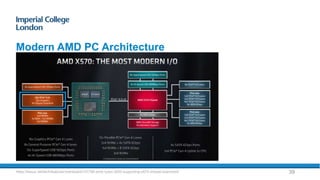
Modern AMD PC Architecture
39
https://hexus.net/tech/features/mainboard/131789-amd-ryzen-3000-supporting-x570-chipset-examined/
Xilinx Alveo U250 Data Center Accelerator Card
40
64 GB DDR4 @600MHz
4 channels of 64-bit 16G RDIMMs
available bandwidth: 77 GB/s
or 2,400 MT/s
16x PCI-Express
Power = 225W
100 Gbit Eth
(QSFP28) x 2
54MB On-chip Memory
available at 38 TB/s
Georgi Gaydadjiev, Advanced Parallel Programming 2019-20
PCIe 3.0 (x16) 15.75
GB/s
PCIe 4.0 (x16) 31.51
GB/s
Modern System Architecture
41
77 GB/s
100 Gbit
Ethernet
https://en.wikipedia.org/wiki/DDR4_SDRAM https://en.wikipedia.org/wiki/List_of_AMD_Ryzen_processors https://www.xilinx.com/products/boards-and-
kits/alveo/u250.html
42
Våge, Liv H
CMS Particle Track
Reconstruction Callgraph
Bottleneck
1. If compute bound -> optimize the algorithm, increase clock frequency
2. If I/O bound, find a strategy to reduce the I/O (caching, compression
accelerate other portion of the code)
3. Repeat until theoretical limit reached
43
Performance Model example
44
45
Performance Model example
46
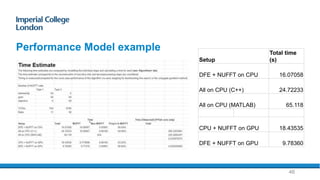
Setup
Total time
(s)
DFE + NUFFT on CPU 16.07058
All on CPU (C++) 24.72233
All on CPU (MATLAB) 65.118
CPU + NUFFT on GPU 18.43535
DFE + NUFFT on GPU 9.78360
FPGA Design Flow (simplified)
47
Problem Definition
Hardware Description
Language (HDL)
Bitstream Generation
Logic Synthesis
Placement and Routing
Programming the FPGA
Modelling and
performance prediction
High-level Synthesis
(HLS)
Final Architecture
Architecture
Benchmark
Current projects
MR-Linac
Source: https://www.icr.ac.uk/news-features/mr-linac
combines an MRI scanner
and a linear particle
accelerator
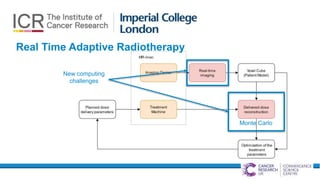
Monte Carlo
Real Time Adaptive Radiotherapy
New computing
challenges
108 particles needs to be simulated to achieve statistical significance
The stochastic behaviour breaks the pipeline of modern CPUs
Not suitable for GPU due to the lack of branch-predictors
Random memory accesses due to many lookup tables
Modern CPU and GPU implementations take more than 1 minute (Ziegenhein2015)
Other cloud-based approaches have reliability concerns (Ziegenhein2017)
Expensive
51
Source: https://iopscience.iop.org/article/10.1088/0031-9155/60/15/6097/meta https://iopscience.iop.org/article/10.1088/1361-6560/aa5d4e/meta
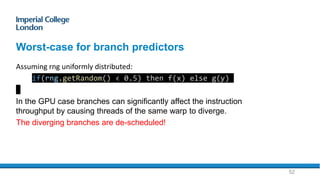
Assuming rng uniformly distributed:
if(rng.getRandom() < 0.5) then f(x) else g(y)
In the GPU case branches can significantly affect the instruction
throughput by causing threads of the same warp to diverge.
The diverging branches are de-scheduled!
Worst-case for branch predictors
52
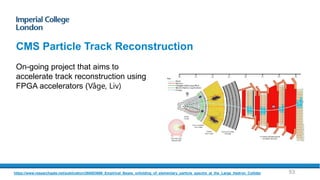
On-going project that aims to
accelerate track reconstruction using
FPGA accelerators (Våge, Liv)
CMS Particle Track Reconstruction
53
https://www.researchgate.net/publication/260003686_Empirical_Bayes_unfolding_of_elementary_particle_spectra_at_the_Large_Hadron_Collider
Summary
• FPGAs are becoming widely used in industry as accelerators for suitable
challenges (ultra low latency inference, graph processing and genomics)
• FPGAs widely used in HEP close to detector (trigger systems)
• Recent toolchain developments making programming FPGAs more accessible
• Potential applications in HEP starting to be studied
54
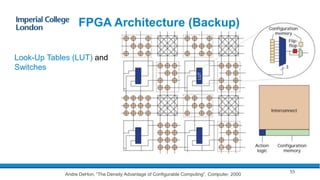
FPGA Architecture (Backup)
55
Look-Up Tables (LUT) and
Switches
Andre DeHon, “The Density Advantage of Configurable Computing”, Computer, 2000
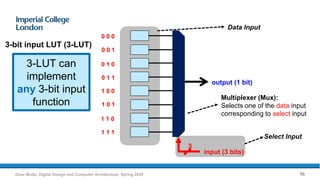
3-bit input LUT (3-LUT)
56
input (3 bits)
output (1 bit)
Data Input
Multiplexer (Mux):
Selects one of the data input
corresponding to select input
3
Select Input
0 0 0
0 0 1
0 1 0
0 1 1
1 0 0
1 0 1
1 1 0
1 1 1
3-LUT can
implement
any 3-bit input
function
Onur Mutlu, Digital Design and Computer Architecture, Spring 2020
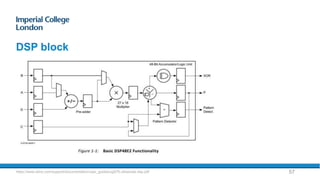
DSP block
57
https://www.xilinx.com/support/documentation/user_guides/ug579-ultrascale-dsp.pdf
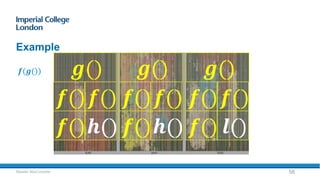
Example
58
Maxeler MaxCompiler
𝒈()
𝒇()𝒇()
𝒇()𝒉()
𝒈()
𝒇()𝒇()
𝒇()𝒉()
𝒈()
𝒇()𝒇()
𝒇() 𝒍()
𝒇(𝒈())
59

Introduction to FPGA acceleration

  • 1.
    Introduction to FPGAacceleration Marco Barbone m.barbone19@imperial.ac.uk Introduction to FPGA acceleration 14/04/2021
  • 2.
    About me 2 • M.Sc.in Computer Science and Networking Scuola superiore Sant’Anna & Università di Pisa • CERN OpenLab Summer student • Research Software Engineer, Maxeler Technologies • Ph.D. Student, Custom Computing research group, Imperial College London, Supervisor Prof. Wayne Luk • Member of Imperial College CMS group • Associate Ph.D. Student, The Institute of Cancer Research, London
  • 3.
    What is anFPGA? 3 https://www.xilinx.com/content/dam/xilinx/imgs/kits/u200-hero-p.jpg https://www.intel.com/content/dam/altera-www/global/en_US/support/boards- kits/stratix10/mx_fpga/stratix10mxboardtop.jpg/_jcr_content/renditions/cq5dam.web.1920.1080.jpeg https://en.wikipedia.org/wiki/Field-programmable_gate_array A field-programmable gate array (FPGA) is an integrated circuit designed to be configured by a customer or a designer after manufacturing – hence the term "field- programmable".
  • 4.
    Microsoft’s Project Brainwave “Microsoft’sProject Brainwave is a deep learning platform for real-time AI inference in the cloud and on the edge. A soft Neural Processing Unit (NPU), based on a high-performance field-programmable gate array (FPGA), accelerates deep neural network (DNN) inferencing, with applications in computer vision and natural language processing. Project Brainwave is transforming computing by augmenting CPUs with an interconnected and configurable compute layer composed of programmable silicon.” 4 https://www.microsoft.com/en-us/research/project/project-brainwave/ https://www.microsoft.com/en-us/research/blog/microsoft-unveils-project-brainwave/
  • 5.
    Amazon EC2 F1instances use FPGAs to enable delivery of custom hardware accelerations. F1 instances are easy to program and come with everything you need to develop, simulate, debug, and compile your hardware acceleration code, including an FPGA Developer AMI and supporting hardware level development on the cloud. Using F1 instances to deploy hardware accelerations can be useful in many applications to solve complex science, engineering, and business problems that require high bandwidth, enhanced networking, and very high compute capabilities. Examples of target applications that can benefit from F1 instance acceleration are genomics, search/analytics, image and video processing, network security, electronic design automation (EDA), image and file compression and big data analytics. Amazon EC2 F1 https://aws.amazon.com/ec2/instance-types/f1/ 5
  • 6.
    The DRAGEN Platformenables labs of all sizes and disciplines to do more with their genomic data. The DRAGEN Platform uses highly reconfigurable field-programmable gate array technology (FPGA) to provide hardware-accelerated implementations of genomic analysis algorithms, such as BCL conversion, mapping, alignment, sorting, duplicate marking, and haplotype variant calling. DNA Sequencing: DRAGEN Platform 6 https://www.illumina.com/products/by-type/informatics-products/dragen-bio-it-platform.html
  • 7.
    The dataflow architecturefor Smith-Waterman Matrix-fill and Traceback alignment stages, to perform short-read alignment on NGS data that delivers ×18 speedup over the respective Bowtie2 standalone components, while our codesigned Bowtie2 demonstrates a 35% boost in performance. Genomics DNA sequencing 7 https://ieeexplore.ieee.org/document/8892144
  • 8.
  • 9.
    Field Programmable GateArray • FPGA is a reconfigurable substrate – Reconfigurable functions, interconnection of functions, input/output • FPGAs fill the gap between software and hardware – higher throughput than software – lower latency than software – more flexibility than hardware 9 Onur Mutlu, Digital Design and Computer Architecture, Spring 2020 Not always true!
  • 10.
    Latency FPGAs achieve lowerlatency than software: – latency in the order of microseconds – latency constant and predictable CPUs are not suitable as thread overhead is ≈ 10 microseconds GPUs are even worse since PCIe bus sys-call requires milliseconds Examples: – Ultra low latency trading – CERN trigger system 10 https://www.velvetech.com/blog/fpga-in-high-frequency-trading/ https://indico.cern.ch/event/557251/contributions/2245644/attachments/1310074/2143323/thea_trg_intro_isotdaq2017.pdf
  • 11.
    Throughput 11 𝒙𝟎 → 𝒇()→ 𝒚𝟎 𝒙𝟏 → 𝒇() → 𝒚𝟏 𝒙𝟐 → 𝒇() → 𝒚𝟐 𝒙𝟑 → 𝒇() → 𝒚𝟑 𝒙𝟒 → 𝒇() → 𝒚𝟒 𝒙𝟓 → 𝒇() → 𝒚𝟓 𝒙𝟔 → 𝒇() → 𝒚𝟔 𝒙𝟕 → 𝒇() → 𝒚𝟕
  • 12.
  • 13.
  • 14.
  • 15.
    CPU 15 https://www.amazon.com/ 64 cores Price $4,985+ RAM FPGA: $8,707.34 64-CORE CPU: $4,985 + RAM 5120 CUDA cores GPU: $8,999
  • 16.
    • FPGA havehigher throughput than CPUs (and GPUs) if the workload: – Has many branch mispredictions – Has many cache faults • CPU: Intel(R) Core(TM) i7-8700 CPU @ 3.20GHz • L1 latency = 2 cycles • L2 latency = 15 cycles • L3 latency = 32 cycles 16 https://github.com/DiamonDinoia/cpp-learning/blob/master/cache-latency/cache_test.c
  • 17.
    1. void main_loop(){ 2. while (true) { 3. for (x=0; x<ROW; x++) { 4. for(y=0;y<COL;y++){ 5. switch (cell_to_char(PLANET[x][y])) { 6. case 'S': 7. if(UPDATE[x][y]==0 && shark_rule2(pw, x, y, k, l)==ALIVE) { 8. shark_rule1 (pw ,x , y, k, l); 9. } 10. break; 11. case 'F': 12. if(UPDATE[x][y]==0){ 13. fish_rule4(pw, x, y, k, l); 14. fish_rule3(pw, x, y, k, l); 15. } 16. break; 17. } 18. } 19. } 20. } 21.} 17 https://github.com/DiamonDinoia/wator/ Simulator example
  • 18.
    1. int shark_rule2(wator_t* pw, int x, int y, int *k, int* l){ 2. int i=0; 3. long rand=random(); 4. motion move[4]; 5. if (DEATH[x][y]==pw->sd) { 6. DEATH[x][y]=0; 7. PLANET[x][y]=char_to_cell('W'); 8. BIRTH[x][y]=0; 9. return DEAD; 10. } 11. if(DEATH[x][y]<pw->sd){ 12. DEATH[x][y]++; 13. } 14. if (BIRTH[x][y]<pw->sb){ 15. BIRTH[x][y]++; 16. return ALIVE; 17. } 18. if (BIRTH[x][y]==pw->sb) { 19. BIRTH[x][y]=0; 20. inizialize_motion(pw, x, y, move); 21. i=partialsort(move, 'W'); 22. if(!i){ 23. return ALIVE; 24. } 25. new_coordinate(x, y, k, l, rand%i, move); 26. return ALIVE; 27. } 28. return ERROR; 29.} 18 Total of 9 branches in 50 lines of code
  • 19.
    Metrics $ perf record-e branch,branch-misses `./wator [ perf record: Woken up 108 times to write data ] [ perf record: Captured and wrote 28.441 MB perf.data (620737 samples) ] $ perf report -n --symbols=main_loop $ 19
  • 20.
  • 21.
    Workload Examples FPGA GPU SparseMatrix Dense Matrix Sparse Graph Dense Graphs Graph Neural Network Convolutional Neural Network Decision tree (Monte-Carlo) Simulation Genomics computation 21 https://ieeexplore.ieee.org/document/8685122
  • 22.
  • 23.
  • 24.
    FPGA Design Flow 24 ProblemDefinition Hardware Description Language (HDL) Verilog, VHDL Bitstream Generation Logic Synthesis Placement and Routing Programming the FPGA Xilinx Vivado Intel Quartus High-level Synthesis (HLS) Google XLS MaxCompiler Vivado HLS oneAPI Place & Route might take days!
  • 25.
    25 CPU GPU FPGA Engineeringtime short medium very long Compilation time short short very long Debugging easy medium hard Maintainability easy medium hard
  • 26.
    • Avoid runningPlace and Route – Simulate VHDL, Verilog using ModelSim • ModelSim is slow! – It is possible to execute very small testbenches in a reasonable amount of time 26
  • 27.
    FPGA Design Flow 27 ProblemDefinition Hardware Description Language (HDL) Bitstream Generation Logic Synthesis Placement and Routing Programming the FPGA High-level Synthesis (HLS)
  • 28.
  • 29.
    High-level Synthesis (HLS) •Using HLS toolchains makes unit testing possible in a reasonable amount of time • It is easy to interface with a reference software implementation to compare the results • It makes FPGA programming much less cumbersome 29
  • 30.
    1. double_multiplier multiplier_39759952( 2..clk(clk), 3. .rst(rst), 4. .input_a(wire_39069600), 5. .input_a_stb(wire_39069600_stb), 6. .input_a_ack(wire_39069600_ack), 7. .input_b(wire_39795024), 8. .input_b_stb(wire_39795024_stb), 9. .input_b_ack(wire_39795024_ack), 10. .output_z(wire_39795168), 11. .output_z_stb(wire_39795168_stb), 12. .output_z_ack(wire_39795168_ack)); 30 https://github.com/dawsonjon/fpu/blob/master/double_multiplier/test_bench.v Double floating-point multiplication in Verilog Using a library function!
  • 31.
  • 32.
  • 33.
    FPGA Programming withHLS 33 CPU GPU FPGA Sim FPGA Hw Engineering time short medium medium medium Compilation time short short short Very long Debugging easy medium medium medium Maintainability easy medium medium medium
  • 34.
    HLS • Advantages: – simplifyprogramming – reduces engineering time – Allows “rapid prototyping” • Disadvantages: – Nowadays HLS still achieves less performance than hand-written optimized Verilog/VHDL 34
  • 35.
    Performance • HLS stillrequires significant engineering effort depending on the size of the problem • Hardware builds still take significant amount of time • What if the FPGA does not perform as hoped? • Reengineer the problem and start from scratch? • Optimize the code a build several times? 35
  • 36.
  • 37.
    To understand themajor factors that dictate performance when using compute co-processors – Bandwidths and latencies of the various interconnects – The capacities of different memories – Impact of data movements – Accelerator specific properties, e.g., for FPGA • Hardware/arithmetic operations space • Clock frequency • Fine-grain tunable numeric operations and their impact • Other custom computing approaches, e.g., compression Accelerator compute capabilities Objective Georgi Gaydadjiev, Advanced Parallel Programming 2019-20
  • 38.
    FPGA Performance • FPGAPerformance is predictable • There is no context switch, garbage collector or any background process • The bitstream will be executed the same number of clock cycles every time • The number of clock cycles needed can be computed easily Further read: Nils Voss et al. (2021), On Predictable Reconfigurable System Design 38 https://doi.org/10.1145/3436995
  • 39.
    Modern AMD PCArchitecture 39 https://hexus.net/tech/features/mainboard/131789-amd-ryzen-3000-supporting-x570-chipset-examined/
  • 40.
    Xilinx Alveo U250Data Center Accelerator Card 40 64 GB DDR4 @600MHz 4 channels of 64-bit 16G RDIMMs available bandwidth: 77 GB/s or 2,400 MT/s 16x PCI-Express Power = 225W 100 Gbit Eth (QSFP28) x 2 54MB On-chip Memory available at 38 TB/s Georgi Gaydadjiev, Advanced Parallel Programming 2019-20
  • 41.
    PCIe 3.0 (x16)15.75 GB/s PCIe 4.0 (x16) 31.51 GB/s Modern System Architecture 41 77 GB/s 100 Gbit Ethernet https://en.wikipedia.org/wiki/DDR4_SDRAM https://en.wikipedia.org/wiki/List_of_AMD_Ryzen_processors https://www.xilinx.com/products/boards-and- kits/alveo/u250.html
  • 42.
    42 Våge, Liv H CMSParticle Track Reconstruction Callgraph Bottleneck
  • 43.
    1. If computebound -> optimize the algorithm, increase clock frequency 2. If I/O bound, find a strategy to reduce the I/O (caching, compression accelerate other portion of the code) 3. Repeat until theoretical limit reached 43
  • 44.
  • 45.
  • 46.
    Performance Model example 46 Setup Totaltime (s) DFE + NUFFT on CPU 16.07058 All on CPU (C++) 24.72233 All on CPU (MATLAB) 65.118 CPU + NUFFT on GPU 18.43535 DFE + NUFFT on GPU 9.78360
  • 47.
    FPGA Design Flow(simplified) 47 Problem Definition Hardware Description Language (HDL) Bitstream Generation Logic Synthesis Placement and Routing Programming the FPGA Modelling and performance prediction High-level Synthesis (HLS) Final Architecture Architecture Benchmark
  • 48.
  • 49.
  • 50.
    Monte Carlo Real TimeAdaptive Radiotherapy New computing challenges
  • 51.
    108 particles needsto be simulated to achieve statistical significance The stochastic behaviour breaks the pipeline of modern CPUs Not suitable for GPU due to the lack of branch-predictors Random memory accesses due to many lookup tables Modern CPU and GPU implementations take more than 1 minute (Ziegenhein2015) Other cloud-based approaches have reliability concerns (Ziegenhein2017) Expensive 51 Source: https://iopscience.iop.org/article/10.1088/0031-9155/60/15/6097/meta https://iopscience.iop.org/article/10.1088/1361-6560/aa5d4e/meta
  • 52.
    Assuming rng uniformlydistributed: if(rng.getRandom() < 0.5) then f(x) else g(y) In the GPU case branches can significantly affect the instruction throughput by causing threads of the same warp to diverge. The diverging branches are de-scheduled! Worst-case for branch predictors 52
  • 53.
    On-going project thataims to accelerate track reconstruction using FPGA accelerators (Våge, Liv) CMS Particle Track Reconstruction 53 https://www.researchgate.net/publication/260003686_Empirical_Bayes_unfolding_of_elementary_particle_spectra_at_the_Large_Hadron_Collider
  • 54.
    Summary • FPGAs arebecoming widely used in industry as accelerators for suitable challenges (ultra low latency inference, graph processing and genomics) • FPGAs widely used in HEP close to detector (trigger systems) • Recent toolchain developments making programming FPGAs more accessible • Potential applications in HEP starting to be studied 54
  • 55.
    FPGA Architecture (Backup) 55 Look-UpTables (LUT) and Switches Andre DeHon, “The Density Advantage of Configurable Computing”, Computer, 2000
  • 56.
    3-bit input LUT(3-LUT) 56 input (3 bits) output (1 bit) Data Input Multiplexer (Mux): Selects one of the data input corresponding to select input 3 Select Input 0 0 0 0 0 1 0 1 0 0 1 1 1 0 0 1 0 1 1 1 0 1 1 1 3-LUT can implement any 3-bit input function Onur Mutlu, Digital Design and Computer Architecture, Spring 2020
  • 57.
  • 58.
  • 59.