FPGA
( Field programmable gate array )
April 2008
• Prepared by :
Muhammad Ziyada
Muhammad Al tabakh
Contents
• Hardware engineers vs software developers
• FPGA Market
• History of FPGA
• Modern developments
• Architecture
• Design and programming
Hardware designers vs software developers
• The hardware engineers roll up their sleeves
and work for months without a break
• software programmers would sit back and
relax, or play ping-pong, until the hardware
was stable.
• the hardware design would quickly become
a hardware redesign for some perceived
deficiency or new feature request
VHDL solution
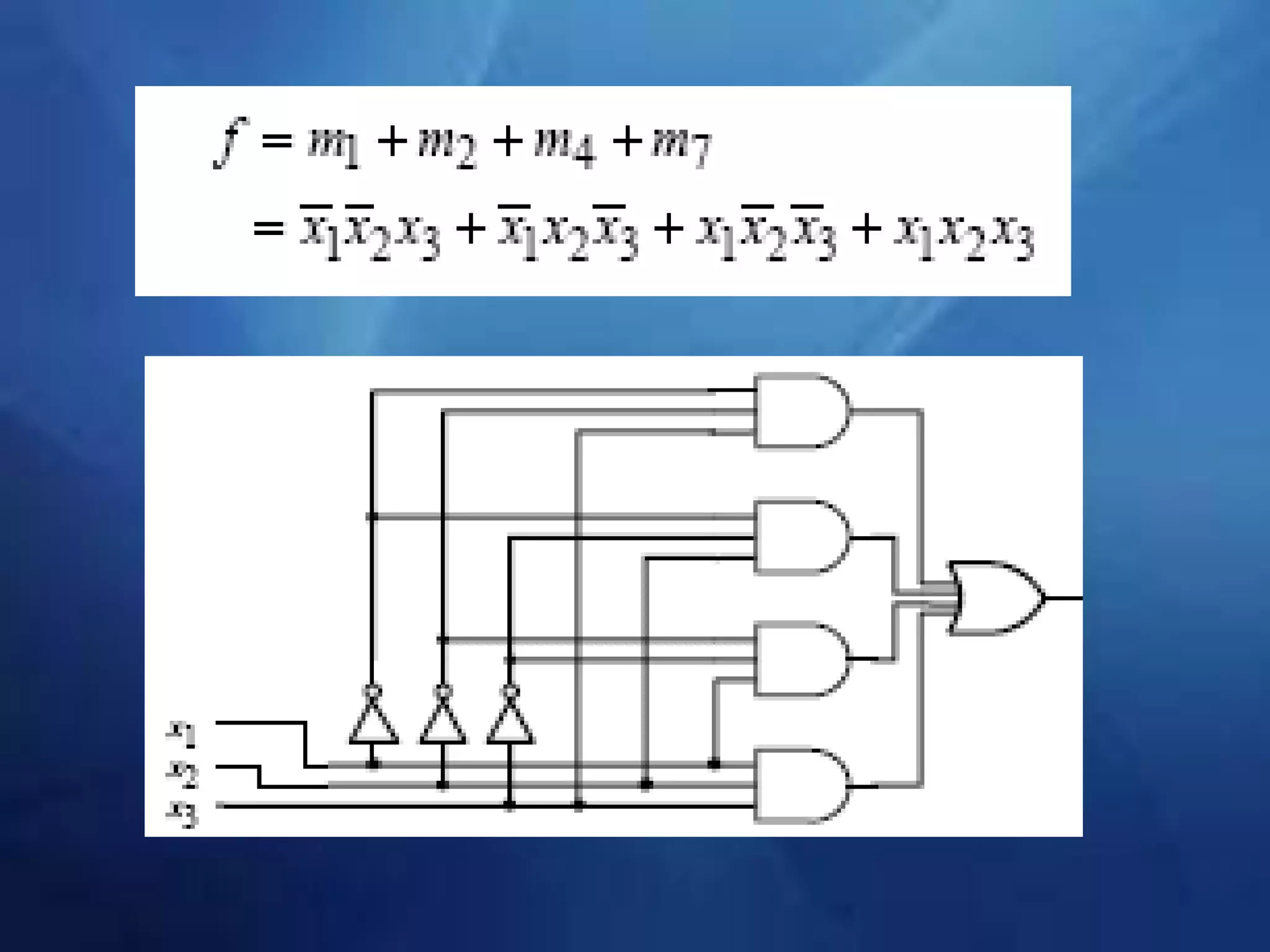
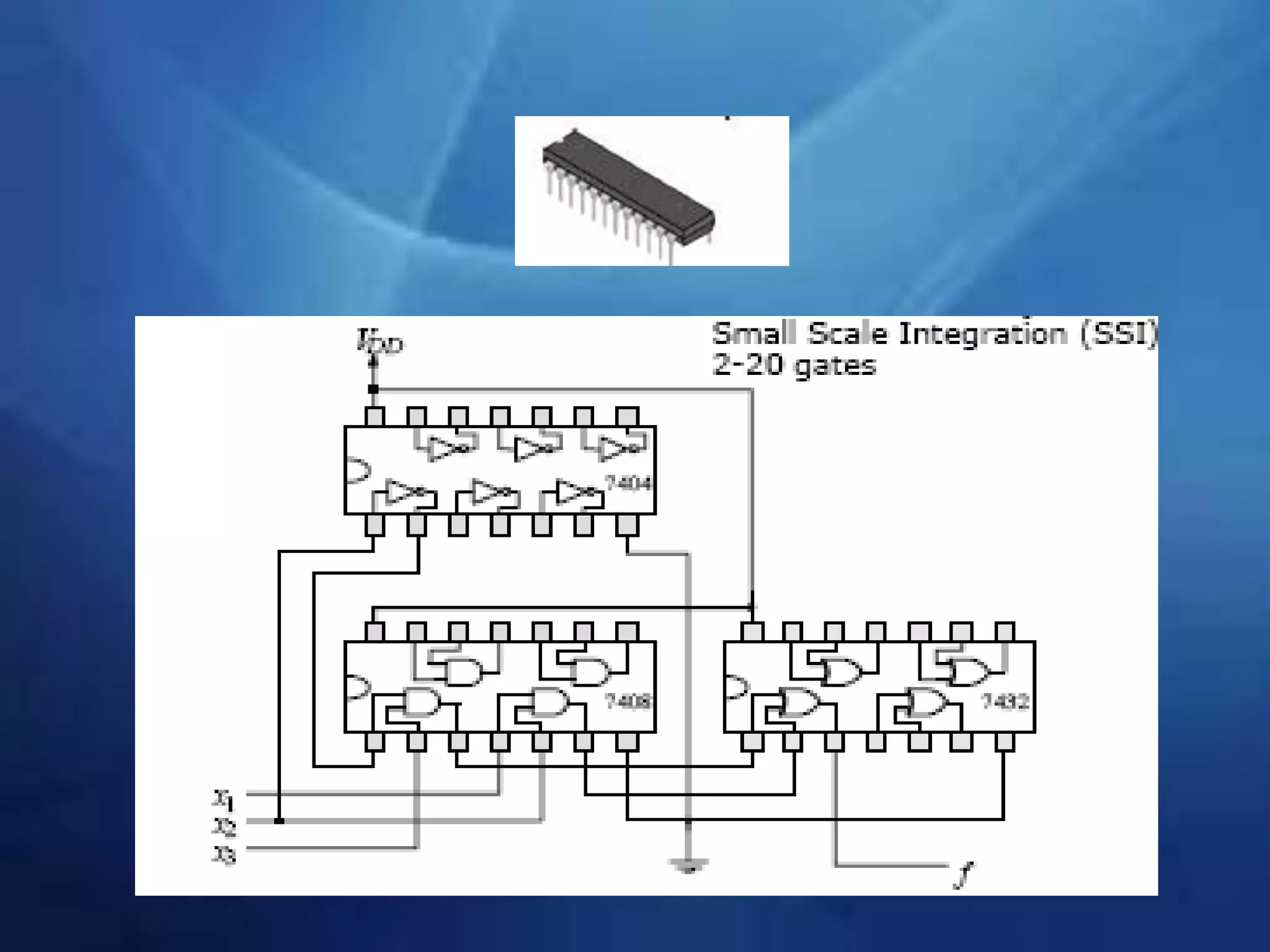
• In the early days, circuits as gate-level
schematics .
• saved by (HDLs).
• allowed us to describe the functionality
• Allowed design to be quickly and easily
represented and simulated
VHDL
• VHSIC hardware description language
• developed at the behest of the US Department of
Defense
• alternative to huge, complex manuals which were
subject to implementation-specific details
• logic simulators were developed to read the
VHDL files
• logic synthesis tools that read the VHDL
FPGA market
• FPGA Market Will Reach $2.75 Billion by Decade’s
End
FPGA market
• January 2008
• Celoxica Holdings has agreed the $3m sale of its
electronic system level (ESL) business to US firm
Catalytic.
• With this move, we can synthesize the top two
languages for high-level algorithm development
— C and MATLAB — and deliver both software
and hardware implementations
FPGA market
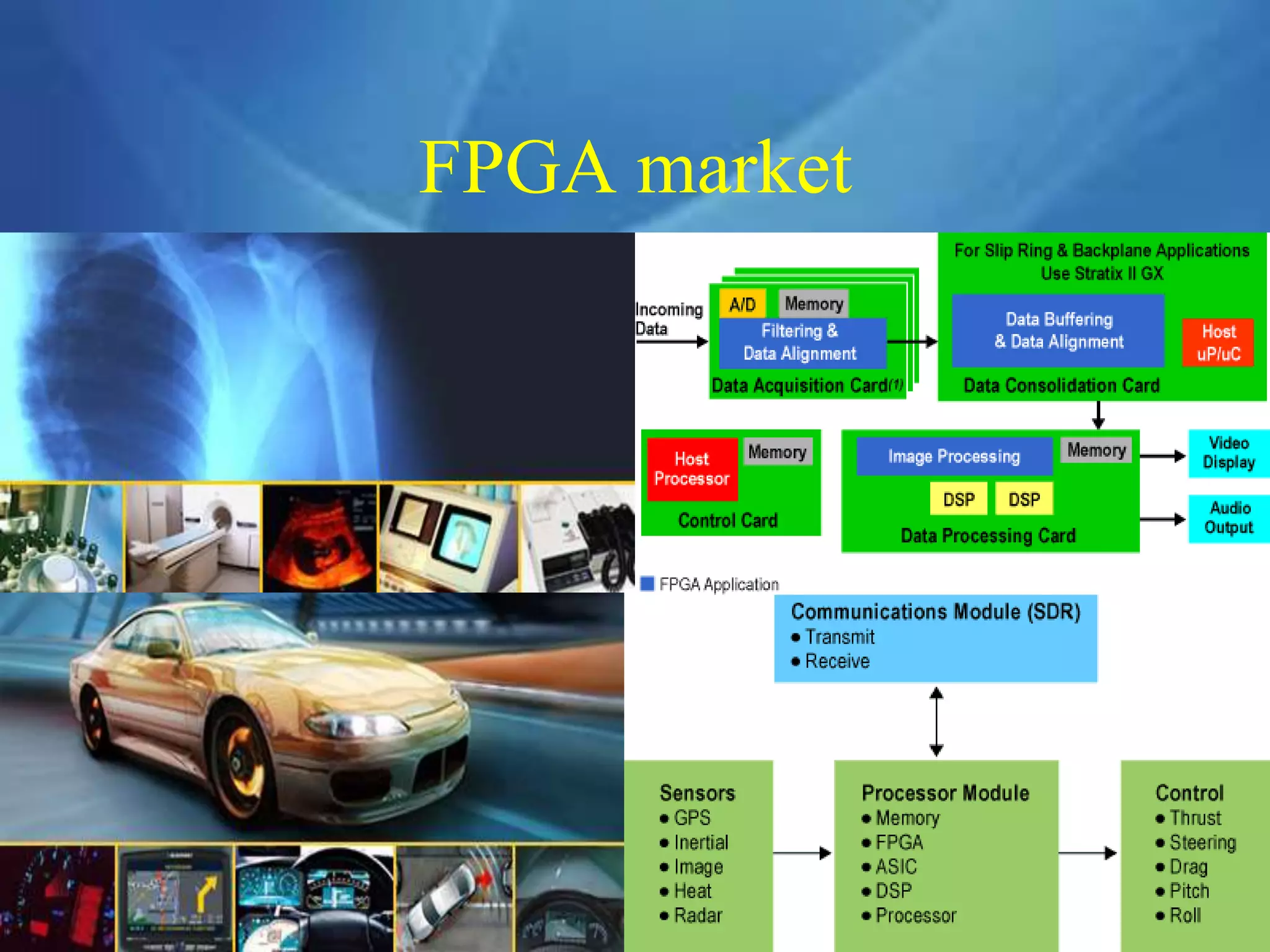
• Aerospace & Defense
• Automotive
• Broadcast Consumer
• Data Processing and Storage
• Industrial / Scientific / Medical
• Wired Communications
• Wireless Communications
FPGA market
Brief history
• the invention of the very first
computers in the 1940's and 1950's
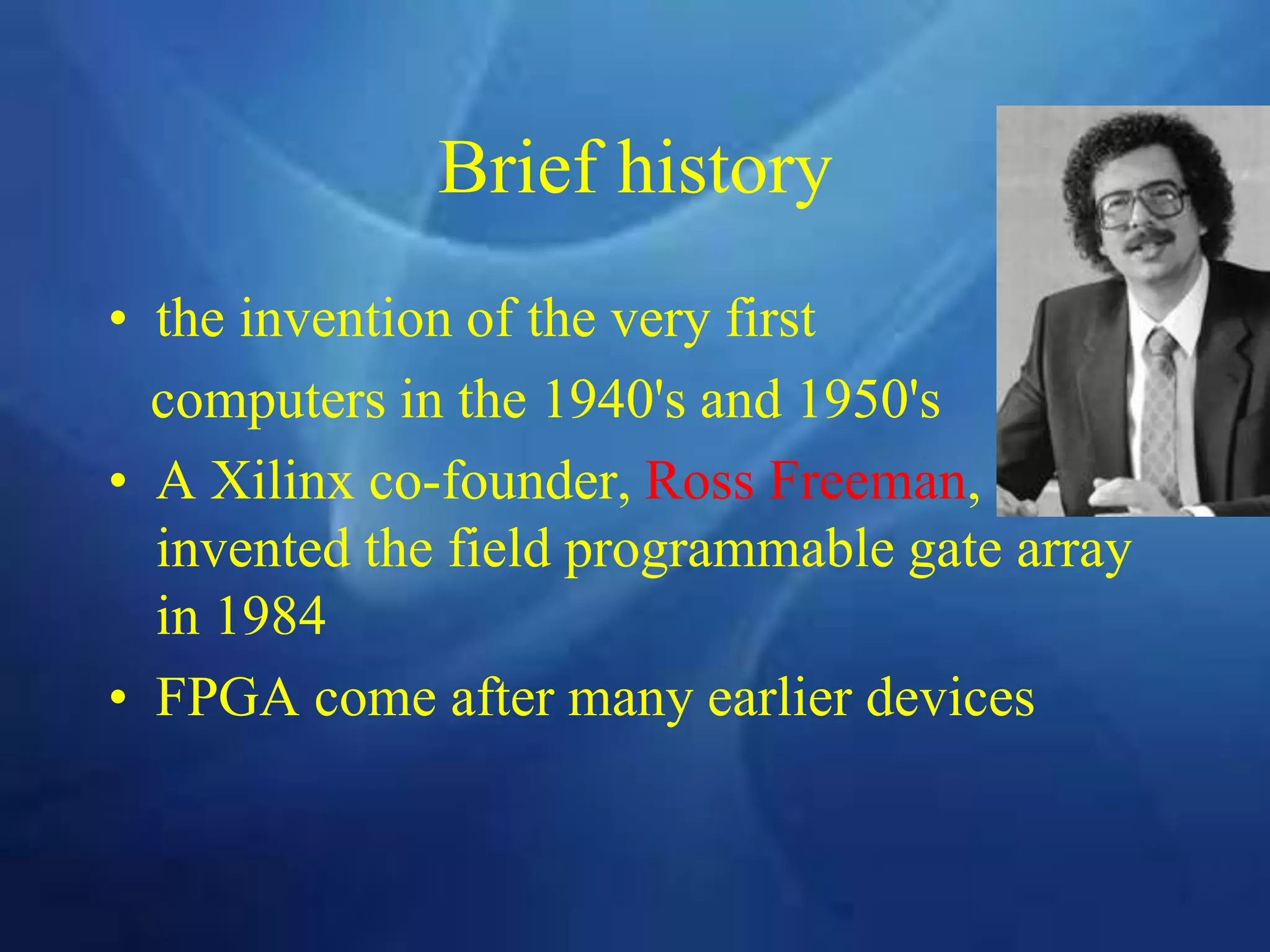
• A Xilinx co-founder, Ross Freeman,
invented the field programmable gate array
in 1984
• FPGA come after many earlier devices
Modern development
• Configurable Logic Blocks
Registers (flip flops) for fast data storage
. Logic Routing
• Input/Output Blocks
Basic pin logic (flip flops, muxs, etc)
• Block Ram
Internal memory for data storage
• Digital Clock Managers
Clock distribution
• Programmable Routing Matrix
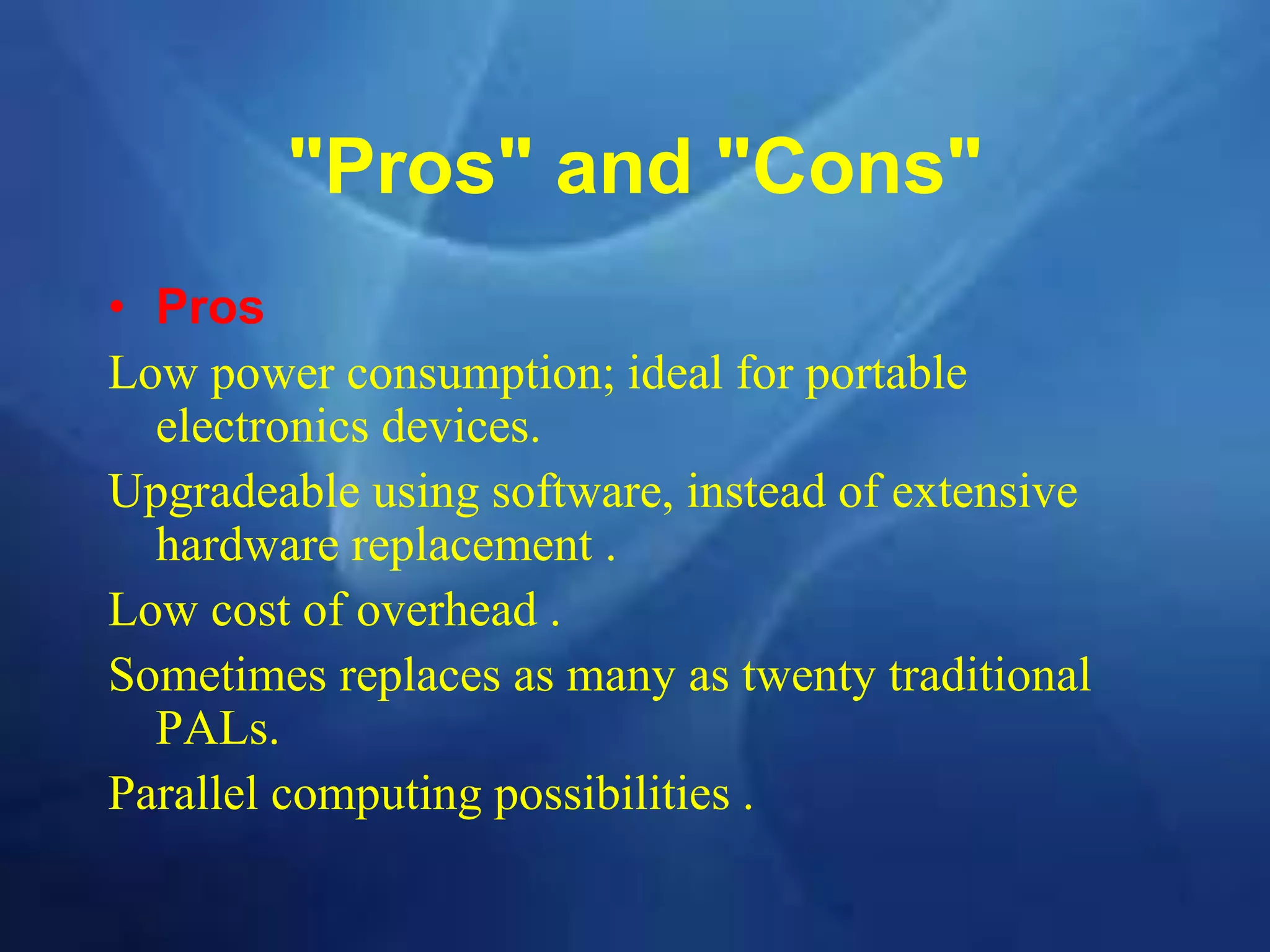
"Pros" and "Cons"
• Pros
Low power consumption; ideal for portable
electronics devices.
Upgradeable using software, instead of extensive
hardware replacement .
Low cost of overhead .
Sometimes replaces as many as twenty traditional
PALs.
Parallel computing possibilities .
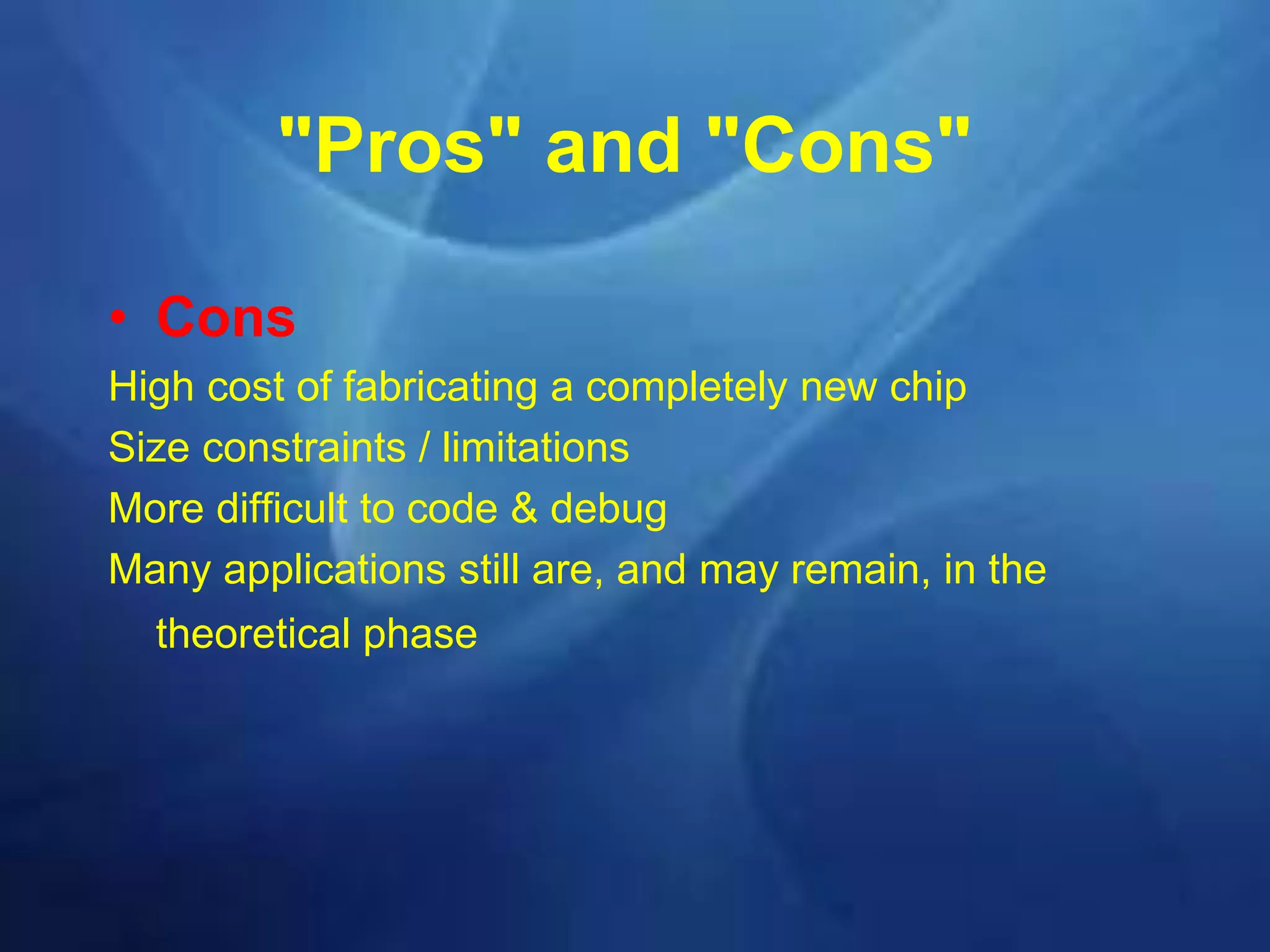
• Cons
High cost of fabricating a completely new chip
Size constraints / limitations
More difficult to code & debug
Many applications still are, and may remain, in the
theoretical phase
"Pros" and "Cons"
FPGA vs classical architecture
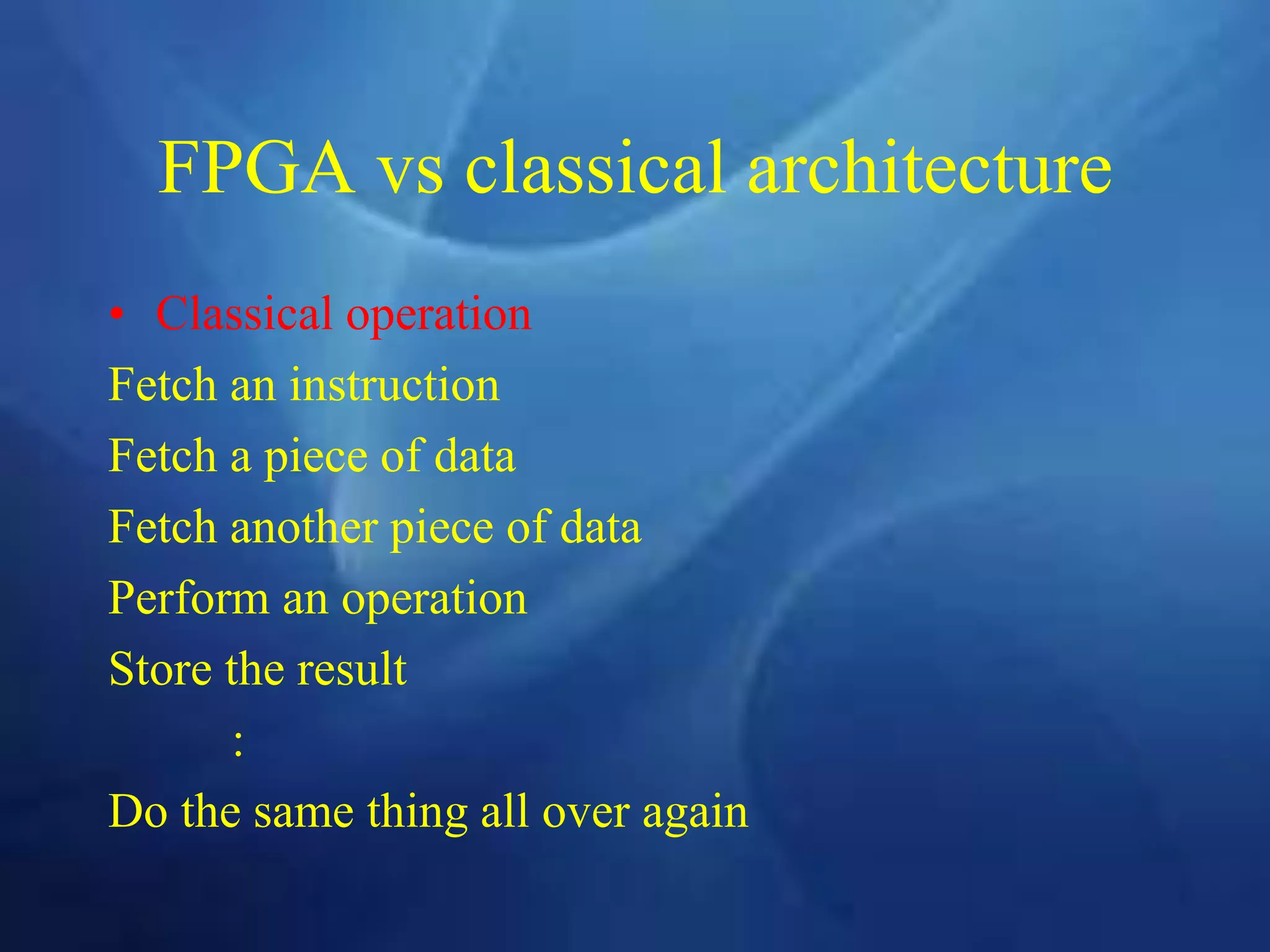
• Classical operation
Fetch an instruction
Fetch a piece of data
Fetch another piece of data
Perform an operation
Store the result
:
Do the same thing all over again
FPGA vs classical architecture
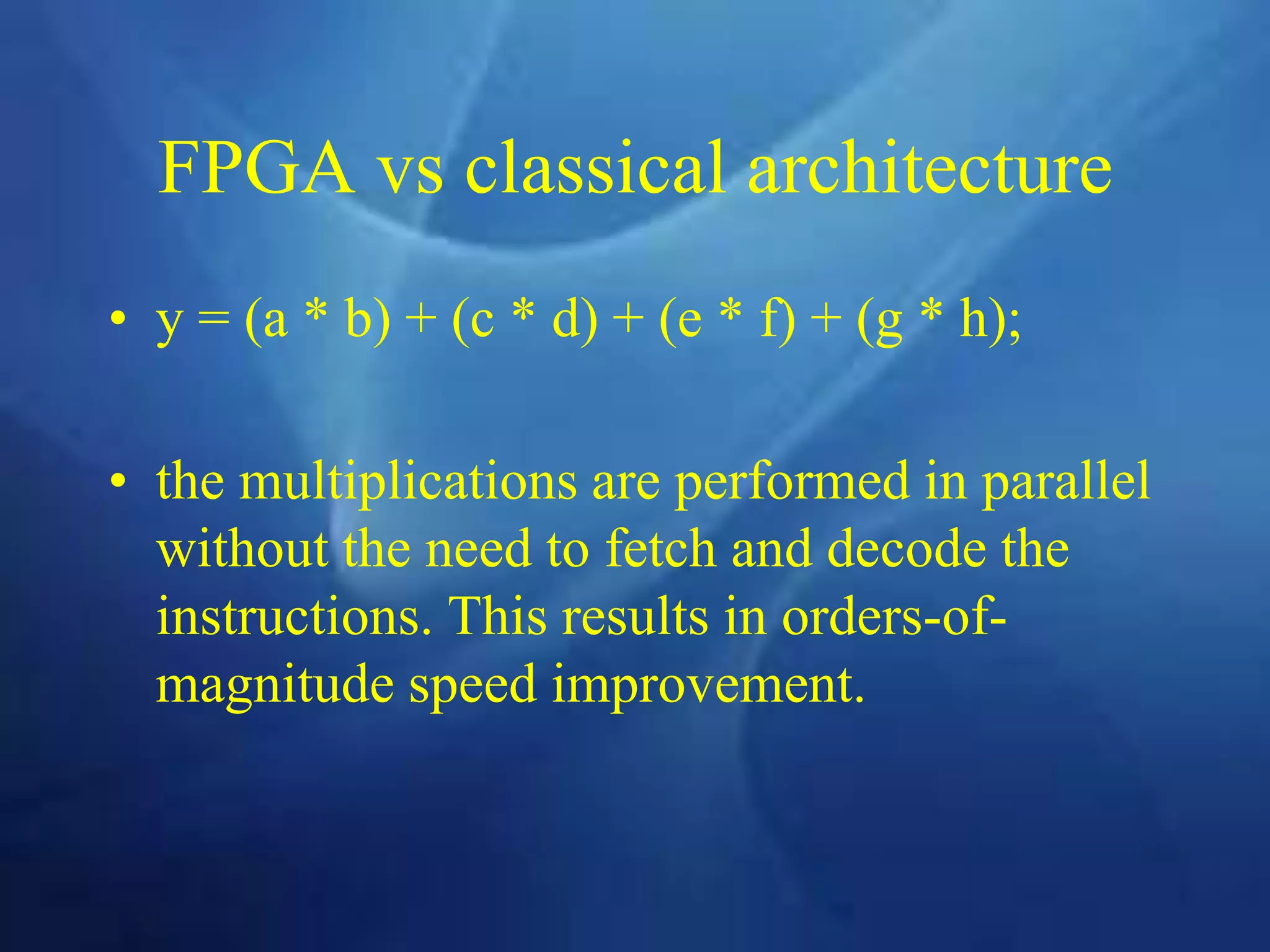
• y = (a * b) + (c * d) + (e * f) + (g * h);
• the multiplications are performed in parallel
without the need to fetch and decode the
instructions. This results in orders-of-
magnitude speed improvement.
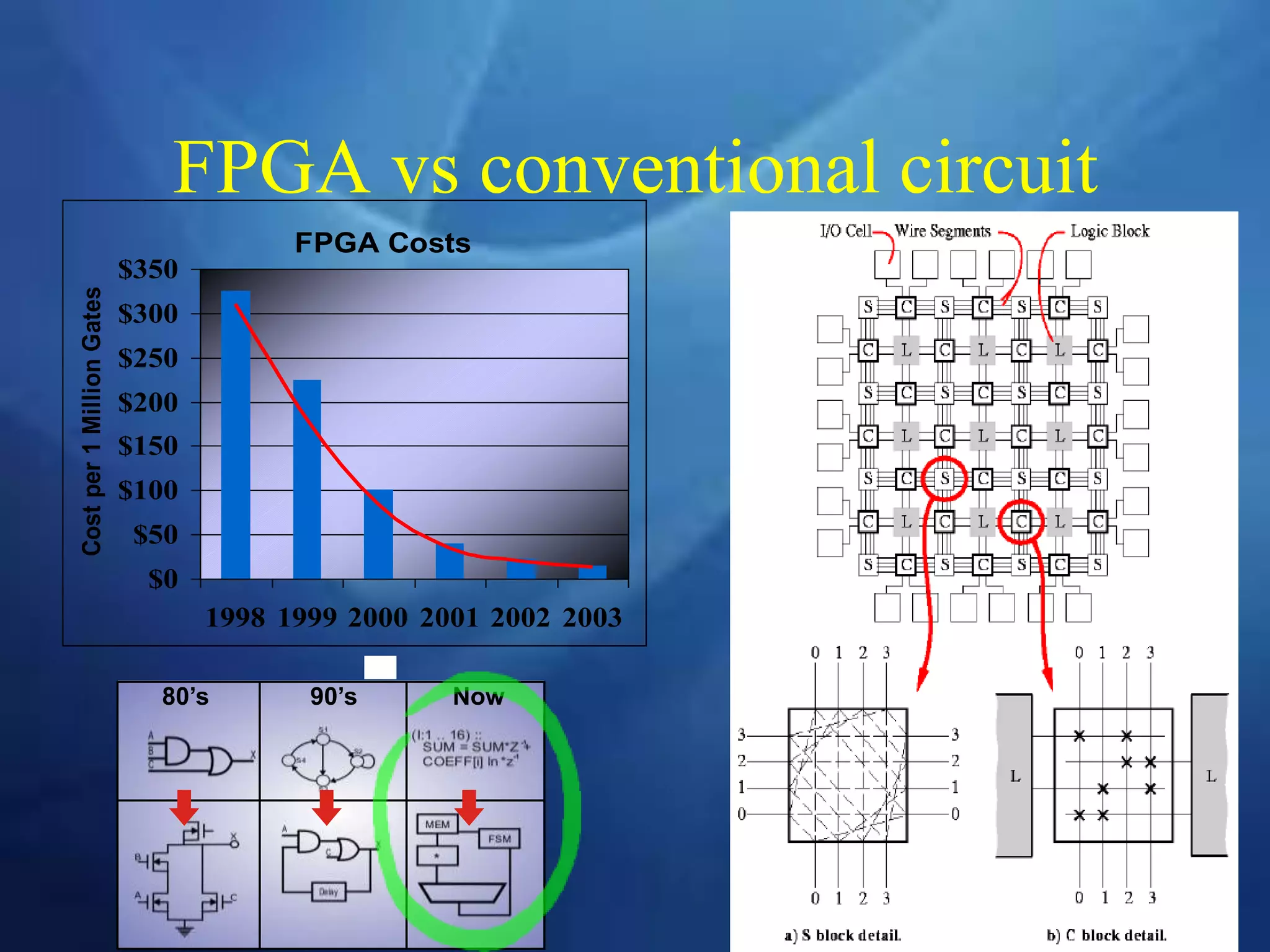
FPGA vs conventional circuit
FPGA Costs
$0
$50
$100
$150
$200
$250
$300
$350
1998 1999 2000 2001 2002 2003
Cost
per
1
Million
Gates
80’s 90’s Now
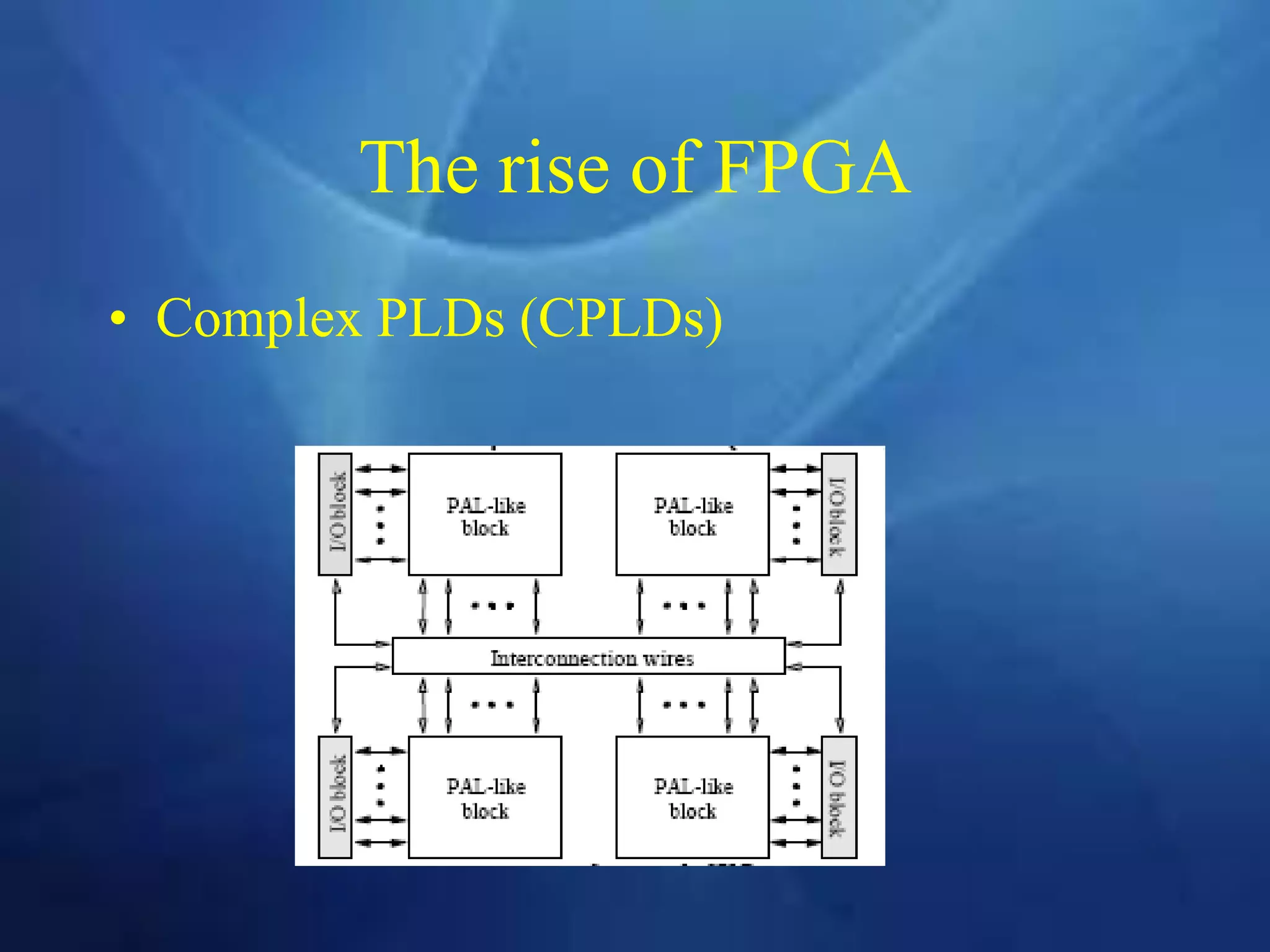
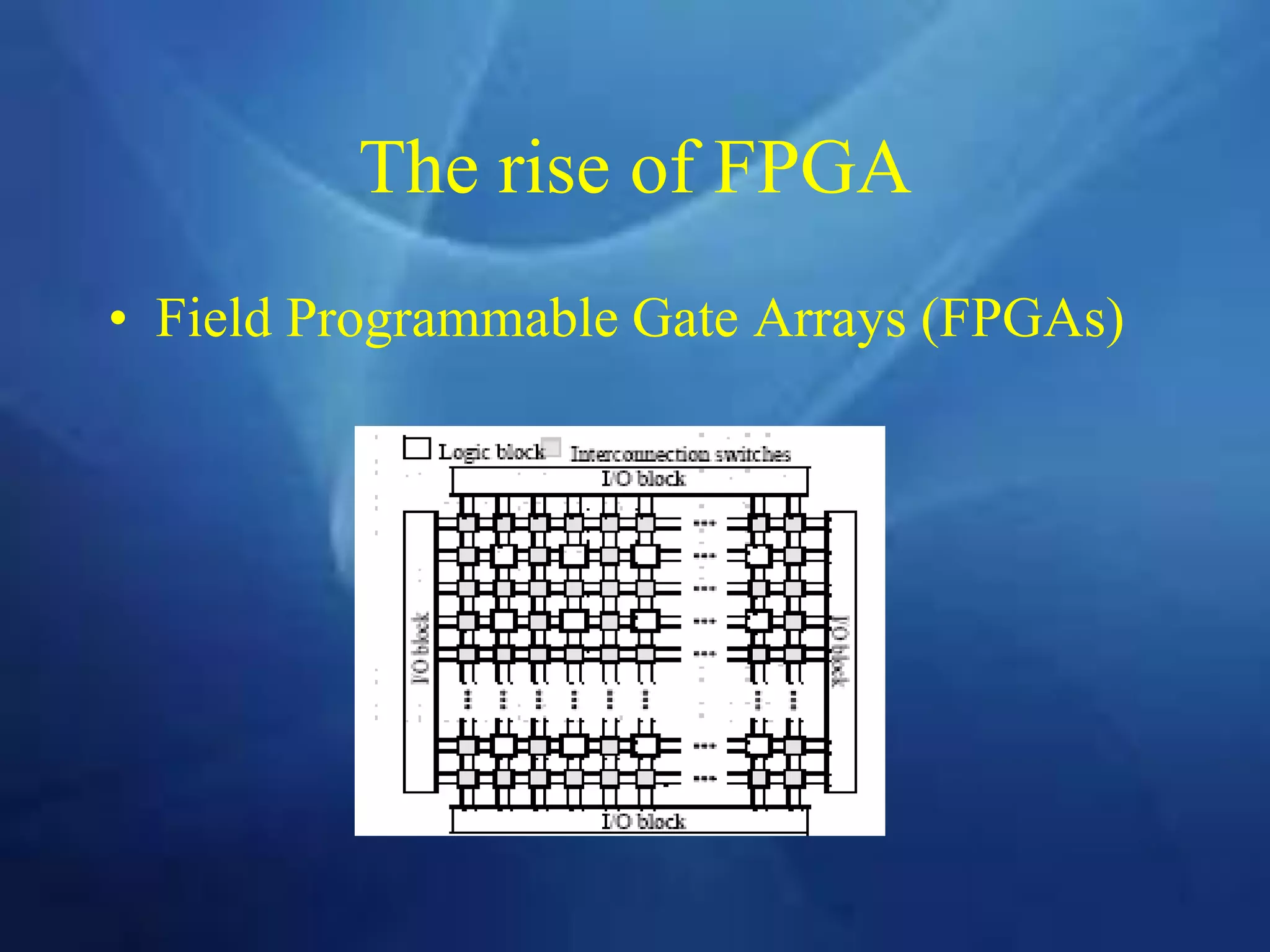
The rise of FPGA
• The first devices were primitive diode
matrices used in TV channel selectors,
HAM radio tuners, emerging defense and
space applications.
• replaced by more capable logic devices
based on arrays of combinatorial gates
• dramatic change in reprogram ability, more
flexible interconnect architectures.
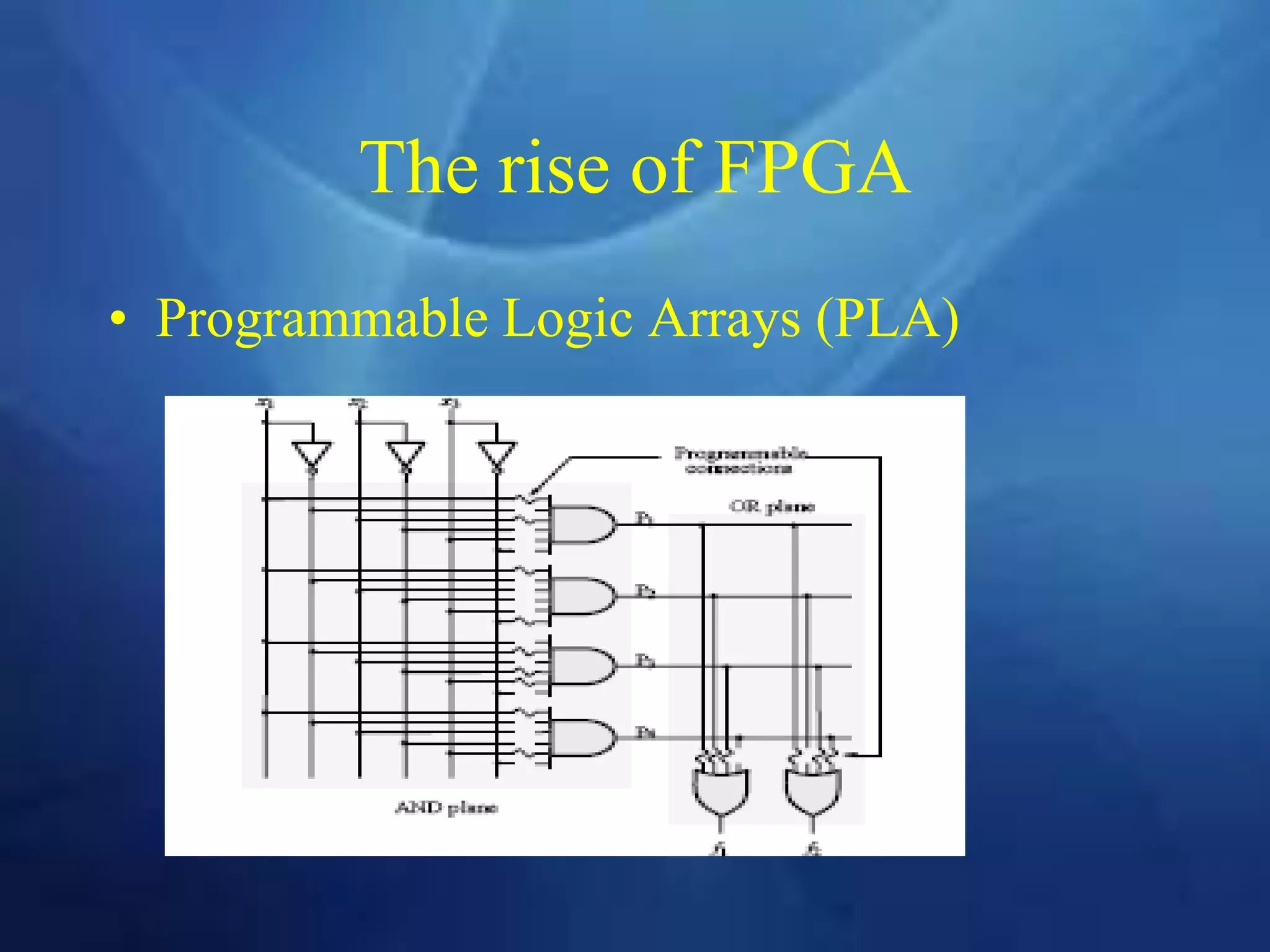
The rise of FPGA
• Programmable Logic Arrays (PLA)
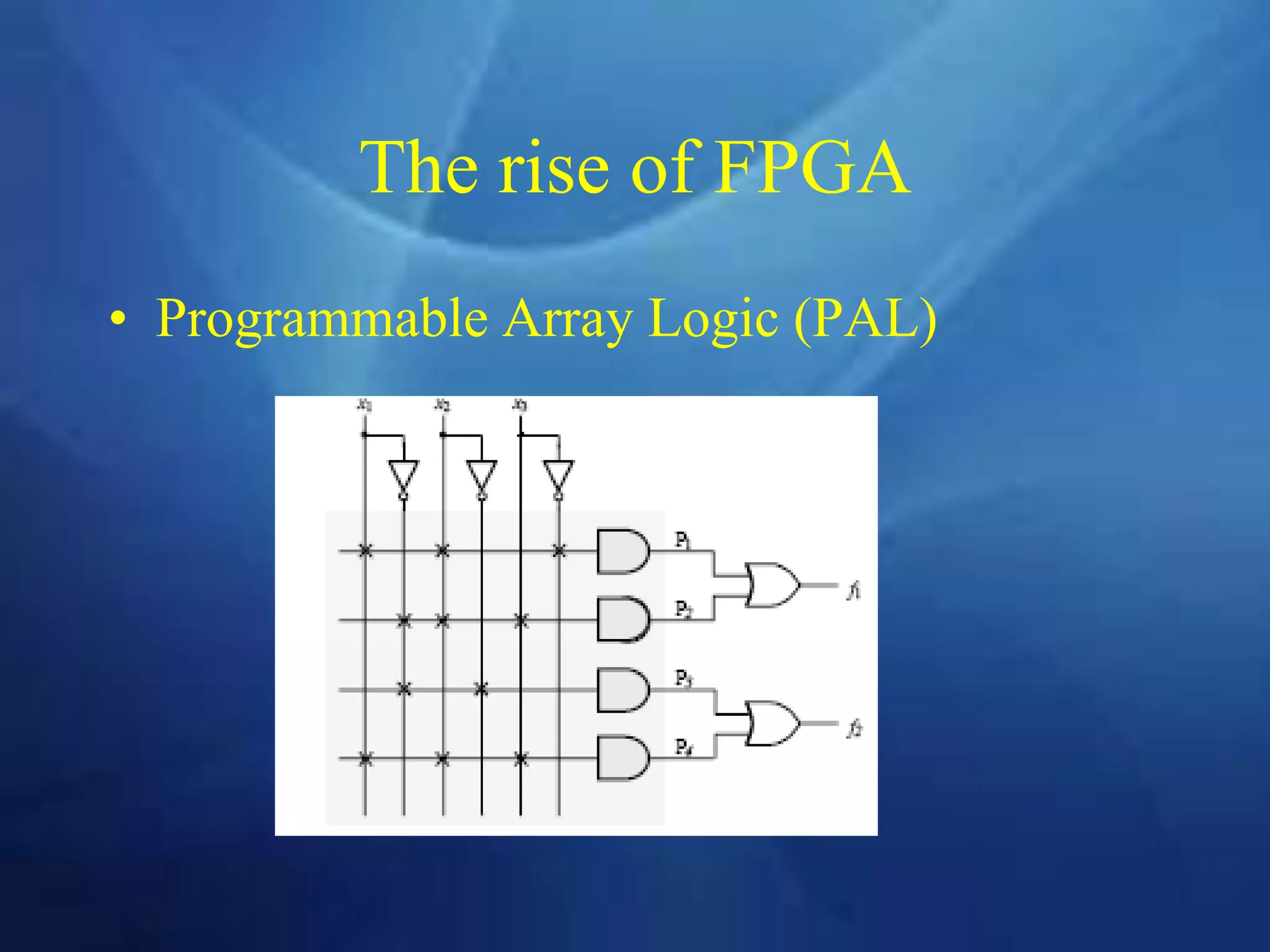
The rise of FPGA
• Programmable Array Logic (PAL)
The rise of FPGA
• Complex PLDs (CPLDs)
The rise of FPGA
• Field Programmable Gate Arrays (FPGAs)
Main vendors
• Xilinx spartan and vertix series
ise webback software
• Altera cyclon series
Quartus software
• Mentor Graphic
FPGAdv software
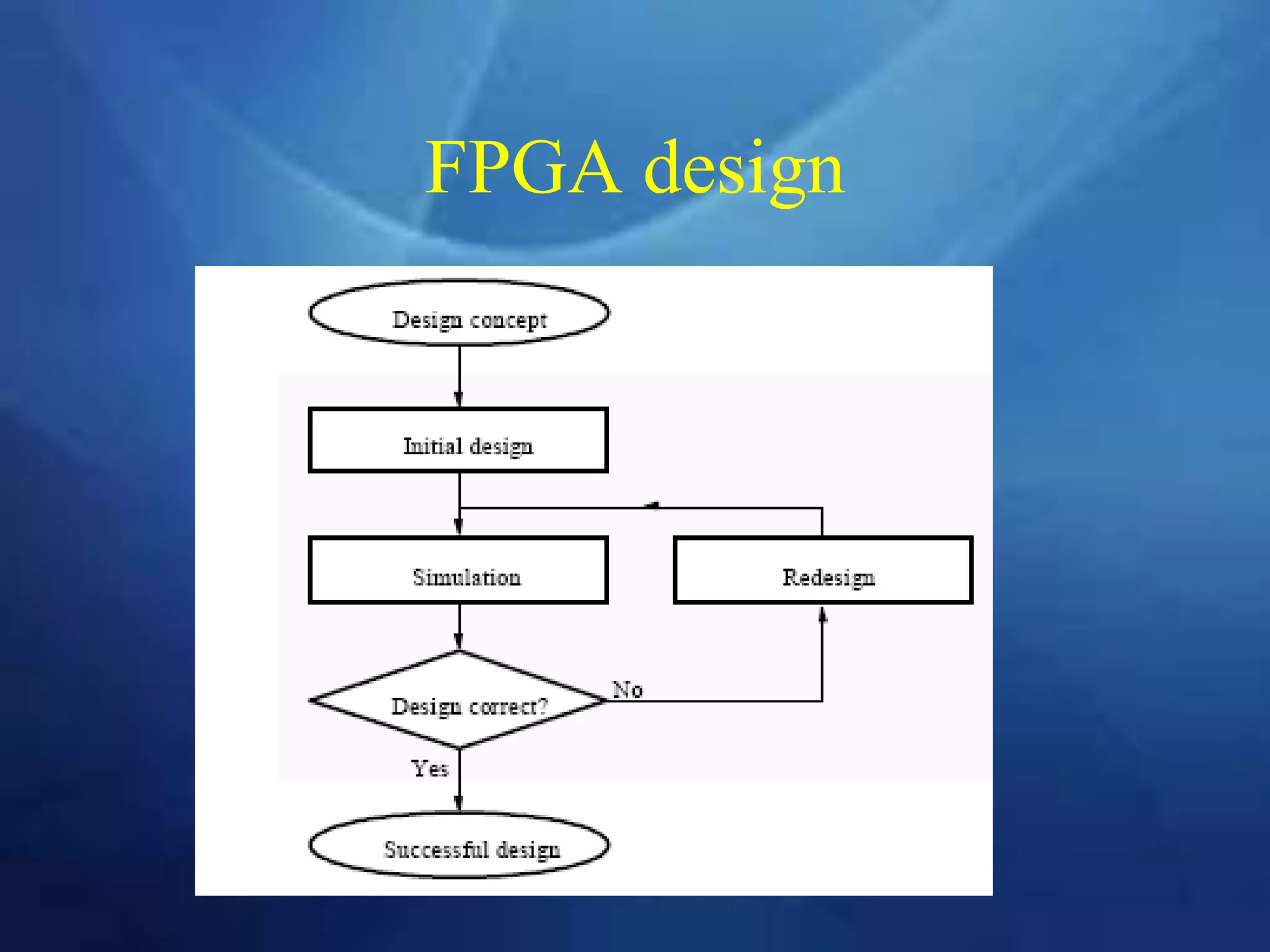
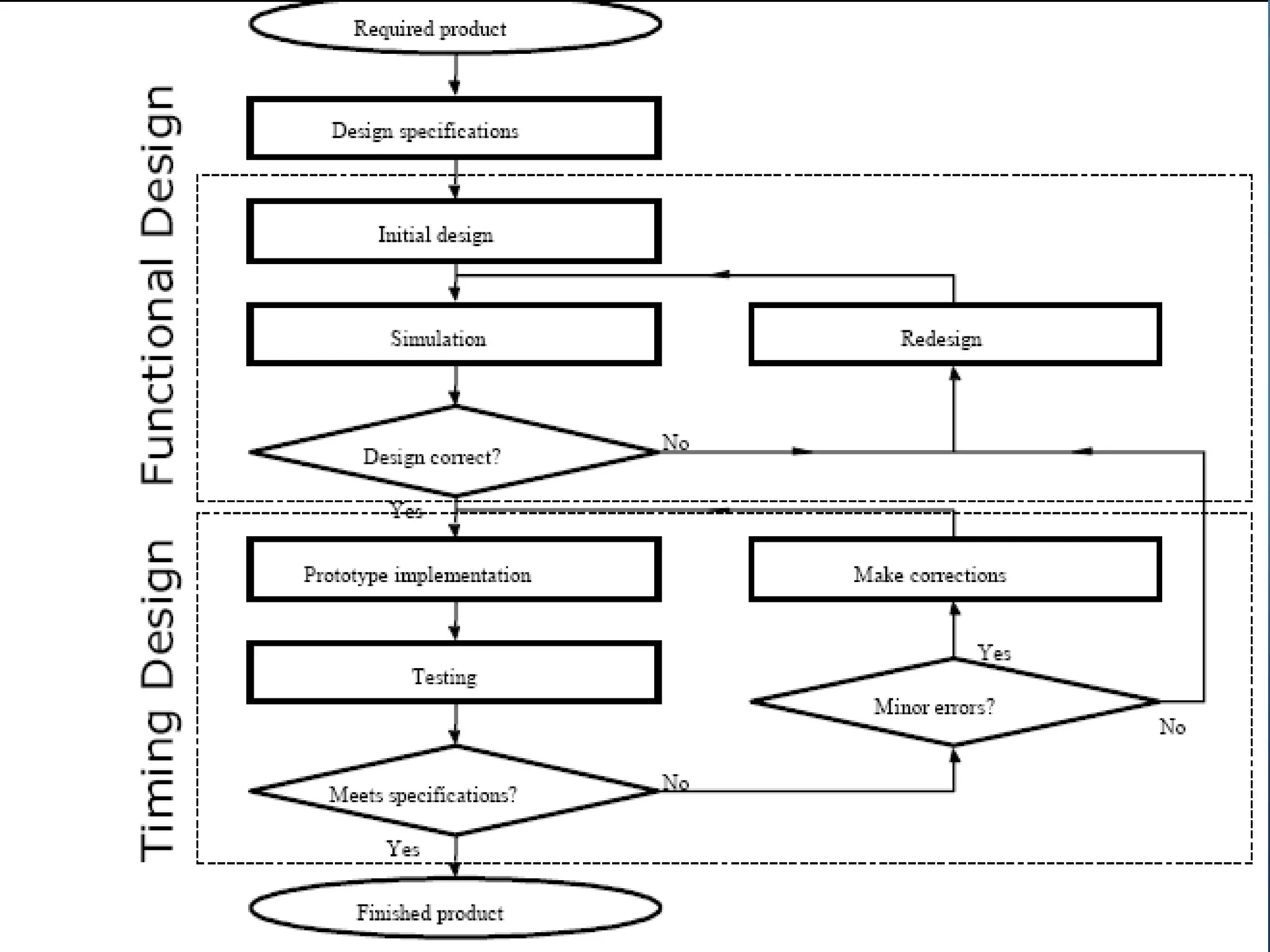
FPGA design
skip
FPGA design
FPGA programming
Languages
HDL languages ( VHDL and VERILOG )
Truth table
Block diagram
Schematic diagram
Flowchart
State machine
And more
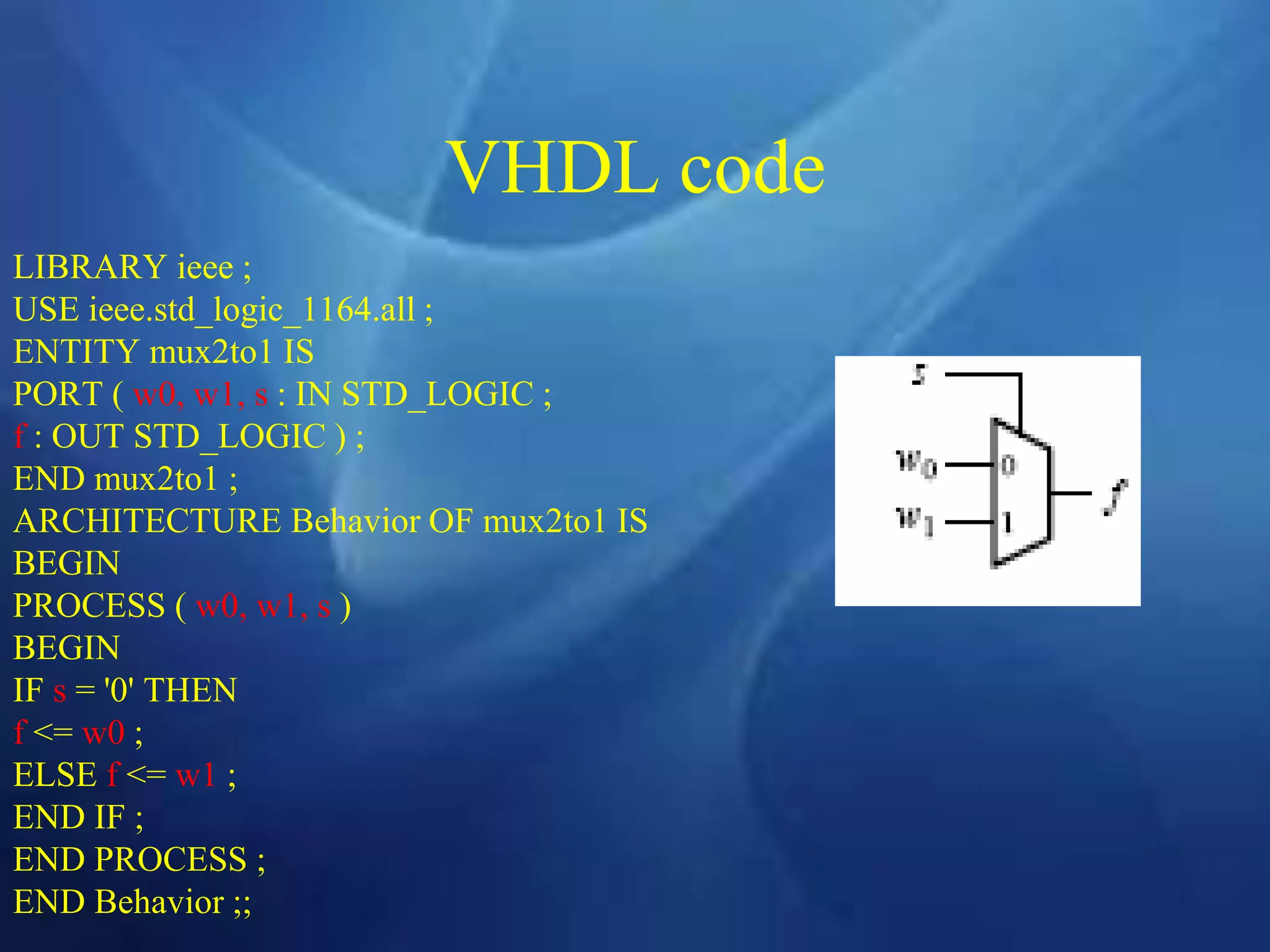
VHDL code
LIBRARY ieee ;
USE ieee.std_logic_1164.all ;
ENTITY mux2to1 IS
PORT ( w0, w1, s : IN STD_LOGIC ;
f : OUT STD_LOGIC ) ;
END mux2to1 ;
ARCHITECTURE Behavior OF mux2to1 IS
BEGIN
PROCESS ( w0, w1, s )
BEGIN
IF s = '0' THEN
f <= w0 ;
ELSE f <= w1 ;
END IF ;
END PROCESS ;
END Behavior ;;
Soft cores
• MicroBlaze,PowerPC,Nios,… soft
processor
• create complete systems composed of, for
example, an 8- or 16-bit controller, a
UART, and other such I/O devices on a
single programmable chip
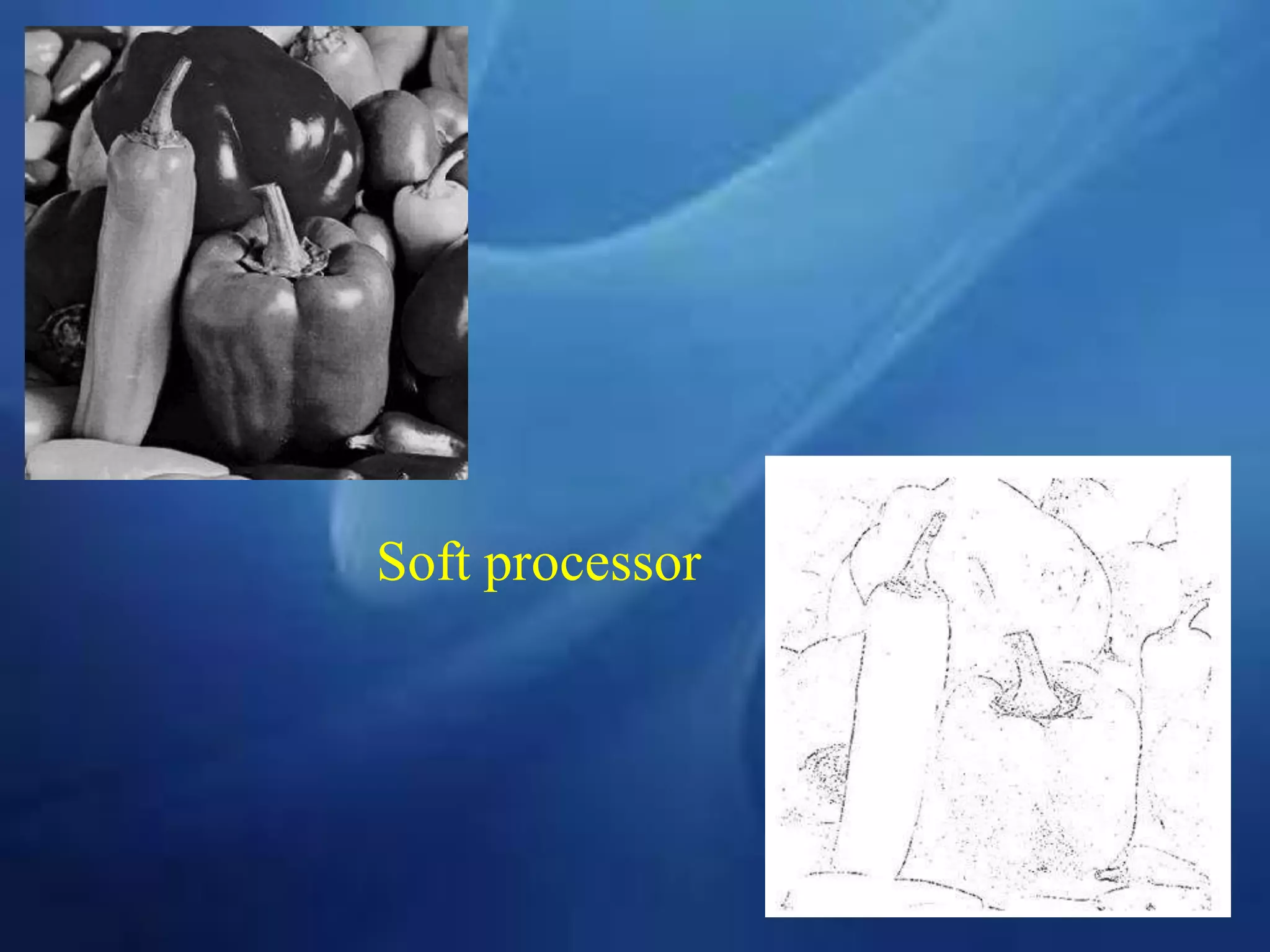
Soft processor
References
• Practical FPGA Programming in C
By David Pellerin, Scott Thibault
• Ece230 vhdl lectures
By Khurram Waheed
• VHDL cookbook
By peter j.ashenden
Thank you
Muhammad ziyada
modeonz007@yahoo.com
+20113246609
Muhammad al tabakh
nooo_impossible@yahoo.com
+20121539035

FPGA.ppt

  • 1.
    FPGA ( Field programmablegate array ) April 2008 • Prepared by : Muhammad Ziyada Muhammad Al tabakh
  • 2.
    Contents • Hardware engineersvs software developers • FPGA Market • History of FPGA • Modern developments • Architecture • Design and programming
  • 3.
    Hardware designers vssoftware developers • The hardware engineers roll up their sleeves and work for months without a break • software programmers would sit back and relax, or play ping-pong, until the hardware was stable. • the hardware design would quickly become a hardware redesign for some perceived deficiency or new feature request
  • 6.
    VHDL solution • Inthe early days, circuits as gate-level schematics . • saved by (HDLs). • allowed us to describe the functionality • Allowed design to be quickly and easily represented and simulated
  • 7.
    VHDL • VHSIC hardwaredescription language • developed at the behest of the US Department of Defense • alternative to huge, complex manuals which were subject to implementation-specific details • logic simulators were developed to read the VHDL files • logic synthesis tools that read the VHDL
  • 8.
    FPGA market • FPGAMarket Will Reach $2.75 Billion by Decade’s End
  • 9.
    FPGA market • January2008 • Celoxica Holdings has agreed the $3m sale of its electronic system level (ESL) business to US firm Catalytic. • With this move, we can synthesize the top two languages for high-level algorithm development — C and MATLAB — and deliver both software and hardware implementations
  • 10.
    FPGA market • Aerospace& Defense • Automotive • Broadcast Consumer • Data Processing and Storage • Industrial / Scientific / Medical • Wired Communications • Wireless Communications
  • 11.
  • 12.
    Brief history • theinvention of the very first computers in the 1940's and 1950's • A Xilinx co-founder, Ross Freeman, invented the field programmable gate array in 1984 • FPGA come after many earlier devices
  • 13.
    Modern development • ConfigurableLogic Blocks Registers (flip flops) for fast data storage . Logic Routing • Input/Output Blocks Basic pin logic (flip flops, muxs, etc) • Block Ram Internal memory for data storage • Digital Clock Managers Clock distribution • Programmable Routing Matrix
  • 14.
    "Pros" and "Cons" •Pros Low power consumption; ideal for portable electronics devices. Upgradeable using software, instead of extensive hardware replacement . Low cost of overhead . Sometimes replaces as many as twenty traditional PALs. Parallel computing possibilities .
  • 15.
    • Cons High costof fabricating a completely new chip Size constraints / limitations More difficult to code & debug Many applications still are, and may remain, in the theoretical phase "Pros" and "Cons"
  • 16.
    FPGA vs classicalarchitecture • Classical operation Fetch an instruction Fetch a piece of data Fetch another piece of data Perform an operation Store the result : Do the same thing all over again
  • 17.
    FPGA vs classicalarchitecture • y = (a * b) + (c * d) + (e * f) + (g * h); • the multiplications are performed in parallel without the need to fetch and decode the instructions. This results in orders-of- magnitude speed improvement.
  • 18.
    FPGA vs conventionalcircuit FPGA Costs $0 $50 $100 $150 $200 $250 $300 $350 1998 1999 2000 2001 2002 2003 Cost per 1 Million Gates 80’s 90’s Now
  • 19.
    The rise ofFPGA • The first devices were primitive diode matrices used in TV channel selectors, HAM radio tuners, emerging defense and space applications. • replaced by more capable logic devices based on arrays of combinatorial gates • dramatic change in reprogram ability, more flexible interconnect architectures.
  • 20.
    The rise ofFPGA • Programmable Logic Arrays (PLA)
  • 21.
    The rise ofFPGA • Programmable Array Logic (PAL)
  • 22.
    The rise ofFPGA • Complex PLDs (CPLDs)
  • 23.
    The rise ofFPGA • Field Programmable Gate Arrays (FPGAs)
  • 24.
    Main vendors • Xilinxspartan and vertix series ise webback software • Altera cyclon series Quartus software • Mentor Graphic FPGAdv software
  • 25.
  • 26.
  • 28.
    FPGA programming Languages HDL languages( VHDL and VERILOG ) Truth table Block diagram Schematic diagram Flowchart State machine And more
  • 29.
    VHDL code LIBRARY ieee; USE ieee.std_logic_1164.all ; ENTITY mux2to1 IS PORT ( w0, w1, s : IN STD_LOGIC ; f : OUT STD_LOGIC ) ; END mux2to1 ; ARCHITECTURE Behavior OF mux2to1 IS BEGIN PROCESS ( w0, w1, s ) BEGIN IF s = '0' THEN f <= w0 ; ELSE f <= w1 ; END IF ; END PROCESS ; END Behavior ;;
  • 30.
    Soft cores • MicroBlaze,PowerPC,Nios,…soft processor • create complete systems composed of, for example, an 8- or 16-bit controller, a UART, and other such I/O devices on a single programmable chip
  • 31.
  • 32.
    References • Practical FPGAProgramming in C By David Pellerin, Scott Thibault • Ece230 vhdl lectures By Khurram Waheed • VHDL cookbook By peter j.ashenden
  • 33.
    Thank you Muhammad ziyada modeonz007@yahoo.com +20113246609 Muhammadal tabakh nooo_impossible@yahoo.com +20121539035