SUBMITTED BY: -
ARPIT GUPTA
(1409140037)
FOUR WHEEL STEERING
&
FOUR WHEEL DRIVE
INTRODUCTION
 Four wheel steering is a system employed by vehicles
that allows the rear wheels to turn for maneuvering,
rather than just follow the front wheels.
 It reduces the turning radius by 20% as well as the space
required for turning. It also enables to change road lane
while driving even at high speed.
 At lower speeds, turning the rear wheels in the opposite
direction to the front wheels results in a smaller turning
radius and faster cornering responses. At high speeds,
turning all four wheels in concert improves high-speed
stability.
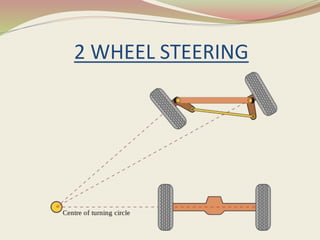
2 WHEEL STEERING
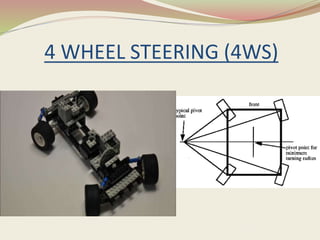
4 WHEEL STEERING (4WS)
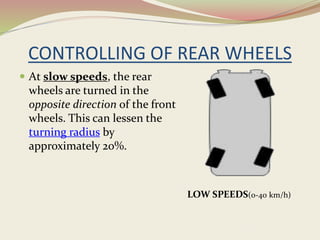
CONTROLLING OF REAR WHEELS
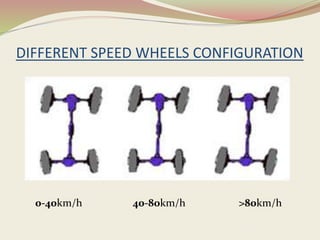
 At slow speeds, the rear
wheels are turned in the
opposite direction of the front
wheels. This can lessen the
turning radius by
approximately 20%.
LOW SPEEDS(0-40 km/h)
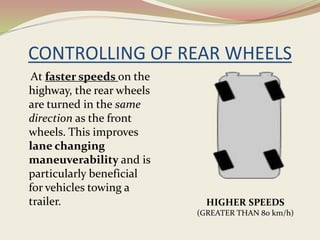
CONTROLLING OF REAR WHEELS
At faster speeds on the
highway, the rear wheels
are turned in the same
direction as the front
wheels. This improves
lane changing
maneuverability and is
particularly beneficial
for vehicles towing a
trailer. HIGHER SPEEDS
(GREATER THAN 80 km/h)
DIFFERENT SPEED WHEELS CONFIGURATION
0-40km/h 40-80km/h >80km/h
TYPES OF 4WS
MECHANICAL 4WS
HYDRAULIC 4WS
ELECTRO/HYDRAULIC 4WS
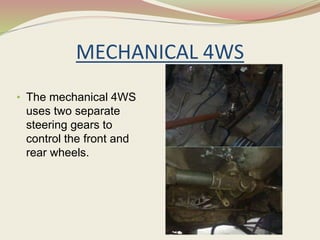
MECHANICAL 4WS
• The mechanical 4WS
uses two separate
steering gears to
control the front and
rear wheels.
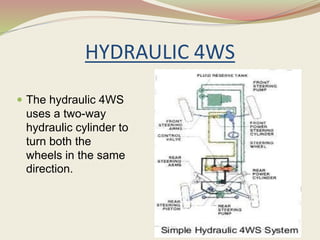
HYDRAULIC 4WS
 The hydraulic 4WS
uses a two-way
hydraulic cylinder to
turn both the
wheels in the same
direction.
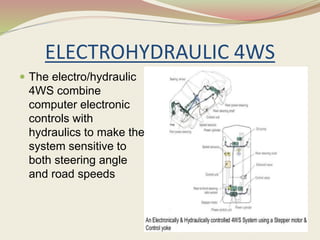
ELECTROHYDRAULIC 4WS
 The electro/hydraulic
4WS combine
computer electronic
controls with
hydraulics to make the
system sensitive to
both steering angle
and road speeds
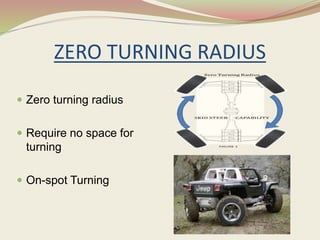
ZERO TURNING RADIUS
 Zero turning radius
 Require no space for
turning
 On-spot Turning
MODERN CARS WITH ACTIVE FOUR WHEEL
STEERING: -
•Acura RLX (P-AWS)
•BMW 850CSi (only Euro spec models)
•BMW 7-Series (2009 onward, part of sport package)
•BMW 5-series (2011 onwards, Integral Active Steering
option)
•Toyota Camry / Vista JDM 1988–1999 (Optional)
•Toyota Carina ED / Toyota Corona EXiV (world's first
dual-mode switchable 2WS to 4WS)
•Toyota Celica (option on 5th and 6th generation, 1990–
1993 ST183 and 1994–1997 ST203) (Dual-mode, high and
low speed)
•Toyota Soarer (UZZ32)
CONCLUSION
 Requires less steering input for corrections.
 Entire vehicle moves in one direction.
 Greater Stability in maneuvers.
 Turn in crab like manner rather than curve.
 Reduces effecting turning radius.
 4WS is complex and expensive.
REFERENCES
 Suspension and Steering Systems, Design of modern
terrain vehicles
By- Shpetim lajqi
Stanislav Pehan
 Automotive Mechanics
BY- Crouse and Anglin
fourwheelsteering

fourwheelsteering

  • 1.
    SUBMITTED BY: - ARPITGUPTA (1409140037)
  • 2.
  • 3.
    INTRODUCTION  Four wheelsteering is a system employed by vehicles that allows the rear wheels to turn for maneuvering, rather than just follow the front wheels.  It reduces the turning radius by 20% as well as the space required for turning. It also enables to change road lane while driving even at high speed.  At lower speeds, turning the rear wheels in the opposite direction to the front wheels results in a smaller turning radius and faster cornering responses. At high speeds, turning all four wheels in concert improves high-speed stability.
  • 4.
  • 5.
  • 7.
    CONTROLLING OF REARWHEELS  At slow speeds, the rear wheels are turned in the opposite direction of the front wheels. This can lessen the turning radius by approximately 20%. LOW SPEEDS(0-40 km/h)
  • 8.
    CONTROLLING OF REARWHEELS At faster speeds on the highway, the rear wheels are turned in the same direction as the front wheels. This improves lane changing maneuverability and is particularly beneficial for vehicles towing a trailer. HIGHER SPEEDS (GREATER THAN 80 km/h)
  • 9.
    DIFFERENT SPEED WHEELSCONFIGURATION 0-40km/h 40-80km/h >80km/h
  • 11.
    TYPES OF 4WS MECHANICAL4WS HYDRAULIC 4WS ELECTRO/HYDRAULIC 4WS
  • 12.
    MECHANICAL 4WS • Themechanical 4WS uses two separate steering gears to control the front and rear wheels.
  • 13.
    HYDRAULIC 4WS  Thehydraulic 4WS uses a two-way hydraulic cylinder to turn both the wheels in the same direction.
  • 14.
    ELECTROHYDRAULIC 4WS  Theelectro/hydraulic 4WS combine computer electronic controls with hydraulics to make the system sensitive to both steering angle and road speeds
  • 15.
    ZERO TURNING RADIUS Zero turning radius  Require no space for turning  On-spot Turning
  • 17.
    MODERN CARS WITHACTIVE FOUR WHEEL STEERING: - •Acura RLX (P-AWS) •BMW 850CSi (only Euro spec models) •BMW 7-Series (2009 onward, part of sport package) •BMW 5-series (2011 onwards, Integral Active Steering option) •Toyota Camry / Vista JDM 1988–1999 (Optional) •Toyota Carina ED / Toyota Corona EXiV (world's first dual-mode switchable 2WS to 4WS) •Toyota Celica (option on 5th and 6th generation, 1990– 1993 ST183 and 1994–1997 ST203) (Dual-mode, high and low speed) •Toyota Soarer (UZZ32)
  • 18.
    CONCLUSION  Requires lesssteering input for corrections.  Entire vehicle moves in one direction.  Greater Stability in maneuvers.  Turn in crab like manner rather than curve.  Reduces effecting turning radius.  4WS is complex and expensive.
  • 19.
    REFERENCES  Suspension andSteering Systems, Design of modern terrain vehicles By- Shpetim lajqi Stanislav Pehan  Automotive Mechanics BY- Crouse and Anglin