SUBMITTED BY: -
ROHAN KUMAR SHARMA
DHEERAJ BARNWAL
CONTENT:-
 INTRODUCTION TO STEERING
 TYPES OF STEERING SYSTEM
 FOUR WHEEL STEERING
 TURNING RADIUS
INTODUCTION TO STEERING:-
Steering is the collection of components, linkages, etc. which allow
a vehicle (car, motorcycle, bicycle) to follow the desired course. An
exception is the case of rail transport by which rail tracks combined
together with railroad switches (and also known as 'points' in British
English) provide the steering function.
Requirement of steering-
•It should multiply the turning effort applied on the steering wheel by
the driver.
•It should be to a certain degree irreversible so that the shocks of the
road surface encountered by the wheels are not transmitted to the
driver’s hand.
•The mechanism should have self –rightening effect so that when the
driver release the steering wheel after negotiating the turn , the wheel
should try to achieve straight ahead position.
TYPES OF STEERING SYSYEM
Front wheel steering.
Rear wheel steering.
Four wheel steering.
FOUR WHEEL STEERING:-
• Four-wheel steering (or all wheel steering) is a system
employed by some vehicles to improve steering response,
increase vehicle stability while maneuvering at high
speed, or to decrease turning radius at low speed. A 4-
wheel steering system is superior to a 2- wheel steering
system. It reduces the turning radius as well as the space
required for turning. It also enables to change road lane
while driving even at high speed.
• At lower speeds, turning the rear wheels in the opposite
direction to the front wheels results in a smaller turning
radius and faster cornering responses. At high speeds,
turning all four wheels in concert improves high-speed
stability.
The Four Wheel steering system offers a 21% reduction in turning
radius. So if a vehicle is capable of making a U-turn in a 25-foot
space. It allows the driver to do it in about 20 feet. . A front wheel
active steering function was added to Rear Active Steer adopted
on the Fuga. By controlling the steering angle of all four wheels,
this active steering system helps improve stability and response at
high speed and helps reduce driver’s steering workload at low
speed. To achieve precise vehicle
• Vehicles move smoothly and are easy to drive both in the city
and on winding roads.
• Added stability means vehicles can be driven safely on
expressways and when changing lanes.
• Quick and responsive control system will allow gentle steering
operation.
TURNING RADIUS:-
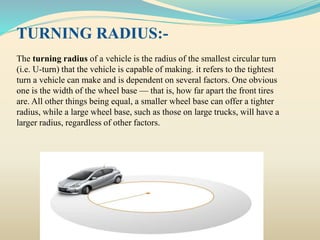
The turning radius of a vehicle is the radius of the smallest circular turn
(i.e. U-turn) that the vehicle is capable of making. it refers to the tightest
turn a vehicle can make and is dependent on several factors. One obvious
one is the width of the wheel base — that is, how far apart the front tires
are. All other things being equal, a smaller wheel base can offer a tighter
radius, while a large wheel base, such as those on large trucks, will have a
larger radius, regardless of other factors.
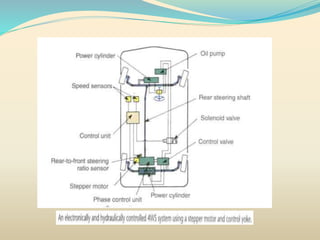
4-WS SYSTEM PARTS: -
• Rack and pinion front steering,
• hydraulically controlled
• Rear-steering shaft
• Vehicle speed sensors
• Steering-phase control unit
• Centering lock spring
• Solenoid valve
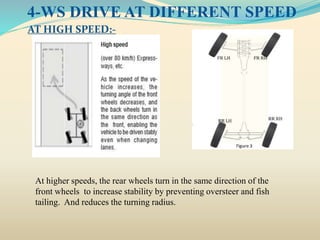
At higher speeds, the rear wheels turn in the same direction of the
front wheels to increase stability by preventing oversteer and fish
tailing. And reduces the turning radius.
AT HIGH SPEED:-
4-WS DRIVE AT DIFFERENT SPEED
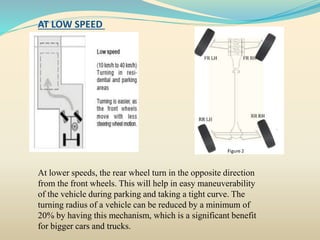
At lower speeds, the rear wheel turn in the opposite direction
from the front wheels. This will help in easy maneuverability
of the vehicle during parking and taking a tight curve. The
turning radius of a vehicle can be reduced by a minimum of
20% by having this mechanism, which is a significant benefit
for bigger cars and trucks.
AT LOW SPEED
ADVANTAGES OF 4WS
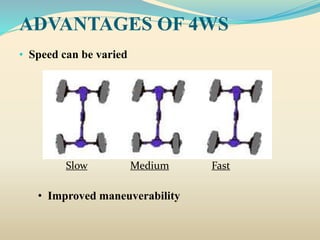
• Speed can be varied
Slow Medium Fast
• Improved maneuverability
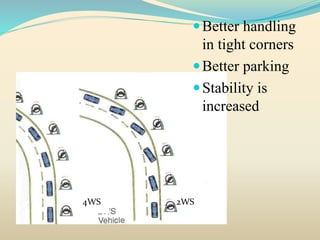
Better handling
in tight corners
Better parking
Stability is
increased
4WS 2WS
MODERN CARS WITH ACTIVE FOUR WHEEL
STEERING: -
•Acura RLX (P-AWS)
•BMW 850CSi (only Euro spec models)
•BMW 7-Series (2009 onward, part of sport package)
•BMW 5-series (2011 onwards, Integral Active Steering option)
•Toyota Camry / Vista JDM 1988–1999 (Optional)
•Toyota Carina ED / Toyota Corona EXiV (world's first dual-mode switchable
2WS to 4WS)
•Toyota Celica (option on 5th and 6th generation, 1990–1993 ST183 and
1994–1997 ST203) (Dual-mode, high and low speed)
•Toyota Soarer (UZZ32)
CONCLUSION: -
An innovative feature of this steering linkage
design and its ability to drive all four (or two)
wheels using a single steering actuator makes it
more efficient than 2WS. Though it is expensive
now but by producing it at big level cost may be
decreased. Its successful implementation will
allow for the development of a four-wheel, steered
power base with maximum maneuverability,
uncompromised static stability, front- and rear-
wheel tracking, and optimum obstacle climbing
capability.
Four wheel steering system

Four wheel steering system

  • 1.
    SUBMITTED BY: - ROHANKUMAR SHARMA DHEERAJ BARNWAL
  • 2.
    CONTENT:-  INTRODUCTION TOSTEERING  TYPES OF STEERING SYSTEM  FOUR WHEEL STEERING  TURNING RADIUS
  • 3.
    INTODUCTION TO STEERING:- Steeringis the collection of components, linkages, etc. which allow a vehicle (car, motorcycle, bicycle) to follow the desired course. An exception is the case of rail transport by which rail tracks combined together with railroad switches (and also known as 'points' in British English) provide the steering function. Requirement of steering- •It should multiply the turning effort applied on the steering wheel by the driver. •It should be to a certain degree irreversible so that the shocks of the road surface encountered by the wheels are not transmitted to the driver’s hand. •The mechanism should have self –rightening effect so that when the driver release the steering wheel after negotiating the turn , the wheel should try to achieve straight ahead position.
  • 4.
    TYPES OF STEERINGSYSYEM Front wheel steering. Rear wheel steering. Four wheel steering.
  • 5.
    FOUR WHEEL STEERING:- •Four-wheel steering (or all wheel steering) is a system employed by some vehicles to improve steering response, increase vehicle stability while maneuvering at high speed, or to decrease turning radius at low speed. A 4- wheel steering system is superior to a 2- wheel steering system. It reduces the turning radius as well as the space required for turning. It also enables to change road lane while driving even at high speed. • At lower speeds, turning the rear wheels in the opposite direction to the front wheels results in a smaller turning radius and faster cornering responses. At high speeds, turning all four wheels in concert improves high-speed stability.
  • 6.
    The Four Wheelsteering system offers a 21% reduction in turning radius. So if a vehicle is capable of making a U-turn in a 25-foot space. It allows the driver to do it in about 20 feet. . A front wheel active steering function was added to Rear Active Steer adopted on the Fuga. By controlling the steering angle of all four wheels, this active steering system helps improve stability and response at high speed and helps reduce driver’s steering workload at low speed. To achieve precise vehicle • Vehicles move smoothly and are easy to drive both in the city and on winding roads. • Added stability means vehicles can be driven safely on expressways and when changing lanes. • Quick and responsive control system will allow gentle steering operation.
  • 7.
    TURNING RADIUS:- The turningradius of a vehicle is the radius of the smallest circular turn (i.e. U-turn) that the vehicle is capable of making. it refers to the tightest turn a vehicle can make and is dependent on several factors. One obvious one is the width of the wheel base — that is, how far apart the front tires are. All other things being equal, a smaller wheel base can offer a tighter radius, while a large wheel base, such as those on large trucks, will have a larger radius, regardless of other factors.
  • 8.
    4-WS SYSTEM PARTS:- • Rack and pinion front steering, • hydraulically controlled • Rear-steering shaft • Vehicle speed sensors • Steering-phase control unit • Centering lock spring • Solenoid valve
  • 10.
    At higher speeds,the rear wheels turn in the same direction of the front wheels to increase stability by preventing oversteer and fish tailing. And reduces the turning radius. AT HIGH SPEED:- 4-WS DRIVE AT DIFFERENT SPEED
  • 11.
    At lower speeds,the rear wheel turn in the opposite direction from the front wheels. This will help in easy maneuverability of the vehicle during parking and taking a tight curve. The turning radius of a vehicle can be reduced by a minimum of 20% by having this mechanism, which is a significant benefit for bigger cars and trucks. AT LOW SPEED
  • 12.
    ADVANTAGES OF 4WS •Speed can be varied Slow Medium Fast • Improved maneuverability
  • 13.
    Better handling in tightcorners Better parking Stability is increased 4WS 2WS
  • 14.
    MODERN CARS WITHACTIVE FOUR WHEEL STEERING: - •Acura RLX (P-AWS) •BMW 850CSi (only Euro spec models) •BMW 7-Series (2009 onward, part of sport package) •BMW 5-series (2011 onwards, Integral Active Steering option) •Toyota Camry / Vista JDM 1988–1999 (Optional) •Toyota Carina ED / Toyota Corona EXiV (world's first dual-mode switchable 2WS to 4WS) •Toyota Celica (option on 5th and 6th generation, 1990–1993 ST183 and 1994–1997 ST203) (Dual-mode, high and low speed) •Toyota Soarer (UZZ32)
  • 15.
    CONCLUSION: - An innovativefeature of this steering linkage design and its ability to drive all four (or two) wheels using a single steering actuator makes it more efficient than 2WS. Though it is expensive now but by producing it at big level cost may be decreased. Its successful implementation will allow for the development of a four-wheel, steered power base with maximum maneuverability, uncompromised static stability, front- and rear- wheel tracking, and optimum obstacle climbing capability.