ACTIVE
SUSPENSION
History of Suspension and
latest technology in
suspension.
Submitted by:
Mayank Khare
SGSITS, Indore
• The story of old passive suspensions was
determined entirely by the road surface
only.
• The Skyhook theory is an idea that states
that an object can maintain a stable
posture if it is traveling suspended by an
imaginary straight line (Skyhook). The
theory forms the basis of Active
suspension.
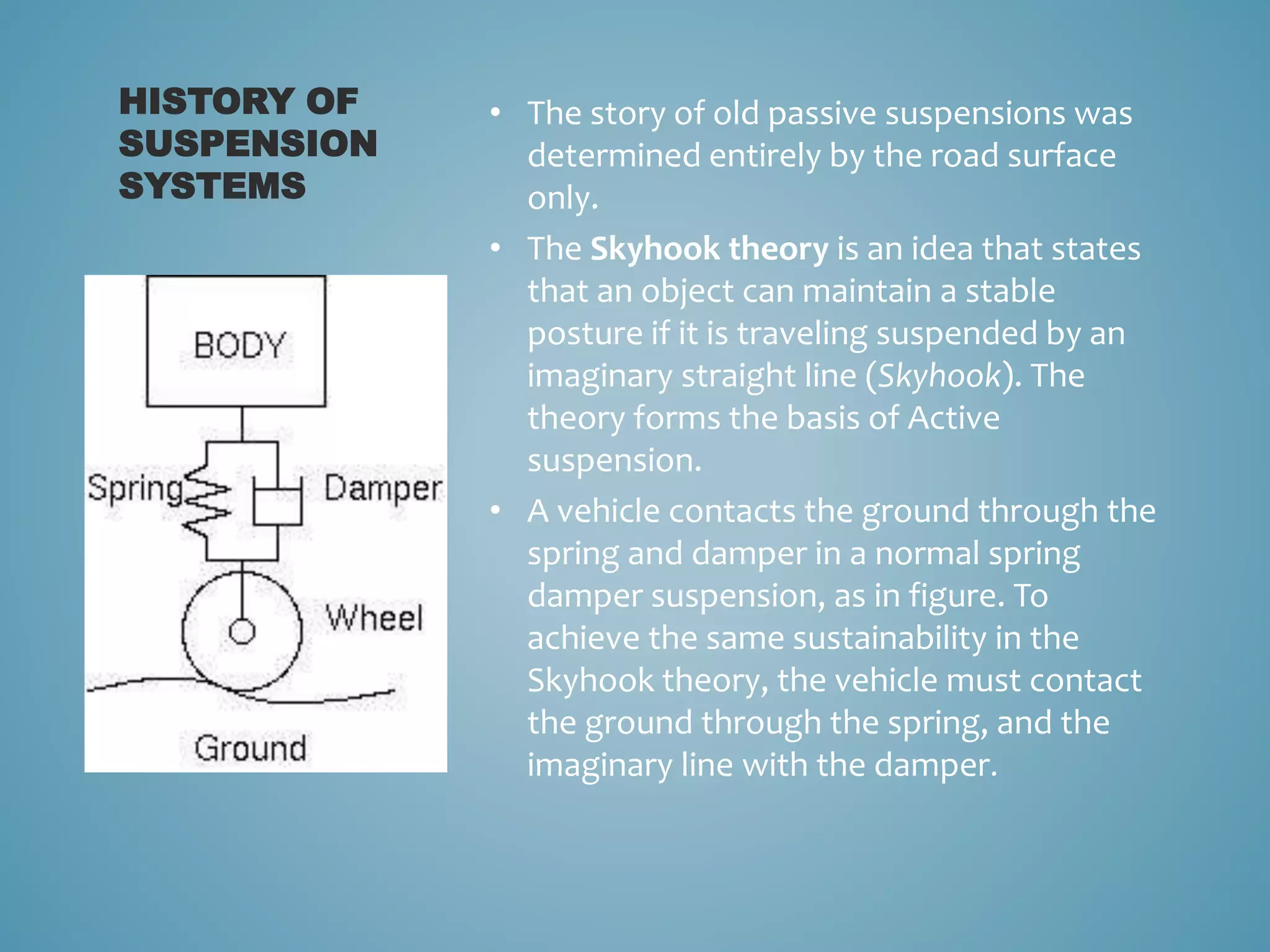
• A vehicle contacts the ground through the
spring and damper in a normal spring
damper suspension, as in figure. To
achieve the same sustainability in the
Skyhook theory, the vehicle must contact
the ground through the spring, and the
imaginary line with the damper.
HISTORY OF
SUSPENSION
SYSTEMS
• Active
– Hydraulic actuated
– Electromagnetic recuperative
• Adaptive
– Solenoid/valve actuated
– Magnetorheological damper
• Some production vehicles with active
and semi-active suspension
TYPES OF
SUSPENSIONS
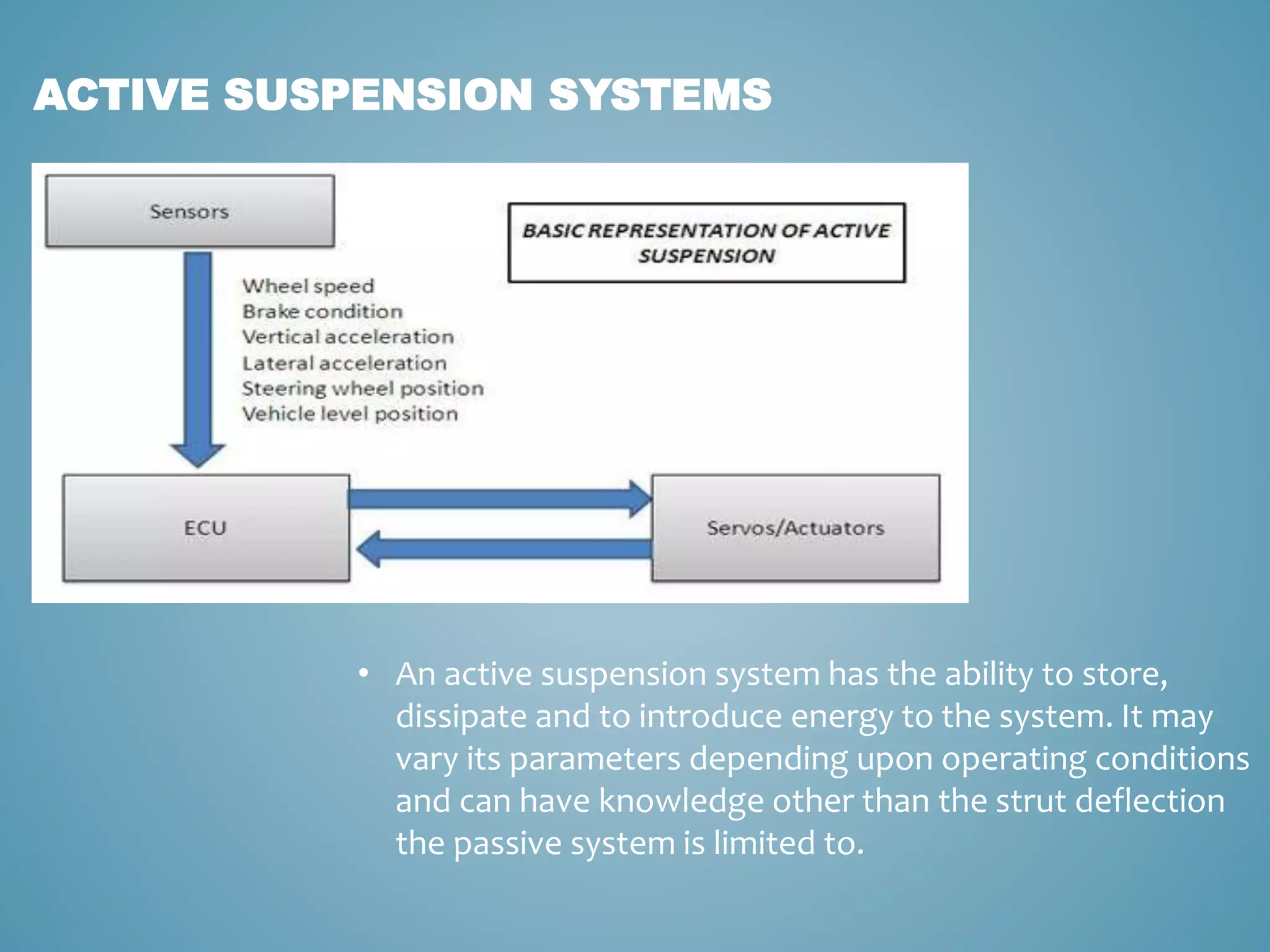
• An active suspension system has the ability to store,
dissipate and to introduce energy to the system. It may
vary its parameters depending upon operating conditions
and can have knowledge other than the strut deflection
the passive system is limited to.
ACTIVE SUSPENSION SYSTEMS
High bandwidth systems
• In a high bandwidth (or ``fully active'') suspension
system we generally consider an actuator connected
between the sprung and un-sprung masses of the
vehicle.
• A fully active system aims to control the suspension
over the full bandwidth of the system.
• In particular this means that we aim to improve the
suspension response around both the ``rattle-space''
frequency (10-12 Hz) and ``tyre-hop'' frequency(3-4Hz).
The terms rattle-space and tyre-hop may be regarded as
resonant frequencies of the system.
• A fully active system will consume a significant amount
of power and will require actuators with a relatively
wide bandwidth. These have been successfully
implemented in Formula One cars and by, for example,
Lotus [Wright 84]
ACTIVE
SUSPENSION’S
CONTINUED:
Low bandwidth systems
• Also known as slow-active or band-limited
systems.
• In this class the actuator will be placed in
series with a road spring and/or a damper.
• A low bandwidth system aims to control the
suspension over the lower frequency range,
and specifically around the rattle space
frequency.
• At higher frequencies the actuator effectively
locks-up and hence the wheel-hop motion is
controlled passively.
• With these systems we can achieve a
significant reduction in body roll and pitch
during maneuver's such as cornering and
braking, with lower energy consumption than
a high bandwidth system.
ACTIVE
SUSPENSION’S
CONTINUED:
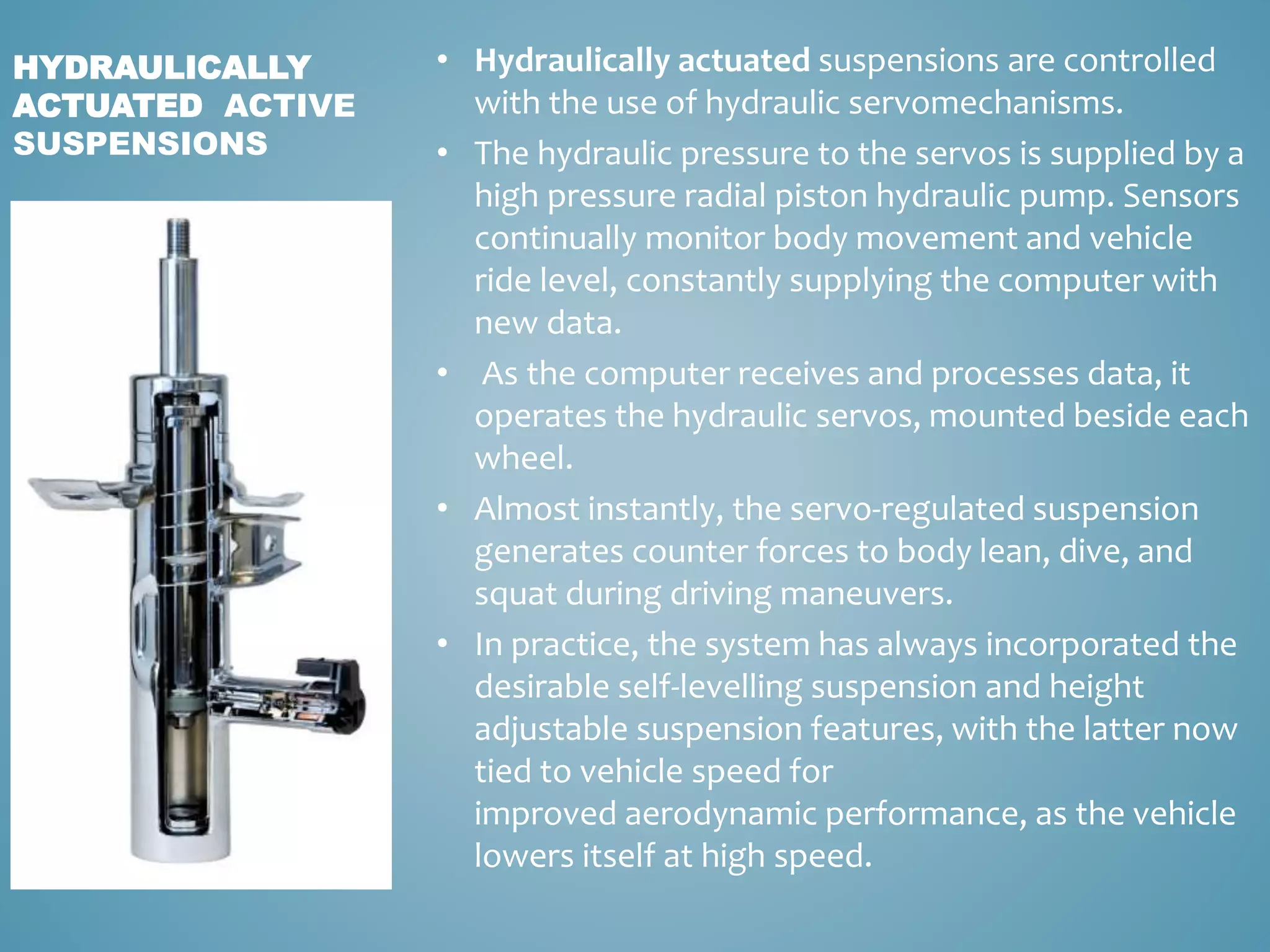
• Hydraulically actuated suspensions are controlled
with the use of hydraulic servomechanisms.
• The hydraulic pressure to the servos is supplied by a
high pressure radial piston hydraulic pump. Sensors
continually monitor body movement and vehicle
ride level, constantly supplying the computer with
new data.
• As the computer receives and processes data, it
operates the hydraulic servos, mounted beside each
wheel.
• Almost instantly, the servo-regulated suspension
generates counter forces to body lean, dive, and
squat during driving maneuvers.
• In practice, the system has always incorporated the
desirable self-levelling suspension and height
adjustable suspension features, with the latter now
tied to vehicle speed for
improved aerodynamic performance, as the vehicle
lowers itself at high speed.
HYDRAULICALLY
ACTUATED ACTIVE
SUSPENSIONS
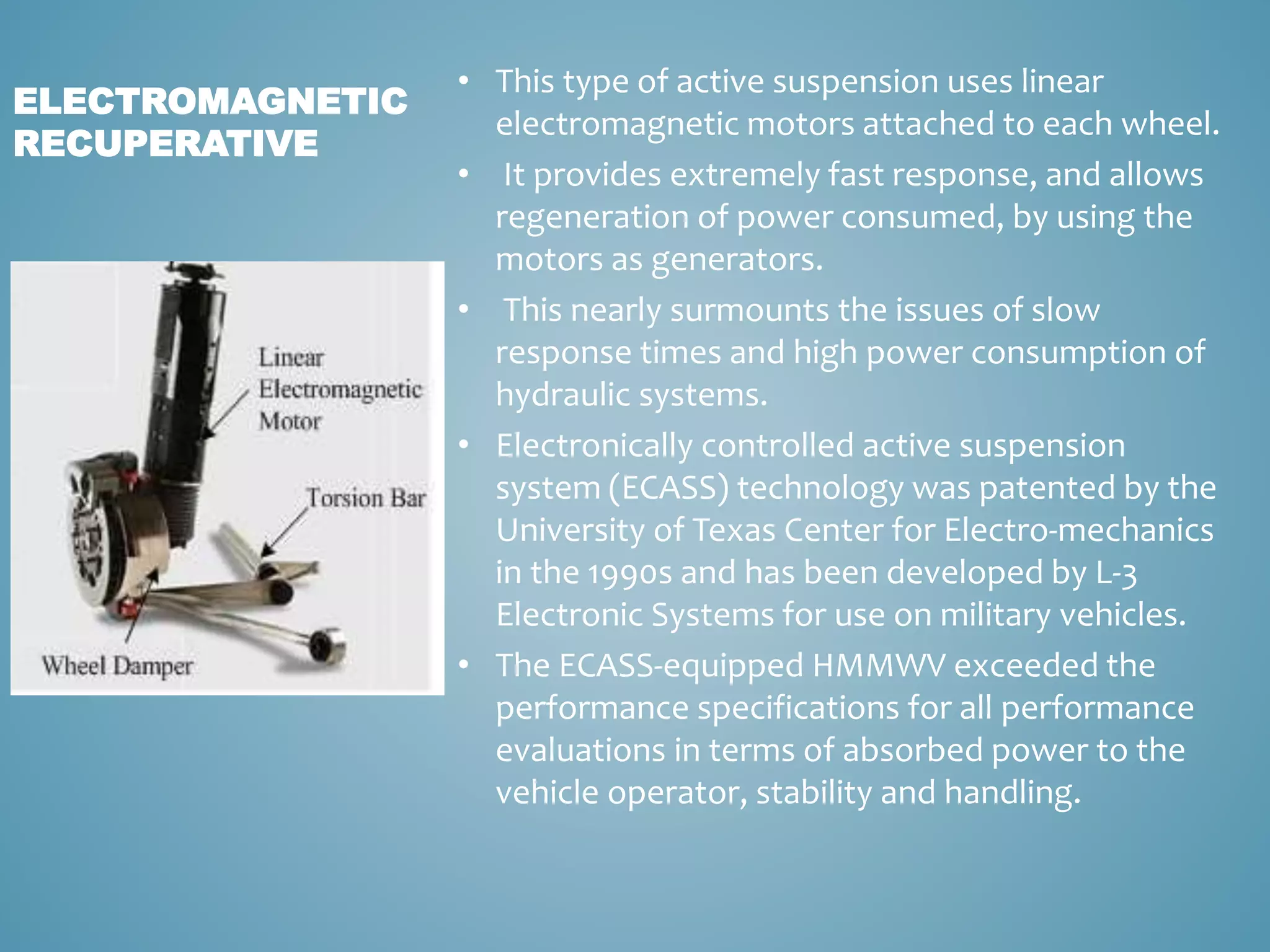
• This type of active suspension uses linear
electromagnetic motors attached to each wheel.
• It provides extremely fast response, and allows
regeneration of power consumed, by using the
motors as generators.
• This nearly surmounts the issues of slow
response times and high power consumption of
hydraulic systems.
• Electronically controlled active suspension
system (ECASS) technology was patented by the
University of Texas Center for Electro-mechanics
in the 1990s and has been developed by L-3
Electronic Systems for use on military vehicles.
• The ECASS-equipped HMMWV exceeded the
performance specifications for all performance
evaluations in terms of absorbed power to the
vehicle operator, stability and handling.
ELECTROMAGNETIC
RECUPERATIVE
• Adaptive suspension is a computer-controlled
suspension system that varies shock absorber
firmness to match changing road or dynamic
conditions.
• Adaptive suspensions rely on a network of sensors
and a computer that optimizes the firmness of its
shock absorbers or struts based on the road surface
or the vehicle’s dynamics as it turns, brakes and
accelerates.
• The key to these systems is the variable-rate shock
or strut, the firmness of which can be changed in
fractions of a second.
• In these devices, an electric signal from the
computer varies the size of a valve through which
hydraulic fluid flows. (The movement of this fluid,
or oil, through valves is the basis of a shock
absorber’s operation.)
ADAPTIVE OR
SEMI-ACTIVE
SYSTEMS
• Basic type of semi-active suspensions.
• They consist of a solenoid valve which alters the
flow of the hydraulic medium inside the shock
absorber, therefore changing the damping
characteristics of the suspension setup.
• The solenoids are wired to the controlling
computer, which sends them commands
depending on the control algorithm (usually the
so-called "Sky-Hook" technique).
• Currently used in: This type of system used
in Cadillac's Computer Command Ride(CCR)
suspension system.
SOLENOID/VALVE
ACTUATED
• What sets it apart from other suspension systems is
the fact that it lacks any electro-mechanical valves
and it basically has no small moving parts. Instead,
the suspension is based on a magnetorheological
fluid (MR), a type of smart fluid, as it is called,
which reacts to a magnetic field.
• The use of a MR suspension system allows for a
better ride due to the flat and stable ride it ensures.
System allows for the action of each wheel to be
smoothened and isolated. The system can be
integrated with vehicle’s stability control to
enhance stability on gravel, and slippery road
surfaces. Thanks to the ECU's software, the MR
system allows for a wide range of damping force
control and high bandwidth for fast response.
• Currently use in: MR will become more of a
common sight as soon as the cost issue is resolved.
So far, the range of vehicles to use such a system
includes Acura MDX, Audi TT, Audi R8, Cadillac
DTS, SRX, STS, Chevrolet Corvette, Ferrari 599
GTB and Holden HSV Commodore.
MAGNETO-
RHEOLOGICAL
(MR)DAMPER
• http://www.autoevolution.com/news/how-
magnetorheological-suspension-works-
8947.html#ixzz4GwxUNxpp
• http://www.bwigroup.com/en/pshow.php?pid=22
• http://www.cvel.clemson.edu/auto/systems/active_susp
ension.html
• http://smartmastertrainer-
academy.blogspot.in/2013/08/electronic-control-
suspension-system.html
• https://w220.ee/Airmatic
• http://voitlab.com/courses/thermodynamics/index.php?
title=Imad_Zahid
REFERENCES:

Active suspension System of Automobiles.

  • 1.
    ACTIVE SUSPENSION History of Suspensionand latest technology in suspension. Submitted by: Mayank Khare SGSITS, Indore
  • 2.
    • The storyof old passive suspensions was determined entirely by the road surface only. • The Skyhook theory is an idea that states that an object can maintain a stable posture if it is traveling suspended by an imaginary straight line (Skyhook). The theory forms the basis of Active suspension. • A vehicle contacts the ground through the spring and damper in a normal spring damper suspension, as in figure. To achieve the same sustainability in the Skyhook theory, the vehicle must contact the ground through the spring, and the imaginary line with the damper. HISTORY OF SUSPENSION SYSTEMS
  • 3.
    • Active – Hydraulicactuated – Electromagnetic recuperative • Adaptive – Solenoid/valve actuated – Magnetorheological damper • Some production vehicles with active and semi-active suspension TYPES OF SUSPENSIONS
  • 4.
    • An activesuspension system has the ability to store, dissipate and to introduce energy to the system. It may vary its parameters depending upon operating conditions and can have knowledge other than the strut deflection the passive system is limited to. ACTIVE SUSPENSION SYSTEMS
  • 5.
    High bandwidth systems •In a high bandwidth (or ``fully active'') suspension system we generally consider an actuator connected between the sprung and un-sprung masses of the vehicle. • A fully active system aims to control the suspension over the full bandwidth of the system. • In particular this means that we aim to improve the suspension response around both the ``rattle-space'' frequency (10-12 Hz) and ``tyre-hop'' frequency(3-4Hz). The terms rattle-space and tyre-hop may be regarded as resonant frequencies of the system. • A fully active system will consume a significant amount of power and will require actuators with a relatively wide bandwidth. These have been successfully implemented in Formula One cars and by, for example, Lotus [Wright 84] ACTIVE SUSPENSION’S CONTINUED:
  • 6.
    Low bandwidth systems •Also known as slow-active or band-limited systems. • In this class the actuator will be placed in series with a road spring and/or a damper. • A low bandwidth system aims to control the suspension over the lower frequency range, and specifically around the rattle space frequency. • At higher frequencies the actuator effectively locks-up and hence the wheel-hop motion is controlled passively. • With these systems we can achieve a significant reduction in body roll and pitch during maneuver's such as cornering and braking, with lower energy consumption than a high bandwidth system. ACTIVE SUSPENSION’S CONTINUED:
  • 7.
    • Hydraulically actuatedsuspensions are controlled with the use of hydraulic servomechanisms. • The hydraulic pressure to the servos is supplied by a high pressure radial piston hydraulic pump. Sensors continually monitor body movement and vehicle ride level, constantly supplying the computer with new data. • As the computer receives and processes data, it operates the hydraulic servos, mounted beside each wheel. • Almost instantly, the servo-regulated suspension generates counter forces to body lean, dive, and squat during driving maneuvers. • In practice, the system has always incorporated the desirable self-levelling suspension and height adjustable suspension features, with the latter now tied to vehicle speed for improved aerodynamic performance, as the vehicle lowers itself at high speed. HYDRAULICALLY ACTUATED ACTIVE SUSPENSIONS
  • 8.
    • This typeof active suspension uses linear electromagnetic motors attached to each wheel. • It provides extremely fast response, and allows regeneration of power consumed, by using the motors as generators. • This nearly surmounts the issues of slow response times and high power consumption of hydraulic systems. • Electronically controlled active suspension system (ECASS) technology was patented by the University of Texas Center for Electro-mechanics in the 1990s and has been developed by L-3 Electronic Systems for use on military vehicles. • The ECASS-equipped HMMWV exceeded the performance specifications for all performance evaluations in terms of absorbed power to the vehicle operator, stability and handling. ELECTROMAGNETIC RECUPERATIVE
  • 9.
    • Adaptive suspensionis a computer-controlled suspension system that varies shock absorber firmness to match changing road or dynamic conditions. • Adaptive suspensions rely on a network of sensors and a computer that optimizes the firmness of its shock absorbers or struts based on the road surface or the vehicle’s dynamics as it turns, brakes and accelerates. • The key to these systems is the variable-rate shock or strut, the firmness of which can be changed in fractions of a second. • In these devices, an electric signal from the computer varies the size of a valve through which hydraulic fluid flows. (The movement of this fluid, or oil, through valves is the basis of a shock absorber’s operation.) ADAPTIVE OR SEMI-ACTIVE SYSTEMS
  • 10.
    • Basic typeof semi-active suspensions. • They consist of a solenoid valve which alters the flow of the hydraulic medium inside the shock absorber, therefore changing the damping characteristics of the suspension setup. • The solenoids are wired to the controlling computer, which sends them commands depending on the control algorithm (usually the so-called "Sky-Hook" technique). • Currently used in: This type of system used in Cadillac's Computer Command Ride(CCR) suspension system. SOLENOID/VALVE ACTUATED
  • 11.
    • What setsit apart from other suspension systems is the fact that it lacks any electro-mechanical valves and it basically has no small moving parts. Instead, the suspension is based on a magnetorheological fluid (MR), a type of smart fluid, as it is called, which reacts to a magnetic field. • The use of a MR suspension system allows for a better ride due to the flat and stable ride it ensures. System allows for the action of each wheel to be smoothened and isolated. The system can be integrated with vehicle’s stability control to enhance stability on gravel, and slippery road surfaces. Thanks to the ECU's software, the MR system allows for a wide range of damping force control and high bandwidth for fast response. • Currently use in: MR will become more of a common sight as soon as the cost issue is resolved. So far, the range of vehicles to use such a system includes Acura MDX, Audi TT, Audi R8, Cadillac DTS, SRX, STS, Chevrolet Corvette, Ferrari 599 GTB and Holden HSV Commodore. MAGNETO- RHEOLOGICAL (MR)DAMPER
  • 12.
    • http://www.autoevolution.com/news/how- magnetorheological-suspension-works- 8947.html#ixzz4GwxUNxpp • http://www.bwigroup.com/en/pshow.php?pid=22 •http://www.cvel.clemson.edu/auto/systems/active_susp ension.html • http://smartmastertrainer- academy.blogspot.in/2013/08/electronic-control- suspension-system.html • https://w220.ee/Airmatic • http://voitlab.com/courses/thermodynamics/index.php? title=Imad_Zahid REFERENCES: